Overcoming Product Data
Challenges in Publishing
Organizations Using
Oracle Product Hub
2 KEEP CHALLENGING November 2014
CAMPEXEC – COGNIZANT REDEFINES CAMPAIGN EXECUTION 3
Abstract
As content in the publishing industry goes online from traditional physical books, along with
various innovations in delivery channels, product data management processes and data model
design to manage the increasing number of product versions becomes more challenging than
ever. This paper deals with some of the critical features that are required to solve growing data
management challenges in publishing using Oracle Product Hub.
Overview
In publishing, as in any other industry, over the past few decades product data has come to exist in a
wide variety of applications, systems and databases, as well as spreadsheets and other formats. Product
information is fragmented throughout different business groups, users or systems, instead of being
available centrally. There is an increasing number of product data outputs required (e.g., online, physical
printcatalogs,learningsolutions,electronicdatafeeds,etc.).Thishasbecomeamajorpublishingchallenge,
andorganizationsarecounteringitbyintroducingproductdatamanagementstrategies.Toignoreitwould
only lead to a high degree of inconsistency and incompleteness in product information, leading to data
redundancyanddataqualityissues.Inordertoproduceaccurateandconsistentinformation,productdata
models must be flexible enough to accommodate multiple manifestations, gathering data from varied
applicationsandmasteringit,beforepublishingitaccordingtowell-definedbusinessrulesforconsumption
by downstream applications.
Critical Features
Now more than ever, publishing organizations need a scalable, configurable, rules-driven and
robust product information platform. Oracle Product Hub capabilities, enriched with Cognizant’s
information management experience, provide the foundation for meeting this growing need.
Some key capabilities of our solution include:
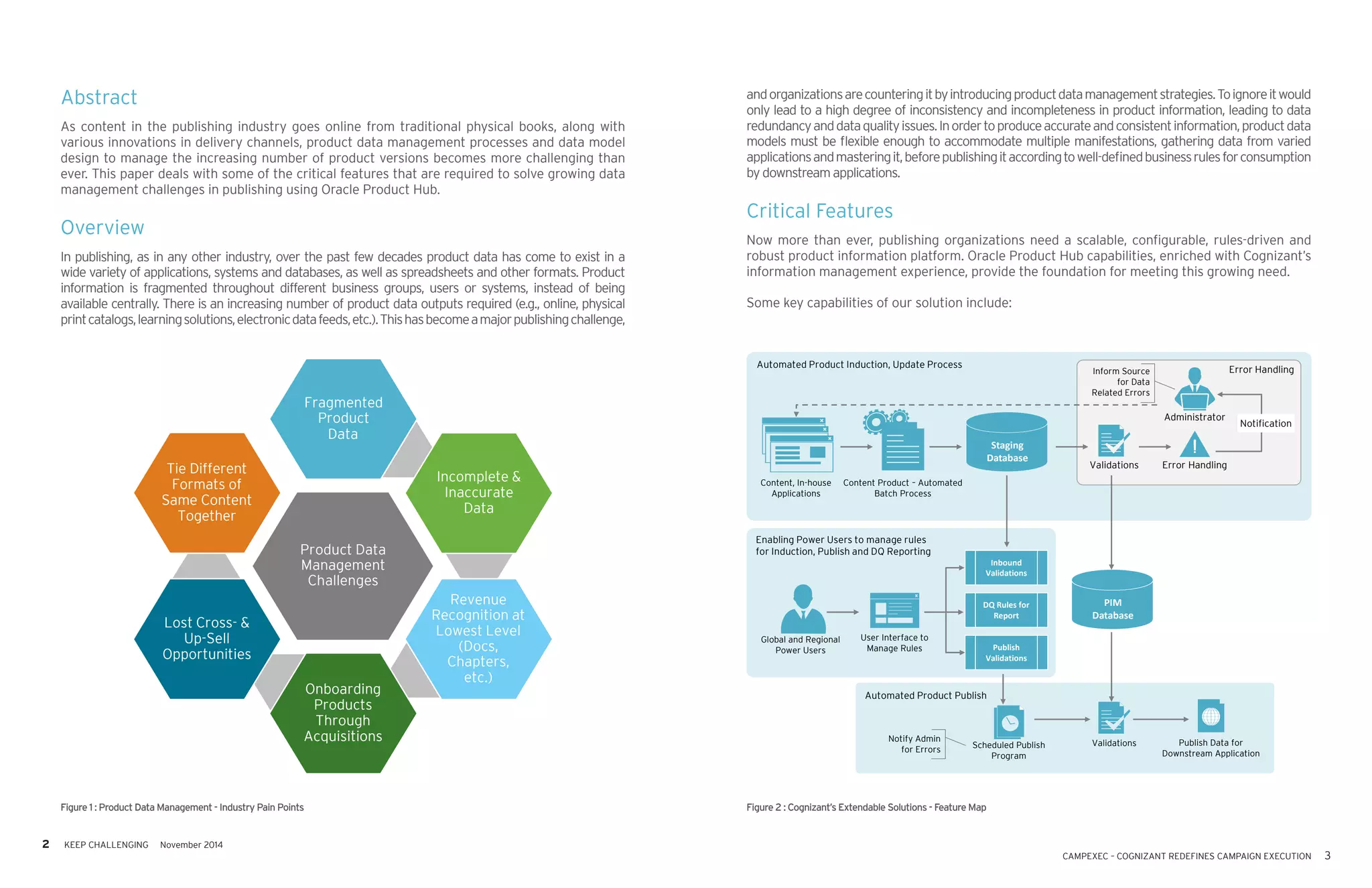
Figure 1 : Product Data Management - Industry Pain Points
Fragmented
Product
Data
Tie Different
Formats of
Same Content
Together
Incomplete &
Inaccurate
Data
Product Data
Management
Challenges
Lost Cross- &
Up-Sell
Opportunities
Revenue
Recognition at
Lowest Level
(Docs,
Chapters,
etc.)
Onboarding
Products
Through
Acquisitions
Figure 2 : Cognizant’s Extendable Solutions - Feature Map
Automated Product Induction, Update Process
Content, In-house
Applications
Content Product – Automated
Batch Process
Error Handling
Administrator
Error HandlingValidations
Automated Product Publish
Scheduled Publish
Program
Validations Publish Data for
Downstream Application
Enabling Power Users to manage rules
for Induction, Publish and DQ Reporting
User Interface to
Manage Rules
Global and Regional
Power Users
Staging
Database
Inform Source
for Data
Related Errors
Notification
Inbound
Validations
DQ Rules for
Report
Publish
Validations
PIM
Database
Notify Admin
for Errors
4 KEEP CHALLENGING November 2014 COGNIZANT 20-20 INSIGHTS 5
Product Data Modeling
Product data modeling is one of the key aspects of any Oracle Product Hub implementation. Prior to
designing the model, any content that is to be associated with the product in Oracle Product Hub, but not
to be managed in Product Hub, must be determined. Oracle Product Hub is where the product is created,
collated, cleansed, governed, shared, published and retired.
Content is managed outside of Product Hub, but is associated with items in Product Hub. Content items
couldresideinanyoftheproductmanifestationsormediuminwhichitistransactedorsoldtocustomers.
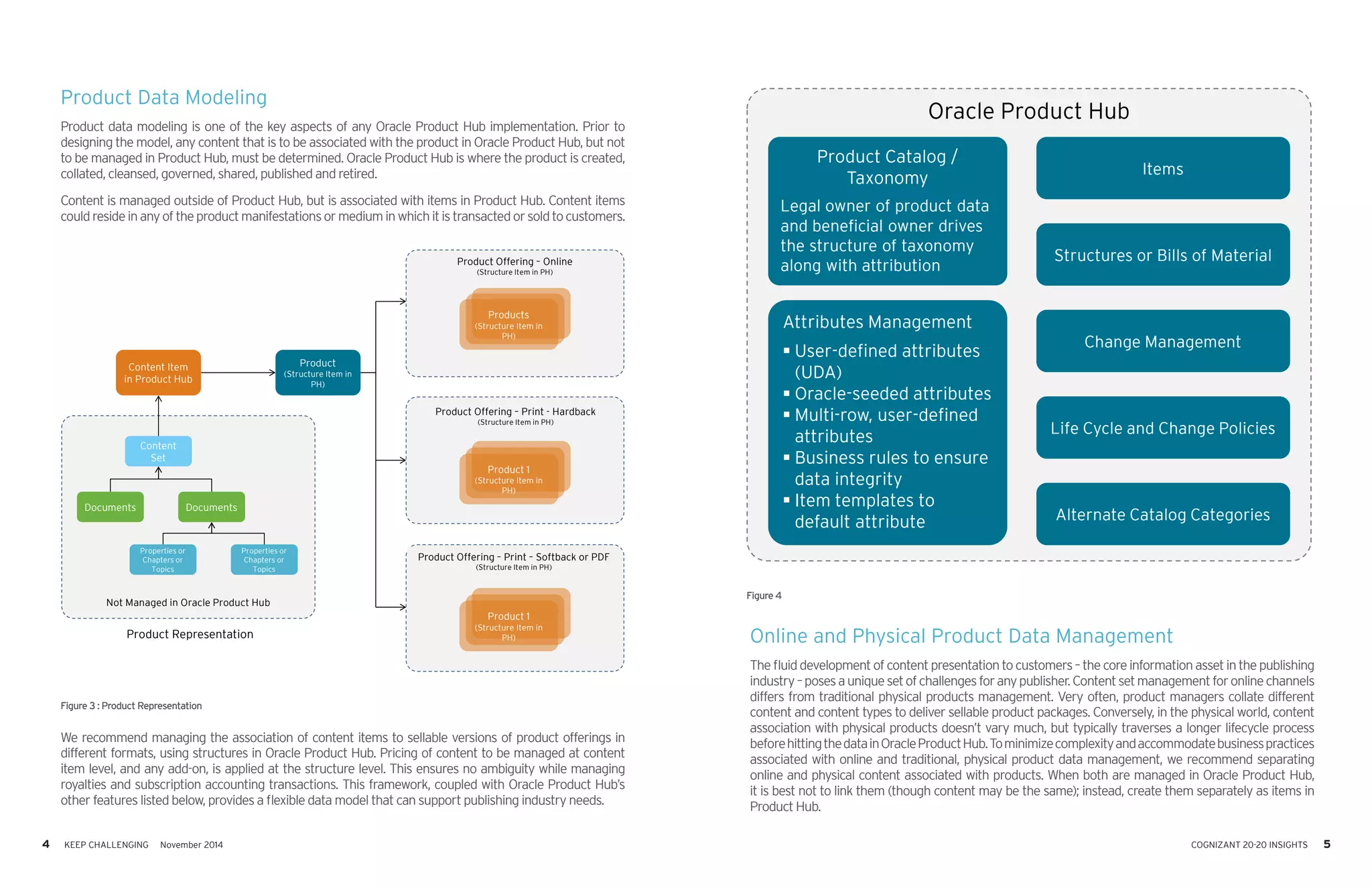
We recommend managing the association of content items to sellable versions of product offerings in
different formats, using structures in Oracle Product Hub. Pricing of content to be managed at content
item level, and any add-on, is applied at the structure level. This ensures no ambiguity while managing
royalties and subscription accounting transactions. This framework, coupled with Oracle Product Hub’s
other features listed below, provides a flexible data model that can support publishing industry needs.
Online and Physical Product Data Management
Thefluiddevelopmentofcontentpresentationtocustomers–thecoreinformationassetinthepublishing
industry–posesauniquesetofchallengesforanypublisher.Contentsetmanagementforonlinechannels
differs from traditional physical products management. Very often, product managers collate different
content and content types to deliver sellable product packages. Conversely, in the physical world, content
association with physical products doesn’t vary much, but typically traverses a longer lifecycle process
beforehittingthedatainOracleProductHub.Tominimizecomplexityandaccommodatebusinesspractices
associated with online and traditional, physical product data management, we recommend separating
online and physical content associated with products. When both are managed in Oracle Product Hub,
it is best not to link them (though content may be the same); instead, create them separately as items in
Product Hub.
Content
Set
Documents Documents
Properties or
Chapters or
Topics
Properties or
Chapters or
Topics
Content Item
in Product Hub
Not Managed in Oracle Product Hub
Product
(Structure Item in
PH)
Product Offering – Online
(Structure Item in PH)
Products
(Structure Item in
PH)
Product Offering – Print - Hardback
(Structure Item in PH)
Product 1
(Structure Item in
PH)
Product Offering – Print – Softback or PDF
(Structure Item in PH)
Product Representation
Product 1
(Structure Item in
PH)
Figure 3 : Product Representation
Figure 4
Product Catalog /
Taxonomy
Legal owner of product data
and beneficial owner drives
the structure of taxonomy
along with attribution
Attributes Management
ď‚§ User-defined attributes
(UDA)
ď‚§ Oracle-seeded attributes
ď‚§ Multi-row, user-defined
attributes
ď‚§ Business rules to ensure
data integrity
ď‚§ Item templates to
default attribute
Items
Structures or Bills of Material
Change Management
Life Cycle and Change Policies
Alternate Catalog Categories
Oracle Product Hub
6 KEEP CHALLENGING November 2014 COGNIZANT 20-20 INSIGHTS 7
Onboarding Product Data, Mergers and Acquisitions
These days, mergers and acquisitions among publishing companies are a common occurrence. In order
to streamline onboarding of product data into our architecture and processes during these events, we
musthaveadefinedbusinessprocess,incorporatingworkflows,andadatamanagementprocessinOracle
ProductHub.Usingthewell-defined,repeatableprocessesandflexibilitythatOracleProductHubprovides,
we can make onboarding product data during a merger or acquisition much easier and manageable.
Online Product Introduction
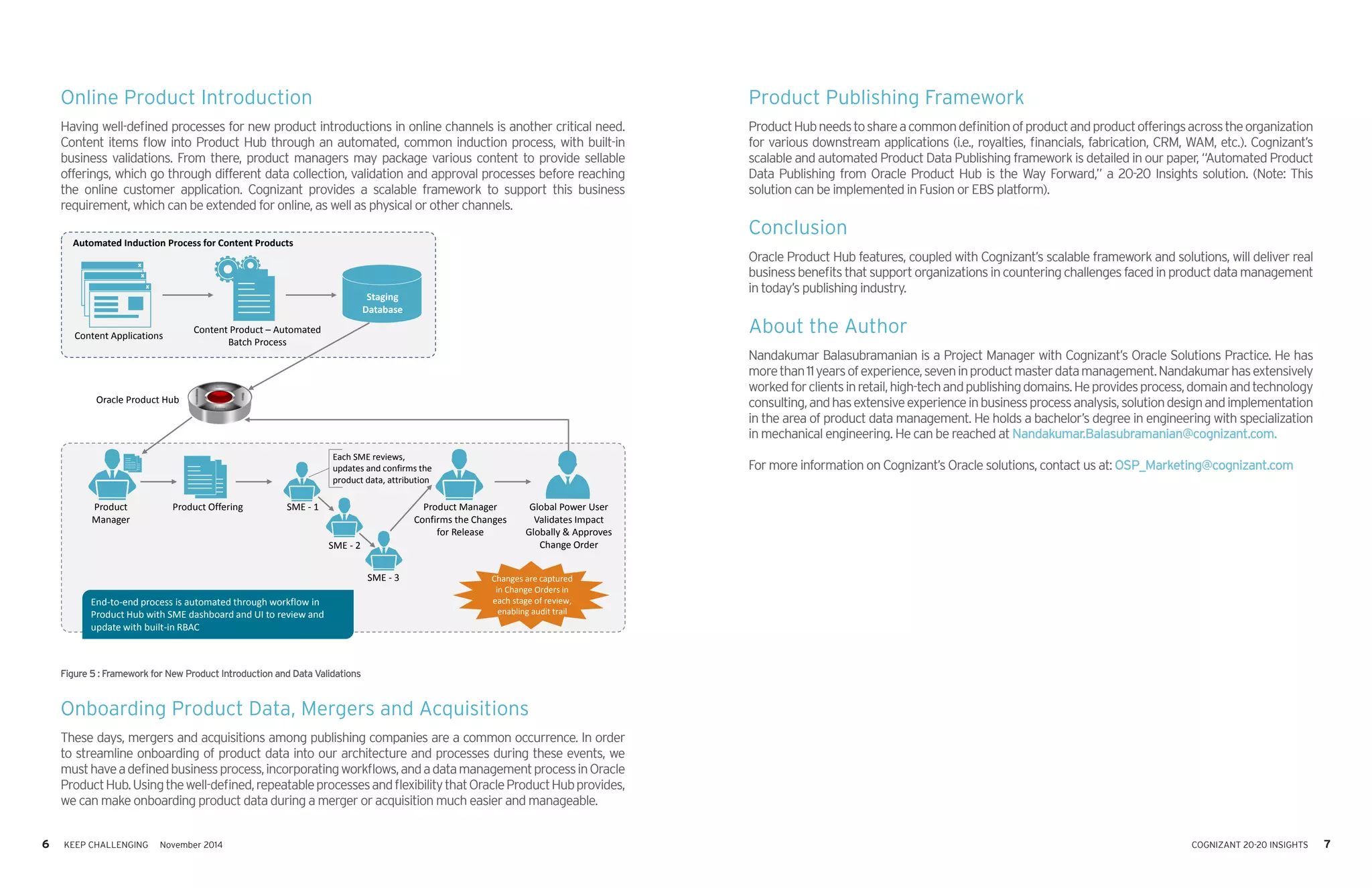
Having well-defined processes for new product introductions in online channels is another critical need.
Content items flow into Product Hub through an automated, common induction process, with built-in
business validations. From there, product managers may package various content to provide sellable
offerings, which go through different data collection, validation and approval processes before reaching
the online customer application. Cognizant provides a scalable framework to support this business
requirement, which can be extended for online, as well as physical or other channels.
Product Publishing Framework
ProductHubneedstoshareacommondefinitionofproductandproductofferingsacrosstheorganization
for various downstream applications (i.e., royalties, financials, fabrication, CRM, WAM, etc.). Cognizant’s
scalable and automated Product Data Publishing framework is detailed in our paper, “Automated Product
Data Publishing from Oracle Product Hub is the Way Forward,” a 20-20 Insights solution. (Note: This
solution can be implemented in Fusion or EBS platform).
Conclusion
Oracle Product Hub features, coupled with Cognizant’s scalable framework and solutions, will deliver real
businessbenefitsthatsupportorganizationsincounteringchallengesfacedinproductdatamanagement
in today’s publishing industry.
About the Author
Nandakumar Balasubramanian is a Project Manager with Cognizant’s Oracle Solutions Practice. He has
morethan11yearsofexperience,seveninproductmasterdatamanagement.Nandakumarhasextensively
workedforclientsinretail,high-techandpublishingdomains.Heprovidesprocess,domainandtechnology
consulting,andhasextensiveexperienceinbusinessprocessanalysis,solutiondesignandimplementation
in the area of product data management. He holds a bachelor’s degree in engineering with specialization
in mechanical engineering. He can be reached at Nandakumar.Balasubramanian@cognizant.com.
For more information on Cognizant’s Oracle solutions, contact us at: OSP_Marketing@cognizant.com
Figure 5 : Framework for New Product Introduction and Data Validations
Automated Induction Process for Content Products
Content Applications
Content Product – Automated
Batch Process
Product
Manager
Product Offering SME - 1
SME - 2
SME - 3
Product Manager
Confirms the Changes
for Release
Global Power User
Validates Impact
Globally & Approves
Change Order
End-to-end process is automated through workflow in
Product Hub with SME dashboard and UI to review and
update with built-in RBAC
Staging
Database
Oracle Product Hub
Each SME reviews,
updates and confirms the
product data, attribution
Changes are captured
in Change Orders in
each stage of review,
enabling audit trail
© Copyright 2014, Cognizant. All rights reserved. No part of this document may be reproduced, stored in a retrieval system, transmitted in any form or by any means,
electronic, mechanical, photocopying, recording, or otherwise, without the express written permission from Cognizant. The information contained herein is subject to
change without notice. All other trademarks mentioned herein are the property of their respective owners.
World Headquarters
500 Frank W. Burr Blvd.
Teaneck, NJ 07666 USA
Phone: +1 201 801 0233
Fax: +1 201 801 0243
Toll Free: +1 888 937 3277
inquiry@cognizant.com
European Headquarters
1 Kingdom Street
Paddington Central
London W2 6BD
Phone: +44 (0) 207 297 7600
Fax: +44 (0) 207 121 0102
infouk@cognizant.com
India Operations Headquarters
#5/535, Old Mahabalipuram Road
Okkiyam Pettai, Thoraipakkam
Chennai, 600 096 India
Phone: +91 (0) 44 4209 6000
Fax: +91 (0) 44 4209 6060
inquiryindia@cognizant.com
About Cognizant
Cognizant (NASDAQ: CTSH) is a leading provider of
information technology, consulting, and business
process outsourcing services, dedicated to helping the
world’s leading companies build stronger businesses.
Headquartered in Teaneck, New Jersey (U.S.), Cognizant
combines a passion for client satisfaction, technology
innovation, deep industry and business process expertise,
and a global, collaborative workforce that embodies the
future of work. With over 75 development and delivery
centers worldwide and approximately 199,700 employees
as of September 30, 2014, Cognizant is a member of the
NASDAQ-100, the S&P 500, the Forbes Global 2000, and
the Fortune 500 and is ranked among the top performing
and fastest growing companies in the world. Visit us online
at www.cognizant.com or follow us on Twitter: Cognizant.

Overcoming Product Data challenges in Publishing Organizations Using Oracle Product Hub

  • 1.
    Overcoming Product Data Challengesin Publishing Organizations Using Oracle Product Hub
  • 2.
    2 KEEP CHALLENGINGNovember 2014 CAMPEXEC – COGNIZANT REDEFINES CAMPAIGN EXECUTION 3 Abstract As content in the publishing industry goes online from traditional physical books, along with various innovations in delivery channels, product data management processes and data model design to manage the increasing number of product versions becomes more challenging than ever. This paper deals with some of the critical features that are required to solve growing data management challenges in publishing using Oracle Product Hub. Overview In publishing, as in any other industry, over the past few decades product data has come to exist in a wide variety of applications, systems and databases, as well as spreadsheets and other formats. Product information is fragmented throughout different business groups, users or systems, instead of being available centrally. There is an increasing number of product data outputs required (e.g., online, physical printcatalogs,learningsolutions,electronicdatafeeds,etc.).Thishasbecomeamajorpublishingchallenge, andorganizationsarecounteringitbyintroducingproductdatamanagementstrategies.Toignoreitwould only lead to a high degree of inconsistency and incompleteness in product information, leading to data redundancyanddataqualityissues.Inordertoproduceaccurateandconsistentinformation,productdata models must be flexible enough to accommodate multiple manifestations, gathering data from varied applicationsandmasteringit,beforepublishingitaccordingtowell-definedbusinessrulesforconsumption by downstream applications. Critical Features Now more than ever, publishing organizations need a scalable, configurable, rules-driven and robust product information platform. Oracle Product Hub capabilities, enriched with Cognizant’s information management experience, provide the foundation for meeting this growing need. Some key capabilities of our solution include: Figure 1 : Product Data Management - Industry Pain Points Fragmented Product Data Tie Different Formats of Same Content Together Incomplete & Inaccurate Data Product Data Management Challenges Lost Cross- & Up-Sell Opportunities Revenue Recognition at Lowest Level (Docs, Chapters, etc.) Onboarding Products Through Acquisitions Figure 2 : Cognizant’s Extendable Solutions - Feature Map Automated Product Induction, Update Process Content, In-house Applications Content Product – Automated Batch Process Error Handling Administrator Error HandlingValidations Automated Product Publish Scheduled Publish Program Validations Publish Data for Downstream Application Enabling Power Users to manage rules for Induction, Publish and DQ Reporting User Interface to Manage Rules Global and Regional Power Users Staging Database Inform Source for Data Related Errors Notification Inbound Validations DQ Rules for Report Publish Validations PIM Database Notify Admin for Errors
  • 3.
    4 KEEP CHALLENGINGNovember 2014 COGNIZANT 20-20 INSIGHTS 5 Product Data Modeling Product data modeling is one of the key aspects of any Oracle Product Hub implementation. Prior to designing the model, any content that is to be associated with the product in Oracle Product Hub, but not to be managed in Product Hub, must be determined. Oracle Product Hub is where the product is created, collated, cleansed, governed, shared, published and retired. Content is managed outside of Product Hub, but is associated with items in Product Hub. Content items couldresideinanyoftheproductmanifestationsormediuminwhichitistransactedorsoldtocustomers. We recommend managing the association of content items to sellable versions of product offerings in different formats, using structures in Oracle Product Hub. Pricing of content to be managed at content item level, and any add-on, is applied at the structure level. This ensures no ambiguity while managing royalties and subscription accounting transactions. This framework, coupled with Oracle Product Hub’s other features listed below, provides a flexible data model that can support publishing industry needs. Online and Physical Product Data Management Thefluiddevelopmentofcontentpresentationtocustomers–thecoreinformationassetinthepublishing industry–posesauniquesetofchallengesforanypublisher.Contentsetmanagementforonlinechannels differs from traditional physical products management. Very often, product managers collate different content and content types to deliver sellable product packages. Conversely, in the physical world, content association with physical products doesn’t vary much, but typically traverses a longer lifecycle process beforehittingthedatainOracleProductHub.Tominimizecomplexityandaccommodatebusinesspractices associated with online and traditional, physical product data management, we recommend separating online and physical content associated with products. When both are managed in Oracle Product Hub, it is best not to link them (though content may be the same); instead, create them separately as items in Product Hub. Content Set Documents Documents Properties or Chapters or Topics Properties or Chapters or Topics Content Item in Product Hub Not Managed in Oracle Product Hub Product (Structure Item in PH) Product Offering – Online (Structure Item in PH) Products (Structure Item in PH) Product Offering – Print - Hardback (Structure Item in PH) Product 1 (Structure Item in PH) Product Offering – Print – Softback or PDF (Structure Item in PH) Product Representation Product 1 (Structure Item in PH) Figure 3 : Product Representation Figure 4 Product Catalog / Taxonomy Legal owner of product data and beneficial owner drives the structure of taxonomy along with attribution Attributes Management  User-defined attributes (UDA)  Oracle-seeded attributes  Multi-row, user-defined attributes  Business rules to ensure data integrity  Item templates to default attribute Items Structures or Bills of Material Change Management Life Cycle and Change Policies Alternate Catalog Categories Oracle Product Hub
  • 4.
    6 KEEP CHALLENGINGNovember 2014 COGNIZANT 20-20 INSIGHTS 7 Onboarding Product Data, Mergers and Acquisitions These days, mergers and acquisitions among publishing companies are a common occurrence. In order to streamline onboarding of product data into our architecture and processes during these events, we musthaveadefinedbusinessprocess,incorporatingworkflows,andadatamanagementprocessinOracle ProductHub.Usingthewell-defined,repeatableprocessesandflexibilitythatOracleProductHubprovides, we can make onboarding product data during a merger or acquisition much easier and manageable. Online Product Introduction Having well-defined processes for new product introductions in online channels is another critical need. Content items flow into Product Hub through an automated, common induction process, with built-in business validations. From there, product managers may package various content to provide sellable offerings, which go through different data collection, validation and approval processes before reaching the online customer application. Cognizant provides a scalable framework to support this business requirement, which can be extended for online, as well as physical or other channels. Product Publishing Framework ProductHubneedstoshareacommondefinitionofproductandproductofferingsacrosstheorganization for various downstream applications (i.e., royalties, financials, fabrication, CRM, WAM, etc.). Cognizant’s scalable and automated Product Data Publishing framework is detailed in our paper, “Automated Product Data Publishing from Oracle Product Hub is the Way Forward,” a 20-20 Insights solution. (Note: This solution can be implemented in Fusion or EBS platform). Conclusion Oracle Product Hub features, coupled with Cognizant’s scalable framework and solutions, will deliver real businessbenefitsthatsupportorganizationsincounteringchallengesfacedinproductdatamanagement in today’s publishing industry. About the Author Nandakumar Balasubramanian is a Project Manager with Cognizant’s Oracle Solutions Practice. He has morethan11yearsofexperience,seveninproductmasterdatamanagement.Nandakumarhasextensively workedforclientsinretail,high-techandpublishingdomains.Heprovidesprocess,domainandtechnology consulting,andhasextensiveexperienceinbusinessprocessanalysis,solutiondesignandimplementation in the area of product data management. He holds a bachelor’s degree in engineering with specialization in mechanical engineering. He can be reached at Nandakumar.Balasubramanian@cognizant.com. For more information on Cognizant’s Oracle solutions, contact us at: OSP_Marketing@cognizant.com Figure 5 : Framework for New Product Introduction and Data Validations Automated Induction Process for Content Products Content Applications Content Product – Automated Batch Process Product Manager Product Offering SME - 1 SME - 2 SME - 3 Product Manager Confirms the Changes for Release Global Power User Validates Impact Globally & Approves Change Order End-to-end process is automated through workflow in Product Hub with SME dashboard and UI to review and update with built-in RBAC Staging Database Oracle Product Hub Each SME reviews, updates and confirms the product data, attribution Changes are captured in Change Orders in each stage of review, enabling audit trail
  • 5.
    © Copyright 2014,Cognizant. All rights reserved. No part of this document may be reproduced, stored in a retrieval system, transmitted in any form or by any means, electronic, mechanical, photocopying, recording, or otherwise, without the express written permission from Cognizant. The information contained herein is subject to change without notice. All other trademarks mentioned herein are the property of their respective owners. World Headquarters 500 Frank W. Burr Blvd. Teaneck, NJ 07666 USA Phone: +1 201 801 0233 Fax: +1 201 801 0243 Toll Free: +1 888 937 3277 inquiry@cognizant.com European Headquarters 1 Kingdom Street Paddington Central London W2 6BD Phone: +44 (0) 207 297 7600 Fax: +44 (0) 207 121 0102 infouk@cognizant.com India Operations Headquarters #5/535, Old Mahabalipuram Road Okkiyam Pettai, Thoraipakkam Chennai, 600 096 India Phone: +91 (0) 44 4209 6000 Fax: +91 (0) 44 4209 6060 inquiryindia@cognizant.com About Cognizant Cognizant (NASDAQ: CTSH) is a leading provider of information technology, consulting, and business process outsourcing services, dedicated to helping the world’s leading companies build stronger businesses. Headquartered in Teaneck, New Jersey (U.S.), Cognizant combines a passion for client satisfaction, technology innovation, deep industry and business process expertise, and a global, collaborative workforce that embodies the future of work. With over 75 development and delivery centers worldwide and approximately 199,700 employees as of September 30, 2014, Cognizant is a member of the NASDAQ-100, the S&P 500, the Forbes Global 2000, and the Fortune 500 and is ranked among the top performing and fastest growing companies in the world. Visit us online at www.cognizant.com or follow us on Twitter: Cognizant.