



Fusion Apps Deep Dive Session - SCM Functional 
Nachiketa Sharma BS, MS
PIM Overview
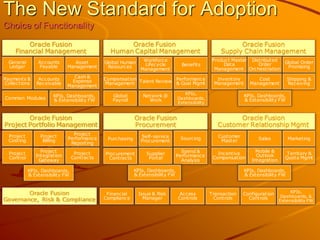
The New Standard for Adoption Choice of Functionality 
Oracle Fusion Financial Management 
General Ledger 
Accounts Payable 
Payments & Collections 
Asset Management 
Accounts Receivable 
Cash & Expense Management 
Common Modules 
KPIs, Dashboards, & Extensibility FW 
Oracle Fusion Human Capital Management 
Oracle Fusion Supply Chain Management 
Product Master Data Management 
Distributed Order Orchestration 
Inventory Management 
Global Order Promising 
Cost Management 
Shipping & Receiving 
KPIs, Dashboards, & Extensibility FW 
Oracle Fusion Project Portfolio Management 
Project Costing 
Project Billing 
Project Control 
Project Performance Reporting 
Project Integration Gateway 
Project Contracts 
KPIs, Dashboards, & Extensibility FW 
Oracle Fusion Customer Relationship Mgmt 
Customer Master 
Sales 
Marketing 
Incentive Compensation 
Mobile & Outlook Integration 
Territory & Quota Mgmt 
KPIs, Dashboards, & Extensibility FW 
Financial Compliance 
Issue & Risk Manager 
Access Controls 
Transaction Controls 
Configuration Controls 
KPIs, Dashboards, & Extensibility FW 
Oracle Fusion Governance, Risk & Compliance 
Global Human Resources 
Workforce Lifecycle Management 
Benefits 
Compensation Management 
Talent Review 
Performance & Goal Mgmt 
Global Payroll 
Network @ Work 
KPIs, Dashboards, Extensibility 
Oracle Fusion Procurement 
Purchasing 
Self-service Procurement 
Sourcing 
Supplier Portal 
Spend & Performance Analysis 
KPIs, Dashboards, & Extensibility FW 
Procurement Contracts
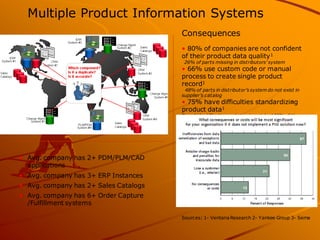
Multiple Product Information Systems 
Sources: 1- Ventana Research 2- Yankee Group 3- Sema 
• 80% of companies are not confident of their product data quality1 26% of parts missing in distributors’ system 
• 66% use custom code or manual process to create single product record1 48% of parts in distributor’s system do not exist in supplier’s catalog 
• 75% have difficulties standardizing product data1 Brand identification code is mismatched 66% of the time 
Consequences 
2 
•Avg. company has 2+ PDM/PLM/CAD applications 
•Avg. company has 3+ ERP Instances 
•Avg. company has 2+ Sales Catalogs 
•Avg. company has 6+ Order Capture /Fulfillment systems
Common Product Model Guiding Principles 
–Provide a central repository for the entire Fusion Suite to store and manage information related to all types of products and services 
–Provide common UI components to enhance consistent User Experience 
–Model each entity only once and reuse in different business processes 
–Provide business user extensibility and configurability to minimize customizations 
–Support all business models, industries, and geographies
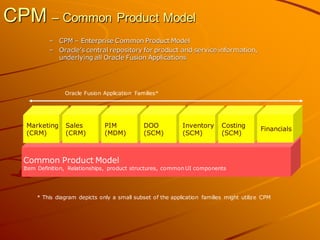
CPM – Common Product Model 
–CPM – Enterprise Common Product Model 
–Oracle’s central repository for product and service information, underlying all Oracle Fusion Applications 
* This diagram depicts only a small subset of the application families might utilize CPM 
Common Product Model 
Item Definition, Relationships, product structures, common UI components 
Oracle Fusion Application Families* 
Marketing (CRM) 
Sales (CRM) 
PIM (MDM) 
DOO (SCM) 
Inventory (SCM) 
Costing (SCM) 
Financials
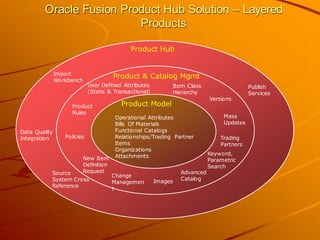
Oracle Fusion Product Hub Solution – Layered Products 
Product Hub 
Import Workbench 
Data Quality Integration 
Source System Cross Reference 
Publish Services 
Product & Catalog Mgmt 
User Defined Attributes (Static & Transactional) 
Trading Partners 
Policies 
Product Rules 
Versions 
New Item Definition Request 
Change Management 
Item Class Hierarchy 
Mass Updates 
Keyword, Parametric Search 
Advanced Catalog 
Images 
Product Model 
Operational Attributes Bills Of Materials Functional Catalogs Relationships/Trading Partner Items Organizations Attachments
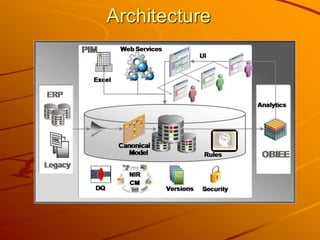
Fusion Product Hub Architecture
What’s new in Fusion Product Hub V1? 
Combines best features from EBS, PSFT & Siebel Product Master and Catalog Management products while enhancing existing features and providing innovations 
Enterprise Common Product Model which will provide a foundation for all Fusion Applications that will need product data. 
Decoupled from Inventory Organizations alleviates need to setup Financials (Chart of Accounts, GL Calendars, Set of Books etc) 
Revision Code has been enhanced to 18 characters as opposed to 3 characters. Revisions will be sorted by effectivity date as opposed to an alphanumeric sort 
 Rationalized Data Model for Item Relationships and Trading Partners 
Common Services for item search(item picker) and contexual actions 
Two products: Product & Catalog Management: provides extensibility, governance workflows, product taxonomy Product Hub: provides master data management functionality to consolidate, cleanse, publish product data from heterogeneous systems
What’s new in Fusion Product Hub V1? (continued…Key Functional Capabilities) 
Item Management 
Real time error checking and data quality functions during item creation process 
Item Versions for streamlined release management 
Configurable item overview page and Operational attribute security 
New Trading Partner Item to model Competitor Items 
SOA Based business Web Services 
Groups Spaces Integration 
Data Discovery, Tracking and Mass Updates 
Item Supplier criteria as part of Advanced Search 
ADFdi (Excel) integration for Mass Updates 
Product Dashboard with OOTB embedded analytics to track and monitor key KPI’s and metrics 
Classification and Catalog Management 
Inheritance of Definition Workflow Steps 
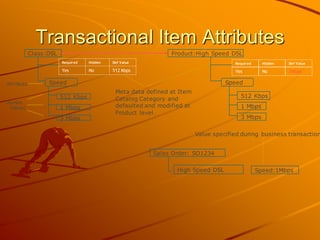
Application domain meta data for Transactional Item Attributes 
Master Catalogs with shareable categories and content 
Images and attachments for Product Catalogs for richer content
What’s new in Fusion Product Hub V1? (continued…Key Functional Capabilities) 
Data Governance Workflow 
Multi class New Item Requests 
Support for authoring operational attributes in new item requests 
Extended definition steps – structures, attachments, organizations 
Optimized task based notifications 
Product Business Rules based Change Policies
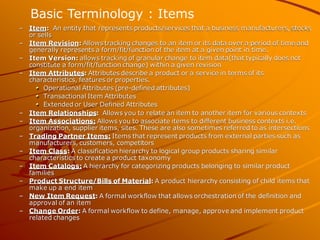
–Item: An entity that represents products/services that a business manufacturers, stocks or sells 
–Item Revision: Allows tracking changes to an item or its data over a period of time and generally represents a form/fit/function of the item at a given point in time. 
–Item Version: allows tracking of granular change to item data(that typically does not constitute a form/fit/function change) within a given revision 
–Item Attributes: Attributes describe a product or a service in terms of its characteristics, features or properties. Operational Attributes (pre-defined attributes) Transactional Item Attributes Extended or User Defined Attributes 
–Item Relationships: Allows you to relate an item to another item for various contexts 
–Item Associations: Allows you to associate items to different business contexts i.e. organization, supplier items, sites. These are also sometimes referred to as intersections 
–Trading Partner Items: Items that represent products from external parties such as manufacturers, customers, competitors 
–Item Class: A classification hierarchy to logical group products sharing similar characteristics to create a product taxonomy 
–Item Catalogs: A hierarchy for categorizing products belonging to similar product families 
–Product Structure/Bills of Material: A product hierarchy consisting of child items that make up a end item 
–New Item Request: A formal workflow that allows orchestration of the definition and approval of an item 
–Change Order: A formal workflow to define, manage, approve and implement product related changes 
Basic Terminology : Items
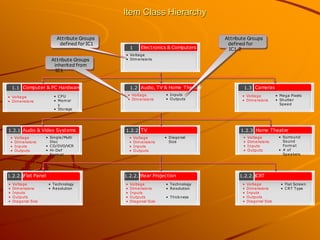
Item Class Hierarchy 
1 
Electronics & Computers 
•Voltage 
•Dimensions 
1.2 
Audio, TV & Home Theater 
•Inputs 
•Outputs 
1.3 
Cameras 
1.1 
Computer & PC Hardware 
•CPU 
•Memory 
•Storage 
1.2.1 
Audio & Video Systems 
1.2.2 
TV 
1.2.3 
Home Theater 
1.2.2.1 
Flat Panel 
•Technology 
•Resolution 
1.2.2.2 
Rear Projection 
1.2.2.3 
CRT 
•Voltage 
•Dimensions 
•Voltage 
•Dimensions 
•Mega Pixels 
•Shutter Speed 
•Voltage 
•Dimensions 
•Voltage 
•Dimensions 
•Inputs 
•Outputs 
•Single/Multi Disc 
•CD/DVD/VCR 
•Hi-Def Format 
•Voltage 
•Dimensions 
•Inputs 
•Outputs 
•Diagonal Size 
•Voltage 
•Dimensions 
•Inputs 
•Outputs 
•Surround Sound Format 
•# of Speakers 
•Voltage 
•Dimensions 
•Inputs 
•Outputs 
•Diagonal Size 
•Technology 
•Resolution 
•Thickness 
•Voltage 
•Dimensions 
•Inputs 
•Outputs 
•Diagonal Size 
•Voltage 
•Dimensions 
•Inputs 
•Outputs 
•Diagonal Size 
•Flat Screen 
•CRT Type 
Attribute Groups defined for IC1 
Attribute Groups inherited from IC1 
Attribute Groups defined for IC1.2
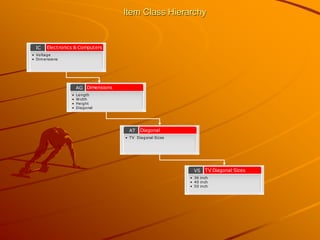
Item Class Hierarchy 
IC 
Electronics & Computers 
•Voltage 
•Dimensions 
AG 
Dimensions 
•Length 
•Width 
•Height 
•Diagonal 
AT 
Diagonal 
•TV Diagonal Sizes 
VS 
TV Diagonal Sizes 
•36 inch 
•40 inch 
•50 inch
Transactional Item Attributes 
Class:DSL 
512 Kbps 
1 Mbps 
3 Mbps 
Meta data defined at Item Catalog Category and defaulted and modified at Product level 
Sales Order: SO1234 
High Speed DSL 
Speed:1Mbps 
Speed 
Value specified during business transaction 
Product:High Speed DSL 
512 Kbps 
1 Mbps 
3 Mbps 
Speed 
Domain Values 
Required 
Hidden 
Def Value 
Yes 
No 
512 Kbps 
Required 
Hidden 
Def Value 
Yes 
No 
1Mbps 
Attribute
16 
Overview 
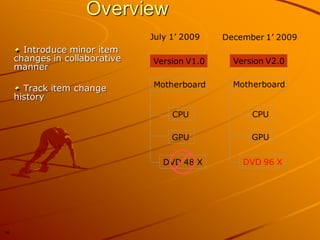
Introduce minor item changes in collaborative manner Track item change history 
July 1’ 2009 
Version V1.0 
Motherboard 
CPU 
GPU 
DVD 48 X 
December 1’ 2009 
Version V2.0 
Motherboard 
CPU 
GPU 
DVD 96 X
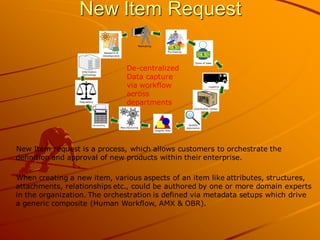
New Item Request 
Point of Sale 
Quality 
Assurance 
Regulatory 
Accounting 
Logistics 
Marketing 
Information 
Technology 
Distribution Center 
Research & 
Development 
Purchasing 
Manufacturing 
Graphic Arts 
De-centralized 
Data capture 
via workflow 
across 
departments 
New Item request is a process, which allows customers to orchestrate the 
definition and approval of new products within their enterprise. 
When creating a new item, various aspects of an item like attributes, structures, 
attachments, relationships etc., could be authored by one or more domain experts 
in the organization. The orchestration is defined via metadata setups which drive 
a generic composite (Human Workflow, AMX & OBR).
Q & A

Fusion Applications - PIM Deep Dive

  • 1.
    Fusion Apps DeepDive Session - SCM Functional Nachiketa Sharma BS, MS
  • 2.
  • 3.
    The New Standardfor Adoption Choice of Functionality Oracle Fusion Financial Management General Ledger Accounts Payable Payments & Collections Asset Management Accounts Receivable Cash & Expense Management Common Modules KPIs, Dashboards, & Extensibility FW Oracle Fusion Human Capital Management Oracle Fusion Supply Chain Management Product Master Data Management Distributed Order Orchestration Inventory Management Global Order Promising Cost Management Shipping & Receiving KPIs, Dashboards, & Extensibility FW Oracle Fusion Project Portfolio Management Project Costing Project Billing Project Control Project Performance Reporting Project Integration Gateway Project Contracts KPIs, Dashboards, & Extensibility FW Oracle Fusion Customer Relationship Mgmt Customer Master Sales Marketing Incentive Compensation Mobile & Outlook Integration Territory & Quota Mgmt KPIs, Dashboards, & Extensibility FW Financial Compliance Issue & Risk Manager Access Controls Transaction Controls Configuration Controls KPIs, Dashboards, & Extensibility FW Oracle Fusion Governance, Risk & Compliance Global Human Resources Workforce Lifecycle Management Benefits Compensation Management Talent Review Performance & Goal Mgmt Global Payroll Network @ Work KPIs, Dashboards, Extensibility Oracle Fusion Procurement Purchasing Self-service Procurement Sourcing Supplier Portal Spend & Performance Analysis KPIs, Dashboards, & Extensibility FW Procurement Contracts
  • 4.
    Multiple Product InformationSystems Sources: 1- Ventana Research 2- Yankee Group 3- Sema • 80% of companies are not confident of their product data quality1 26% of parts missing in distributors’ system • 66% use custom code or manual process to create single product record1 48% of parts in distributor’s system do not exist in supplier’s catalog • 75% have difficulties standardizing product data1 Brand identification code is mismatched 66% of the time Consequences 2 •Avg. company has 2+ PDM/PLM/CAD applications •Avg. company has 3+ ERP Instances •Avg. company has 2+ Sales Catalogs •Avg. company has 6+ Order Capture /Fulfillment systems
  • 5.
    Common Product ModelGuiding Principles –Provide a central repository for the entire Fusion Suite to store and manage information related to all types of products and services –Provide common UI components to enhance consistent User Experience –Model each entity only once and reuse in different business processes –Provide business user extensibility and configurability to minimize customizations –Support all business models, industries, and geographies
  • 6.
    CPM – CommonProduct Model –CPM – Enterprise Common Product Model –Oracle’s central repository for product and service information, underlying all Oracle Fusion Applications * This diagram depicts only a small subset of the application families might utilize CPM Common Product Model Item Definition, Relationships, product structures, common UI components Oracle Fusion Application Families* Marketing (CRM) Sales (CRM) PIM (MDM) DOO (SCM) Inventory (SCM) Costing (SCM) Financials
  • 7.
    Oracle Fusion ProductHub Solution – Layered Products Product Hub Import Workbench Data Quality Integration Source System Cross Reference Publish Services Product & Catalog Mgmt User Defined Attributes (Static & Transactional) Trading Partners Policies Product Rules Versions New Item Definition Request Change Management Item Class Hierarchy Mass Updates Keyword, Parametric Search Advanced Catalog Images Product Model Operational Attributes Bills Of Materials Functional Catalogs Relationships/Trading Partner Items Organizations Attachments
  • 8.
    Fusion Product HubArchitecture
  • 9.
    What’s new inFusion Product Hub V1? Combines best features from EBS, PSFT & Siebel Product Master and Catalog Management products while enhancing existing features and providing innovations Enterprise Common Product Model which will provide a foundation for all Fusion Applications that will need product data. Decoupled from Inventory Organizations alleviates need to setup Financials (Chart of Accounts, GL Calendars, Set of Books etc) Revision Code has been enhanced to 18 characters as opposed to 3 characters. Revisions will be sorted by effectivity date as opposed to an alphanumeric sort  Rationalized Data Model for Item Relationships and Trading Partners Common Services for item search(item picker) and contexual actions Two products: Product & Catalog Management: provides extensibility, governance workflows, product taxonomy Product Hub: provides master data management functionality to consolidate, cleanse, publish product data from heterogeneous systems
  • 10.
    What’s new inFusion Product Hub V1? (continued…Key Functional Capabilities) Item Management Real time error checking and data quality functions during item creation process Item Versions for streamlined release management Configurable item overview page and Operational attribute security New Trading Partner Item to model Competitor Items SOA Based business Web Services Groups Spaces Integration Data Discovery, Tracking and Mass Updates Item Supplier criteria as part of Advanced Search ADFdi (Excel) integration for Mass Updates Product Dashboard with OOTB embedded analytics to track and monitor key KPI’s and metrics Classification and Catalog Management Inheritance of Definition Workflow Steps Application domain meta data for Transactional Item Attributes Master Catalogs with shareable categories and content Images and attachments for Product Catalogs for richer content
  • 11.
    What’s new inFusion Product Hub V1? (continued…Key Functional Capabilities) Data Governance Workflow Multi class New Item Requests Support for authoring operational attributes in new item requests Extended definition steps – structures, attachments, organizations Optimized task based notifications Product Business Rules based Change Policies
  • 12.
    –Item: An entitythat represents products/services that a business manufacturers, stocks or sells –Item Revision: Allows tracking changes to an item or its data over a period of time and generally represents a form/fit/function of the item at a given point in time. –Item Version: allows tracking of granular change to item data(that typically does not constitute a form/fit/function change) within a given revision –Item Attributes: Attributes describe a product or a service in terms of its characteristics, features or properties. Operational Attributes (pre-defined attributes) Transactional Item Attributes Extended or User Defined Attributes –Item Relationships: Allows you to relate an item to another item for various contexts –Item Associations: Allows you to associate items to different business contexts i.e. organization, supplier items, sites. These are also sometimes referred to as intersections –Trading Partner Items: Items that represent products from external parties such as manufacturers, customers, competitors –Item Class: A classification hierarchy to logical group products sharing similar characteristics to create a product taxonomy –Item Catalogs: A hierarchy for categorizing products belonging to similar product families –Product Structure/Bills of Material: A product hierarchy consisting of child items that make up a end item –New Item Request: A formal workflow that allows orchestration of the definition and approval of an item –Change Order: A formal workflow to define, manage, approve and implement product related changes Basic Terminology : Items
  • 13.
    Item Class Hierarchy 1 Electronics & Computers •Voltage •Dimensions 1.2 Audio, TV & Home Theater •Inputs •Outputs 1.3 Cameras 1.1 Computer & PC Hardware •CPU •Memory •Storage 1.2.1 Audio & Video Systems 1.2.2 TV 1.2.3 Home Theater 1.2.2.1 Flat Panel •Technology •Resolution 1.2.2.2 Rear Projection 1.2.2.3 CRT •Voltage •Dimensions •Voltage •Dimensions •Mega Pixels •Shutter Speed •Voltage •Dimensions •Voltage •Dimensions •Inputs •Outputs •Single/Multi Disc •CD/DVD/VCR •Hi-Def Format •Voltage •Dimensions •Inputs •Outputs •Diagonal Size •Voltage •Dimensions •Inputs •Outputs •Surround Sound Format •# of Speakers •Voltage •Dimensions •Inputs •Outputs •Diagonal Size •Technology •Resolution •Thickness •Voltage •Dimensions •Inputs •Outputs •Diagonal Size •Voltage •Dimensions •Inputs •Outputs •Diagonal Size •Flat Screen •CRT Type Attribute Groups defined for IC1 Attribute Groups inherited from IC1 Attribute Groups defined for IC1.2
  • 14.
    Item Class Hierarchy IC Electronics & Computers •Voltage •Dimensions AG Dimensions •Length •Width •Height •Diagonal AT Diagonal •TV Diagonal Sizes VS TV Diagonal Sizes •36 inch •40 inch •50 inch
  • 15.
    Transactional Item Attributes Class:DSL 512 Kbps 1 Mbps 3 Mbps Meta data defined at Item Catalog Category and defaulted and modified at Product level Sales Order: SO1234 High Speed DSL Speed:1Mbps Speed Value specified during business transaction Product:High Speed DSL 512 Kbps 1 Mbps 3 Mbps Speed Domain Values Required Hidden Def Value Yes No 512 Kbps Required Hidden Def Value Yes No 1Mbps Attribute
  • 16.
    16 Overview Introduceminor item changes in collaborative manner Track item change history July 1’ 2009 Version V1.0 Motherboard CPU GPU DVD 48 X December 1’ 2009 Version V2.0 Motherboard CPU GPU DVD 96 X
  • 17.
    New Item Request Point of Sale Quality Assurance Regulatory Accounting Logistics Marketing Information Technology Distribution Center Research & Development Purchasing Manufacturing Graphic Arts De-centralized Data capture via workflow across departments New Item request is a process, which allows customers to orchestrate the definition and approval of new products within their enterprise. When creating a new item, various aspects of an item like attributes, structures, attachments, relationships etc., could be authored by one or more domain experts in the organization. The orchestration is defined via metadata setups which drive a generic composite (Human Workflow, AMX & OBR).
  • 18.