Building a Product Management Data Strategy
December 16, 2015
1
Agenda
The product data imperative
Sources of product data
Quantitative & qualitative data in the Pendo platform
Best practices
Q&A
2
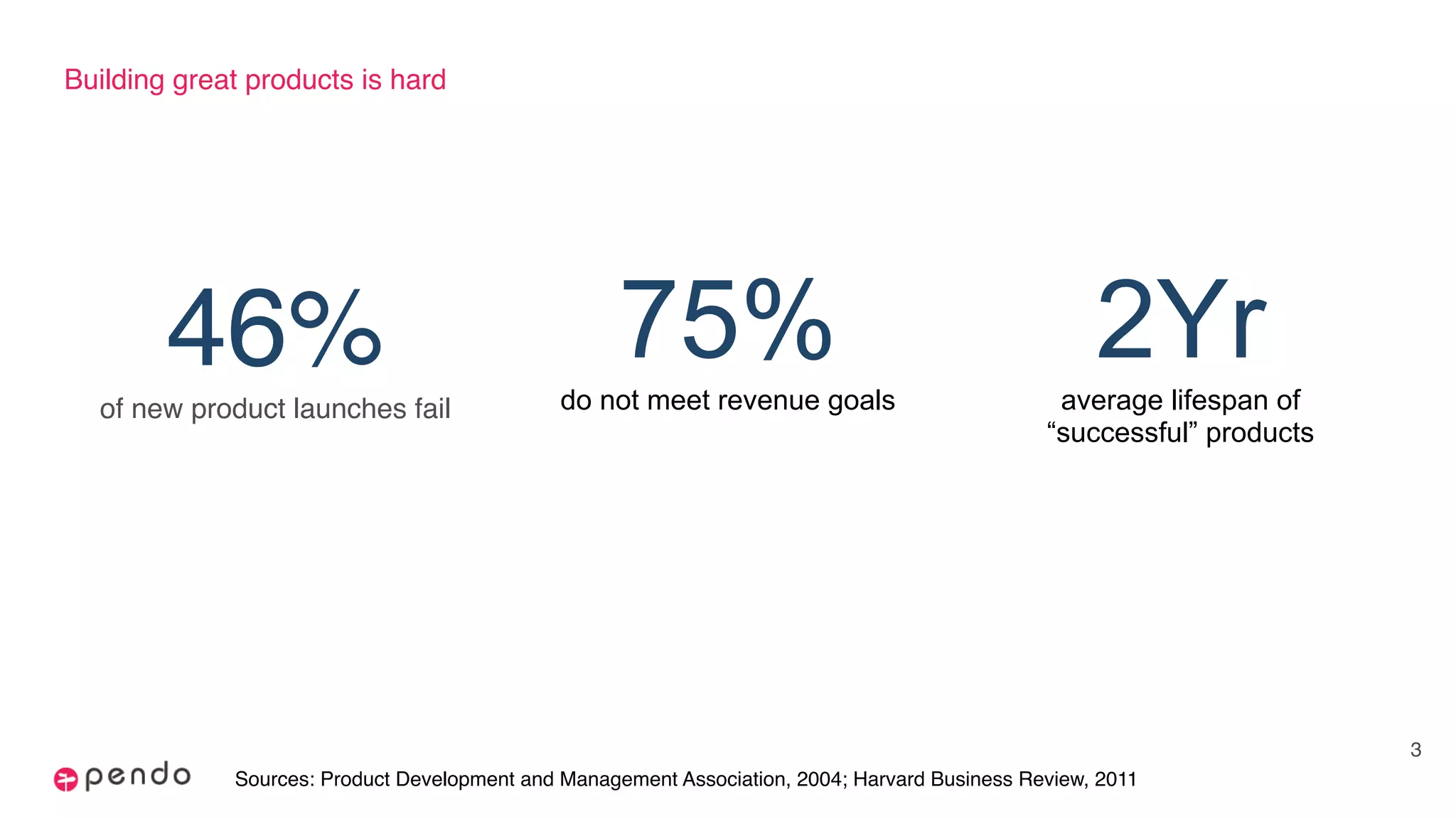
Building great products is hard
46%of new product launches fail
3
75%do not meet revenue goals
2Yraverage lifespan of
“successful” products
Sources: Product Development and Management Association, 2004; Harvard Business Review, 2011
Are the best product managers truly clairvoyant?
4
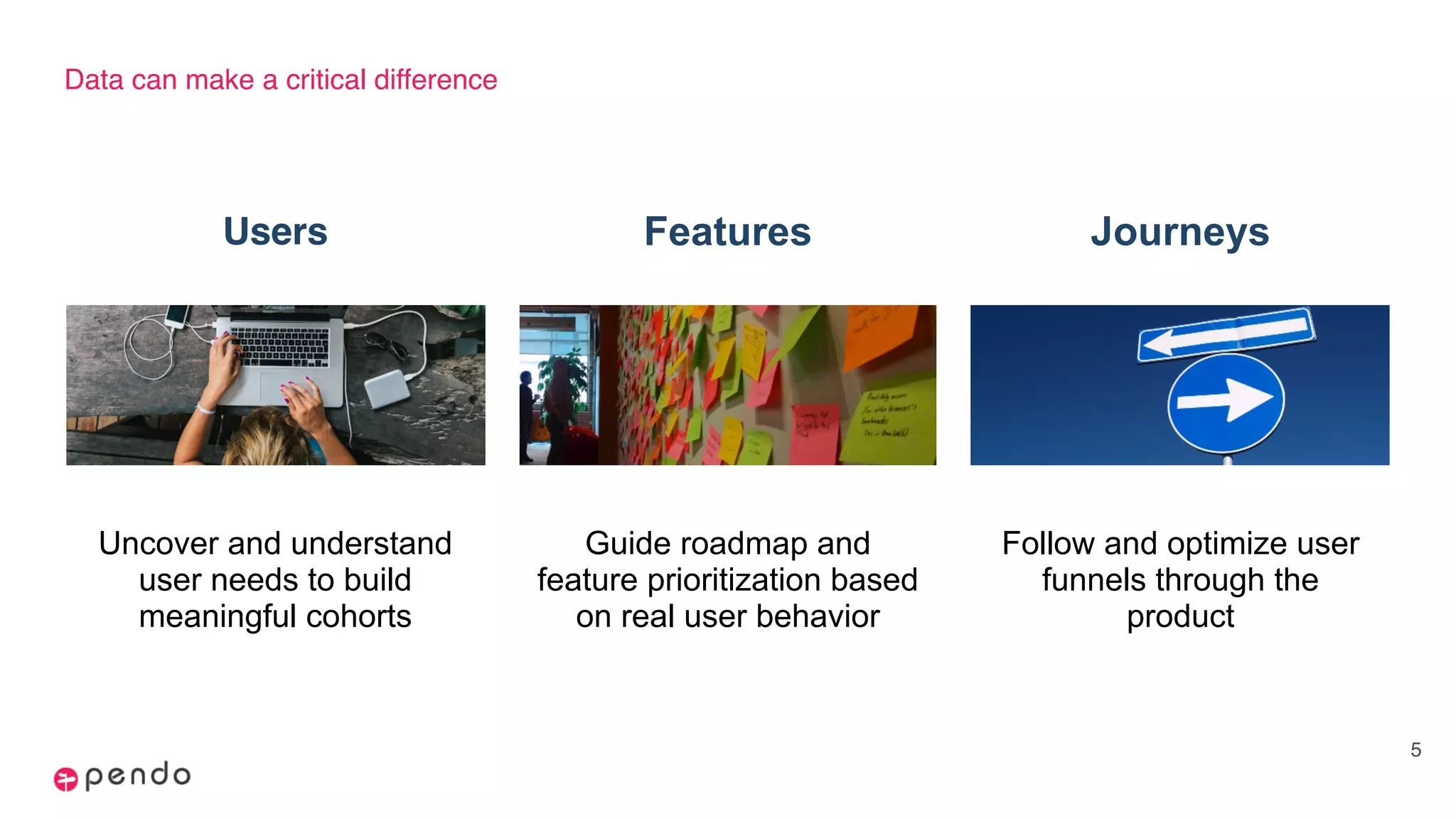
Data can make a critical difference
Users
5
Features Journeys
Uncover and understand
user needs to build
meaningful cohorts
Guide roadmap and
feature prioritization based
on real user behavior
Follow and optimize user
funnels through the
product
Product data sources - internal objects
Key application stats such as users, licences, etc, that is stored as part of application data
6
! Often critical indicators of a product’s
“health”
! Data is consistently collected and is stored /
captured within the application
Challenges
! Can require development resources to
extract and format
Product data sources - web analytics
Page-level and user data captured by instrumenting application pages with Google Analytics or other web
analytics software
7
! Provides measure of usage volume, and
visitor demographic information
! Track “conversion” events and other specific
actions
Challenges
! Engineering work required to implement /
customize
! Optimized for web visitors - does not provide
user or feature-level detail
Product data sources - support cases
Current or archived support requests from help desk (kana, zendesk) or other repository software
8
! Users ask for help when they’re stuck -
identify areas or features of the application
where they struggle
! Level of support requests also indicates
feature usage volume
Challenges
! Data is not summarized - requires extensive
reading / digging to uncover insights
?
Product data sources - User testing & surveys
Qualitative user feedback from observed UX testing sessions and user surveys
9
! Captures direct input and feedback from
users
! User testing allows direct observation of
application use. Can gauge overall feature
utility in addition to UI usability
Challenges
! Data is not detailed, but not necessarily
representative
! Difficult to assemble and get responses from
user groups
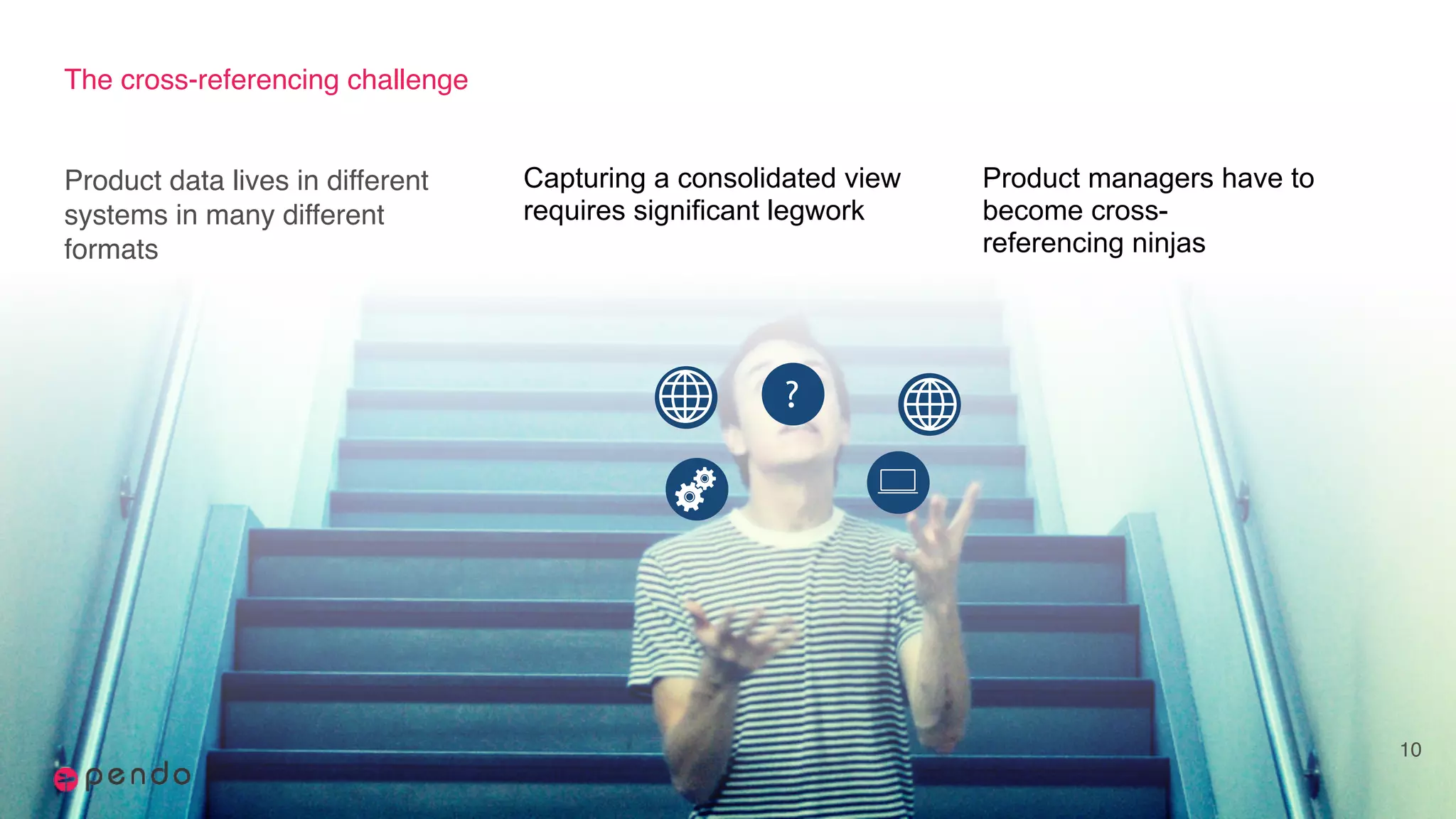
The cross-referencing challenge
10
Product data lives in different
systems in many different
formats
Capturing a consolidated view
requires significant legwork
Product managers have to
become cross-
referencing ninjas
?
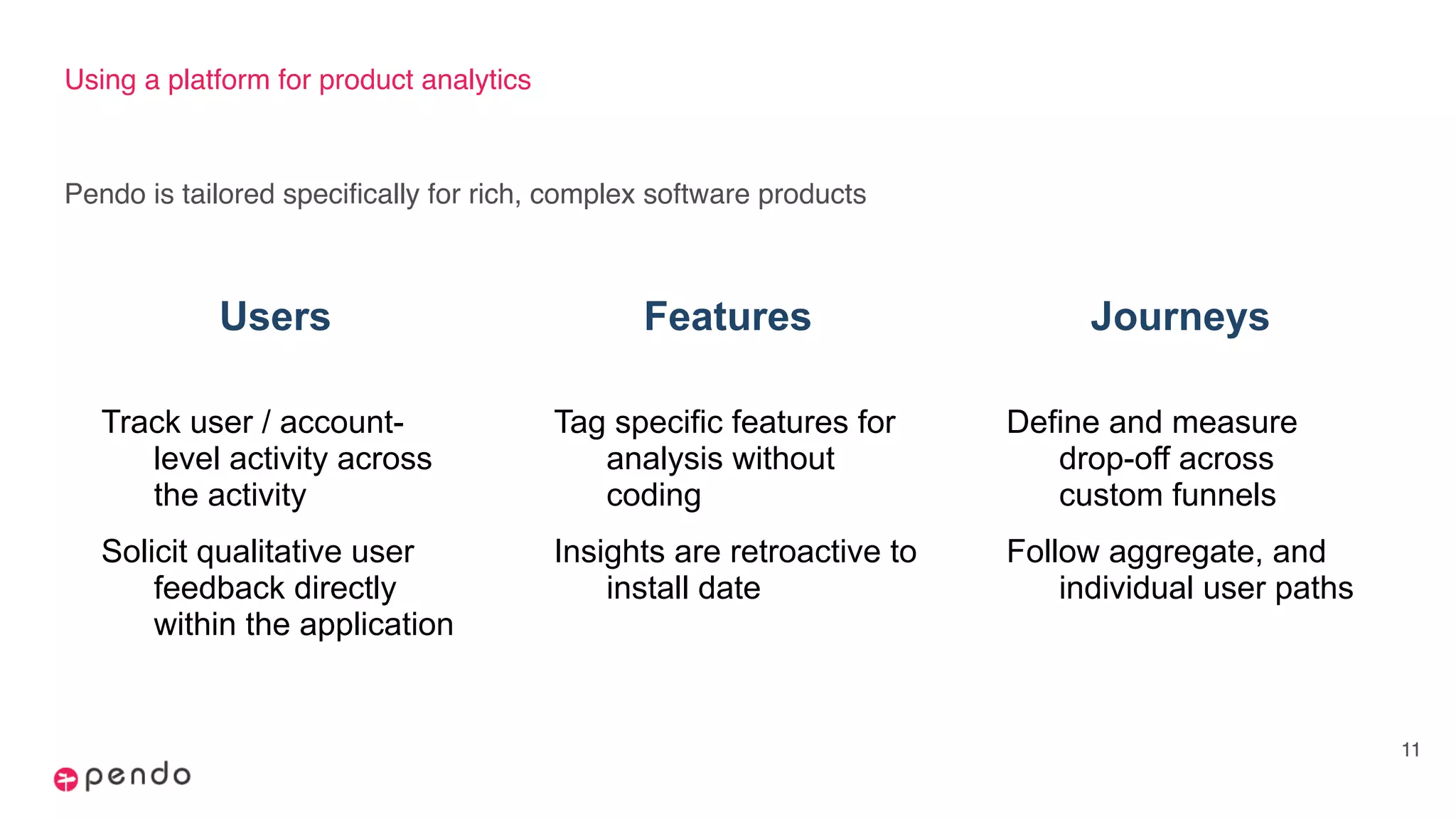
Using a platform for product analytics
Pendo is tailored specifically for rich, complex software products
11
Users Features Journeys
Track user / account-
level activity across
the activity
Solicit qualitative user
feedback directly
within the application
Tag specific features for
analysis without
coding
Insights are retroactive to
install date
Define and measure
drop-off across
custom funnels
Follow aggregate, and
individual user paths
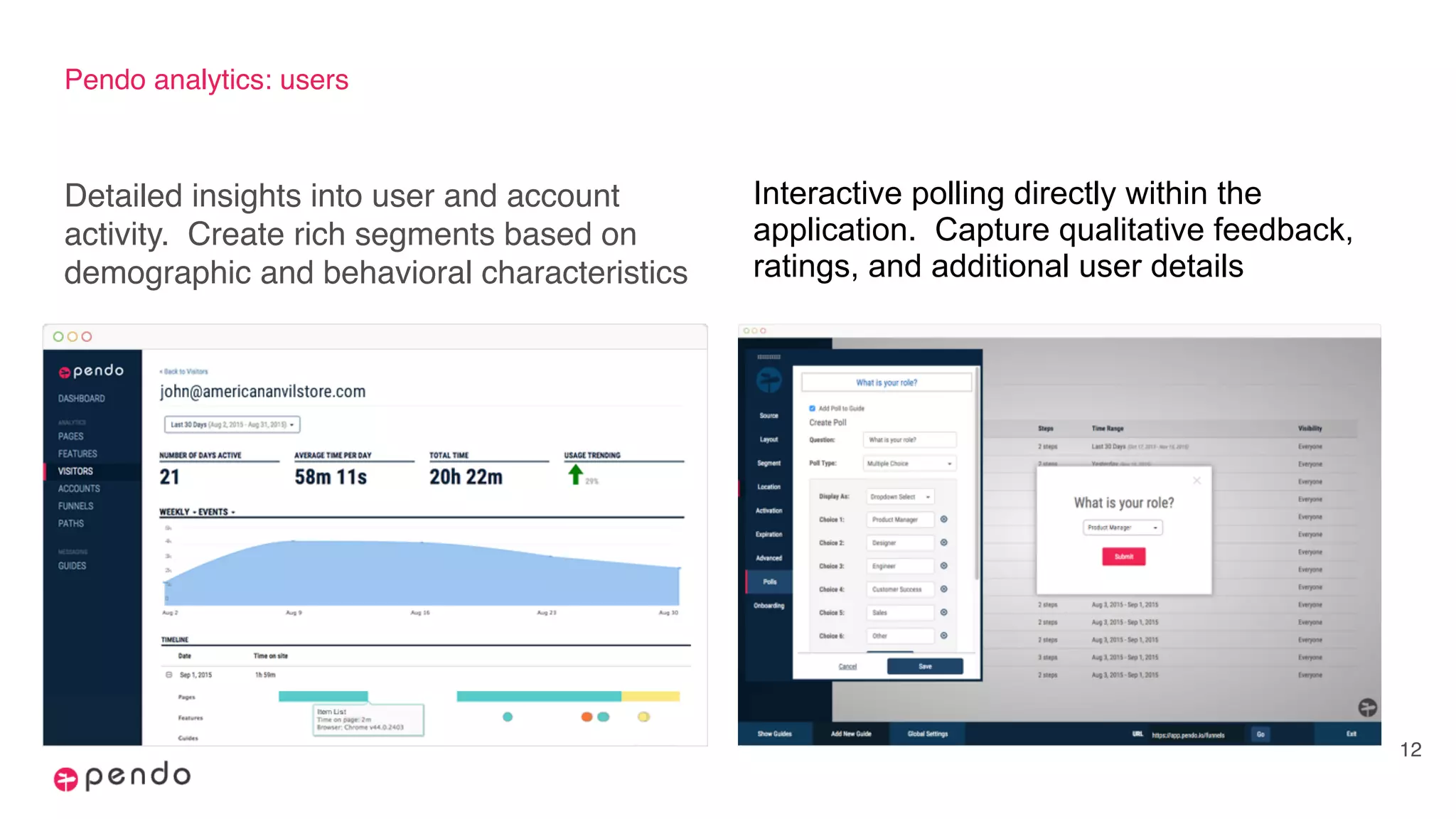
Pendo analytics: users
Detailed insights into user and account
activity. Create rich segments based on
demographic and behavioral characteristics
12
Interactive polling directly within the
application. Capture qualitative feedback,
ratings, and additional user details
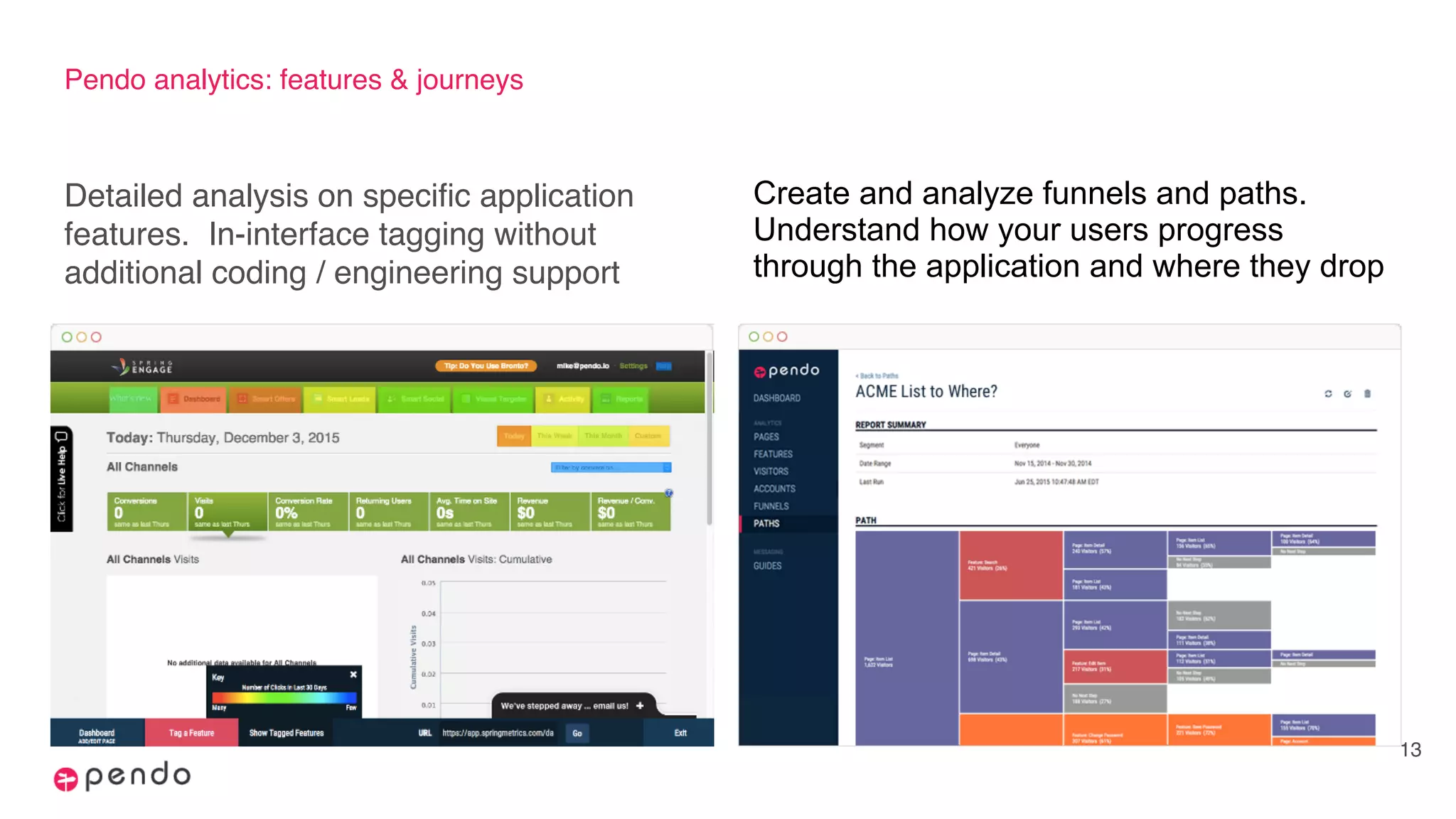
Pendo analytics: features & journeys
Detailed analysis on specific application
features. In-interface tagging without
additional coding / engineering support
13
Create and analyze funnels and paths.
Understand how your users progress
through the application and where they drop
Product data improves feature adoption
Challenge
Needed to expand user adoption of new tool
No clear understanding of how features were used,
leading to difficulty prioritizing improvements
A New Approach
Instrumented feature set to measure usage
Tracked users across defined “funnel” to find
breakpoints
Re-designed UI based on observed user activity
14
Product data provides rapid insight
Challenge
Struggled to capture actionable user data
Metrics and reports needed to be defined prior to
product release - any changes required
development work and application updates
A New Approach
Implemented a product data platform to capture user
events
New feature / user tracking implemented in minutes
without any additional coding
15
Smarter decision-making balances data and insight
Data is critical, but it isn’t the answer to
everything. A good product data strategy
brings in additional insight without
ignoring the flashes of intuition that can
lead to transformative solutions.
16
Tenets of a successful product data strategy
1. Use fast, focused experiments: Build insight through multiple, short tests and
prototypes
2. Share your data: Understanding and insights can come from anywhere. The entire
product team should have access to data
3. Formalize product reviews: Don’t over-analyze, or get too close to the development
process. Specific review cycles can help to balance insight and intuition
4. Be open to surprises: Product data isn’t just an answer to a specific question - it’s a
way to openly observe users. Insights are often unexpected.
17
Questions
Eric Boduch
Founder
Pendo
eric@pendo.io
18
Michael Peach
Product Marketing
Pendo
mike@pendo.io
Learn more at www.pendo.io

Building a product management data strategy

  • 1.
    Building a ProductManagement Data Strategy December 16, 2015 1
  • 2.
    Agenda The product dataimperative Sources of product data Quantitative & qualitative data in the Pendo platform Best practices Q&A 2
  • 3.
    Building great productsis hard 46%of new product launches fail 3 75%do not meet revenue goals 2Yraverage lifespan of “successful” products Sources: Product Development and Management Association, 2004; Harvard Business Review, 2011
  • 4.
    Are the bestproduct managers truly clairvoyant? 4
  • 5.
    Data can makea critical difference Users 5 Features Journeys Uncover and understand user needs to build meaningful cohorts Guide roadmap and feature prioritization based on real user behavior Follow and optimize user funnels through the product
  • 6.
    Product data sources- internal objects Key application stats such as users, licences, etc, that is stored as part of application data 6 ! Often critical indicators of a product’s “health” ! Data is consistently collected and is stored / captured within the application Challenges ! Can require development resources to extract and format
  • 7.
    Product data sources- web analytics Page-level and user data captured by instrumenting application pages with Google Analytics or other web analytics software 7 ! Provides measure of usage volume, and visitor demographic information ! Track “conversion” events and other specific actions Challenges ! Engineering work required to implement / customize ! Optimized for web visitors - does not provide user or feature-level detail
  • 8.
    Product data sources- support cases Current or archived support requests from help desk (kana, zendesk) or other repository software 8 ! Users ask for help when they’re stuck - identify areas or features of the application where they struggle ! Level of support requests also indicates feature usage volume Challenges ! Data is not summarized - requires extensive reading / digging to uncover insights ?
  • 9.
    Product data sources- User testing & surveys Qualitative user feedback from observed UX testing sessions and user surveys 9 ! Captures direct input and feedback from users ! User testing allows direct observation of application use. Can gauge overall feature utility in addition to UI usability Challenges ! Data is not detailed, but not necessarily representative ! Difficult to assemble and get responses from user groups
  • 10.
    The cross-referencing challenge 10 Productdata lives in different systems in many different formats Capturing a consolidated view requires significant legwork Product managers have to become cross- referencing ninjas ?
  • 11.
    Using a platformfor product analytics Pendo is tailored specifically for rich, complex software products 11 Users Features Journeys Track user / account- level activity across the activity Solicit qualitative user feedback directly within the application Tag specific features for analysis without coding Insights are retroactive to install date Define and measure drop-off across custom funnels Follow aggregate, and individual user paths
  • 12.
    Pendo analytics: users Detailedinsights into user and account activity. Create rich segments based on demographic and behavioral characteristics 12 Interactive polling directly within the application. Capture qualitative feedback, ratings, and additional user details
  • 13.
    Pendo analytics: features& journeys Detailed analysis on specific application features. In-interface tagging without additional coding / engineering support 13 Create and analyze funnels and paths. Understand how your users progress through the application and where they drop
  • 14.
    Product data improvesfeature adoption Challenge Needed to expand user adoption of new tool No clear understanding of how features were used, leading to difficulty prioritizing improvements A New Approach Instrumented feature set to measure usage Tracked users across defined “funnel” to find breakpoints Re-designed UI based on observed user activity 14
  • 15.
    Product data providesrapid insight Challenge Struggled to capture actionable user data Metrics and reports needed to be defined prior to product release - any changes required development work and application updates A New Approach Implemented a product data platform to capture user events New feature / user tracking implemented in minutes without any additional coding 15
  • 16.
    Smarter decision-making balancesdata and insight Data is critical, but it isn’t the answer to everything. A good product data strategy brings in additional insight without ignoring the flashes of intuition that can lead to transformative solutions. 16
  • 17.
    Tenets of asuccessful product data strategy 1. Use fast, focused experiments: Build insight through multiple, short tests and prototypes 2. Share your data: Understanding and insights can come from anywhere. The entire product team should have access to data 3. Formalize product reviews: Don’t over-analyze, or get too close to the development process. Specific review cycles can help to balance insight and intuition 4. Be open to surprises: Product data isn’t just an answer to a specific question - it’s a way to openly observe users. Insights are often unexpected. 17
  • 18.
    Questions Eric Boduch Founder Pendo eric@pendo.io 18 Michael Peach ProductMarketing Pendo mike@pendo.io Learn more at www.pendo.io