

Overcoming catastrophic
forgetting in neural
networks
2017/04/28
Katy@Datalab
PNAS, Proceedings of the National Academy of Sciences
citation: 4
Background
• Catastrophic forgetting is forgetting key
information needed to solve a previous task when
training on a new task.
The kind of consolidation
that occur in the brain
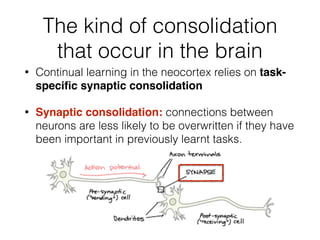
• Continual learning in the neocortex relies on task-
specific synaptic consolidation
• Synaptic consolidation: connections between
neurons are less likely to be overwritten if they have
been important in previously learnt tasks.
• knowledge is durably encoded by rendering a
proportion of synapses less plastic and therefore
stable over long timescales.
Related Work
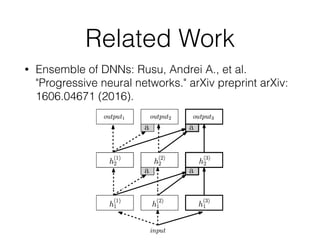
• Ensemble of DNNs: Rusu, Andrei A., et al.
"Progressive neural networks." arXiv preprint arXiv:
1606.04671 (2016).
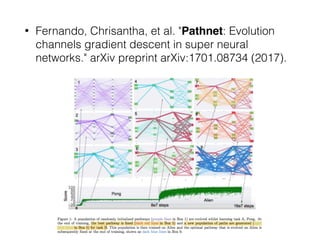
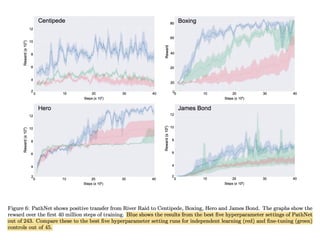
• Fernando, Chrisantha, et al. "Pathnet: Evolution
channels gradient descent in super neural
networks." arXiv preprint arXiv:1701.08734 (2017).
Intuition
• They implement an algorithm that performs a
similar operation in artificial neural networks by
constraining important parameters to stay close
to their old values.
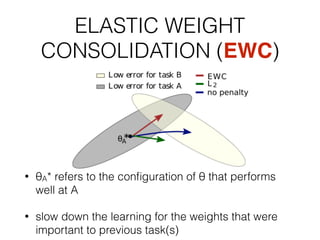
ELASTIC WEIGHT
CONSOLIDATION (EWC)
• θA* refers to the configuration of θ that performs
well at A
• slow down the learning for the weights that were
important to previous task(s)
Key Question
• How to determine which weights are most
important to task A?
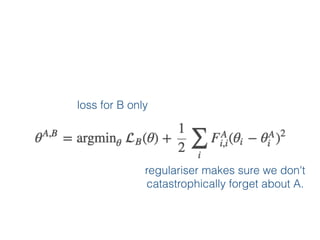
loss for B only
regulariser makes sure we don't
catastrophically forget about A.
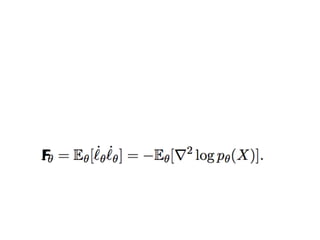
F
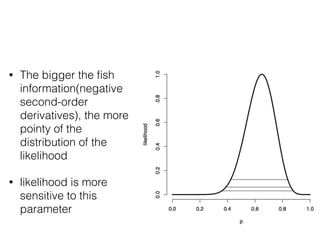
• The bigger the fish
information(negative
second-order
derivatives), the more
pointy of the
distribution of the
likelihood
• likelihood is more
sensitive to this
parameter
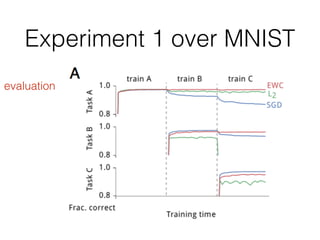
evaluation
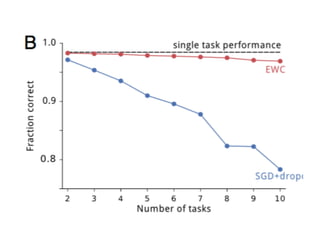
Experiment 1 over MNIST
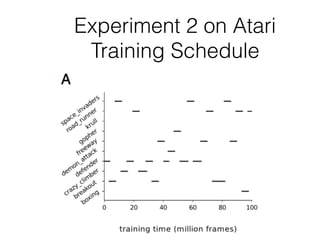
Experiment 2 on Atari
Training Schedule
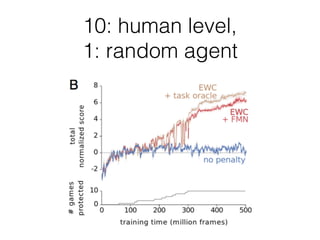
10: human level,
1: random agent
Conclusion
• The ability to learn tasks in succession without
forgetting is a core component of biological and
artificial intelligence.
• Weight uncertainty should inform learning rates.
• EWC allows the network to effectively squeeze in
more functionality into a network with fixed
capacity,

Overcoming catastrophic forgetting in neural network

  • 1.
    Overcoming catastrophic forgetting inneural networks 2017/04/28 Katy@Datalab PNAS, Proceedings of the National Academy of Sciences citation: 4
  • 2.
    Background • Catastrophic forgettingis forgetting key information needed to solve a previous task when training on a new task.
  • 3.
    The kind ofconsolidation that occur in the brain • Continual learning in the neocortex relies on task- specific synaptic consolidation • Synaptic consolidation: connections between neurons are less likely to be overwritten if they have been important in previously learnt tasks.
  • 4.
    • knowledge isdurably encoded by rendering a proportion of synapses less plastic and therefore stable over long timescales.
  • 5.
    Related Work • Ensembleof DNNs: Rusu, Andrei A., et al. "Progressive neural networks." arXiv preprint arXiv: 1606.04671 (2016).
  • 6.
    • Fernando, Chrisantha,et al. "Pathnet: Evolution channels gradient descent in super neural networks." arXiv preprint arXiv:1701.08734 (2017).
  • 8.
    Intuition • They implementan algorithm that performs a similar operation in artificial neural networks by constraining important parameters to stay close to their old values.
  • 9.
    ELASTIC WEIGHT CONSOLIDATION (EWC) •θA* refers to the configuration of θ that performs well at A • slow down the learning for the weights that were important to previous task(s)
  • 10.
    Key Question • Howto determine which weights are most important to task A?
  • 11.
    loss for Bonly regulariser makes sure we don't catastrophically forget about A.
  • 12.
  • 13.
    • The biggerthe fish information(negative second-order derivatives), the more pointy of the distribution of the likelihood • likelihood is more sensitive to this parameter
  • 14.
  • 16.
    Experiment 2 onAtari Training Schedule
  • 17.
    10: human level, 1:random agent
  • 18.
    Conclusion • The abilityto learn tasks in succession without forgetting is a core component of biological and artificial intelligence. • Weight uncertainty should inform learning rates. • EWC allows the network to effectively squeeze in more functionality into a network with fixed capacity,