Outsourcing Matrix
ra tSense fC
Customer’s view
(service system choice criteria)
We do only things that give us competitive
advantage – all the rest we outsource
ra tSense fC
Perspective I
Perspective I
Any company, explicitly or implicitly, distinguish the main
business (the “CORE COMPETENCE” in the Matrix I),
and supporting activity.
In theory, any supporting activity may be outsourced.
In practice, though, functions most important for the main
business will always be kept inside the organization
(“CRITICALITY” axis of the Matrix I)
At the opposite end of priorities there are activities so
unessential that outsourcing services for them become
commodities (lower left corner of the Matrix I with the minimal
values along all four axes).
ra tSense fC
Matrix I
ra tSense fC
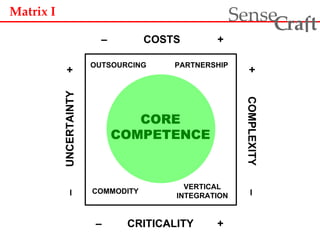
CORE
COMPETENCE
OUTSOURCING PARTNERSHIP
VERTICAL
INTEGRATION
– CRITICALITY +
– COSTS +
–UNCERTAINTY+
+COMPLEXITY–
COMMODITY
Perspective I
So there are three reasons to outsource:
- a wish to unload part of commercial risks onto the
service provider
(axis “UNCERTAINTY” of the Matrix I)
- a wish to unload part of costs onto the
service provider (axis “COSTS” of the Matrix I)
- lack of the own employees’ competence
(axis “COMPLEXITY” of the Matrix I)
ra tSense fC
Perspective I
As such, the outsourcing of some activity
(upper left corner of the Matrix I) makes sense when
the following conditions are met:
- the activity is not on the list of your company core
competencies
- the activity is too complex
(i.e. it needs special knowledge and skills)
- The costs of the activity account for a minor part of overall
operational costs
- the activity is not critical for the main business
- there are risks associated with uncertainty
(business scale fluctuations, change of environment,
customer preferences shift, etc.)
ra tSense fC
Requirements to the supplier
(maturity level)
The set of competitive advantages needed
by a company entering the outsourcing
market is a mirror reflection of your
requirements to this supplier
ra tSense fC
Perspective II
Perspective II
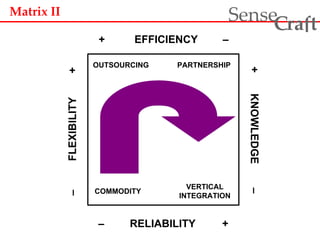
Relevant tool for selection and evaluation of
needed characteristics is Matrix II
(let’s call it the Outsourcer’s Matrix):
- high degree of operating flexibility (axis “FLEXIBILITY”)
to cope with the uncertainty
- large economy of scale and/or firm control of operating
expenses (axis “EFFICIENCY”) to absorb part of the
customer’s costs
- specific knowledge (axis “KNOWLEDGE”) to cover the
complexity of outsourced activity
- extra resources to assure quality and terms of service
(axis “RELIABILITY”) that may be replaced by the reputation
along with the development of partnership
ra tSense fC
Matrix II
ra tSense fC
OUTSOURCING PARTNERSHIP
VERTICAL
INTEGRATION
– RELIABILITY +
+ EFFICIENCY –
–FLEXIBILITY+
+KNOWLEDGE–
COMMODITY
Provider’s view
(market entry conditions)
To enter the outsourcing market one
should choose the following path for
gradual development of competitive
advantages:
ra tSense fC
Perspective III
Matrix III
ra tSense fC
OUTSOURCING PARTNERSHIP
– INVESTMENTS +
– ECONOMICS +
–BUSINESSPROCESSES+
+KNOWLEDGEBASE–
COMMODITY
Perspective III
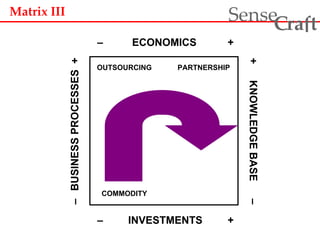
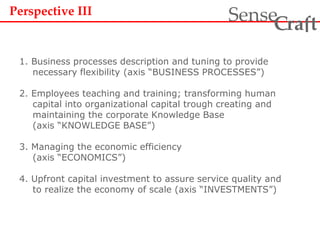
1. Business processes description and tuning to provide
necessary flexibility (axis “BUSINESS PROCESSES”)
2. Employees teaching and training; transforming human
capital into organizational capital trough creating and
maintaining the corporate Knowledge Base
(axis “KNOWLEDGE BASE”)
3. Managing the economic efficiency
(axis “ECONOMICS”)
4. Upfront capital investment to assure service quality and
to realize the economy of scale (axis “INVESTMENTS”)
ra tSense fC
Thank you!
© 2003
Сергей Хромов-Борисов
khromov@sensecraft.ru
ra tSense fC

Outsourcing Matrix Revisited

  • 1.
  • 2.
    Customer’s view (service systemchoice criteria) We do only things that give us competitive advantage – all the rest we outsource ra tSense fC Perspective I
  • 3.
    Perspective I Any company,explicitly or implicitly, distinguish the main business (the “CORE COMPETENCE” in the Matrix I), and supporting activity. In theory, any supporting activity may be outsourced. In practice, though, functions most important for the main business will always be kept inside the organization (“CRITICALITY” axis of the Matrix I) At the opposite end of priorities there are activities so unessential that outsourcing services for them become commodities (lower left corner of the Matrix I with the minimal values along all four axes). ra tSense fC
  • 4.
    Matrix I ra tSensefC CORE COMPETENCE OUTSOURCING PARTNERSHIP VERTICAL INTEGRATION – CRITICALITY + – COSTS + –UNCERTAINTY+ +COMPLEXITY– COMMODITY
  • 5.
    Perspective I So thereare three reasons to outsource: - a wish to unload part of commercial risks onto the service provider (axis “UNCERTAINTY” of the Matrix I) - a wish to unload part of costs onto the service provider (axis “COSTS” of the Matrix I) - lack of the own employees’ competence (axis “COMPLEXITY” of the Matrix I) ra tSense fC
  • 6.
    Perspective I As such,the outsourcing of some activity (upper left corner of the Matrix I) makes sense when the following conditions are met: - the activity is not on the list of your company core competencies - the activity is too complex (i.e. it needs special knowledge and skills) - The costs of the activity account for a minor part of overall operational costs - the activity is not critical for the main business - there are risks associated with uncertainty (business scale fluctuations, change of environment, customer preferences shift, etc.) ra tSense fC
  • 7.
    Requirements to thesupplier (maturity level) The set of competitive advantages needed by a company entering the outsourcing market is a mirror reflection of your requirements to this supplier ra tSense fC Perspective II
  • 8.
    Perspective II Relevant toolfor selection and evaluation of needed characteristics is Matrix II (let’s call it the Outsourcer’s Matrix): - high degree of operating flexibility (axis “FLEXIBILITY”) to cope with the uncertainty - large economy of scale and/or firm control of operating expenses (axis “EFFICIENCY”) to absorb part of the customer’s costs - specific knowledge (axis “KNOWLEDGE”) to cover the complexity of outsourced activity - extra resources to assure quality and terms of service (axis “RELIABILITY”) that may be replaced by the reputation along with the development of partnership ra tSense fC
  • 9.
    Matrix II ra tSensefC OUTSOURCING PARTNERSHIP VERTICAL INTEGRATION – RELIABILITY + + EFFICIENCY – –FLEXIBILITY+ +KNOWLEDGE– COMMODITY
  • 10.
    Provider’s view (market entryconditions) To enter the outsourcing market one should choose the following path for gradual development of competitive advantages: ra tSense fC Perspective III
  • 11.
    Matrix III ra tSensefC OUTSOURCING PARTNERSHIP – INVESTMENTS + – ECONOMICS + –BUSINESSPROCESSES+ +KNOWLEDGEBASE– COMMODITY
  • 12.
    Perspective III 1. Businessprocesses description and tuning to provide necessary flexibility (axis “BUSINESS PROCESSES”) 2. Employees teaching and training; transforming human capital into organizational capital trough creating and maintaining the corporate Knowledge Base (axis “KNOWLEDGE BASE”) 3. Managing the economic efficiency (axis “ECONOMICS”) 4. Upfront capital investment to assure service quality and to realize the economy of scale (axis “INVESTMENTS”) ra tSense fC
  • 13.
    Thank you! © 2003 СергейХромов-Борисов khromov@sensecraft.ru ra tSense fC