By Tobie
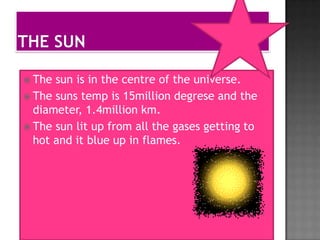
 The sun is in the centre of the universe.
 The suns temp is 15million degrese and the
  diameter, 1.4million km.
 The sun lit up from all the gases getting to
  hot and it blue up in flames.
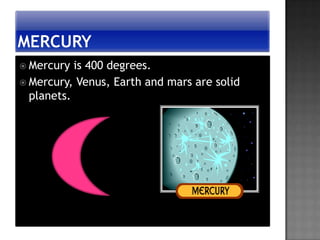
 Mercury  is 400 degrees.
 Mercury, Venus, Earth and mars are solid
  planets.
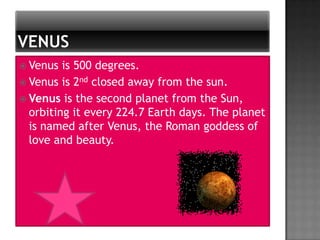
 Venus  is 500 degrees.
 Venus is 2nd closed away from the sun.
 Venus is the second planet from the Sun,
  orbiting it every 224.7 Earth days. The planet
  is named after Venus, the Roman goddess of
  love and beauty.
 The moon travels around earth in 4 weeks.
 Earth (or the Earth) is the third planet from
  the Sun, and the densest and fifth-largest of
  the eight planets in the Solar System.
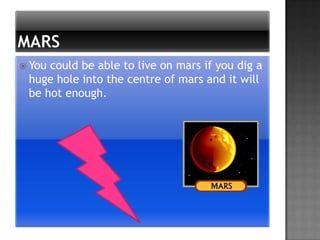
 Youcould be able to live on mars if you dig a
 huge hole into the centre of mars and it will
 be hot enough.
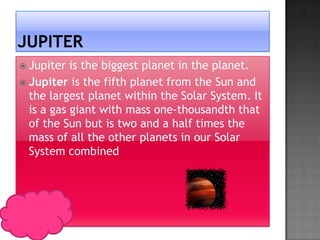
 Jupiter  is the biggest planet in the planet.
 Jupiter is the fifth planet from the Sun and
  the largest planet within the Solar System. It
  is a gas giant with mass one-thousandth that
  of the Sun but is two and a half times the
  mass of all the other planets in our Solar
  System combined
 Jupiter,   Saturn, Uranus and Neptune are gas
  planets.
 Saturn is the sixth planet from the Sun and
  the second largest planet in the Solar
  System, after Jupiter.
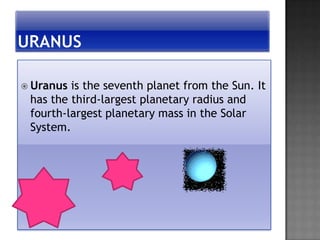
 Uranus is the seventh planet from the Sun. It
 has the third-largest planetary radius and
 fourth-largest planetary mass in the Solar
 System.
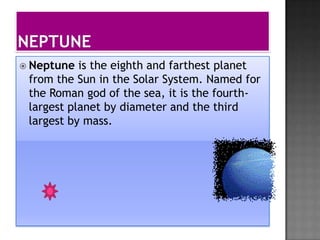
 Neptune  is the eighth and farthest planet
 from the Sun in the Solar System. Named for
 the Roman god of the sea, it is the fourth-
 largest planet by diameter and the third
 largest by mass.
 Wiki
 Nasa book
 Nasa on google.com
 Other people.
 Science book

Our solar system

  • 1.
  • 2.
     The sunis in the centre of the universe.  The suns temp is 15million degrese and the diameter, 1.4million km.  The sun lit up from all the gases getting to hot and it blue up in flames.
  • 3.
     Mercury is 400 degrees.  Mercury, Venus, Earth and mars are solid planets.
  • 4.
     Venus is 500 degrees.  Venus is 2nd closed away from the sun.  Venus is the second planet from the Sun, orbiting it every 224.7 Earth days. The planet is named after Venus, the Roman goddess of love and beauty.
  • 5.
     The moontravels around earth in 4 weeks.  Earth (or the Earth) is the third planet from the Sun, and the densest and fifth-largest of the eight planets in the Solar System.
  • 6.
     Youcould beable to live on mars if you dig a huge hole into the centre of mars and it will be hot enough.
  • 7.
     Jupiter is the biggest planet in the planet.  Jupiter is the fifth planet from the Sun and the largest planet within the Solar System. It is a gas giant with mass one-thousandth that of the Sun but is two and a half times the mass of all the other planets in our Solar System combined
  • 8.
     Jupiter, Saturn, Uranus and Neptune are gas planets.  Saturn is the sixth planet from the Sun and the second largest planet in the Solar System, after Jupiter.
  • 9.
     Uranus isthe seventh planet from the Sun. It has the third-largest planetary radius and fourth-largest planetary mass in the Solar System.
  • 10.
     Neptune is the eighth and farthest planet from the Sun in the Solar System. Named for the Roman god of the sea, it is the fourth- largest planet by diameter and the third largest by mass.
  • 11.
     Wiki  Nasabook  Nasa on google.com  Other people.  Science book