SOLAR SYSTEM
THE SUN
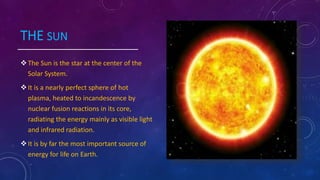
The Sun is the star at the center of the
Solar System.
It is a nearly perfect sphere of hot
plasma, heated to incandescence by
nuclear fusion reactions in its core,
radiating the energy mainly as visible light
and infrared radiation.
It is by far the most important source of
energy for life on Earth.
PLANETS IN SOLAR SYSTEM
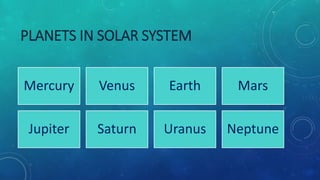
Mercury Venus Earth Mars
Jupiter Saturn Uranus Neptune
MERCURY
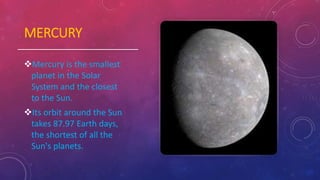
Mercury is the smallest
planet in the Solar
System and the closest
to the Sun.
Its orbit around the Sun
takes 87.97 Earth days,
the shortest of all the
Sun's planets.
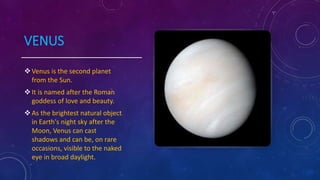
VENUS
Venus is the second planet
from the Sun.
It is named after the Roman
goddess of love and beauty.
As the brightest natural object
in Earth's night sky after the
Moon, Venus can cast
shadows and can be, on rare
occasions, visible to the naked
eye in broad daylight.
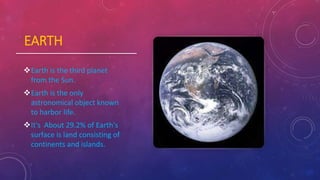
EARTH
Earth is the third planet
from the Sun.
Earth is the only
astronomical object known
to harbor life.
It's About 29.2% of Earth's
surface is land consisting of
continents and islands.
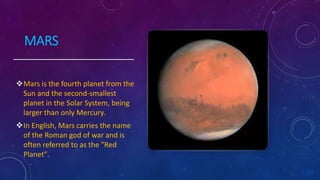
MARS
Mars is the fourth planet from the
Sun and the second-smallest
planet in the Solar System, being
larger than only Mercury.
In English, Mars carries the name
of the Roman god of war and is
often referred to as the "Red
Planet".
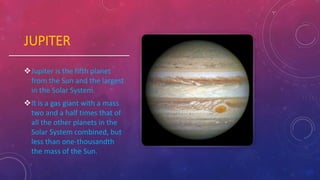
JUPITER
Jupiter is the fifth planet
from the Sun and the largest
in the Solar System.
It is a gas giant with a mass
two and a half times that of
all the other planets in the
Solar System combined, but
less than one-thousandth
the mass of the Sun.
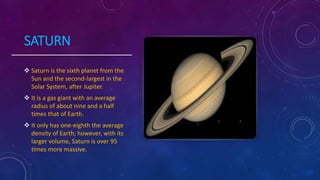
SATURN
 Saturn is the sixth planet from the
Sun and the second-largest in the
Solar System, after Jupiter.
 It is a gas giant with an average
radius of about nine and a half
times that of Earth.
 It only has one-eighth the average
density of Earth; however, with its
larger volume, Saturn is over 95
times more massive.
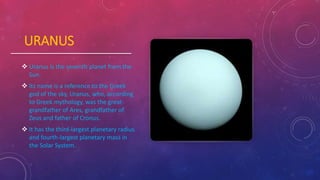
URANUS
 Uranus is the seventh planet from the
Sun.
 Its name is a reference to the Greek
god of the sky, Uranus, who, according
to Greek mythology, was the great-
grandfather of Ares, grandfather of
Zeus and father of Cronus.
 It has the third-largest planetary radius
and fourth-largest planetary mass in
the Solar System.
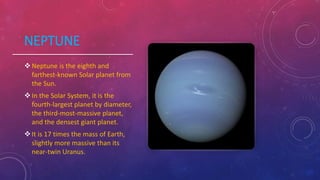
NEPTUNE
Neptune is the eighth and
farthest-known Solar planet from
the Sun.
In the Solar System, it is the
fourth-largest planet by diameter,
the third-most-massive planet,
and the densest giant planet.
It is 17 times the mass of Earth,
slightly more massive than its
near-twin Uranus.
Thank you
- Kaival Shah

Solar system

  • 1.
  • 2.
    THE SUN The Sunis the star at the center of the Solar System. It is a nearly perfect sphere of hot plasma, heated to incandescence by nuclear fusion reactions in its core, radiating the energy mainly as visible light and infrared radiation. It is by far the most important source of energy for life on Earth.
  • 3.
    PLANETS IN SOLARSYSTEM Mercury Venus Earth Mars Jupiter Saturn Uranus Neptune
  • 4.
    MERCURY Mercury is thesmallest planet in the Solar System and the closest to the Sun. Its orbit around the Sun takes 87.97 Earth days, the shortest of all the Sun's planets.
  • 5.
    VENUS Venus is thesecond planet from the Sun. It is named after the Roman goddess of love and beauty. As the brightest natural object in Earth's night sky after the Moon, Venus can cast shadows and can be, on rare occasions, visible to the naked eye in broad daylight.
  • 6.
    EARTH Earth is thethird planet from the Sun. Earth is the only astronomical object known to harbor life. It's About 29.2% of Earth's surface is land consisting of continents and islands.
  • 7.
    MARS Mars is thefourth planet from the Sun and the second-smallest planet in the Solar System, being larger than only Mercury. In English, Mars carries the name of the Roman god of war and is often referred to as the "Red Planet".
  • 8.
    JUPITER Jupiter is thefifth planet from the Sun and the largest in the Solar System. It is a gas giant with a mass two and a half times that of all the other planets in the Solar System combined, but less than one-thousandth the mass of the Sun.
  • 9.
    SATURN  Saturn isthe sixth planet from the Sun and the second-largest in the Solar System, after Jupiter.  It is a gas giant with an average radius of about nine and a half times that of Earth.  It only has one-eighth the average density of Earth; however, with its larger volume, Saturn is over 95 times more massive.
  • 10.
    URANUS  Uranus isthe seventh planet from the Sun.  Its name is a reference to the Greek god of the sky, Uranus, who, according to Greek mythology, was the great- grandfather of Ares, grandfather of Zeus and father of Cronus.  It has the third-largest planetary radius and fourth-largest planetary mass in the Solar System.
  • 11.
    NEPTUNE Neptune is theeighth and farthest-known Solar planet from the Sun. In the Solar System, it is the fourth-largest planet by diameter, the third-most-massive planet, and the densest giant planet. It is 17 times the mass of Earth, slightly more massive than its near-twin Uranus.
  • 12.