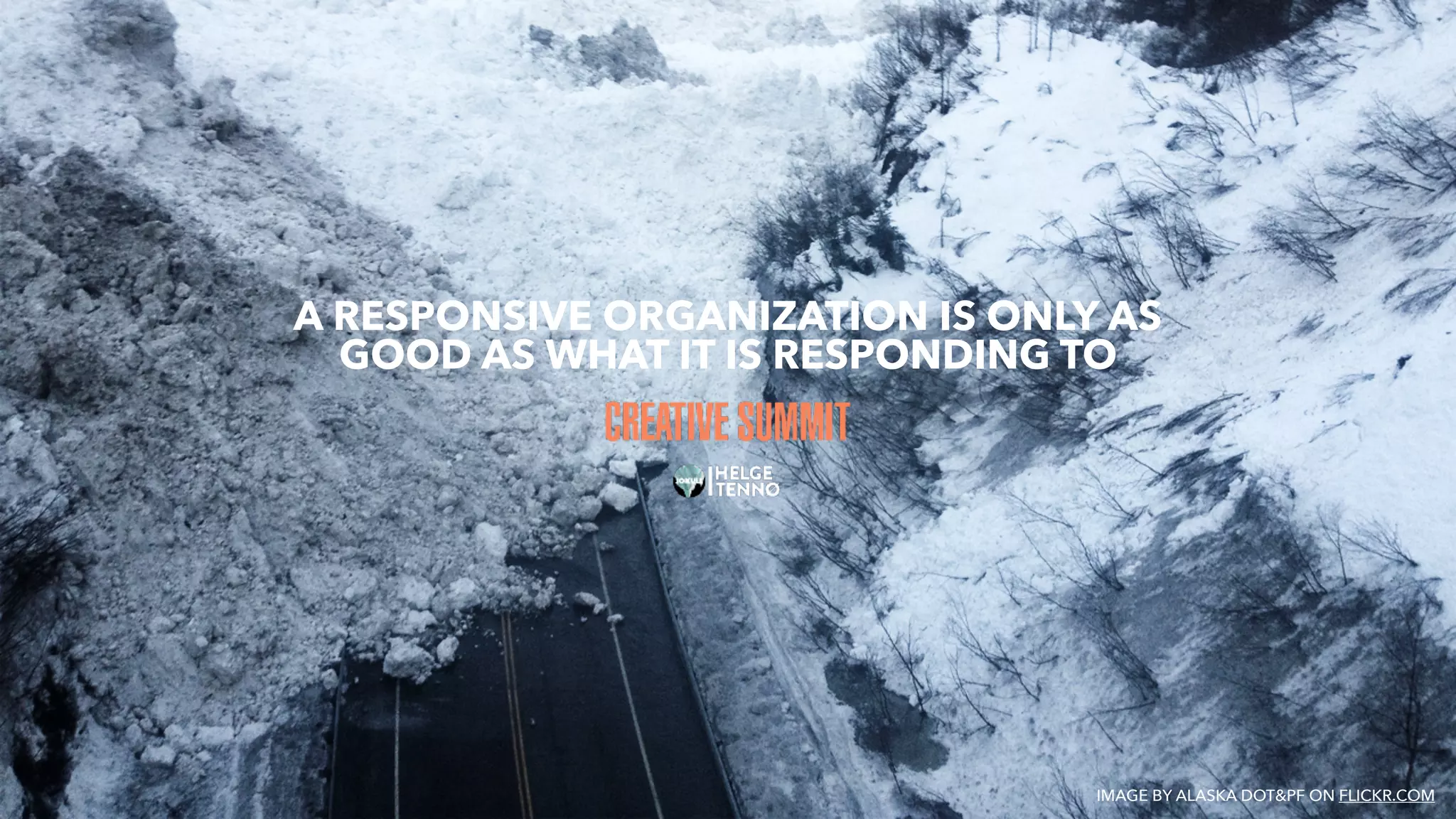






A RESPONSIVE ORGANIZATION IS ONLY AS
GOOD AS WHAT IT IS RESPONDING TO
IMAGE BY ALASKA DOT&PF ON FLICKR.COM
THIS IS AN IDEA
« I work with input variables, what kind of data,
experience, information do we put into our organizations
to make them tick»
GAPI sense there is a gap between what we want our
organizations to be and what we put into them
PART 1
A business is distilled down to nine elements A human is distilled down to three elements
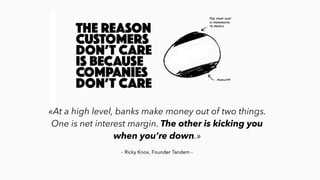
«At a high level, banks make money out of two things.
One is net interest margin. The other is kicking you
when you’re down.»
- Ricky Knox, Founder Tandem -
The organization does not exist in a vacuum
PART 2
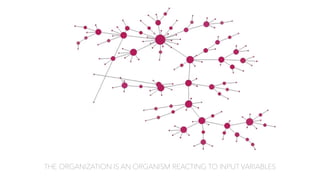
THE ORGANIZATION IS AN ORGANISM REACTING TO INPUT VARIABLES
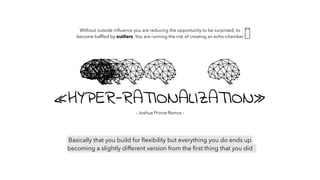
Basically that you build for flexibility but everything you do ends up
becoming a slightly different version from the first thing that you did
Without outside influence you are reducing the opportunity to be surprised, to
become baffled by outliers. You are running the risk of creating an echo-chamber
«HYPER-RATIONALIZATION»
- Joshua Prince-Ramus -
Experts are a dangerous species
you create a room full of experts, and the problem with experts is
that they loose their ability to change their mind
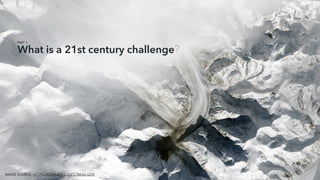
What is a 21st century challenge?
IMAGE SOURCE: HTTPS://EOIMAGES.GSFC.NASA.GOV
PART 3
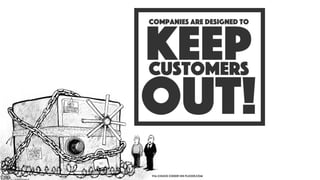
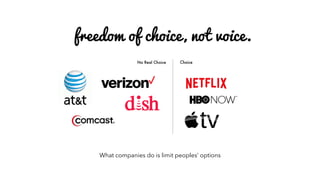
What companies do is limit peoples’ options
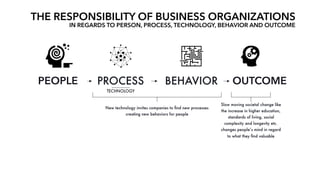
THE RESPONSIBILITY OF BUSINESS ORGANIZATIONS
IN REGARDS TO PERSON, PROCESS, TECHNOLOGY, BEHAVIOR AND OUTCOME
29/365 - 2017
OUTCOMEPEOPLE
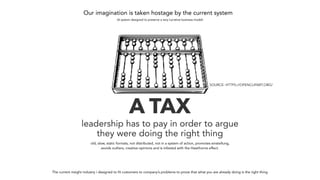
A TAX
leadership has to pay in order to argue
they were doing the right thing
old, slow, static formats, not distributed, not in a system of action, promotes einstellung,
avoids outliers, creative opinions and is infested with the Hawthorne effect.
Our imagination is taken hostage by the current system
(A system designed to preserve a very lucrative business model)
The current insight industry i designed to fit customers to company’s problems to prove that what you are already doing is the right thing
SOURCE: HTTPS://OPENCLIPART.ORG/
Do we need responsive organizations to
create productivity gains through flexiblity?
QUESTIONS - Turn to the person next to you. For 90 seconds discuss:
qOr are we building them to respond to
21st century challenges?
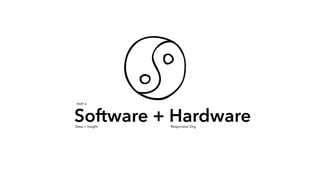
Software + HardwareResponsive Org.Data + Insight
PART 4
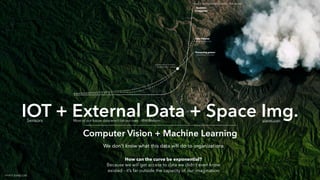
IOT + External Data + Space Img.
We don’t know what this data will do to organizations
Computer Vision + Machine Learning
How can the curve be exponential?
Because we will get access to data we didn’t even know
existed - it’s far outside the capacity of our imagination
Sensors
Processing power
(Doubles every 12 months)
Data Volume
(Doubles every 18 months)
Systemix
Compexity
Big Data allows evidence-
based decision-making
SOURCE: DIGITAL GROWTH. SOURCE: DIRK HELBING
SOURCE: PLANET.COM
Most of our future data won’t be our own - IBM Watson planet.com
Mental Models
Data informs the mental models by which we manage our organizations and make decisions.
Data informs the mental models by which we manage
our organizations and make decisions. Big space data,
computer vision and machine learning creates a new
generation of data and gives companies a completely
new framework for understanding the world.
We will start seeing our world differently - creating new
Solving the short comings of todays rude, inefficienct and static
data. Are we ready to be rewired and reprogrammed?
But today companies need insight to make decisions that
challenge their assumptions, their core technology, vector,
processes and core business models. Insight that challenge
their customers own perception of what they want. And in
a format and through a system that distributes this
knowledge to every talent and team empowering them to
make their own decisions in their interactions with the
customer.
All in real-time
- Helge Tennø -
Thank You

Our imagination is taken hostage (by outdated input variables)

  • 1.
    A RESPONSIVE ORGANIZATIONIS ONLY AS GOOD AS WHAT IT IS RESPONDING TO IMAGE BY ALASKA DOT&PF ON FLICKR.COM
  • 2.
    THIS IS ANIDEA « I work with input variables, what kind of data, experience, information do we put into our organizations to make them tick»
  • 3.
    GAPI sense thereis a gap between what we want our organizations to be and what we put into them PART 1
  • 5.
    A business isdistilled down to nine elements A human is distilled down to three elements
  • 6.
    «At a highlevel, banks make money out of two things. One is net interest margin. The other is kicking you when you’re down.» - Ricky Knox, Founder Tandem -
  • 7.
    The organization doesnot exist in a vacuum PART 2
  • 8.
    THE ORGANIZATION ISAN ORGANISM REACTING TO INPUT VARIABLES
  • 9.
    Basically that youbuild for flexibility but everything you do ends up becoming a slightly different version from the first thing that you did Without outside influence you are reducing the opportunity to be surprised, to become baffled by outliers. You are running the risk of creating an echo-chamber «HYPER-RATIONALIZATION» - Joshua Prince-Ramus -
  • 10.
    Experts are adangerous species you create a room full of experts, and the problem with experts is that they loose their ability to change their mind
  • 11.
    What is a21st century challenge? IMAGE SOURCE: HTTPS://EOIMAGES.GSFC.NASA.GOV PART 3
  • 12.
    What companies dois limit peoples’ options
  • 13.
    THE RESPONSIBILITY OFBUSINESS ORGANIZATIONS IN REGARDS TO PERSON, PROCESS, TECHNOLOGY, BEHAVIOR AND OUTCOME 29/365 - 2017 OUTCOMEPEOPLE
  • 15.
    A TAX leadership hasto pay in order to argue they were doing the right thing old, slow, static formats, not distributed, not in a system of action, promotes einstellung, avoids outliers, creative opinions and is infested with the Hawthorne effect. Our imagination is taken hostage by the current system (A system designed to preserve a very lucrative business model) The current insight industry i designed to fit customers to company’s problems to prove that what you are already doing is the right thing SOURCE: HTTPS://OPENCLIPART.ORG/
  • 16.
    Do we needresponsive organizations to create productivity gains through flexiblity? QUESTIONS - Turn to the person next to you. For 90 seconds discuss: qOr are we building them to respond to 21st century challenges?
  • 17.
    Software + HardwareResponsiveOrg.Data + Insight PART 4
  • 18.
    IOT + ExternalData + Space Img. We don’t know what this data will do to organizations Computer Vision + Machine Learning How can the curve be exponential? Because we will get access to data we didn’t even know existed - it’s far outside the capacity of our imagination Sensors Processing power (Doubles every 12 months) Data Volume (Doubles every 18 months) Systemix Compexity Big Data allows evidence- based decision-making SOURCE: DIGITAL GROWTH. SOURCE: DIRK HELBING SOURCE: PLANET.COM Most of our future data won’t be our own - IBM Watson planet.com
  • 19.
    Mental Models Data informsthe mental models by which we manage our organizations and make decisions. Data informs the mental models by which we manage our organizations and make decisions. Big space data, computer vision and machine learning creates a new generation of data and gives companies a completely new framework for understanding the world. We will start seeing our world differently - creating new Solving the short comings of todays rude, inefficienct and static data. Are we ready to be rewired and reprogrammed?
  • 20.
    But today companiesneed insight to make decisions that challenge their assumptions, their core technology, vector, processes and core business models. Insight that challenge their customers own perception of what they want. And in a format and through a system that distributes this knowledge to every talent and team empowering them to make their own decisions in their interactions with the customer. All in real-time - Helge Tennø - Thank You