SEEING THE WORLD THROUGH THE EYES OF
YOUR CUSTOMERS, NOT YOUR PRODUCTS
DIGITAL
DESIGN
THINKING
AGILE
CUSTOMER
THINKING
THERE IS A GAP BETWEEN WHAT
WE WANT OUR ORGANIZATIONS
TO BECOME AND WHAT WE PUT
INTO THEM TO GET THERE.
Our imagination is shaped by the
tools we use to see the world; the
data we collect, the experiences we
engage in and the stories we share.
“Our tools are not time machines”
- Helge Tennø
AGILE CUSTOMER THINKING
BUYING SUCCESS (TRAFFIC) IS LIMITED
TO THE CAMPAIGN ITSELF — AND WE ARE
PRODUCING LIMITED LEARNING.
1. Why did it work / what did people find valuable?
2. Can we replicate the success?
3. Can we scale it to other activities, formats,
services or relationships?
4. Can we share any insights or learning with the
rest of the organization so that they can grow as
well?
THE ULTIMATE GOAL
IS CUSTOMER VALUE
ExerciseWORKSHOP
GRAB YOUR PEN AND POST-IT
“When asked direct questions about their interests and
preferences, people tend to give answers they believe the
questionnaire wants to hear.Again, this is not because they
intend to mislead. It is because people respond to these
questions within their cortexes, the part of the brain that
contains intelligence rather than emotion or instinct”
- Clotaire Rapaille,The Culture Code
“We tend to throw out the most meaningful and most
revolutionary if we ask people about their preferences” -
Malcolm Gladwell
If we ask for peoples opinions, they will start inventing
details and stereotypically correct details. If we ask them to
retell a story we can get much closer to the truth.
(Dave Snowden, Cognitive Edge, Cynefin, SenseMaker)
“A distributed network doesn’t know what it’s going to do
until input hits it.And when you are the input variable…
So the entire premise of building a higly efficient top down
bureaucratic system, that is built around the idea of being
able to predict the actions of [a customer network] … goes
out the window.” - Chris Fussel, McChrystal Group
@AERIALS 2015
FRAMEWORK:
A. People dont know what
they want — until you give
it to them
B. What do people find
valuable? (the yolk)
The Corporate Perspective
TASK 1
A. WRITE THE TITLE OF ONE
OF YOUR CURRENT PROJECTS
Pick one post-it note and write one project title of a project you are
currently working on
The Corporate Perspective
TASK 1
A. WRITE THE TITLE OF ONE
OF YOUR CURRENT PROJECTS
Write a short sentence summarizing what your organization
is trying to accomplish with this project
B. WHAT IS THE PURPOSE
OF THE PROJECT?
The Corporate Perspective
TASK 1
A. WRITE THE TITLE OF ONE
OF YOUR CURRENT PROJECTS
Write a few of the projects success measures / KPI’s
B. WHAT IS THE PURPOSE
OF THE PROJECT?
C. HOW WILL THE SUCCESS OF
THE PROJECT BE MEASURED
The Corporate Perspective
TASK 1
A. WRITE THE TITLE OF ONE
OF YOUR CURRENT PROJECTS
B. WHAT IS THE PURPOSE
OF THE PROJECT?
C. HOW WILL THE SUCCESS OF
THE PROJECT BE MEASURED
Summarize briefly how what you are outputting in order
to achieve the project goals
D. HOW DO YOU DO THIS?
Customer Job-to-be-done
PART 2
WRITE DOWN WHICH SITUATION THE CUSTOMER IS IN AND WHICH PROGRESS THEY ARE TRYING TO ACHIEVE OR
STRUGGLE THEY ARE TRYING TO OVERCOME
A. WHAT IS THE CUSTOMER TRYING TO SOLVE?
REMEMBER, WE ARE NOT
PUBLISHERS OR PRODUCER.
WE ARE:
SOLVING
CUSTOMER
PROBLEMS
REMEMBER, WE ARE NOT
PUBLISHERS OR PRODUCER.
WE ARE:
SOLVING
CUSTOMER
PROBLEMS
Customer Job-to-be-done
PART 2
WRITE DOWN WHICH SITUATION THE CUSTOMER IS IN AND WHICH PROGRESS THEY ARE TRYING TO ACHIEVE OR
STRUGGLE THEY ARE TRYING TO OVERCOME
A. WHAT IS THE CUSTOMER TRYING TO SOLVE?
Customer Job-to-be-done
PART 2
B. HOW DO WE SOLVE THIS PROBLEM?
Write three suggestions on individual post-it notes. For how you will solve this problem.
Adjustment / evolution / revolution
A. WHAT IS THE CUSTOMER TRYING TO SOLVE?
Customer Job-to-be-done
PART 2
B. HOW DO WE SOLVE THIS PROBLEM?
Write three suggestions on individual post-it notes. For how you will solve this problem.
Adjustment / evolution / revolution
A. WHAT IS THE CUSTOMER TRYING TO SOLVE?
Customer Job-to-be-done
PART 2
C. PICK THE MOST CRITICAL HYPOTHESIS
Pick the most important hypothesis to continue with
B. HOW DO WE SOLVE THIS PROBLEM?
A. WHAT IS THE CUSTOMER TRYING TO SOLVE?
Assumptions
PART 3
A.FOR THE HYPOTHESIS TO BE TRUE, THIS
ASSUMPTION about the customer HAS TO
BE TRUE
Write 3X assumptions that has to be true for the customer hypothesis to be true.
Assumptions
PART 3
A.FOR THE HYPOTHESIS TO BE TRUE, THIS
ASSUMPTION about the customer HAS TO
BE TRUE
Choose the most important customer assumption
B. PICK THE MOST CRITICAL
CUSTOMER ASSUMPTION
Assumptions
PART 3
A.FOR THE HYPOTHESIS TO BE TRUE, THIS
ASSUMPTION about the customer HAS TO
BE TRUE
C. HOW CAN WE TEST THIS ASSUMPTION?
B. PICK THE MOST CRITICAL
CUSTOMER ASSUMPTION
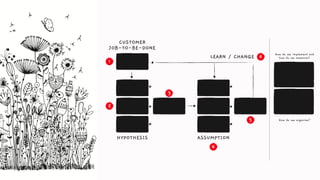
HYPOTHESIS ASSUMPTION
CUSTOMER
JOB-TO-BE-DONE
LEARN / CHANGE
1
2
3
4
5
6
How do we implement and
how do we measure?
How do we organize?
Discuss
PART 4
TURN TO THE PERSON
NEXT TO YOU AND DISCUSS:
HOW CAN YOU APPLY THIS
ON MONDAY?
Thank you!

Agile Customer Thinking - Introduction Workshop

  • 1.
    SEEING THE WORLDTHROUGH THE EYES OF YOUR CUSTOMERS, NOT YOUR PRODUCTS DIGITAL DESIGN THINKING AGILE CUSTOMER THINKING
  • 2.
    THERE IS AGAP BETWEEN WHAT WE WANT OUR ORGANIZATIONS TO BECOME AND WHAT WE PUT INTO THEM TO GET THERE. Our imagination is shaped by the tools we use to see the world; the data we collect, the experiences we engage in and the stories we share. “Our tools are not time machines” - Helge Tennø
  • 3.
  • 4.
    BUYING SUCCESS (TRAFFIC)IS LIMITED TO THE CAMPAIGN ITSELF — AND WE ARE PRODUCING LIMITED LEARNING. 1. Why did it work / what did people find valuable? 2. Can we replicate the success? 3. Can we scale it to other activities, formats, services or relationships? 4. Can we share any insights or learning with the rest of the organization so that they can grow as well? THE ULTIMATE GOAL IS CUSTOMER VALUE
  • 5.
  • 6.
    “When asked directquestions about their interests and preferences, people tend to give answers they believe the questionnaire wants to hear.Again, this is not because they intend to mislead. It is because people respond to these questions within their cortexes, the part of the brain that contains intelligence rather than emotion or instinct” - Clotaire Rapaille,The Culture Code “We tend to throw out the most meaningful and most revolutionary if we ask people about their preferences” - Malcolm Gladwell If we ask for peoples opinions, they will start inventing details and stereotypically correct details. If we ask them to retell a story we can get much closer to the truth. (Dave Snowden, Cognitive Edge, Cynefin, SenseMaker) “A distributed network doesn’t know what it’s going to do until input hits it.And when you are the input variable… So the entire premise of building a higly efficient top down bureaucratic system, that is built around the idea of being able to predict the actions of [a customer network] … goes out the window.” - Chris Fussel, McChrystal Group @AERIALS 2015 FRAMEWORK: A. People dont know what they want — until you give it to them B. What do people find valuable? (the yolk)
  • 7.
    The Corporate Perspective TASK1 A. WRITE THE TITLE OF ONE OF YOUR CURRENT PROJECTS Pick one post-it note and write one project title of a project you are currently working on
  • 8.
    The Corporate Perspective TASK1 A. WRITE THE TITLE OF ONE OF YOUR CURRENT PROJECTS Write a short sentence summarizing what your organization is trying to accomplish with this project B. WHAT IS THE PURPOSE OF THE PROJECT?
  • 9.
    The Corporate Perspective TASK1 A. WRITE THE TITLE OF ONE OF YOUR CURRENT PROJECTS Write a few of the projects success measures / KPI’s B. WHAT IS THE PURPOSE OF THE PROJECT? C. HOW WILL THE SUCCESS OF THE PROJECT BE MEASURED
  • 10.
    The Corporate Perspective TASK1 A. WRITE THE TITLE OF ONE OF YOUR CURRENT PROJECTS B. WHAT IS THE PURPOSE OF THE PROJECT? C. HOW WILL THE SUCCESS OF THE PROJECT BE MEASURED Summarize briefly how what you are outputting in order to achieve the project goals D. HOW DO YOU DO THIS?
  • 11.
    Customer Job-to-be-done PART 2 WRITEDOWN WHICH SITUATION THE CUSTOMER IS IN AND WHICH PROGRESS THEY ARE TRYING TO ACHIEVE OR STRUGGLE THEY ARE TRYING TO OVERCOME A. WHAT IS THE CUSTOMER TRYING TO SOLVE?
  • 12.
    REMEMBER, WE ARENOT PUBLISHERS OR PRODUCER. WE ARE: SOLVING CUSTOMER PROBLEMS
  • 14.
    REMEMBER, WE ARENOT PUBLISHERS OR PRODUCER. WE ARE: SOLVING CUSTOMER PROBLEMS
  • 15.
    Customer Job-to-be-done PART 2 WRITEDOWN WHICH SITUATION THE CUSTOMER IS IN AND WHICH PROGRESS THEY ARE TRYING TO ACHIEVE OR STRUGGLE THEY ARE TRYING TO OVERCOME A. WHAT IS THE CUSTOMER TRYING TO SOLVE?
  • 16.
    Customer Job-to-be-done PART 2 B.HOW DO WE SOLVE THIS PROBLEM? Write three suggestions on individual post-it notes. For how you will solve this problem. Adjustment / evolution / revolution A. WHAT IS THE CUSTOMER TRYING TO SOLVE?
  • 18.
    Customer Job-to-be-done PART 2 B.HOW DO WE SOLVE THIS PROBLEM? Write three suggestions on individual post-it notes. For how you will solve this problem. Adjustment / evolution / revolution A. WHAT IS THE CUSTOMER TRYING TO SOLVE?
  • 19.
    Customer Job-to-be-done PART 2 C.PICK THE MOST CRITICAL HYPOTHESIS Pick the most important hypothesis to continue with B. HOW DO WE SOLVE THIS PROBLEM? A. WHAT IS THE CUSTOMER TRYING TO SOLVE?
  • 20.
    Assumptions PART 3 A.FOR THEHYPOTHESIS TO BE TRUE, THIS ASSUMPTION about the customer HAS TO BE TRUE Write 3X assumptions that has to be true for the customer hypothesis to be true.
  • 21.
    Assumptions PART 3 A.FOR THEHYPOTHESIS TO BE TRUE, THIS ASSUMPTION about the customer HAS TO BE TRUE Choose the most important customer assumption B. PICK THE MOST CRITICAL CUSTOMER ASSUMPTION
  • 22.
    Assumptions PART 3 A.FOR THEHYPOTHESIS TO BE TRUE, THIS ASSUMPTION about the customer HAS TO BE TRUE C. HOW CAN WE TEST THIS ASSUMPTION? B. PICK THE MOST CRITICAL CUSTOMER ASSUMPTION
  • 23.
    HYPOTHESIS ASSUMPTION CUSTOMER JOB-TO-BE-DONE LEARN /CHANGE 1 2 3 4 5 6 How do we implement and how do we measure? How do we organize?
  • 25.
    Discuss PART 4 TURN TOTHE PERSON NEXT TO YOU AND DISCUSS: HOW CAN YOU APPLY THIS ON MONDAY?
  • 26.