Consumer Health Information

www.fda.gov/consumer/updates/interactions112808.html

www.fda.gov/consumer

Avoiding
Tips to Avoid Problems
There are lots of things you can do to take prescription or overthe-counter (OTC) medications in a safe and responsible manner.
• 
Always read drug labels carefully.
•  earn about the warnings for all the drugs you take.
L
•  eep medications in their original containers so that you can
K
easily identify them.
•  sk your doctor what you need to avoid when you are
A
prescribed a new medication. Ask about food, beverages,
dietary supplements, and other drugs.
•  heck with your doctor or pharmacist before taking an OTC
C
drug if you are taking any prescription medications.

P

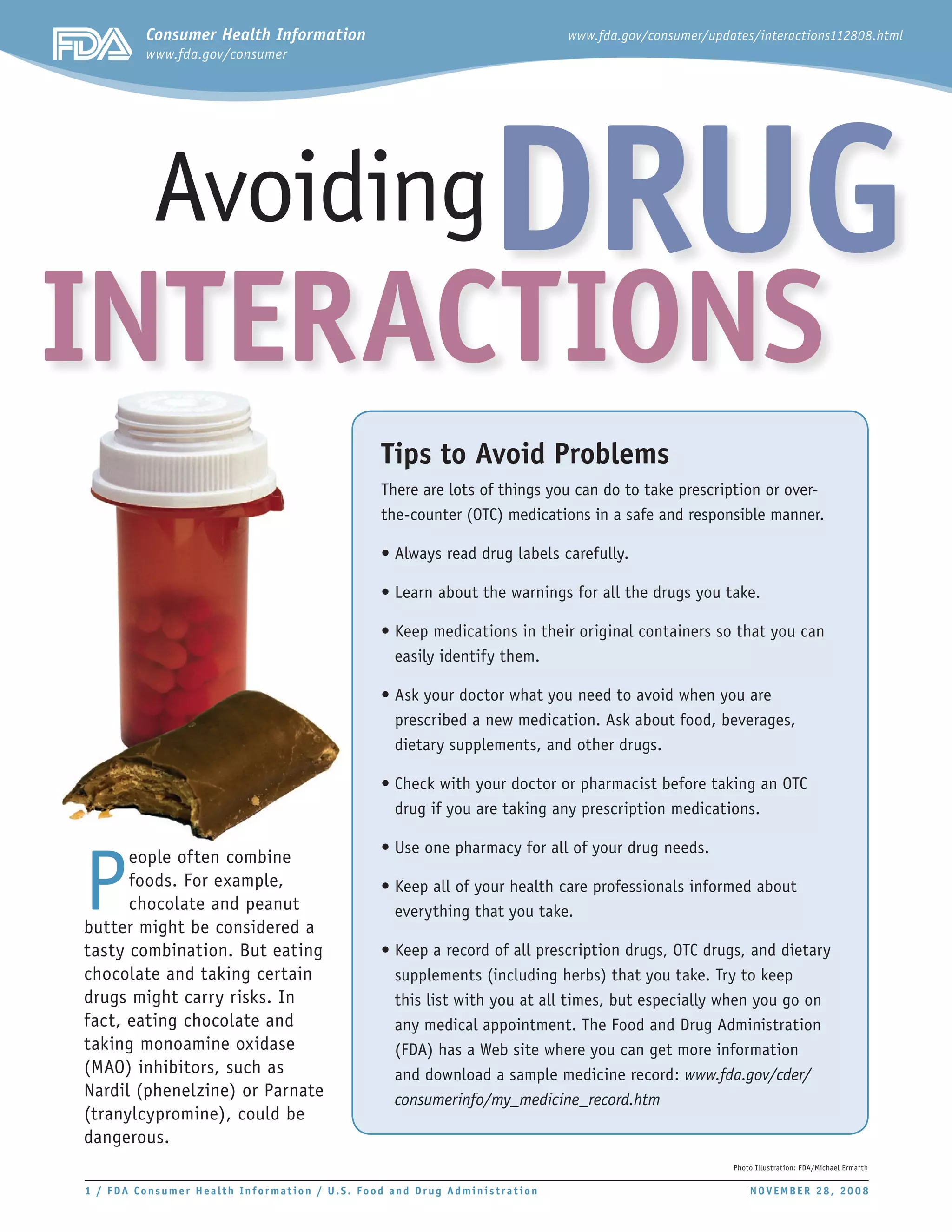
eople often combine
foods. For example,
chocolate and peanut
butter might be considered a
tasty combination. But eating
chocolate and taking certain
drugs might carry risks. In
fact, eating chocolate and
taking monoamine oxidase
(MAO) inhibitors, such as
Nardil (phenelzine) or Parnate
(tranylcypromine), could be
dangerous.

•  se one pharmacy for all of your drug needs.
U
•  eep all of your health care professionals informed about
K
everything that you take.
•  eep a record of all prescription drugs, OTC drugs, and dietary
K
supplements (including herbs) that you take. Try to keep
this list with you at all times, but especially when you go on
any medical appointment. The Food and Drug Administration
(FDA) has a Web site where you can get more information
and download a sample medicine record: www.fda.gov/cder/
consumerinfo/my_medicine_record.htm

Photo Illustration: FDA/Michael Ermarth

1 / FDA Consumer Health Infor mat ion / U. S. Food and Drug Administrat ion	

NOVEMBER 28, 2008
Consumer Health Information

www.fda.gov/consumer/updates/interactions112808.html

www.fda.gov/consumer

“Consumers should learn about the warnings for their
medications and talk with their health care professionals
about how to lower the risk of interactions.”
MAO inhibitors treat depression.
Someone who eats an e xcessive
amount of chocolate after taking
an MAO inhibitor may experience a
sharp rise in blood pressure.
Other foods that should be avoided
when taking MAO inhibitors: aged
cheese, sausage, bologna, pepperoni,
and salami. These foods can also
cause elevated blood pressure when
taken with these medications.
There are three main types of drug
interactions:
• Drugs with food and beverages
• Drugs with dietary supplements
• Drugs with other drugs
“Consumers should learn about
the warnings for their medications
and talk with their health care professionals about how to lower the
risk of interactions,” says Shiew-Mei
Huang, Ph.D., deputy director of the
Office of Clinical Pharmacology in
the Food and Drug Administration’s
(FDA) Center for Drug Evaluation and
Research (CDER).

Drugs with Food
and Beverages
Consequences of drug interactions
with food and beverages may include
delayed, decreased, or enhanced
absorption of a medication. Food can
affect the bioavailability (the degree
and rate at which a drug is absorbed
into someone’s system), metabolism,
and excretion of certain medications.
Examples of drug interactions with
food and beverages …

Alcohol: If you are taking any sort
of medication, it’s recommended
that you avoid alcohol, which can
increase or decrease the effect of
many drugs.

such as Ritalin (methylphenidate),
increasing their effect, or by decreasing the effect of sedative-hypnotics
such as Ambien (zolpidem).

Grapefruit juice: Grapefruit juice is
often mentioned as a product that can
interact negatively with drugs, but
the actual number of drugs the juice
can interact with is less well-known.
Grapefruit juice shouldn’t be taken
with certain blood pressure-lowering
drugs or cyclosporine for the prevention of organ transplant rejection.
That’s because grapefruit juice can
cause higher levels of those medicines in your body, making it more
likely that you will have side effects
from the medicine. The juice can also
interact to cause higher blood levels
of the anti-anxiety medicine Buspar
(buspirone); the anti-malaria drugs
Quinerva or Quinite (quinine); and
Halcion (triazolam), a medication
used to treat insomnia.

Drugs with
Dietary Supplements

Licorice: This would appear to be a
fairly harmless snack food. However,
for someone taking Lanoxin (digoxin),
some forms of licorice may increase
the risk for Lanoxin toxicity. Lanoxin
is used to treat congestive heart failure
and abnormal heart rhythms. Licorice
may also reduce the effects of blood
pressure drugs or diuretic (urine-producing) drugs, including Hydrodiuril
(hydrochlorothiazide) and Aldactone
(spironolactone).
Chocolate: MAO inhibitors are just
one category of drugs that shouldn’t
be consumed with excessive amounts
of chocolate. The caffeine in chocolate
can also interact with stimulant drugs

2 / FDA Consumer Health Infor mat ion / U. S. Food and Drug Administrat ion	

Research has shown that 50 percent or more of American adults use
dietary supplements on a regular
basis, according to congressional testimony by the Office of Dietary Supplements in the National Institutes
of Health.
The law defines dietary supplements in part as products taken by
mouth that contain a “dietary ingredient.” Dietary ingredients include
vitamins, minerals, amino acids, and
herbs or botanicals, as well as other
substances that can be used to supplement the diet.
Examples of drug interactions with
dietary supplements …
St. John’s Wort (Hypericum perforatum): This herb is considered
an inducer of liver enzymes, which
means it can reduce the concentration
of medications in the blood. St. John’s
Wort can reduce the blood level of
medications such as Lanoxin, the cholesterol-lowering drugs Mevacor and
Altocor (lovastatin), and the erectile
dysfunction drug Viagra (sildenafil).
Vitamin E: Taking vitamin E with a
blood-thinning medication such as
Coumadin can increase anti-clotting
activity and may cause an increased
risk of bleeding.
NOVEMBER 28, 2008
Consumer Health Information

www.fda.gov/consumer/updates/interactions112808.html

www.fda.gov/consumer

The rate of adverse drug reactions increases dramatically
after a patient is on four or more medications.
Ginseng: This herb can interfere with
the bleeding effects of Coumadin. In
addition, ginseng can enhance the
bleeding effects of heparin, aspirin,
and nonsteroidal anti-inflammatory
drugs such as ibuprofen, naproxen,
and ketoprofen. Combining ginseng
with MAO inhibitors such as Nardil or Parnate may cause headache,
trouble sleeping, nervousness, and
hyperactivity.
Ginkgo Biloba: High doses of the
herb Ginkgo biloba could decrease
the effectiveness of anticonvulsant
therapy in patients taking the following medications to control seizures:
Tegretol, Equetro or Carbatrol (carbamazepine), and Depakote (valproic acid).

Drugs with
Other Drugs
Two out of every three patients who
visit a doctor leave with at least one
prescription for medication, according
to a 2007 report on medication safety
issued by the Institute for Safe Medication Practices. Close to 40 percent of
the U.S. population receive prescriptions for four or more medications.
And the rate of adverse drug reactions
increases dramatically after a patient is
on four or more medications.
Drug-drug interactions have led
to adverse events and withdrawals
of drugs from the market, according
to an article on drug interactions coauthored by Shiew-Mei Huang, Ph.D.,
deputy director of FDA’s Office of
Clinical Pharmacology. The paper was
published in the June 2008 issue of the
Journal of Clinical Pharmacology.
However, market withdrawal of a

drug is a fairly drastic measure. More
often, FDA will issue an alert warning the public and health care providers about risks as the result of drug
interactions.
Examples of drug interactions with
other drugs …
Cordarone (amiodarone): FDA
issued an alert in August 2008, warning patients about taking Cordarone
to correct abnormal rhythms of the
heart and the cholesterol-lowering
drug Zocor (Simvastatin). Patients
taking Zocor in doses higher than 20
mg while also taking Cordarone run
the risk of developing a rare condition
of muscle injury called rhabdomyolysis, which can lead to kidney failure or
death. “Cordarone also can inhibit or
reduce the effect of the blood thinner
Coumadin (warfarin),” said Huang.
“So if you’re using Cordarone, you
may need to reduce the amount of
Coumadin you’re taking.”
Lanoxin (digoxin): “Lanoxin has a narrow therapeutic range. So other drugs,
such as Norvir (ritonvair), can elevate
the level of Lanoxin,” says Huang. “And
an increased level of Lanoxin can cause
irregular heart rhythms.” Norvir is a
protease inhibitor used to treat HIV,
the virus that causes AIDS.
Antihistamines: Over-the-counter
(OTC) antihistamines are drugs that
temporarily relieve a runny nose, or
reduce sneezing, itching of the nose
or throat, and itchy watery eyes. If you
are taking sedatives, tranquilizers,
or a prescription drug for high blood
pressure or depression, you should
check with a doctor or pharmacist
before you start using antihistimines.
Some antihistamines can increase

3 / FDA Consumer Health Infor mat ion / U. S. Food and Drug Administrat ion	

the depressant effects (such as sleepiness) of a sedative or tranquilizer.
The sedating effect of some antihistamines combined with a sedating
antidepressant could strongly affect
your concentration level. Operating a
car or any other machinery could be
particularly dangerous if your ability
to focus is impaired. Antihistamines
taken in conjunction with blood pressure medication may cause a person’s
blood pressure to increase and may
also speed up the heart rate.
This article appears on FDA’s
Consumer Health Information Web
page (www.fda.gov/consumer), which
features the latest updates on FDAregulated products. Sign up for free
e-mail subscriptions at www.fda.gov/
consumer/consumerenews.html.

For More Information
Protect Your Health
Joint FDA/WebMD resource
www.webmd.com/fda
FDA’s Drug Development and Drug
Interactions Web site
www.fda.gov/cder/drug/
drugInteractions/default.htm
Consumer Education: Ensuring Safe
Use of Medicine
www.fda.gov/cder/consumerinfo/
ensuring_safe_use_text.htm
MedWatch
www.fda.gov/medwatch/
Preventable Adverse Drug
Reactions: A Focus on Drug
Interactions
www.fda.gov/cder/drug/drugReactions/
default.htm

NOVEMBER 28, 2008

Interacciones farmacológicas

  • 1.
    Consumer Health Information www.fda.gov/consumer/updates/interactions112808.html www.fda.gov/consumer Avoiding Tipsto Avoid Problems There are lots of things you can do to take prescription or overthe-counter (OTC) medications in a safe and responsible manner. • Always read drug labels carefully. • earn about the warnings for all the drugs you take. L • eep medications in their original containers so that you can K easily identify them. • sk your doctor what you need to avoid when you are A prescribed a new medication. Ask about food, beverages, dietary supplements, and other drugs. • heck with your doctor or pharmacist before taking an OTC C drug if you are taking any prescription medications. P eople often combine foods. For example, chocolate and peanut butter might be considered a tasty combination. But eating chocolate and taking certain drugs might carry risks. In fact, eating chocolate and taking monoamine oxidase (MAO) inhibitors, such as Nardil (phenelzine) or Parnate (tranylcypromine), could be dangerous. • se one pharmacy for all of your drug needs. U • eep all of your health care professionals informed about K everything that you take. • eep a record of all prescription drugs, OTC drugs, and dietary K supplements (including herbs) that you take. Try to keep this list with you at all times, but especially when you go on any medical appointment. The Food and Drug Administration (FDA) has a Web site where you can get more information and download a sample medicine record: www.fda.gov/cder/ consumerinfo/my_medicine_record.htm Photo Illustration: FDA/Michael Ermarth 1 / FDA Consumer Health Infor mat ion / U. S. Food and Drug Administrat ion NOVEMBER 28, 2008
  • 2.
    Consumer Health Information www.fda.gov/consumer/updates/interactions112808.html www.fda.gov/consumer “Consumersshould learn about the warnings for their medications and talk with their health care professionals about how to lower the risk of interactions.” MAO inhibitors treat depression. Someone who eats an e xcessive amount of chocolate after taking an MAO inhibitor may experience a sharp rise in blood pressure. Other foods that should be avoided when taking MAO inhibitors: aged cheese, sausage, bologna, pepperoni, and salami. These foods can also cause elevated blood pressure when taken with these medications. There are three main types of drug interactions: • Drugs with food and beverages • Drugs with dietary supplements • Drugs with other drugs “Consumers should learn about the warnings for their medications and talk with their health care professionals about how to lower the risk of interactions,” says Shiew-Mei Huang, Ph.D., deputy director of the Office of Clinical Pharmacology in the Food and Drug Administration’s (FDA) Center for Drug Evaluation and Research (CDER). Drugs with Food and Beverages Consequences of drug interactions with food and beverages may include delayed, decreased, or enhanced absorption of a medication. Food can affect the bioavailability (the degree and rate at which a drug is absorbed into someone’s system), metabolism, and excretion of certain medications. Examples of drug interactions with food and beverages … Alcohol: If you are taking any sort of medication, it’s recommended that you avoid alcohol, which can increase or decrease the effect of many drugs. such as Ritalin (methylphenidate), increasing their effect, or by decreasing the effect of sedative-hypnotics such as Ambien (zolpidem). Grapefruit juice: Grapefruit juice is often mentioned as a product that can interact negatively with drugs, but the actual number of drugs the juice can interact with is less well-known. Grapefruit juice shouldn’t be taken with certain blood pressure-lowering drugs or cyclosporine for the prevention of organ transplant rejection. That’s because grapefruit juice can cause higher levels of those medicines in your body, making it more likely that you will have side effects from the medicine. The juice can also interact to cause higher blood levels of the anti-anxiety medicine Buspar (buspirone); the anti-malaria drugs Quinerva or Quinite (quinine); and Halcion (triazolam), a medication used to treat insomnia. Drugs with Dietary Supplements Licorice: This would appear to be a fairly harmless snack food. However, for someone taking Lanoxin (digoxin), some forms of licorice may increase the risk for Lanoxin toxicity. Lanoxin is used to treat congestive heart failure and abnormal heart rhythms. Licorice may also reduce the effects of blood pressure drugs or diuretic (urine-producing) drugs, including Hydrodiuril (hydrochlorothiazide) and Aldactone (spironolactone). Chocolate: MAO inhibitors are just one category of drugs that shouldn’t be consumed with excessive amounts of chocolate. The caffeine in chocolate can also interact with stimulant drugs 2 / FDA Consumer Health Infor mat ion / U. S. Food and Drug Administrat ion Research has shown that 50 percent or more of American adults use dietary supplements on a regular basis, according to congressional testimony by the Office of Dietary Supplements in the National Institutes of Health. The law defines dietary supplements in part as products taken by mouth that contain a “dietary ingredient.” Dietary ingredients include vitamins, minerals, amino acids, and herbs or botanicals, as well as other substances that can be used to supplement the diet. Examples of drug interactions with dietary supplements … St. John’s Wort (Hypericum perforatum): This herb is considered an inducer of liver enzymes, which means it can reduce the concentration of medications in the blood. St. John’s Wort can reduce the blood level of medications such as Lanoxin, the cholesterol-lowering drugs Mevacor and Altocor (lovastatin), and the erectile dysfunction drug Viagra (sildenafil). Vitamin E: Taking vitamin E with a blood-thinning medication such as Coumadin can increase anti-clotting activity and may cause an increased risk of bleeding. NOVEMBER 28, 2008
  • 3.
    Consumer Health Information www.fda.gov/consumer/updates/interactions112808.html www.fda.gov/consumer Therate of adverse drug reactions increases dramatically after a patient is on four or more medications. Ginseng: This herb can interfere with the bleeding effects of Coumadin. In addition, ginseng can enhance the bleeding effects of heparin, aspirin, and nonsteroidal anti-inflammatory drugs such as ibuprofen, naproxen, and ketoprofen. Combining ginseng with MAO inhibitors such as Nardil or Parnate may cause headache, trouble sleeping, nervousness, and hyperactivity. Ginkgo Biloba: High doses of the herb Ginkgo biloba could decrease the effectiveness of anticonvulsant therapy in patients taking the following medications to control seizures: Tegretol, Equetro or Carbatrol (carbamazepine), and Depakote (valproic acid). Drugs with Other Drugs Two out of every three patients who visit a doctor leave with at least one prescription for medication, according to a 2007 report on medication safety issued by the Institute for Safe Medication Practices. Close to 40 percent of the U.S. population receive prescriptions for four or more medications. And the rate of adverse drug reactions increases dramatically after a patient is on four or more medications. Drug-drug interactions have led to adverse events and withdrawals of drugs from the market, according to an article on drug interactions coauthored by Shiew-Mei Huang, Ph.D., deputy director of FDA’s Office of Clinical Pharmacology. The paper was published in the June 2008 issue of the Journal of Clinical Pharmacology. However, market withdrawal of a drug is a fairly drastic measure. More often, FDA will issue an alert warning the public and health care providers about risks as the result of drug interactions. Examples of drug interactions with other drugs … Cordarone (amiodarone): FDA issued an alert in August 2008, warning patients about taking Cordarone to correct abnormal rhythms of the heart and the cholesterol-lowering drug Zocor (Simvastatin). Patients taking Zocor in doses higher than 20 mg while also taking Cordarone run the risk of developing a rare condition of muscle injury called rhabdomyolysis, which can lead to kidney failure or death. “Cordarone also can inhibit or reduce the effect of the blood thinner Coumadin (warfarin),” said Huang. “So if you’re using Cordarone, you may need to reduce the amount of Coumadin you’re taking.” Lanoxin (digoxin): “Lanoxin has a narrow therapeutic range. So other drugs, such as Norvir (ritonvair), can elevate the level of Lanoxin,” says Huang. “And an increased level of Lanoxin can cause irregular heart rhythms.” Norvir is a protease inhibitor used to treat HIV, the virus that causes AIDS. Antihistamines: Over-the-counter (OTC) antihistamines are drugs that temporarily relieve a runny nose, or reduce sneezing, itching of the nose or throat, and itchy watery eyes. If you are taking sedatives, tranquilizers, or a prescription drug for high blood pressure or depression, you should check with a doctor or pharmacist before you start using antihistimines. Some antihistamines can increase 3 / FDA Consumer Health Infor mat ion / U. S. Food and Drug Administrat ion the depressant effects (such as sleepiness) of a sedative or tranquilizer. The sedating effect of some antihistamines combined with a sedating antidepressant could strongly affect your concentration level. Operating a car or any other machinery could be particularly dangerous if your ability to focus is impaired. Antihistamines taken in conjunction with blood pressure medication may cause a person’s blood pressure to increase and may also speed up the heart rate. This article appears on FDA’s Consumer Health Information Web page (www.fda.gov/consumer), which features the latest updates on FDAregulated products. Sign up for free e-mail subscriptions at www.fda.gov/ consumer/consumerenews.html. For More Information Protect Your Health Joint FDA/WebMD resource www.webmd.com/fda FDA’s Drug Development and Drug Interactions Web site www.fda.gov/cder/drug/ drugInteractions/default.htm Consumer Education: Ensuring Safe Use of Medicine www.fda.gov/cder/consumerinfo/ ensuring_safe_use_text.htm MedWatch www.fda.gov/medwatch/ Preventable Adverse Drug Reactions: A Focus on Drug Interactions www.fda.gov/cder/drug/drugReactions/ default.htm NOVEMBER 28, 2008