Y
our Garden
and climate change

Practical tips

for preparing your
growing space
Common Cause
Common Cause is a Lewes based,
not for profit social enterprise, that
promotes the local economy by
supporting sustainable farming and
facilitates wider access to local foods
and involvement in growing food.
We have trialled techniques for coping
with changing weather patterns over
the last few years at our growing sites
in East Sussex.

This booklet has been funded by
The Lewes Pound ‘Live Lewes Fund’
through Sussex Community Foundation.

www.commoncause.org.uk
www.thelewespound.org
www.sussexgiving.org.uk

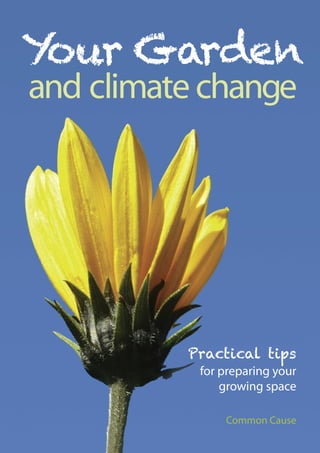
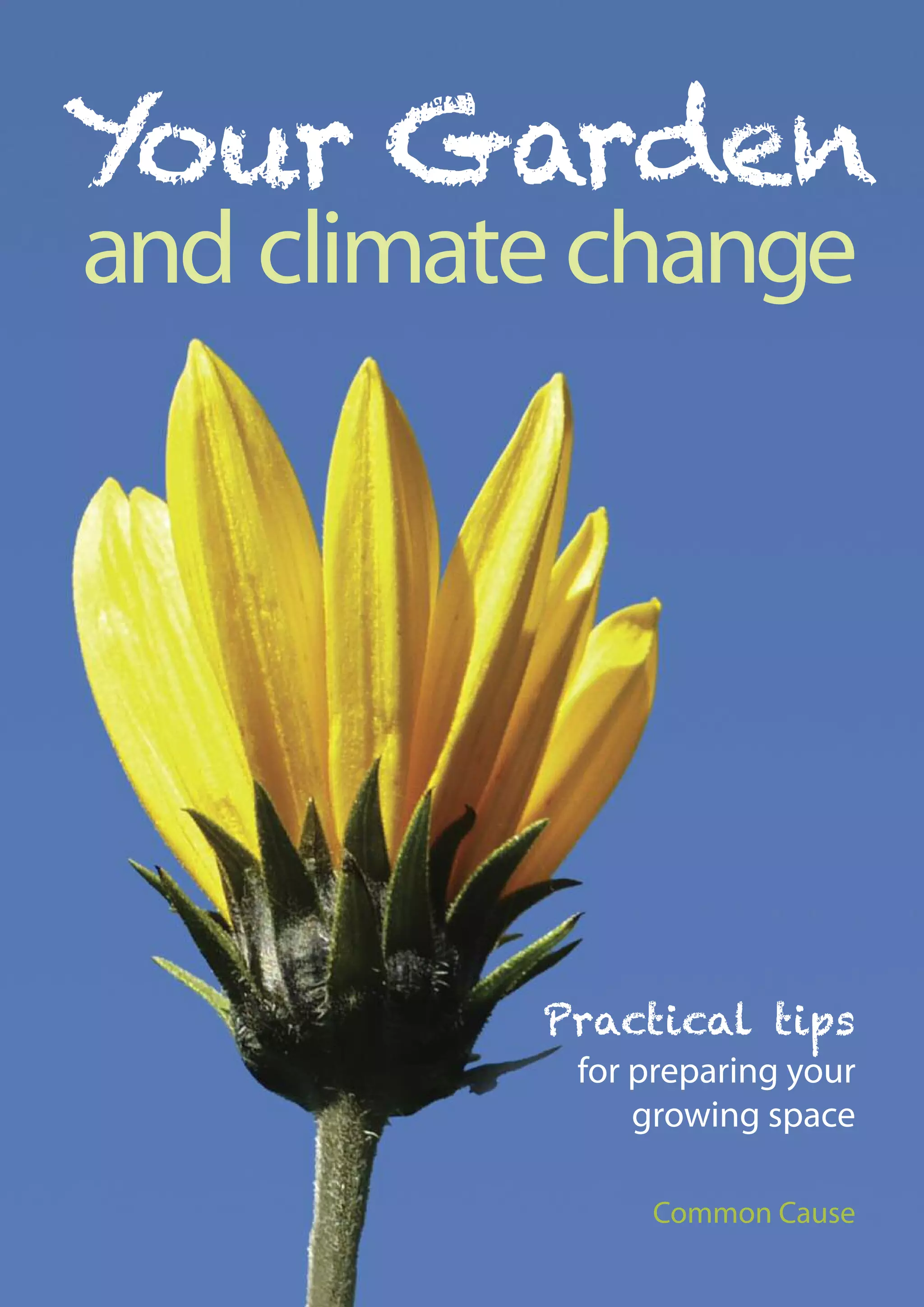
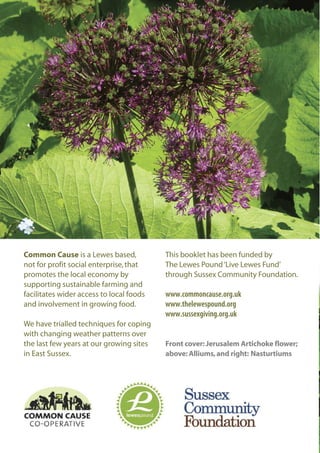
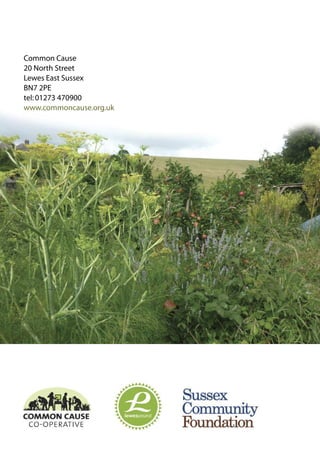
Front cover: Jerusalem Artichoke flower;
above: Alliums, and right: Nasturtiums
Contents
What can we expect from climate change?

2–3

Start with the soil and composting for strong plants

4–5

Techniques for adding nutrients
naturally and improving soil fertility

6–7

Water conservation – drip feeding, planting,
mulching, plastic bottle bed

8–9

Type of plants to grow, choosing suitable plants

10 – 11

Lawns versus edible meadows

12

1
Our Changing Climate
This booklet is about the steps that
you can take to make your garden
more resilient and ready for the
predicted changes in our climate.
The predictions from Climate South
East are for“climate change to lead
to hotter drier summers, warmer
wetter winters, higher sea levels and
an increase in extreme events such
as heatwaves, droughts and floods”
.
We are already experiencing milder
winters, with less frost and snow to
help control pests. When it rains it
is often as heavier downpours,
running off baked dry land rather
than seeping in where its needed.
The scale of predicted climate
change can feel daunting. However,
there are steps that can be taken at
a local level which will help to make
a difference, particularly if a whole
street, neighbourhood, town and
County make adaptations.
Further information

• www.climatesoutheast.org.uk
• www.transitiontownlewes.org
• www.smarterliving.org.uk
2

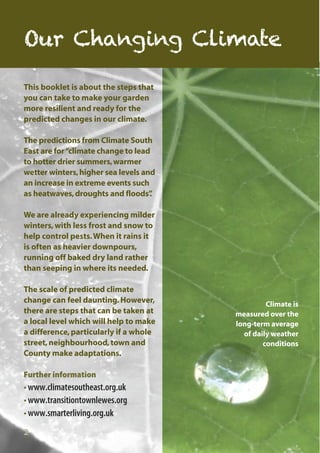
Climate is
measured over the
long-term average
of daily weather
conditions
How will this affect gardening?

What can be done?
The immediate problems facing a
gardener in the South East will be
ensuring plants have enough water,
protecting plants from storm damage,
preventing soil erosion and nutrient
depletion, and dealing with new pests
and diseases brought in by milder
conditions.
On the following pages you will find
practical steps that you can take to
adapt your garden for successful future
growing. It is likely to mean
reconsidering the types of plants

that you currently grow, the structure of
your garden, how you conserve water
for your plants and what tools and
machinery you use. All power
equipment whether electric or petrol
will increase your carbon footprint, so
think about whether you could use
alternatives, or look at some of the
different growing methods described
here such as forest gardening.
You will find useful links throughout
to explore possibilities further.
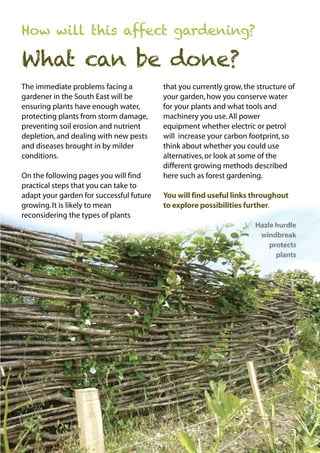
Hazle hurdle
windbreak
protects
plants

3
Start with the soil
Having a healthy, nutrient packed soil
with a balanced mix of soil organisms is
probably the best way of helping your
garden’s chances of flourishing.
Increasing soil fertility will re-pay you
in stronger, healthier plants more able
to withstand adverse conditions.
It is better for the life in the soil
if chemicals such as herbicides and
pesticides are not used.They will result
in a depletion of natural soil bacteria and
other life. Digging the soil dries it out and
releases carbon into the atmosphere so
a no-dig system, where weeds are
mulched (page 9) and soil aerated by
adding compost which worms will pull
down, will avoid this.
Over the years soil fertility in no-dig
builds up with the compost added, and it
willl have a thriving, healthy community
of micro-organisms creating a natural
ecosystem, providing benefits for plants
and wildlife. If you are growing in pots
choose large ones with more plants in
together, as small pots dry out quickly.

The problem with peat
In the UK, more than 24 million
wheelbarrows of peat are used every
year by amateur gardeners. Despite
peat being used so readily, most people
don’t realise the destructive impact this
has on the wider environment,
including the release of thousands of
tonnes of carbon dioxide every year and
the loss of the homes of birds, insects
and plants.
Peat is still added to compost so it is
important to make sure that you choose
a peat-free bag – it is worth asking your
garden centre why they still stock peat
products as customer pressure can help
to address the problem. See the Garden
Organic pages for more information
about why peat bogs are so valuable,
and tips for sustainable gardening.
What can be used instead? Apart from
buying peat free compost, its worth
having a go at making your own,
following the steps in the link below.

Further information

• www.gardenorganic.org.uk/growyourown/Activities/A38.pdf
• www.idontdigpeat.org.uk
• www.gardenorganic.org.uk
4
Composting
If you have tried composting and ended
up with sludge or a static twiggy pile,
don’t give up, because you can change
this to a properly working compost with
a few easy steps!

Tips for making compost
The secret is to get the right mix of green
(nitrogen rich) and brown (carbon rich)
materials which will create a perfect
environment for worms, insects and
microbes which will do the work for you.
Gather as much material together at the
same time to start – the bigger the
heap or fuller the compost bin, the
quicker composting will happen.
An ideal mix would be a base of twiggy
garden cuttings (chopped up with
shears in a wheelbarrow) greener
garden cuttings, kitchen waste, scrap
paper scrumpled up, some nettle tops
to accelerate the process and a bucket
of water to dampen it all.
A rodent proof bin such as a Green
Johanna means that you can compost

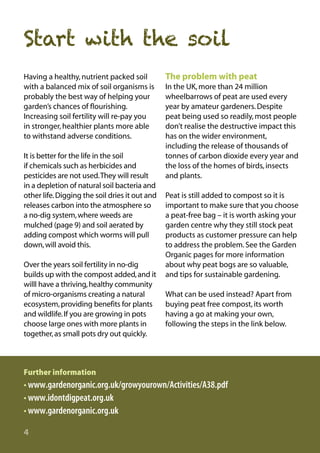
Home made potting compost

cooked waste, meat, fish and dairy
scraps as well. All these things will break
down into compost, but they need to
be mixed with shredded paper, twiggy
garden waste or torn up cardboard for
best results. Biochar can also be added.
(see next page).

For more information and factsheets on all stages of composting see

• www.recyclenow.com/home_composting
• www.eastsussex.gov.uk/environment/rubbishandrecycling/whatyoucando/composting

5
Techniques for adding
nutrients naturally
Green manures
Sowing green manure in the autumn
will add valuable nutrients when it is
cut and turned into the soil in spring.
Over the winter as it is growing the
roots will hold soil in place, preventing
wind erosion, evaporation and loss of
nutrients. It is worth experimenting
with different types; phacellia is easy
to turn in and if you leave a few to
flower, provides a food source that
bees will love.

I Making in a raised barrel with a tap

will make it easier to harvest your
natural liquid fertiliser into a watering
can. Dilute 10:1 with rainwater.
I After a few months under water the

pernicious weeds can safely be added
to the compost heap or used as a
mulch.

Biochar
Biochar is made by burning woody
material in kilns whereby the gases are
re-cycled, unlike those formed in the
making of charcoal.There is evidence
of its use by ancient communities in the
Amazon.

When plants are well established they
will benefit from a feed high in
nutrients such as nitrogen, phosphorus
and potassium which you can make
yourself from nettles, comfrey, wormery
liquid, seaweed or even just weeds!
These plants contain trace elements
essential to plant health and resilience.

Conversion into biochar results in fewer
greenhouse gas emissions than if the
biomass had rotted or been burnt.

Making plant feed

How to use

I In an old barrel place a porous cloth

Homemade biochar is best used added
to a compost heap initially. Ready made
products are available which can be
added to seed compost, when planting
out, or as a top dressing for shallow
rooted plants.

sack/bag containing a good number
of nettle or comfrey leaves, or
pernicious weed roots like
bindweed/couch grass/ground elder
inside.Tie neck securely.
I Weigh down with a slab or brick.

Cover with rainwater. It can develop
a strong smell, so site it carefully!

6
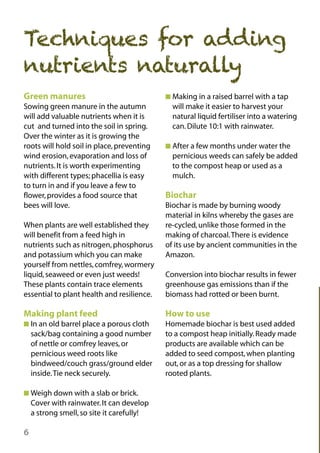
Phacellia

Mycorrhizal fungi
Mycorrhizal fungi act as a vast drought
combating network making use of all
available moisture, increasing uptake of
trace elements and transferring nutrients,
building healthier, stronger plants and
increasing yields of edible crops.
Mycorrhizas may speed plant growth,
stimulate fine root development and
lengthen the life of the roots.They can
also protect plants from drought (such
as nematode worms) and pathogens
(micro-organisms that cause disease).
These fungi can also act as a buffer
protecting surrounding plants from the
harmful effects of any toxic heavy
metals present in the soil.
Source: Trees for Life

Further information

• www.gardenorganic.org.uk/factsheets/gs3.php
• www.youtube.com/watch?v=dEJiHHdjGeI&feature=related
• www.treesforlife.org.uk/forest/ecological/mycorrhizas.html
• www.permaculture.co.uk/articles/plants-and-fungi-using-beneficial-mycorrhizalfungi-boost-plant-growth
• www.carbongold.com
• www.wiserearth.org/event/view/712b3cdeee2aa5953f103dd0413e305f

7
Water conservation
Water conservation
With water shortage likely to become
more commonplace people will need
alternatives to using mains water and a
garden hose to water gardens.
With hose pipe bans increasing, saving
winter rainfall will continue to be the best
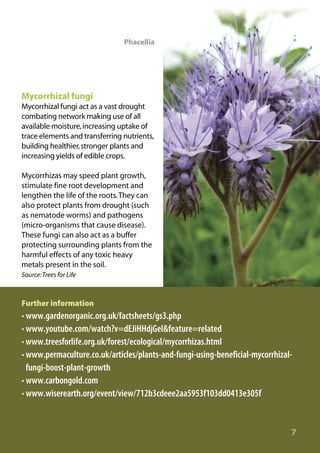
option. Fit a water butt in your garden if
you do not have one.They can be
attached to down pipes from guttering
around roofs. Consider one for the front
and one for the back garden.They can
have a cascade system to avoid
overflowing and maximise rain collection.

Drip feeding
Buy a piece of hose, or if you have an
old garden hose then this is ideal to
make holes in and wind through the
garden. Attaching the leaky hose to a
water butt with a tap allows you to
water slowly but steadily in dry spells
which will benefit the plant more than a
sudden rush from a watering can.

and reduce the need for a lot of future
watering.If you are on chalk and have
very free draining soil, lining planting
holes/trenches with corrugated
cardboard or newspaper will also help,
but add a handful of nitrogen rich chicken
manure pellets to balance the high
carbon content of the cardboard/paper.
When watering using a watering can
give plants a really good soak, aiming the
water spout right at the soil where the
roots will be and not at the plant leaves –
a short burst only wets the surface and
does not go down to the roots. If you use
a greenhouse then make sure that all
plants and seed trays are set up in larger
solid based trays to catch any water as it
seeps through after watering.

Planting
When planting out anything from
seedlings to trees, fill planting holes or
trenches with a good amount of
homemade compost first.Once you have
placed your plant in the hole with more
compost, water well before covering, with
a dry soil layer on the surface.This helps
to prevent evaporation and reduce water
loss and will give the plant a good start

8

Water butt cascade
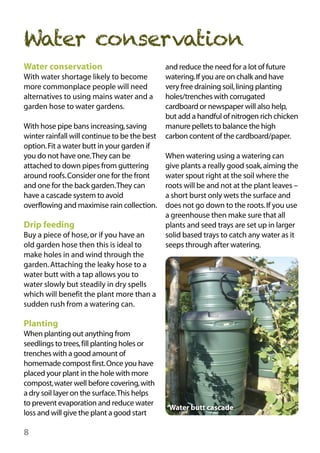
Plastic bottle bed

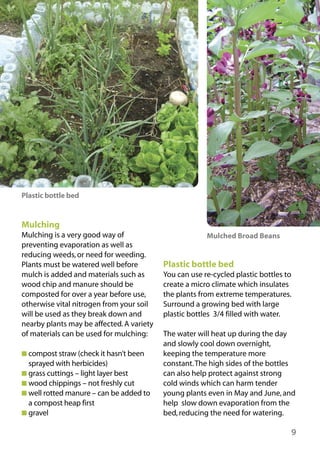
Mulching
Mulching is a very good way of
preventing evaporation as well as
reducing weeds, or need for weeding.
Plants must be watered well before
mulch is added and materials such as
wood chip and manure should be
composted for over a year before use,
otherwise vital nitrogen from your soil
will be used as they break down and
nearby plants may be affected. A variety
of materials can be used for mulching:
I compost straw (check it hasn’t been

sprayed with herbicides)
I grass cuttings – light layer best
I wood chippings – not freshly cut
I well rotted manure – can be added to

a compost heap first
I gravel

Mulched Broad Beans

Plastic bottle bed
You can use re-cycled plastic bottles to
create a micro climate which insulates
the plants from extreme temperatures.
Surround a growing bed with large
plastic bottles 3/4 filled with water.
The water will heat up during the day
and slowly cool down overnight,
keeping the temperature more
constant.The high sides of the bottles
can also help protect against strong
cold winds which can harm tender
young plants even in May and June, and
help slow down evaporation from the
bed, reducing the need for watering.

9
Plants to grow
Leaves and stems have developed ways
to combat drought such as silver, waxy
or hairy leaves. Choosing plants with
these characteristics rather than
struggling to continue with plants that
are less adaptable to highs and lows of
temperature and unpredictable
weather will save a lot of work and
heartache.
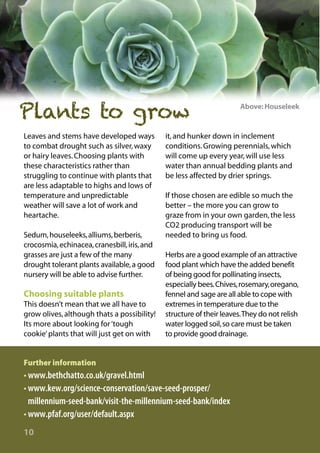
Sedum, houseleeks, alliums, berberis,
crocosmia, echinacea, cranesbill, iris, and
grasses are just a few of the many
drought tolerant plants available, a good
nursery will be able to advise further.

Choosing suitable plants
This doesn’t mean that we all have to
grow olives, although thats a possibility!
Its more about looking for ‘tough
cookie’ plants that will just get on with

it, and hunker down in inclement
conditions. Growing perennials, which
will come up every year, will use less
water than annual bedding plants and
be less affected by drier springs.
If those chosen are edible so much the
better – the more you can grow to
graze from in your own garden, the less
CO2 producing transport will be
needed to bring us food.
Herbs are a good example of an attractive
food plant which have the added benefit
of being good for pollinating insects,
especially bees.Chives, rosemary, oregano,
fennel and sage are all able to cope with
extremes in temperature due to the
structure of their leaves.They do not relish
water logged soil, so care must be taken
to provide good drainage.

Further information

• www.bethchatto.co.uk/gravel.html
• www.kew.org/science-conservation/save-seed-prosper/
millennium-seed-bank/visit-the-millennium-seed-bank/index
• www.pfaf.org/user/default.aspx
10

Above: Houseleek
Different methods
of growing
Permaculture
The word ‘permaculture’ is derived from
the two phrases ‘permanent agriculture’
and ‘permanent culture’. It is a system of
design for improving all aspects of our
lives, and encompasses efficient ways to
garden and grow particularly suited to
adapting to a variable climate. Courses
are run locally by Brighton
Permaculture Trust, see link below.

Forest Gardening
A good structure of edible shrubs, and
trees if you have room, will provide
shelter, stability and dappled shade.
Growing plants in a stacking method,
with fruit and nut trees, then bushes
underplanted with perennial
vegetables, herbs and flowers creates a
more natural and self reliant system.The
link below to Martin Crawford’s forest
garden in Dartington also has
information about Mycorrhizal fungi.

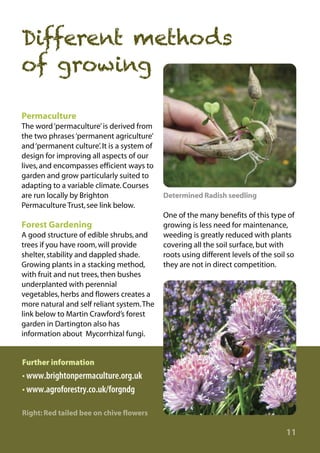
Determined Radish seedling

One of the many benefits of this type of
growing is less need for maintenance,
weeding is greatly reduced with plants
covering all the soil surface, but with
roots using different levels of the soil so
they are not in direct competition.

Further information

• www.brightonpermaculture.org.uk
• www.agroforestry.co.uk/forgndg
Right: Red tailed bee on chive flowers

11
Edible
meadows

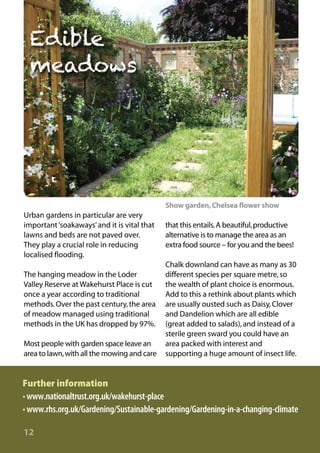
Show garden, Chelsea flower show

Urban gardens in particular are very
important ‘soakaways’ and it is vital that
lawns and beds are not paved over.
They play a crucial role in reducing
localised flooding.
The hanging meadow in the Loder
Valley Reserve at Wakehurst Place is cut
once a year according to traditional
methods. Over the past century, the area
of meadow managed using traditional
methods in the UK has dropped by 97%.
Most people with garden space leave an
area to lawn, with all the mowing and care

that this entails.A beautiful, productive
alternative is to manage the area as an
extra food source – for you and the bees!
Chalk downland can have as many as 30
different species per square metre, so
the wealth of plant choice is enormous.
Add to this a rethink about plants which
are usually ousted such as Daisy, Clover
and Dandelion which are all edible
(great added to salads), and instead of a
sterile green sward you could have an
area packed with interest and
supporting a huge amount of insect life.

Further information
• www.nationaltrust.org.uk/wakehurst-place
• www.rhs.org.uk/Gardening/Sustainable-gardening/Gardening-in-a-changing-climate
12
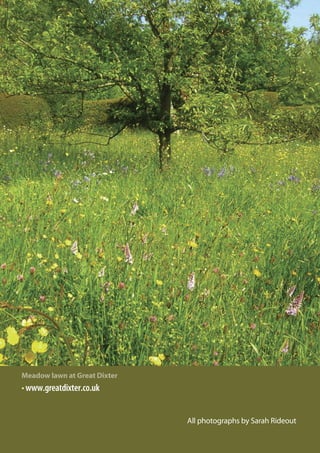
Meadow lawn at Great Dixter

• www.greatdixter.co.uk

All photographs by Sarah Rideout
Common Cause
20 North Street
Lewes East Sussex
BN7 2PE
tel: 01273 470900
www.commoncause.org.uk

Your Garden and Global Warming

  • 1.
    Y our Garden and climatechange Practical tips for preparing your growing space Common Cause
  • 2.
    Common Cause isa Lewes based, not for profit social enterprise, that promotes the local economy by supporting sustainable farming and facilitates wider access to local foods and involvement in growing food. We have trialled techniques for coping with changing weather patterns over the last few years at our growing sites in East Sussex. This booklet has been funded by The Lewes Pound ‘Live Lewes Fund’ through Sussex Community Foundation. www.commoncause.org.uk www.thelewespound.org www.sussexgiving.org.uk Front cover: Jerusalem Artichoke flower; above: Alliums, and right: Nasturtiums
  • 3.
    Contents What can weexpect from climate change? 2–3 Start with the soil and composting for strong plants 4–5 Techniques for adding nutrients naturally and improving soil fertility 6–7 Water conservation – drip feeding, planting, mulching, plastic bottle bed 8–9 Type of plants to grow, choosing suitable plants 10 – 11 Lawns versus edible meadows 12 1
  • 4.
    Our Changing Climate Thisbooklet is about the steps that you can take to make your garden more resilient and ready for the predicted changes in our climate. The predictions from Climate South East are for“climate change to lead to hotter drier summers, warmer wetter winters, higher sea levels and an increase in extreme events such as heatwaves, droughts and floods” . We are already experiencing milder winters, with less frost and snow to help control pests. When it rains it is often as heavier downpours, running off baked dry land rather than seeping in where its needed. The scale of predicted climate change can feel daunting. However, there are steps that can be taken at a local level which will help to make a difference, particularly if a whole street, neighbourhood, town and County make adaptations. Further information • www.climatesoutheast.org.uk • www.transitiontownlewes.org • www.smarterliving.org.uk 2 Climate is measured over the long-term average of daily weather conditions
  • 5.
    How will thisaffect gardening? What can be done? The immediate problems facing a gardener in the South East will be ensuring plants have enough water, protecting plants from storm damage, preventing soil erosion and nutrient depletion, and dealing with new pests and diseases brought in by milder conditions. On the following pages you will find practical steps that you can take to adapt your garden for successful future growing. It is likely to mean reconsidering the types of plants that you currently grow, the structure of your garden, how you conserve water for your plants and what tools and machinery you use. All power equipment whether electric or petrol will increase your carbon footprint, so think about whether you could use alternatives, or look at some of the different growing methods described here such as forest gardening. You will find useful links throughout to explore possibilities further. Hazle hurdle windbreak protects plants 3
  • 6.
    Start with thesoil Having a healthy, nutrient packed soil with a balanced mix of soil organisms is probably the best way of helping your garden’s chances of flourishing. Increasing soil fertility will re-pay you in stronger, healthier plants more able to withstand adverse conditions. It is better for the life in the soil if chemicals such as herbicides and pesticides are not used.They will result in a depletion of natural soil bacteria and other life. Digging the soil dries it out and releases carbon into the atmosphere so a no-dig system, where weeds are mulched (page 9) and soil aerated by adding compost which worms will pull down, will avoid this. Over the years soil fertility in no-dig builds up with the compost added, and it willl have a thriving, healthy community of micro-organisms creating a natural ecosystem, providing benefits for plants and wildlife. If you are growing in pots choose large ones with more plants in together, as small pots dry out quickly. The problem with peat In the UK, more than 24 million wheelbarrows of peat are used every year by amateur gardeners. Despite peat being used so readily, most people don’t realise the destructive impact this has on the wider environment, including the release of thousands of tonnes of carbon dioxide every year and the loss of the homes of birds, insects and plants. Peat is still added to compost so it is important to make sure that you choose a peat-free bag – it is worth asking your garden centre why they still stock peat products as customer pressure can help to address the problem. See the Garden Organic pages for more information about why peat bogs are so valuable, and tips for sustainable gardening. What can be used instead? Apart from buying peat free compost, its worth having a go at making your own, following the steps in the link below. Further information • www.gardenorganic.org.uk/growyourown/Activities/A38.pdf • www.idontdigpeat.org.uk • www.gardenorganic.org.uk 4
  • 7.
    Composting If you havetried composting and ended up with sludge or a static twiggy pile, don’t give up, because you can change this to a properly working compost with a few easy steps! Tips for making compost The secret is to get the right mix of green (nitrogen rich) and brown (carbon rich) materials which will create a perfect environment for worms, insects and microbes which will do the work for you. Gather as much material together at the same time to start – the bigger the heap or fuller the compost bin, the quicker composting will happen. An ideal mix would be a base of twiggy garden cuttings (chopped up with shears in a wheelbarrow) greener garden cuttings, kitchen waste, scrap paper scrumpled up, some nettle tops to accelerate the process and a bucket of water to dampen it all. A rodent proof bin such as a Green Johanna means that you can compost Home made potting compost cooked waste, meat, fish and dairy scraps as well. All these things will break down into compost, but they need to be mixed with shredded paper, twiggy garden waste or torn up cardboard for best results. Biochar can also be added. (see next page). For more information and factsheets on all stages of composting see • www.recyclenow.com/home_composting • www.eastsussex.gov.uk/environment/rubbishandrecycling/whatyoucando/composting 5
  • 8.
    Techniques for adding nutrientsnaturally Green manures Sowing green manure in the autumn will add valuable nutrients when it is cut and turned into the soil in spring. Over the winter as it is growing the roots will hold soil in place, preventing wind erosion, evaporation and loss of nutrients. It is worth experimenting with different types; phacellia is easy to turn in and if you leave a few to flower, provides a food source that bees will love. I Making in a raised barrel with a tap will make it easier to harvest your natural liquid fertiliser into a watering can. Dilute 10:1 with rainwater. I After a few months under water the pernicious weeds can safely be added to the compost heap or used as a mulch. Biochar Biochar is made by burning woody material in kilns whereby the gases are re-cycled, unlike those formed in the making of charcoal.There is evidence of its use by ancient communities in the Amazon. When plants are well established they will benefit from a feed high in nutrients such as nitrogen, phosphorus and potassium which you can make yourself from nettles, comfrey, wormery liquid, seaweed or even just weeds! These plants contain trace elements essential to plant health and resilience. Conversion into biochar results in fewer greenhouse gas emissions than if the biomass had rotted or been burnt. Making plant feed How to use I In an old barrel place a porous cloth Homemade biochar is best used added to a compost heap initially. Ready made products are available which can be added to seed compost, when planting out, or as a top dressing for shallow rooted plants. sack/bag containing a good number of nettle or comfrey leaves, or pernicious weed roots like bindweed/couch grass/ground elder inside.Tie neck securely. I Weigh down with a slab or brick. Cover with rainwater. It can develop a strong smell, so site it carefully! 6
  • 9.
    Phacellia Mycorrhizal fungi Mycorrhizal fungiact as a vast drought combating network making use of all available moisture, increasing uptake of trace elements and transferring nutrients, building healthier, stronger plants and increasing yields of edible crops. Mycorrhizas may speed plant growth, stimulate fine root development and lengthen the life of the roots.They can also protect plants from drought (such as nematode worms) and pathogens (micro-organisms that cause disease). These fungi can also act as a buffer protecting surrounding plants from the harmful effects of any toxic heavy metals present in the soil. Source: Trees for Life Further information • www.gardenorganic.org.uk/factsheets/gs3.php • www.youtube.com/watch?v=dEJiHHdjGeI&feature=related • www.treesforlife.org.uk/forest/ecological/mycorrhizas.html • www.permaculture.co.uk/articles/plants-and-fungi-using-beneficial-mycorrhizalfungi-boost-plant-growth • www.carbongold.com • www.wiserearth.org/event/view/712b3cdeee2aa5953f103dd0413e305f 7
  • 10.
    Water conservation Water conservation Withwater shortage likely to become more commonplace people will need alternatives to using mains water and a garden hose to water gardens. With hose pipe bans increasing, saving winter rainfall will continue to be the best option. Fit a water butt in your garden if you do not have one.They can be attached to down pipes from guttering around roofs. Consider one for the front and one for the back garden.They can have a cascade system to avoid overflowing and maximise rain collection. Drip feeding Buy a piece of hose, or if you have an old garden hose then this is ideal to make holes in and wind through the garden. Attaching the leaky hose to a water butt with a tap allows you to water slowly but steadily in dry spells which will benefit the plant more than a sudden rush from a watering can. and reduce the need for a lot of future watering.If you are on chalk and have very free draining soil, lining planting holes/trenches with corrugated cardboard or newspaper will also help, but add a handful of nitrogen rich chicken manure pellets to balance the high carbon content of the cardboard/paper. When watering using a watering can give plants a really good soak, aiming the water spout right at the soil where the roots will be and not at the plant leaves – a short burst only wets the surface and does not go down to the roots. If you use a greenhouse then make sure that all plants and seed trays are set up in larger solid based trays to catch any water as it seeps through after watering. Planting When planting out anything from seedlings to trees, fill planting holes or trenches with a good amount of homemade compost first.Once you have placed your plant in the hole with more compost, water well before covering, with a dry soil layer on the surface.This helps to prevent evaporation and reduce water loss and will give the plant a good start 8 Water butt cascade
  • 11.
    Plastic bottle bed Mulching Mulchingis a very good way of preventing evaporation as well as reducing weeds, or need for weeding. Plants must be watered well before mulch is added and materials such as wood chip and manure should be composted for over a year before use, otherwise vital nitrogen from your soil will be used as they break down and nearby plants may be affected. A variety of materials can be used for mulching: I compost straw (check it hasn’t been sprayed with herbicides) I grass cuttings – light layer best I wood chippings – not freshly cut I well rotted manure – can be added to a compost heap first I gravel Mulched Broad Beans Plastic bottle bed You can use re-cycled plastic bottles to create a micro climate which insulates the plants from extreme temperatures. Surround a growing bed with large plastic bottles 3/4 filled with water. The water will heat up during the day and slowly cool down overnight, keeping the temperature more constant.The high sides of the bottles can also help protect against strong cold winds which can harm tender young plants even in May and June, and help slow down evaporation from the bed, reducing the need for watering. 9
  • 12.
    Plants to grow Leavesand stems have developed ways to combat drought such as silver, waxy or hairy leaves. Choosing plants with these characteristics rather than struggling to continue with plants that are less adaptable to highs and lows of temperature and unpredictable weather will save a lot of work and heartache. Sedum, houseleeks, alliums, berberis, crocosmia, echinacea, cranesbill, iris, and grasses are just a few of the many drought tolerant plants available, a good nursery will be able to advise further. Choosing suitable plants This doesn’t mean that we all have to grow olives, although thats a possibility! Its more about looking for ‘tough cookie’ plants that will just get on with it, and hunker down in inclement conditions. Growing perennials, which will come up every year, will use less water than annual bedding plants and be less affected by drier springs. If those chosen are edible so much the better – the more you can grow to graze from in your own garden, the less CO2 producing transport will be needed to bring us food. Herbs are a good example of an attractive food plant which have the added benefit of being good for pollinating insects, especially bees.Chives, rosemary, oregano, fennel and sage are all able to cope with extremes in temperature due to the structure of their leaves.They do not relish water logged soil, so care must be taken to provide good drainage. Further information • www.bethchatto.co.uk/gravel.html • www.kew.org/science-conservation/save-seed-prosper/ millennium-seed-bank/visit-the-millennium-seed-bank/index • www.pfaf.org/user/default.aspx 10 Above: Houseleek
  • 13.
    Different methods of growing Permaculture Theword ‘permaculture’ is derived from the two phrases ‘permanent agriculture’ and ‘permanent culture’. It is a system of design for improving all aspects of our lives, and encompasses efficient ways to garden and grow particularly suited to adapting to a variable climate. Courses are run locally by Brighton Permaculture Trust, see link below. Forest Gardening A good structure of edible shrubs, and trees if you have room, will provide shelter, stability and dappled shade. Growing plants in a stacking method, with fruit and nut trees, then bushes underplanted with perennial vegetables, herbs and flowers creates a more natural and self reliant system.The link below to Martin Crawford’s forest garden in Dartington also has information about Mycorrhizal fungi. Determined Radish seedling One of the many benefits of this type of growing is less need for maintenance, weeding is greatly reduced with plants covering all the soil surface, but with roots using different levels of the soil so they are not in direct competition. Further information • www.brightonpermaculture.org.uk • www.agroforestry.co.uk/forgndg Right: Red tailed bee on chive flowers 11
  • 14.
    Edible meadows Show garden, Chelseaflower show Urban gardens in particular are very important ‘soakaways’ and it is vital that lawns and beds are not paved over. They play a crucial role in reducing localised flooding. The hanging meadow in the Loder Valley Reserve at Wakehurst Place is cut once a year according to traditional methods. Over the past century, the area of meadow managed using traditional methods in the UK has dropped by 97%. Most people with garden space leave an area to lawn, with all the mowing and care that this entails.A beautiful, productive alternative is to manage the area as an extra food source – for you and the bees! Chalk downland can have as many as 30 different species per square metre, so the wealth of plant choice is enormous. Add to this a rethink about plants which are usually ousted such as Daisy, Clover and Dandelion which are all edible (great added to salads), and instead of a sterile green sward you could have an area packed with interest and supporting a huge amount of insect life. Further information • www.nationaltrust.org.uk/wakehurst-place • www.rhs.org.uk/Gardening/Sustainable-gardening/Gardening-in-a-changing-climate 12
  • 15.
    Meadow lawn atGreat Dixter • www.greatdixter.co.uk All photographs by Sarah Rideout
  • 16.
    Common Cause 20 NorthStreet Lewes East Sussex BN7 2PE tel: 01273 470900 www.commoncause.org.uk