Learning in Two Languages Plan
Bilingual Education for preschoolers with special needs.
I work at Nye ECC. This is a SFPS Special Education Preschool Center in a
bilingual classroom. Because most of my students have been diagnosed
with Speech/Language Impairment in their first language (Spanish) we
speak Spanish most of the time. I use the 90/10 bilingual model. These
means we have a certain group time devoted for reading and singing in
English. I also use English in context during lunch time and other social
contexts.
Learning in Two Languages Plan
Engaging Parents
Research has proved that parent’s participation at school yells to multiple academic and
social benefits for students.
I plan to restart the process of engagement next school year with prearranged home visits
followed by questionnaires to learn about students and their families. In my previous
practice I have invited parents to participate in the educational curriculum using their
funds of knowledge by sharing their real world experiences: Parents had come to cook,
shared their experiences and talked about their jobs; they have shared their skills and
talents with the students by playing a musical instrument and singing. I would be great for
next school years to have some parents to come to teach children how to play football
soccer.
Since I am myself an immigrant parent, I have felt the need to I tell parents about the
differences between their home country school system and American school system. I have
done so individually with each parent, but maybe next school year we may schedule some
time to talk about it with a group of parents. Also, I would like to invite parents to a couple
of meetings to talk and discuss together about best practices for helping children to learn
at the preschool level and to talk about the educational benefits of preserving native
language at home and at school. We could also plan some family projects that support
literacy and math learning described in Service of Learning article(by Rahima Wade in EL
Magazine May 2011 Vol. 68, Number 8).
Learning in Two Languages Plan
Fostering billiteracy, bilingualism and biculturalism
Our school is very open to respect students’ culture and language. Administrators often
speak during the IEP meetings about the importance of students receiving instruction in
their first language in order for them to advance in their development; and the school has
recently adopted a new preschool curriculum with bilingual components. The main
problem though, is the lack of bilingual teachers. Although all children receive appropriate
therapies in their first language, many of them (monolingual Spanish students with
Speech/Language Impairment) are placed in English only classrooms because there are not
enough bilingual teachers.
Learning in Two Languages Plan
Classroom policies that lead to the development of billiteracy, bilingualism and
biculturalism are based on Culturally Responsive Pedagogy and they start with teacher’s
right attitude toward cultural diverse students. Second, students should be guided to value
their culture and language and use it a tool for learning: In a classroom that values
bilingualism and biculturalism “students’ cultures become an integral part of the
instruction, rather than merely being added on the curriculum”. Then, they need to learn
how to live in a new culture, or explicitly teaching what the culture of power values, accept
and reject and the cultural capital associated with it. The result expected is the
development of a bicultural identity.
Learning in Two Languages Plan
Techniques and methods that promote students’ linguistic, cognitive, academic, cultural and social
development.
We learned our first language in context and tied to our immediate needs. Accordingly to research, the
process of learning a second language is similar to first language development.
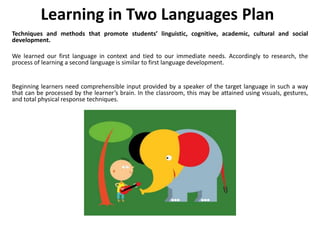
Beginning learners need comprehensible input provided by a speaker of the target language in such a way
that can be processed by the learner’s brain. In the classroom, this may be attained using visuals, gestures,
and total physical response techniques.
Learning in Two Languages Plan
For intermediate students, sheltering and scaffolding language are the best ways to
promote L2 acquisition. Sheltered instructions utilizes also visuals like pictures, graphs and
charts to assist in explaining concepts; context embedded instruction (based on authentic
experiences) and communicative opportunities in the social environment. At this stage,
students are able to learn language through content and content through language using
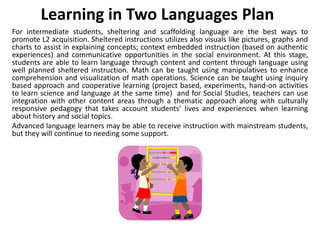
well planned sheltered instruction. Math can be taught using manipulatives to enhance
comprehension and visualization of math operations. Science can be taught using inquiry
based approach and cooperative learning (project based, experiments, hand-on activities
to learn science and language at the same time) and for Social Studies, teachers can use
integration with other content areas through a thematic approach along with culturally
responsive pedagogy that takes account students’ lives and experiences when learning
about history and social topics.
Advanced language learners may be able to receive instruction with mainstream students,
but they will continue to needing some support.
Learning in Two Languages Plan
Reyes and Klein in our text book describe additional considerations for teaching
bilingual students:
-Recognizing and teaching the specialized language of the content area.
-Addressing the cultural or experimental and linguistic challenges of texts by
reading aloud and paraphrasing passage.
-Using a thematic approach to teaching content
-providing hands on materials for active learning
-Employing graphic organizers for teaching and assessment so as to limit the
amount of written text that students have to process.
-Using native language where feasible and appropriate.
-Maximizing the use of sheltered English when necessary to make the content
comprehensible and insuring that content area teaching is not delayed until
students have enough fluency in English.
In my classroom, at the preschool level I use bilingual simple books, bilingual
songs and finger plays to introduce English. I use total physical response with
simple commands and simple phrases during appropriate social situations like
“open the door”, “line up” “do you want juice or milk?”
Learning in Two Languages Plan
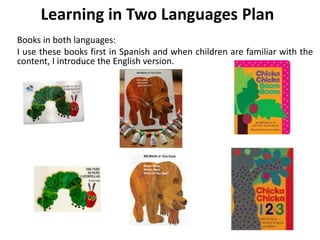
Books in both languages:
I use these books first in Spanish and when children are familiar with the
content, I introduce the English version.
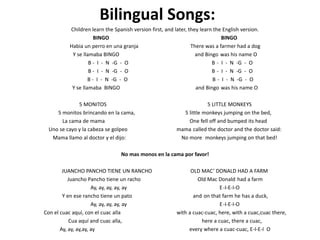
Bilingual Songs:
Children learn the Spanish version first, and later, they learn the English version.
BINGO BINGO
Habia un perro en una granja There was a farmer had a dog
Y se llamaba BINGO and Bingo was his name O
B - I - N -G - O B - I - N -G - O
Y se llamaba BINGO and Bingo was his name O
5 MONITOS 5 LITTLE MONKEYS
5 monitos brincando en la cama, 5 little monkeys jumping on the bed,
La cama de mama One fell off and bumped its head
Uno se cayo y la cabeza se golpeo mama called the doctor and the doctor said:
Mama llamo al doctor y el dijo: No more monkeys jumping on that bed!
No mas monos en la cama por favor!
JUANCHO PANCHO TIENE UN RANCHO OLD MAC’ DONALD HAD A FARM
Juancho Pancho tiene un racho Old Mac Donald had a farm
Ay, ay, ay, ay, ay E-I-E-I-O
Y en ese rancho tiene un pato and on that farm he has a duck,
Ay, ay, ay, ay, ay E-I-E-I-O
Con el cuac aquí, con el cuac alla with a cuac-cuac, here, with a cuac,cuac there,
Cua aquí and cuac alla, here a cuac, there a cuac,
Ay, ay, ay,ay, ay every where a cuac-cuac, E-I-E-I O
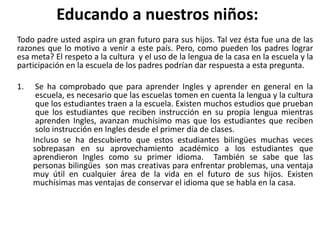
Educando a nuestros niños:
Todo padre usted aspira un gran futuro para sus hijos. Tal vez ésta fue una de las
razones que lo motivo a venir a este país. Pero, como pueden los padres lograr
esa meta? El respeto a la cultura y el uso de la lengua de la casa en la escuela y la
participación en la escuela de los padres podrían dar respuesta a esta pregunta.
1. Se ha comprobado que para aprender Ingles y aprender en general en la
escuela, es necesario que las escuelas tomen en cuenta la lengua y la cultura
que los estudiantes traen a la escuela. Existen muchos estudios que prueban
que los estudiantes que reciben instrucción en su propia lengua mientras
aprenden Ingles, avanzan muchísimo mas que los estudiantes que reciben
solo instrucción en Ingles desde el primer día de clases.
Incluso se ha descubierto que estos estudiantes bilingües muchas veces
sobrepasan en su aprovechamiento académico a los estudiantes que
aprendieron Ingles como su primer idioma. También se sabe que las
personas bilingües son mas creativas para enfrentar problemas, una ventaja
muy útil en cualquier área de la vida en el futuro de sus hijos. Existen
muchísimas mas ventajas de conservar el idioma que se habla en la casa.
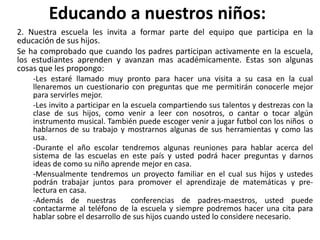
2. Nuestra escuela les invita a formar parte del equipo que participa en la
educación de sus hijos.
Se ha comprobado que cuando los padres participan activamente en la escuela,
los estudiantes aprenden y avanzan mas académicamente. Estas son algunas
cosas que les propongo:
-Les estaré llamado muy pronto para hacer una visita a su casa en la cual
llenaremos un cuestionario con preguntas que me permitirán conocerle mejor
para servirles mejor.
-Les invito a participar en la escuela compartiendo sus talentos y destrezas con la
clase de sus hijos, como venir a leer con nosotros, o cantar o tocar algún
instrumento musical. También puede escoger venir a jugar futbol con los niños o
hablarnos de su trabajo y mostrarnos algunas de sus herramientas y como las
usa.
-Durante el año escolar tendremos algunas reuniones para hablar acerca del
sistema de las escuelas en este país y usted podrá hacer preguntas y darnos
ideas de como su niño aprende mejor en casa.
-Mensualmente tendremos un proyecto familiar en el cual sus hijos y ustedes
podrán trabajar juntos para promover el aprendizaje de matemáticas y pre-
lectura en casa.
-Además de nuestras conferencias de padres-maestros, usted puede
contactarme al teléfono de la escuela y siempre podremos hacer una cita para
hablar sobre el desarrollo de sus hijos cuando usted lo considere necesario.
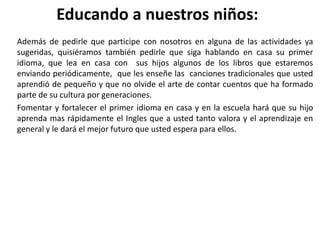
Educando a nuestros niños:
Además de pedirle que participe con nosotros en alguna de las actividades ya
sugeridas, quisiéramos también pedirle que siga hablando en casa su primer
idioma, que lea en casa con sus hijos algunos de los libros que estaremos
enviando periódicamente, que les enseñe las canciones tradicionales que usted
aprendió de pequeño y que no olvide el arte de contar cuentos que ha formado
parte de su cultura por generaciones.
Fomentar y fortalecer el primer idioma en casa y en la escuela hará que su hijo
aprenda mas rápidamente el Ingles que a usted tanto valora y el aprendizaje en
general y le dará el mejor futuro que usted espera para ellos.

Learning in Two Languages Plan

  • 1.
    Learning in TwoLanguages Plan Bilingual Education for preschoolers with special needs. I work at Nye ECC. This is a SFPS Special Education Preschool Center in a bilingual classroom. Because most of my students have been diagnosed with Speech/Language Impairment in their first language (Spanish) we speak Spanish most of the time. I use the 90/10 bilingual model. These means we have a certain group time devoted for reading and singing in English. I also use English in context during lunch time and other social contexts.
  • 2.
    Learning in TwoLanguages Plan Engaging Parents Research has proved that parent’s participation at school yells to multiple academic and social benefits for students. I plan to restart the process of engagement next school year with prearranged home visits followed by questionnaires to learn about students and their families. In my previous practice I have invited parents to participate in the educational curriculum using their funds of knowledge by sharing their real world experiences: Parents had come to cook, shared their experiences and talked about their jobs; they have shared their skills and talents with the students by playing a musical instrument and singing. I would be great for next school years to have some parents to come to teach children how to play football soccer. Since I am myself an immigrant parent, I have felt the need to I tell parents about the differences between their home country school system and American school system. I have done so individually with each parent, but maybe next school year we may schedule some time to talk about it with a group of parents. Also, I would like to invite parents to a couple of meetings to talk and discuss together about best practices for helping children to learn at the preschool level and to talk about the educational benefits of preserving native language at home and at school. We could also plan some family projects that support literacy and math learning described in Service of Learning article(by Rahima Wade in EL Magazine May 2011 Vol. 68, Number 8).
  • 3.
    Learning in TwoLanguages Plan Fostering billiteracy, bilingualism and biculturalism Our school is very open to respect students’ culture and language. Administrators often speak during the IEP meetings about the importance of students receiving instruction in their first language in order for them to advance in their development; and the school has recently adopted a new preschool curriculum with bilingual components. The main problem though, is the lack of bilingual teachers. Although all children receive appropriate therapies in their first language, many of them (monolingual Spanish students with Speech/Language Impairment) are placed in English only classrooms because there are not enough bilingual teachers.
  • 4.
    Learning in TwoLanguages Plan Classroom policies that lead to the development of billiteracy, bilingualism and biculturalism are based on Culturally Responsive Pedagogy and they start with teacher’s right attitude toward cultural diverse students. Second, students should be guided to value their culture and language and use it a tool for learning: In a classroom that values bilingualism and biculturalism “students’ cultures become an integral part of the instruction, rather than merely being added on the curriculum”. Then, they need to learn how to live in a new culture, or explicitly teaching what the culture of power values, accept and reject and the cultural capital associated with it. The result expected is the development of a bicultural identity.
  • 5.
    Learning in TwoLanguages Plan Techniques and methods that promote students’ linguistic, cognitive, academic, cultural and social development. We learned our first language in context and tied to our immediate needs. Accordingly to research, the process of learning a second language is similar to first language development. Beginning learners need comprehensible input provided by a speaker of the target language in such a way that can be processed by the learner’s brain. In the classroom, this may be attained using visuals, gestures, and total physical response techniques.
  • 6.
    Learning in TwoLanguages Plan For intermediate students, sheltering and scaffolding language are the best ways to promote L2 acquisition. Sheltered instructions utilizes also visuals like pictures, graphs and charts to assist in explaining concepts; context embedded instruction (based on authentic experiences) and communicative opportunities in the social environment. At this stage, students are able to learn language through content and content through language using well planned sheltered instruction. Math can be taught using manipulatives to enhance comprehension and visualization of math operations. Science can be taught using inquiry based approach and cooperative learning (project based, experiments, hand-on activities to learn science and language at the same time) and for Social Studies, teachers can use integration with other content areas through a thematic approach along with culturally responsive pedagogy that takes account students’ lives and experiences when learning about history and social topics. Advanced language learners may be able to receive instruction with mainstream students, but they will continue to needing some support.
  • 7.
    Learning in TwoLanguages Plan Reyes and Klein in our text book describe additional considerations for teaching bilingual students: -Recognizing and teaching the specialized language of the content area. -Addressing the cultural or experimental and linguistic challenges of texts by reading aloud and paraphrasing passage. -Using a thematic approach to teaching content -providing hands on materials for active learning -Employing graphic organizers for teaching and assessment so as to limit the amount of written text that students have to process. -Using native language where feasible and appropriate. -Maximizing the use of sheltered English when necessary to make the content comprehensible and insuring that content area teaching is not delayed until students have enough fluency in English. In my classroom, at the preschool level I use bilingual simple books, bilingual songs and finger plays to introduce English. I use total physical response with simple commands and simple phrases during appropriate social situations like “open the door”, “line up” “do you want juice or milk?”
  • 8.
    Learning in TwoLanguages Plan Books in both languages: I use these books first in Spanish and when children are familiar with the content, I introduce the English version.
  • 9.
    Bilingual Songs: Children learnthe Spanish version first, and later, they learn the English version. BINGO BINGO Habia un perro en una granja There was a farmer had a dog Y se llamaba BINGO and Bingo was his name O B - I - N -G - O B - I - N -G - O B - I - N -G - O B - I - N -G - O B - I - N -G - O B - I - N -G - O Y se llamaba BINGO and Bingo was his name O 5 MONITOS 5 LITTLE MONKEYS 5 monitos brincando en la cama, 5 little monkeys jumping on the bed, La cama de mama One fell off and bumped its head Uno se cayo y la cabeza se golpeo mama called the doctor and the doctor said: Mama llamo al doctor y el dijo: No more monkeys jumping on that bed! No mas monos en la cama por favor! JUANCHO PANCHO TIENE UN RANCHO OLD MAC’ DONALD HAD A FARM Juancho Pancho tiene un racho Old Mac Donald had a farm Ay, ay, ay, ay, ay E-I-E-I-O Y en ese rancho tiene un pato and on that farm he has a duck, Ay, ay, ay, ay, ay E-I-E-I-O Con el cuac aquí, con el cuac alla with a cuac-cuac, here, with a cuac,cuac there, Cua aquí and cuac alla, here a cuac, there a cuac, Ay, ay, ay,ay, ay every where a cuac-cuac, E-I-E-I O
  • 10.
    Educando a nuestrosniños: Todo padre usted aspira un gran futuro para sus hijos. Tal vez ésta fue una de las razones que lo motivo a venir a este país. Pero, como pueden los padres lograr esa meta? El respeto a la cultura y el uso de la lengua de la casa en la escuela y la participación en la escuela de los padres podrían dar respuesta a esta pregunta. 1. Se ha comprobado que para aprender Ingles y aprender en general en la escuela, es necesario que las escuelas tomen en cuenta la lengua y la cultura que los estudiantes traen a la escuela. Existen muchos estudios que prueban que los estudiantes que reciben instrucción en su propia lengua mientras aprenden Ingles, avanzan muchísimo mas que los estudiantes que reciben solo instrucción en Ingles desde el primer día de clases. Incluso se ha descubierto que estos estudiantes bilingües muchas veces sobrepasan en su aprovechamiento académico a los estudiantes que aprendieron Ingles como su primer idioma. También se sabe que las personas bilingües son mas creativas para enfrentar problemas, una ventaja muy útil en cualquier área de la vida en el futuro de sus hijos. Existen muchísimas mas ventajas de conservar el idioma que se habla en la casa.
  • 11.
    2. Nuestra escuelales invita a formar parte del equipo que participa en la educación de sus hijos. Se ha comprobado que cuando los padres participan activamente en la escuela, los estudiantes aprenden y avanzan mas académicamente. Estas son algunas cosas que les propongo: -Les estaré llamado muy pronto para hacer una visita a su casa en la cual llenaremos un cuestionario con preguntas que me permitirán conocerle mejor para servirles mejor. -Les invito a participar en la escuela compartiendo sus talentos y destrezas con la clase de sus hijos, como venir a leer con nosotros, o cantar o tocar algún instrumento musical. También puede escoger venir a jugar futbol con los niños o hablarnos de su trabajo y mostrarnos algunas de sus herramientas y como las usa. -Durante el año escolar tendremos algunas reuniones para hablar acerca del sistema de las escuelas en este país y usted podrá hacer preguntas y darnos ideas de como su niño aprende mejor en casa. -Mensualmente tendremos un proyecto familiar en el cual sus hijos y ustedes podrán trabajar juntos para promover el aprendizaje de matemáticas y pre- lectura en casa. -Además de nuestras conferencias de padres-maestros, usted puede contactarme al teléfono de la escuela y siempre podremos hacer una cita para hablar sobre el desarrollo de sus hijos cuando usted lo considere necesario. Educando a nuestros niños:
  • 12.
    Educando a nuestrosniños: Además de pedirle que participe con nosotros en alguna de las actividades ya sugeridas, quisiéramos también pedirle que siga hablando en casa su primer idioma, que lea en casa con sus hijos algunos de los libros que estaremos enviando periódicamente, que les enseñe las canciones tradicionales que usted aprendió de pequeño y que no olvide el arte de contar cuentos que ha formado parte de su cultura por generaciones. Fomentar y fortalecer el primer idioma en casa y en la escuela hará que su hijo aprenda mas rápidamente el Ingles que a usted tanto valora y el aprendizaje en general y le dará el mejor futuro que usted espera para ellos.