MIPIM 2012:
 Insights from participants


Prof. François Ortalo-Magné
Albert O. Nicholas Dean
Wisconsin School of Business
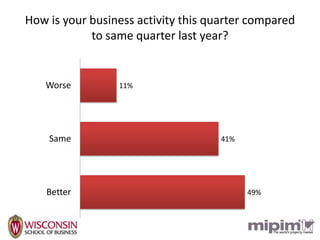
How is your business activity this quarter compared
            to same quarter last year?


   Worse         11%


    Same                             41%


    Better                                 49%
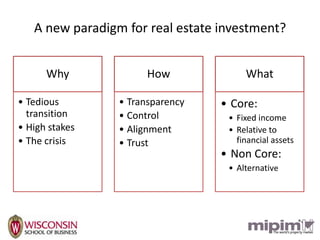
A new paradigm for real estate investment?


      Why              How             What

• Tedious        • Transparency   • Core:
  transition     • Control         • Fixed income
• High stakes    • Alignment       • Relative to
• The crisis     • Trust             financial assets
                                  • Non Core:
                                   • Alternative
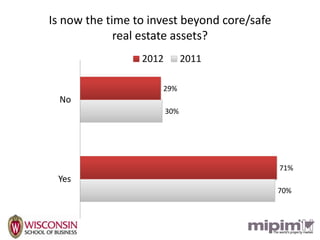
Is now the time to invest beyond core/safe
             real estate assets?
                 2012         2011

                     29%
  No
                        30%


                                             71%
 Yes
                                             70%
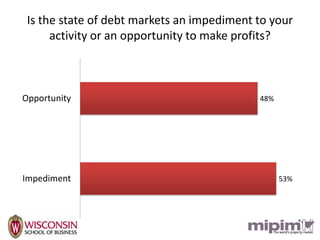
Is the state of debt markets an impediment to your
      activity or an opportunity to make profits?


Opportunity                                 48%


Impediment                                        53%
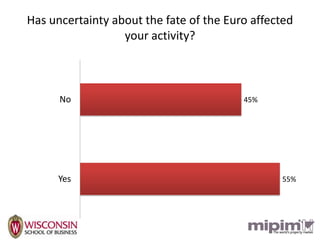
Has uncertainty about the fate of the Euro affected
                  your activity?


      No                                 45%


      Yes                                       55%
Proactive and competitive cities


    Low Risk           Spillovers          Concerns

• Fiscal            • Infrastructure    • Who pays?
  responsibility    • Catalysts         • Elections
• Social            • Cultural change   • National
  responsibility                          framework
• Local DNA
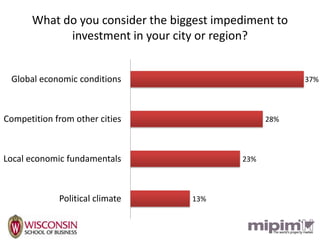
What do you consider the biggest impediment to
            investment in your city or region?


 Global economic conditions                            37%


Competition from other cities                    28%


Local economic fundamentals                23%


             Political climate    13%
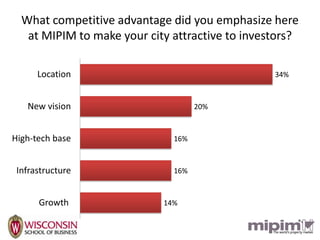
What competitive advantage did you emphasize here
   at MIPIM to make your city attractive to investors?

      Location                                   34%


   New vision                       20%


High-tech base                16%


 Infrastructure               16%


      Growth                14%
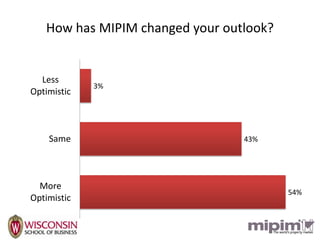
How has MIPIM changed your outlook?


  Less
             3%
Optimistic


    Same                         43%


  More
                                         54%
Optimistic
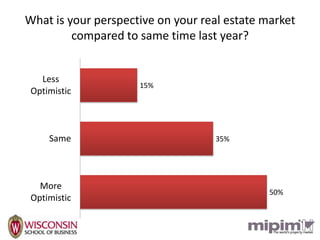
What is your perspective on your real estate market
         compared to same time last year?


   Less
                     15%
 Optimistic


     Same                          35%


   More
                                              50%
 Optimistic
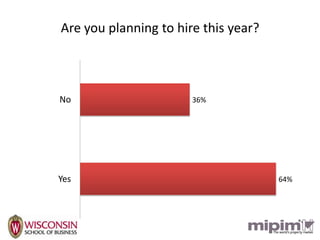
Are you planning to hire this year?


No                     36%


Yes                                   64%
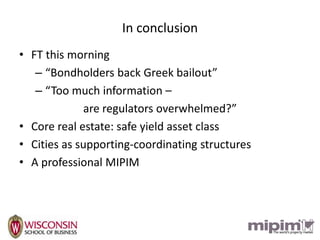
In conclusion
• FT this morning
   – “Bondholders back Greek bailout”
   – “Too much information –
             are regulators overwhelmed?”
• Core real estate: safe yield asset class
• Cities as supporting-coordinating structures
• A professional MIPIM
Survey conducted by

The Wisconsin Real Estate MBA Class of 2013
           With the support of
           Prof. Erwan Quintin

MIPIM 2012 - Wrap-Up Keynote address from Francois Ortalo-Magne

  • 1.
    MIPIM 2012: Insightsfrom participants Prof. François Ortalo-Magné Albert O. Nicholas Dean Wisconsin School of Business
  • 2.
    How is yourbusiness activity this quarter compared to same quarter last year? Worse 11% Same 41% Better 49%
  • 3.
    A new paradigmfor real estate investment? Why How What • Tedious • Transparency • Core: transition • Control • Fixed income • High stakes • Alignment • Relative to • The crisis • Trust financial assets • Non Core: • Alternative
  • 4.
    Is now thetime to invest beyond core/safe real estate assets? 2012 2011 29% No 30% 71% Yes 70%
  • 5.
    Is the stateof debt markets an impediment to your activity or an opportunity to make profits? Opportunity 48% Impediment 53%
  • 6.
    Has uncertainty aboutthe fate of the Euro affected your activity? No 45% Yes 55%
  • 7.
    Proactive and competitivecities Low Risk Spillovers Concerns • Fiscal • Infrastructure • Who pays? responsibility • Catalysts • Elections • Social • Cultural change • National responsibility framework • Local DNA
  • 8.
    What do youconsider the biggest impediment to investment in your city or region? Global economic conditions 37% Competition from other cities 28% Local economic fundamentals 23% Political climate 13%
  • 9.
    What competitive advantagedid you emphasize here at MIPIM to make your city attractive to investors? Location 34% New vision 20% High-tech base 16% Infrastructure 16% Growth 14%
  • 10.
    How has MIPIMchanged your outlook? Less 3% Optimistic Same 43% More 54% Optimistic
  • 11.
    What is yourperspective on your real estate market compared to same time last year? Less 15% Optimistic Same 35% More 50% Optimistic
  • 12.
    Are you planningto hire this year? No 36% Yes 64%
  • 13.
    In conclusion • FTthis morning – “Bondholders back Greek bailout” – “Too much information – are regulators overwhelmed?” • Core real estate: safe yield asset class • Cities as supporting-coordinating structures • A professional MIPIM
  • 14.
    Survey conducted by TheWisconsin Real Estate MBA Class of 2013 With the support of Prof. Erwan Quintin

Editor's Notes

  • #2 Last Year: Theme: money chasing safe yieldFocus on the Fabulous Four: Paris, London, New York and Washington DC. Global economy and the US Federal governmentMoving to Germany: strong yield performanceComplain: tough to find deals and to execute
  • #3 We asked you how to you feel compare to last year
  • #4 Tedious transitionAcross continents: Toward China and AsiaWithin continents:Gridlock in American politicsGridlock within the EU.Everywhere asking what will be the role of government, the scope of regulationsThe stakes are high:Unchartered territory in terms of fiscal policy and monetary policyEuro crisis: Joschka Fischer -> the historical perspective; only two ways forward: further integration or break down of the whole process. First time in history political integration that does not come from war.The crisis taught us a few lessons:Limitations of financial contracts to ensure alignment and efficient resolutions Due diligence matters!So we are trying to reinvent ourselves. How?Greater transparencyStart with more data on the marketData on specific investmentsGreater communication on strategy, business plan, what happens ifSuccessFailuresMore data and more communication opens the door to more controlFalse security? More problems?Control requires expertise – risk of duplication? Is that being good stewards of the savers money?Control comes with liability If all the LP have some control then investing requires due diligence on GP and on every other LP!!!Control is limitedSo we hear about alignment – finding likeminded investors – likemindedness, a new word for this year.Investors with same interest, do joint ventures and club deal. Share in the gains and the losses, Share control.Works for the large playersNot everyone can plan the JV game. The structured finance, GP-LP game is here to stay. Structured finance, to the extent differentiates claims by level of seniority, guarantees our interests will not always be aligned. Possibly on the way up, but not on the way down.Also, real estate is local. Can’t have expertise in every market. So we talk about finding partners we trust.What is trust?IntegrityIf we get into a tough situation, I trust you to treat me fairly. But contract take care of that. There is more to it: example US when equity investor is out of the money and bank do not squeeze them outManagement of the asset – one factorFuture deals, expectation of profits together in the future.I think this is what we mean by trust: I look at your track record and I feel that over the coming years, you will bring a string of deals to me that will on average be profitable. So even if a particular deal right now, I have the right to squeeze you out and I would benefit from squeezing you out, I won’t do it because I trust that tomorrow, you may bring me a deal that is profitable. Trusting in your future aligns our interest: our profits tomorrow will be greater if we keep cooperating even if today, I could make a short gain by squeezing you out.If trust matters, track record matters. I wonder what it means for the ability of new players to enter the market. Maybe that good for the big established platform where the brand value replaces the individual’s track record. Or for the experienced niche players.What are people investing in?Mark covered the various market opportunities around the world.This year at MIPIM we heard about core assets in and outside the central city, or core assets in nearby cities (London subcenters, or Birmingham).US beyond NYC, no longer Washington (Republicans will win? Employment in DC depends a lot in private sector on federal government)Brazil, Turkey, Poland and other Eastern European countries.Really about safe yields, about core assets.We all share the view that RE has become a legitimate asset class. Listening to market participants this year, I wonder about the concept.Rather, I would submit to you that core RE has become a legitimate asset class, a legitimate component of financial portfolios, seating alongside stocks and bonds.It is a useful complement to other financial assets because of the low risk and high yield.If that is the case, then core RE is akin to a fixed income asset. Investment allocation are driven by performance relative to other financial asset. And right now, bonds are not delivering yield. So RE is the preferred asset for yield. What will happen when markets turn?And for these players, if you want to move out of safe yield toward more growth or more risk: why stick to real estate? Move toward more stocks.The non-core business does to remain part of alternative strategies. Not surprising we hear of private equity and hedge fund activityRoom for focused niche players with a track record.
  • #8 Cities:First year we hear cities selling themselves for their low-risk: Helsinki, MississaugaLow risk is about fiscal responsibilityIt’s also about social responsibility: how we deal with our population. Handling local inequalities for exampleIt’s about respecting the local DNA. Qatar presenting who they are and what they are about, possibly in contrast to the way Dubai used to present itself here at MIPIMFocus of action on harnessing spillovers from public actionInfrastructure investmentCatalyst investments : CopenhagenConcerns:Who pays? Wide cultural differences across countries on ability to charge users, to charge taxpayersCities know to use the value conferred on land by their regulatory powers.National framework for local action: constant complaint from city leaders. National interference. With regards to infrastructure in particular it is an issue because Elections: Good plans are long term plans. London 75 year plan for Olympic village may be extreme but a few mayors talked about planning over 4-6 election cycles