Topics covered: medical office building (MOB) sales trends, national CRE
         values, MOB leasing activity, capital markets, and a market forecast

                                                                 Fact #4: Metro Atlantaโ€™s MOB vacancy rate is 19%ยฒ
                  Medical Office Sales
                                                                 Fact #5: Net absportion for MOB space is negative 104,193
                                                                 square feet YTDยฒ
   700                                                           Advice to tenants: landlords are more willing to consider
   600                                                           incentives such as turn-key space and a few months of free
                                                                 rent; however, very few medical buildings are distressed
   500
                                                 number of       Advice to landlords: review your investment strategy to
   400
                                                 transactions    decide whether to add tenants in this environment or wait
   300
                                                 volume in
                                                                 until the market stabalizes
   200                                           (10,000,000s)
   100
                                                                  Fact #6: 80% LTV, interest only, 10 year debt at a 5.5%
     0
                                                                  interest rate is gone. This has been replaced by mid 6s to
          2007       2008        2009
                                                                  low 7s interest rates, 60-70% LTV, 5 year debt. Also, non-
                                                                  recourse is basically non-existent.
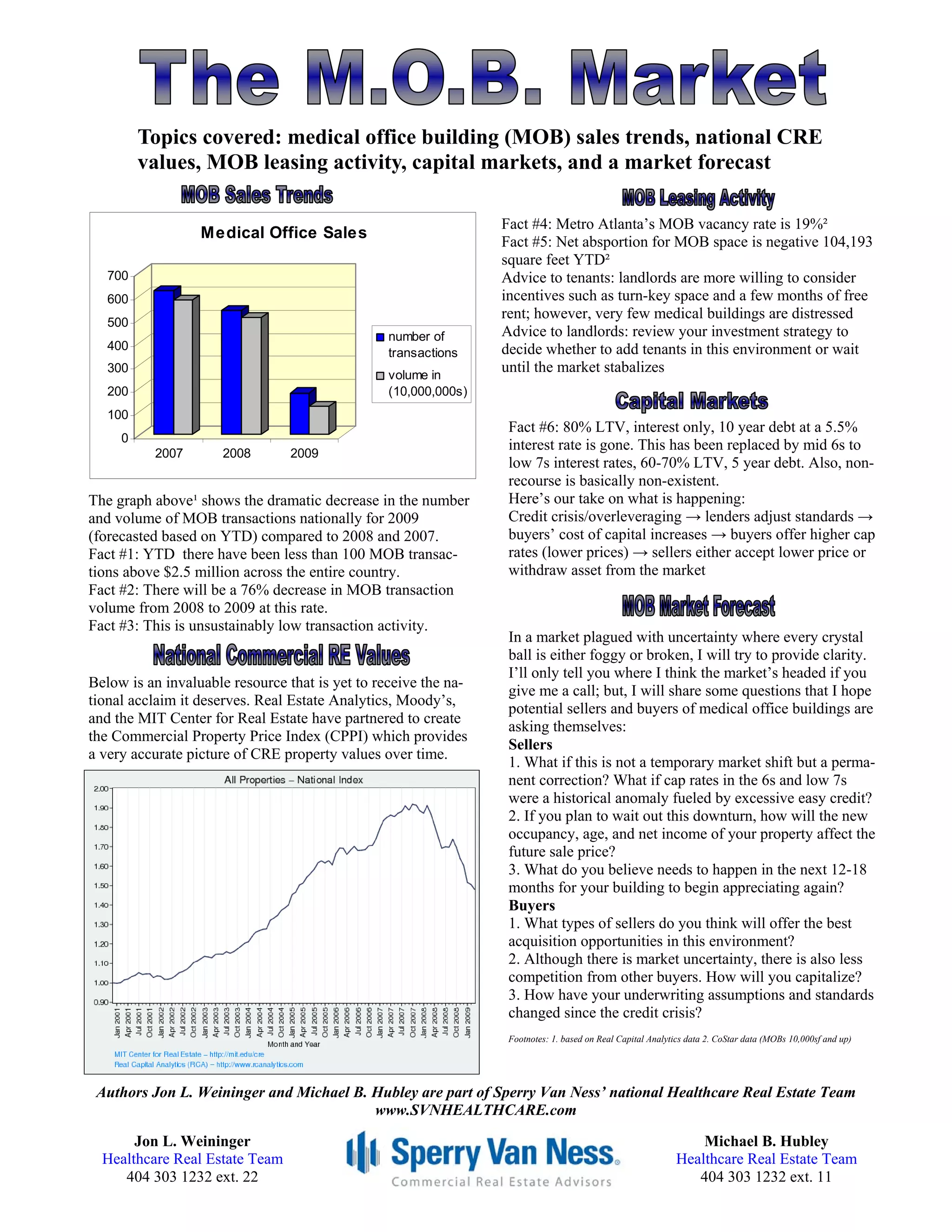
The graph aboveยน shows the dramatic decrease in the number        Hereโ€™s our take on what is happening:
and volume of MOB transactions nationally for 2009                Credit crisis/overleveraging โ†’ lenders adjust standards โ†’
(forecasted based on YTD) compared to 2008 and 2007.              buyersโ€™ cost of capital increases โ†’ buyers offer higher cap
Fact #1: YTD there have been less than 100 MOB transac-           rates (lower prices) โ†’ sellers either accept lower price or
tions above $2.5 million across the entire country.               withdraw asset from the market
Fact #2: There will be a 76% decrease in MOB transaction
volume from 2008 to 2009 at this rate.
Fact #3: This is unsustainably low transaction activity.
                                                                  In a market plagued with uncertainty where every crystal
                                                                  ball is either foggy or broken, I will try to provide clarity.
                                                                  Iโ€™ll only tell you where I think the marketโ€™s headed if you
Below is an invaluable resource that is yet to receive the na-
                                                                  give me a call; but, I will share some questions that I hope
tional acclaim it deserves. Real Estate Analytics, Moodyโ€™s,
                                                                  potential sellers and buyers of medical office buildings are
and the MIT Center for Real Estate have partnered to create
                                                                  asking themselves:
the Commercial Property Price Index (CPPI) which provides
                                                                  Sellers
a very accurate picture of CRE property values over time.
                                                                  1. What if this is not a temporary market shift but a perma-
                                                                  nent correction? What if cap rates in the 6s and low 7s
                                                                  were a historical anomaly fueled by excessive easy credit?
                                                                  2. If you plan to wait out this downturn, how will the new
                                                                  occupancy, age, and net income of your property affect the
                                                                  future sale price?
                                                                  3. What do you believe needs to happen in the next 12-18
                                                                  months for your building to begin appreciating again?
                                                                  Buyers
                                                                  1. What types of sellers do you think will offer the best
                                                                  acquisition opportunities in this environment?
                                                                  2. Although there is market uncertainty, there is also less
                                                                  competition from other buyers. How will you capitalize?
                                                                  3. How have your underwriting assumptions and standards
                                                                  changed since the credit crisis?
                                                                  Footnotes: 1. based on Real Capital Analytics data 2. CoStar data (MOBs 10,000sf and up)


 Authors Jon L. Weininger and Michael B. Hubley are part of Sperry Van Nessโ€™ national Healthcare Real Estate Team
                                         www.SVNHEALTHCARE.com
       Jon L. Weininger                                                                                          Michael B. Hubley
  Healthcare Real Estate Team                                                                                Healthcare Real Estate Team
     404 303 1232 ext. 22                                                                                       404 303 1232 ext. 11

Medical Office Market

  • 1.
    Topics covered: medicaloffice building (MOB) sales trends, national CRE values, MOB leasing activity, capital markets, and a market forecast Fact #4: Metro Atlantaโ€™s MOB vacancy rate is 19%ยฒ Medical Office Sales Fact #5: Net absportion for MOB space is negative 104,193 square feet YTDยฒ 700 Advice to tenants: landlords are more willing to consider 600 incentives such as turn-key space and a few months of free rent; however, very few medical buildings are distressed 500 number of Advice to landlords: review your investment strategy to 400 transactions decide whether to add tenants in this environment or wait 300 volume in until the market stabalizes 200 (10,000,000s) 100 Fact #6: 80% LTV, interest only, 10 year debt at a 5.5% 0 interest rate is gone. This has been replaced by mid 6s to 2007 2008 2009 low 7s interest rates, 60-70% LTV, 5 year debt. Also, non- recourse is basically non-existent. The graph aboveยน shows the dramatic decrease in the number Hereโ€™s our take on what is happening: and volume of MOB transactions nationally for 2009 Credit crisis/overleveraging โ†’ lenders adjust standards โ†’ (forecasted based on YTD) compared to 2008 and 2007. buyersโ€™ cost of capital increases โ†’ buyers offer higher cap Fact #1: YTD there have been less than 100 MOB transac- rates (lower prices) โ†’ sellers either accept lower price or tions above $2.5 million across the entire country. withdraw asset from the market Fact #2: There will be a 76% decrease in MOB transaction volume from 2008 to 2009 at this rate. Fact #3: This is unsustainably low transaction activity. In a market plagued with uncertainty where every crystal ball is either foggy or broken, I will try to provide clarity. Iโ€™ll only tell you where I think the marketโ€™s headed if you Below is an invaluable resource that is yet to receive the na- give me a call; but, I will share some questions that I hope tional acclaim it deserves. Real Estate Analytics, Moodyโ€™s, potential sellers and buyers of medical office buildings are and the MIT Center for Real Estate have partnered to create asking themselves: the Commercial Property Price Index (CPPI) which provides Sellers a very accurate picture of CRE property values over time. 1. What if this is not a temporary market shift but a perma- nent correction? What if cap rates in the 6s and low 7s were a historical anomaly fueled by excessive easy credit? 2. If you plan to wait out this downturn, how will the new occupancy, age, and net income of your property affect the future sale price? 3. What do you believe needs to happen in the next 12-18 months for your building to begin appreciating again? Buyers 1. What types of sellers do you think will offer the best acquisition opportunities in this environment? 2. Although there is market uncertainty, there is also less competition from other buyers. How will you capitalize? 3. How have your underwriting assumptions and standards changed since the credit crisis? Footnotes: 1. based on Real Capital Analytics data 2. CoStar data (MOBs 10,000sf and up) Authors Jon L. Weininger and Michael B. Hubley are part of Sperry Van Nessโ€™ national Healthcare Real Estate Team www.SVNHEALTHCARE.com Jon L. Weininger Michael B. Hubley Healthcare Real Estate Team Healthcare Real Estate Team 404 303 1232 ext. 22 404 303 1232 ext. 11