CBRE


                                                                                              Italy ViewPoint
www.cbre.it/research                                                                                                   November 2011


                            Italy: Is a retail upturn possible?
                            By Mario Taccini & Raffaella Pinto


 OVERVIEW
 Given Italy’s role as the nominated country of honour at MAPIC 2011 – the annual international retail property show – CBRE
 has created a special report on Italy to show international players that, behind the newspaper headlines and speculation of recent
 months, lies a two-fold economy and economical players: more sound households and a less reliable political system. The next
 couple of years will be difficult, but we must remember Albert Einstein’s words: “Let's not pretend that things will change
 if we keep doing the same things. A crisis can be a real blessing to any person, to any nation. For all crises bring
 progress.” With this report, CBRE aims to bring the insider aspects of Italy to the attention of international retailers. Despite a
 challenging economic outlook and an ageing population, a strong development pipeline, structural market characteristics and
 resilient consumer base are providing exciting opportunities for international retailers to expand.

 KEY THEMES
 •   Italy is one of the most populated countries in Europe
 •   Italian households are sound and are among the wealthiest and the least in debt in Europe
 •   Italian households have a high level of consumption
 •   The Italian retail market is highly fragmented and the modern retail penetration rate is one of the lowest in Europe (48% versus
     an average of 65%)
 •   Barriers to entry prevent the risk of over-supply
 •   Market fundamentals are sound: rents and retail trade are stable, vacancy levels remain low
 •   The development pipeline is stable and sustainable
 •   In CBRE’s How Active are Retailers in EMEA? survey, which examines expansion plans of leading retailers across the region,
     Italy took top spot. Almost half (47%) of the retailers surveyed are looking to expand there in 2012.

 These factors lead us to believe that Italy should be a potential target destination for both retailers and investors.


 ECONOMIC FUNDAMENTALS ARE WEAKENING…
 Late July and early August 2011 saw extreme volatility in the financial markets. This has been reflected most obviously in
 the substantial movements in stock markets worldwide. Italy is struggling to be kept separate from the other PIIGS countries
 (Portugal, Ireland, Greece and Spain), as its extremely high debt level is increasingly worrying. Expectations for the future
 have definitely changed all over the world and economic growth expectations have been cut, standing largely below 1%
 for Italy over the next couple of years. According to latest official data from The National Institute for Statistics (Istat), Italy's
 GDP grew by 0.8% in Q2 2011 compared to Q2 2010, and by 0.3% compared to Q1 2011. Over the beginning of Q3,
 tensions over sovereign debt spread to Italy, increasing fears over the future stability of the country. The Italian GDP/debt
 ratio remains high, and the government swiftly passed a budget plan in July to balance the budget by 2014. Due to low
 confidence in the national economic climate and increasing inflationary pressures, the Consumer Confidence Index
 weakened again in September, standing at 98.5, down from 100.3 in August, continuing the declining trend since
 December 2010 when it had slightly improved to 109.1. In July 2011, the seasonally adjusted retail trade index according
 to Istat decreased by 0.1% over June, with food goods decreasing by 0.3% and non-food goods by 0.1%. The average of
 the last three months compared to the previous three months decreased by 0.4%.


                                                                                                                            ©2011, CBRE, Spa.
Italy ViewPoint

                  …BUT THE REGIONAL GAP IS STILL WIDE                                                         Regional population and unemployment, Italy
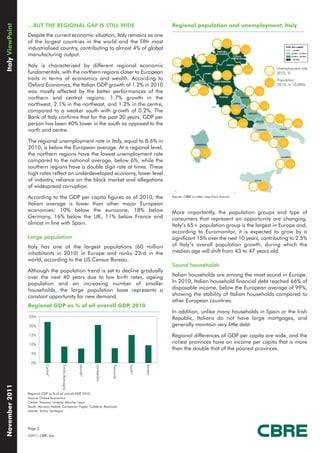
                  Despite the current economic situation, Italy remains as one
                  of the largest countries in the world and the fifth most                                                                3.5 103
                  industrialised country, contributing to almost 4% of global                                                                            5.7    123
                  manufacturing output.
                                                                                                                                 5.6    983
                                                                                                               4.4    13
                  Italy is characterised by different regional economic                                                                                                                Unemployment rate
                                                                                                                                                          5.8    491
                  fundamentals, with the northern regions closer to European                                                                                                     0.0   2010, %
                                                                                                                                          5.7    439
                  traits in terms of economics and wealth. According to                                        7.6   445                                                               Population
                                                                                                                                                                                 0.0
                  Oxford Economics, the Italian GDP growth of 1.2% in 2010                                                                                                             2010, in 10,000s
                  was mostly affected by the better performances of the                                                    6.5    161     6.1    373                 5.7   156
                  northern and central regions: 1.7% growth in the
                  northwest, 2.1% in the northeast, and 1.2% in the centre,                                                                                            8.8   134
                  compared to a weaker south with growth of 0.2%. The                                                                           6.6       90
                  Bank of Italy confirms that for the past 30 years, GDP per                                                                                                     8.4      32
                  person has been 40% lower in the south as opposed to the                                                                              9.3    568                             13.5 408
                  north and centre.
                                                                                                                                                                       14.0 582
                  The regional unemployment rate in Italy, equal to 8.6% in                                                                                                        13.0    59
                  2010, is below the European average. At a regional level,
                  the northern regions have the lowest unemployment rate                                                   14.1 167

                  compared to the national average, below 6%, while the
                                                                                                                                                                                       11.9 200
                  southern regions have a double digit rate at times. These
                  high rates reflect an underdeveloped economy, lower level
                  of industry, reliance on the black market and allegations
                  of widespread corruption.                                                                                                                           14.7 504

                  According to the GDP per capita figures as of 2010, the                                     Source: CBRE on Istat, map from Sincron

                  Italian average is lower than other major European
                  economies: 10% below the eurozone, 18% below                                                More importantly, the population groups and type of
                  Germany, 16% below the UK, 11% below France and                                             consumers that represent an opportunity are changing.
                  almost in line with Spain.                                                                  Italy’s 65+ population group is the largest in Europe and,
                                                                                                              according to Euromonitor, it is expected to grow by a
                  Large population                                                                            significant 15% over the next 10 years, contributing to 2.5%
                  Italy has one of the largest populations (60 million                                        of Italy’s overall population growth, during which the
                  inhabitants in 2010) in Europe and ranks 23rd in the                                        median age will shift from 43 to 47 years old.
                  world, according to the US Census Bureau.
                                                                                                              Sound households
                  Although the population trend is set to decline gradually
                  over the next 40 years due to low birth rates, ageing                                       Italian households are among the most sound in Europe.
                  population and an increasing number of smaller                                              In 2010, Italian household financial debt reached 66% of
                  households, the large population base represents a                                          disposable income, below the European average of 99%,
                  constant opportunity for new demand.                                                        showing the stability of Italian households compared to
                                                                                                              other European countries.
                  Regional GDP as % of all overall GDP 2010
                                                      ,
                                                                                                              In addition, unlike many households in Spain or the Irish
                  25%                                                                                         Republic, Italians do not have large mortgages, and
                  20%                                                                                         generally maintain very little debt.
                  15%                                                                                         Regional differences of GDP per capita are wide, and the
                  10%
                                                                                                              richest provinces have an income per capita that is more
                                                                                                              than the double that of the poorest provinces.
                    5%

                    0%
                              Centre*


                                         Emilia-Romagna


                                                          Islands*


                                                                     Lombardia


                                                                                 Piemonte


                                                                                            South*


                                                                                                     Veneto
November 2011


                  Regional GDP as % of all overall GDP 2010
                                                      ,
                  Source: Oxford Economics
                  Centre: Toscana, Umbria, Marche, Lazio
                  South: Abruzzo, Molise, Campania, Puglia, Calabria, Basilicata
                  Islands: Sicilia, Sardegna


                  Page 2
                  ©2011, CBRE, Spa.
Italy ViewPoint
For example, Milan and Bolzan have a GDP per capita in             On the same note, since marriage seems to be occurring
the range of €35-40,000, which is more than double that            at a later age, unmarried men have higher disposable
of some southern provinces with a GDP per capita in the            incomes to spend on indulgences like fashion, technology
range of €15-20,000 per capita.                                    and music.

The toll of the recession on Italy’s economy is likely to lead     Age group spending habits
to higher income inequalities as top income earners are
                                                                   Italians have always been passionate about fashion,
expected to show the highest growth over the next five
                                                                   believing that quality and elegance define their history, and
years. Per capita annual disposable income is expected to
                                                                   the recession has not changed this. In 2009, Italian
slightly increase but remain behind the UK and France.
                                                                   spending on clothing (including footwear) as a percentage
                                                                   of total consumption was 7.6%, the highest recorded in
Over the next few years, Italy will continue to feel the effects   Europe (it was around 5% in the UK, Germany and Spain,
of the recession, however, high income earners are unlikely        4-4.5% in France, and below 4% in Poland, Romania and
to change their spending habits significantly, despite having      Hungary).
their wealth reduced.
                                                                                              % of
                                                                          Age                                    % change        Retail
Consumers lifestyle                                                                        population
                                                                         group                                    by 2020      opportunity
                                                                                             2009
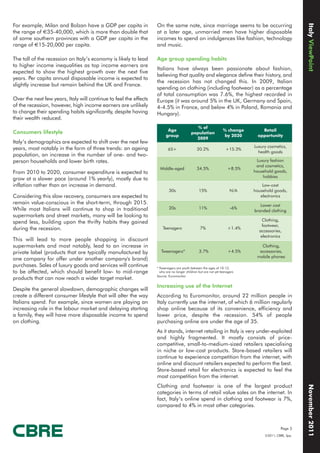
Italy’s demographics are expected to shift over the next few
years, most notably in the form of three trends: an ageing                                                                   Luxury cosmetics,
                                                                          65+                  20.2%               +15.3%
                                                                                                                               health goods
population, an increase in the number of one- and two-
person households and lower birth rates.                                                                                      Luxury fashion
                                                                                                                              and cosmetics,
                                                                     Middle-aged               34.5%                +8.5%
From 2010 to 2020, consumer expenditure is expected to                                                                       household goods,
                                                                                                                                 hobbies
grow at a slower pace (around 1% yearly), mostly due to
inflation rather than an increase in demand.                                                                                     Low-cost
                                                                           30s                  15%                   N/A    household goods,
Considering this slow recovery, consumers are expected to                                                                       electronics
remain value-conscious in the short-term, through 2015.                                                                         Lower cost
While most Italians will continue to shop in traditional                   20s                  11%                   -6%
                                                                                                                             branded clothing
supermarkets and street markets, many will be looking to
                                                                                                                                 Clothing,
spend less, building upon the thrifty habits they gained
                                                                                                                                 footwear,
during the recession.                                                  Teenagers                 7%                 +1.4%
                                                                                                                               accessories,
                                                                                                                                electronics
This will lead to more people shopping in discount
supermarkets and most notably, lead to an increase in                                                                           Clothing,
private label (products that are typically manufactured by            Tweenagers*               3.7%                 +4.5%     accessories,
                                                                                                                              mobile phones
one company for offer under another company's brand)
purchases. Sales of luxury goods and services will continue        * Tweenagers are youth between the ages of 10-12,
to be affected, which should benefit low- to mid-range               who are no longer children but are not yet teenagers
                                                                   Source: Euromonitor
products that can now reach a wider target market.
                                                                   Increasing use of the Internet
Despite the general slowdown, demographic changes will
create a different consumer lifestyle that will alter the way      According to Euromonitor, around 22 million people in
Italians spend. For example, since women are playing an            Italy currently use the internet, of which 6 million regularly
increasing role in the labour market and delaying starting         shop online because of its convenience, efficiency and
a family, they will have more disposable income to spend           lower price, despite the recession. 54% of people
on clothing.                                                       purchasing online are under the age of 35.
                                                                   As it stands, internet retailing in Italy is very under-exploited
                                                                   and highly fragmented. It mostly consists of price-
                                                                   competitive, small-to-medium-sized retailers specialising
                                                                   in niche or low-cost products. Store-based retailers will
                                                                   continue to experience competition from the internet, with
                                                                   online and discount retailers expected to perform the best.
                                                                   Store-based retail for electronics is expected to feel the
                                                                   most competition from the internet.
                                                                   Clothing and footwear is one of the largest product
                                                                                                                                                      November 2011


                                                                   categories in terms of retail value sales on the internet. In
                                                                   fact, Italy’s online spend in clothing and footwear is 7%,
                                                                   compared to 4% in most other categories.


                                                                                                                                           Page 3
                                                                                                                                  ©2011, CBRE, Spa.
Italy ViewPoint

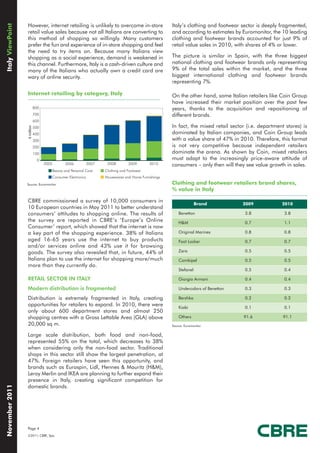
                  However, internet retailing is unlikely to overcome in-store                         Italy’s clothing and footwear sector is deeply fragmented,
                  retail value sales because not all Italians are converting to                        and according to estimates by Euromonitor, the 10 leading
                  this method of shopping so willingly. Many customers                                 clothing and footwear brands accounted for just 9% of
                  prefer the fun and experience of in-store shopping and feel                          retail value sales in 2010, with shares of 4% or lower.
                  the need to try items on. Because many Italians view
                  shopping as a social experience, demand is weakened in                               The picture is similar in Spain, with the three biggest
                  this channel. Furthermore, Italy is a cash-driven culture and                        national clothing and footwear brands only representing
                  many of the Italians who actually own a credit card are                              9% of the total sales within the market, and the three
                  wary of online security.                                                             biggest international clothing and footwear brands
                                                                                                       representing 7%.

                  Internet retailing by category, Italy                                                On the other hand, some Italian retailers like Coin Group
                                                                                                       have increased their market position over the past few
                              800                                                                      years, thanks to the acquisition and repositioning of
                              700                                                                      different brands.
                              600
                                                                                                       In fact, the mixed retail sector (i.e. department stores) is
                  € million


                              500
                              400                                                                      dominated by Italian companies, and Coin Group leads
                              300                                                                      with a value share of 47% in 2010. Therefore, this format
                              200                                                                      is not very competitive because independent retailers
                              100                                                                      dominate the arena. As shown by Coin, mixed retailers
                               0                                                                       must adapt to the increasingly price-aware attitude of
                                    2005      2006            2007    2008        2009        2010     consumers – only then will they see value growth in sales.
                                       Beauty and Personal Care      Clothing and Footwear
                                       Consumer Electronics          Housewares and Home Furnishings
                  Source: Euromonitor                                                                  Clothing and footwear retailers brand shares,
                                                                                                       % value in Italy

                  CBRE commissioned a survey of 10,000 consumers in
                                                                                                                      Brand           2009             2010
                  10 European countries in May 2011 to better understand
                  consumers’ attitudes to shopping online. The results of                                  Benetton                    3.8              3.8
                  the survey are reported in CBRE’s ’Europe’s Online                                       H&M                         0.7              1.1
                  Consumer’ report, which showed that the internet is now
                  a key part of the shopping experience. 38% of Italians                                   Original Marines            0.8              0.8
                  aged 16-65 years use the internet to buy products                                        Foot Locker                 0.7              0.7
                  and/or services online and 43% use it for browsing
                  goods. The survey also revealed that, in future, 44% of                                  Zara                        0.5              0.5
                  Italians plan to use the internet for shopping more/much                                 Combipel                    0.5              0.5
                  more than they currently do.
                                                                                                           Stefanel                    0.5              0.4

                  RETAIL SECTOR IN ITALY                                                                   Giorgio Armani              0.4              0.4

                  Modern distribution is fragmented                                                        Undercolors of Benetton     0.3              0.3

                  Distribution is extremely fragmented in Italy, creating                                  Bershka                     0.2              0.2
                  opportunities for retailers to expand. In 2010, there were                               Kiabi                       0.1              0.1
                  only about 600 department stores and almost 250
                  shopping centres with a Gross Lettable Area (GLA) above                                  Others                     91.6              91.1
                  20,000 sq m.                                                                         Source: Euromonitor

                  Large scale distribution, both food and non-food,
                  represented 55% on the total, which decreases to 38%
                  when considering only the non-food sector. Traditional
                  shops in this sector still show the largest penetration, at
                  47%. Foreign retailers have seen this opportunity, and
                  brands such as Eurospin, Lidl, Hennes & Mauritz (H&M),
                  Leroy Merlin and IKEA are planning to further expand their
                  presence in Italy, creating significant competition for
                  domestic brands.
November 2011


                  Page 4
                  ©2011, CBRE, Spa.
Italy ViewPoint
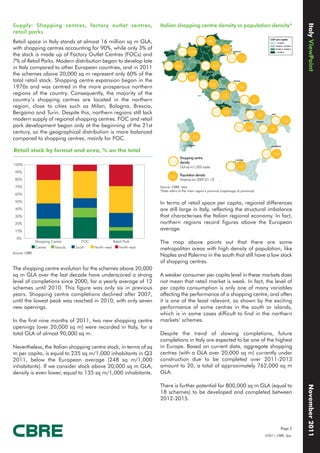
Supply: Shopping centres, factory outlet centres,                         Italian shopping centre density vs population density*
retail parks
Retail space in Italy stands at almost 16 million sq m GLA,                                              171    85
with shopping centres accounting for 90%, while only 3% of                                                           326 348
                                                                                        397 1,997
the stock is made up of Factory Outlet Centres (FOCs) and
                                                                                                                                 326 1,117
7% of Retail Parks. Modern distribution began to develop late
                                                                             250       336                 354    266
in Italy compared to other European countries, and in 2011
the schemes above 20,000 sq m represent only 60% of the
                                                                                         95        480
total retail stock. Shopping centre expansion began in the
                                                                                                          251    282
1970s and was centred in the more prosperous northern                                                                            214    247
regions of the country. Consequently, the majority of the                                                        296       105
country’s shopping centres are located in the northern                                                                                   373    61
region, close to cities such as Milan, Bologna, Brescia,
Bergamo and Turin. Despite this, northern regions still lack                                                         220   772
                                                                                                                                              574    80
modern supply of regional shopping centres. FOC and retail                                                                                                      254     312
park development began only at the beginning of the 21st                                                                               106 2,630      83        59
century, so the geographical distribution is more balanced
compared to shopping centres, mainly for FOC.                                                334    123


Retail stock by format and area, % on the total
                                                                                                                                                          158    154
                                                                                         Shopping centre
                                                                                 0.0     density
100%                                                                                                                         111
                                                                                         GLA sq m/1,000 capita                          250
 90%
                                                                                 0.0     Population density
 80%                                                                                     Inhab/sq km 2009 (31-12)
 70%                                                                      Source: CBRE, Istat
                                                                          *Data refers to the main region’s province (capoluogo di provincia)
 60%
 50%                                                                      In terms of retail space per capita, regional differences
 40%                                                                      are still large in Italy, reflecting the structural imbalance
 30%                                                                      that characterises the Italian regional economy. In fact,
 20%                                                                      northern regions record figures above the European
 10%
                                                                          average.
  0%
               Shopping Centre         FOC                Retail Park     The map above points out that there are some
               Centre     Islands   South    North-west      North-east   metropolitan areas with high density of population, like
Source: CBRE
                                                                          Naples and Palermo in the south that still have a low stock
                                                                          of shopping centres.
The shopping centre evolution for the schemes above 20,000
sq m GLA over the last decade have underscored a strong                   A weaker consumer per capita level in these markets does
level of completions since 2000, for a yearly average of 12               not mean that retail market is weak. In fact, the level of
schemes until 2010. This figure was only six in previous                  per capita consumption is only one of many variables
years. Shopping centre completions declined after 2007,                   affecting the performance of a shopping centre, and often
until the lowest peak was reached in 2010, with only seven                it is one of the least relevant, as shown by the exciting
new openings.                                                             performance of some centres in the south or islands,
                                                                          which is in some cases difficult to find in the northern
In the first nine months of 2011, two new shopping centre                 markets’ schemes.
openings (over 20,000 sq m) were recorded in Italy, for a
total GLA of almost 90,000 sq m.                                          Despite the trend of slowing completions, future
                                                                          completions in Italy are expected to be one of the highest
Nevertheless, the Italian shopping centre stock, in terms of sq           in Europe. Based on current data, aggregate shopping
m per capita, is equal to 235 sq m/1,000 inhabitants in Q3                centres (with a GLA over 20,000 sq m) currently under
2011, below the European average (248 sq m/1,000                          construction due to be completed over 2011-2013
inhabitants). If we consider stock above 20,000 sq m GLA,                 amount to 20, a total of approximately 762,000 sq m
density is even lower, equal to 135 sq m/1,000 inhabitants.               GLA.

                                                                          There is further potential for 800,000 sq m GLA (equal to
                                                                                                                                                                                November 2011


                                                                          18 schemes) to be developed and completed between
                                                                          2012-2015.


                                                                                                                                                                       Page 5
                                                                                                                                                          ©2011, CBRE, Spa.
Italy ViewPoint

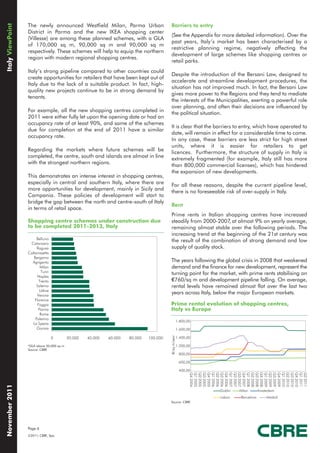
                  The newly announced Westfield Milan, Parma Urban                       Barriers to entry
                  District in Parma and the new IKEA shopping center
                                                                                         (See the Appendix for more detailed information). Over the
                  (Villesse) are among these planned schemes, with a GLA
                                                                                         past years, Italy’s market has been characterised by a
                  of 170,000 sq m, 90,000 sq m and 90,000 sq m
                                                                                         restrictive planning regime, negatively affecting the
                  respectively. These schemes will help to equip the northern
                                                                                         development of large schemes like shopping centres or
                  region with modern regional shopping centres.
                                                                                         retail parks.
                  Italy’s strong pipeline compared to other countries could
                                                                                         Despite the introduction of the Bersani Law, designed to
                  create opportunities for retailers that have been kept out of
                                                                                         accelerate and streamline development procedures, the
                  Italy due to the lack of a suitable product. In fact, high-
                                                                                         situation has not improved much. In fact, the Bersani Law
                  quality new projects continue to be in strong demand by
                                                                                         gives more power to the Regions and they tend to mediate
                  tenants.
                                                                                         the interests of the Municipalities, exerting a powerful role
                                                                                         over planning, and often their decisions are influenced by
                  For example, all the new shopping centres completed in
                                                                                         the political situation.
                  2011 were either fully let upon the opening date or had an
                  occupancy rate of at least 90%, and some of the schemes
                                                                                         It is clear that the barriers to entry, which have operated to
                  due for completion at the end of 2011 have a similar
                                                                                         date, will remain in effect for a considerable time to come.
                  occupancy rate.
                                                                                         In any case, these barriers are less strict for high street
                                                                                         units, where it is easier for retailers to get
                  Regarding the markets where future schemes will be
                                                                                         licences. Furthermore, the structure of supply in Italy is
                  completed, the centre, south and islands are almost in line
                                                                                         extremely fragmented (for example, Italy still has more
                  with the strongest northern regions.
                                                                                         than 800,000 commercial licenses), which has hindered
                                                                                         the expansion of new developments.
                  This demonstrates an intense interest in shopping centres,
                  especially in central and southern Italy, where there are
                                                                                         For all these reasons, despite the current pipeline level,
                  more opportunities for development, mainly in Sicily and
                                                                                         there is no foreseeable risk of over-supply in Italy.
                  Campania. These policies of development will start to
                  bridge the gap between the north and centre-south of Italy
                                                                                         Rent
                  in terms of retail space.
                                                                                         Prime rents in Italian shopping centres have increased
                  Shopping centre schemes under construction due                         steadily from 2000-2007, at almost 9% on yearly average,
                  to be completed 2011-2013, Italy                                       remaining almost stable over the following periods. The
                                                                                         increasing trend at the beginning of the 21st century was
                       Belluno
                   Catanzaro
                                                                                         the result of the combination of strong demand and low
                       Ragusa                                                            supply of quality stock.
                  Caltanissetta
                     Bergamo
                    Agrigento                                                            The years following the global crisis in 2008 that weakened
                          Milan                                                          demand and the finance for new development, represent the
                           Turin
                                                                                         turning point for the market, with prime rents stabilising on
                        Naples
                         Trento                                                          €760/sq m and development pipeline falling. On average,
                       Salerno                                                           rental levels have remained almost flat over the last two
                         Udine
                       Verona
                                                                                         years across Italy, below the major European markets.
                      Florence
                        Foggia                                                           Prime rental evolution of shopping centres,
                        Parma                                                            Italy vs Europe
                          Rome
                      Palermo
                                                                                                       1.800,00
                     La Spezia
                       Gorizia                                                                         1.600,00
                                                                                         €/sq m/year


                                   0       20.000   40.000   60.000   80.000   100.000                 1.400,00

                  *GLA above 20,000 sq m                                                               1.200,00
                  Source: CBRE
                                                                                                        800,00

                                                                                                        600,00

                                                                                                        400,00
                                                                                                              Q4 2004
                                                                                                              Q1 2005
                                                                                                              Q2 2005
                                                                                                              Q3 2005
                                                                                                              Q4 2005
                                                                                                              Q1 2006
                                                                                                              Q2 2006
                                                                                                              Q3 2006
                                                                                                              Q4 2006
                                                                                                              Q1 2007
                                                                                                              Q2 2007
                                                                                                              Q3 2007
                                                                                                              Q4 2007
                                                                                                              Q1 2008
                                                                                                              Q2 2008
                                                                                                              Q3 2008
                                                                                                              Q4 2008
                                                                                                              Q1 2009
                                                                                                              Q2 2009
                                                                                                              Q3 2009
                                                                                                              Q4 2009
                                                                                                              Q1 2010
                                                                                                              Q2 2010
                                                                                                              Q3 2010
                                                                                                              Q4 2010
                                                                                                              Q1 2011
                                                                                                              Q2 2011
November 2011


                                                                                                                  ––––Dublin ––––Milan ––––Amsterdam
                                                                                                                  ––––Lisbon   ––––Barcelona ––––Madrid
                                                                                         Source: CBRE


                  Page 6
                  ©2011, CBRE, Spa.
Italy ViewPoint
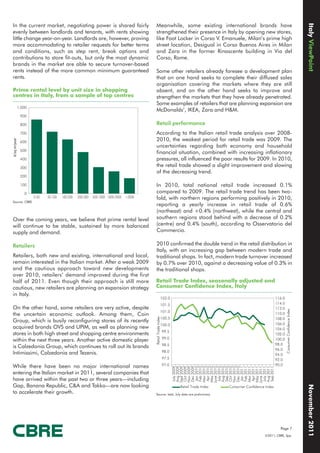
In the current market, negotiating power is shared fairly                            Meanwhile, some existing international brands have
evenly between landlords and tenants, with rents showing                             strengthened their presence in Italy by opening new stores,
little change year-on-year. Landlords are, however, proving                          like Foot Locker in Corso V. Emanuele, Milan’s prime high
more accommodating to retailer requests for better terms                             street location, Desigual in Corso Buenos Aires in Milan
and conditions, such as step rent, break options and                                 and Zara in the former Rinascente building in Via del
contributions to store fit-outs, but only the most dynamic                           Corso, Rome.
brands in the market are able to secure turnover-based
rents instead of the more common minimum guaranteed                                  Some other retailers already foresee a development plan
rents.                                                                               that on one hand seeks to complete their diffused sales
                                                                                     organisation covering the markets where they are still
Prime rental level by unit size in shopping                                          absent, and on the other hand seeks to improve and
centres in Italy, from a sample of top centres                                       strengthen the markets that they have already penetrated.
                                                                                     Some examples of retailers that are planning expansion are
          1.000
                                                                                     McDonalds’, IKEA, Zara and H&M.
              900

              800                                                                    Retail performance
              700                                                                    According to the Italian retail trade analysis over 2008-
                                                                                     2010, the weakest period for retail trade was 2009. The
€/sq m/year


              600
                                                                                     uncertainties regarding both economy and household
              500
                                                                                     financial situation, combined with increasing inflationary
              400                                                                    pressures, all influenced the poor results for 2009. In 2010,
              300
                                                                                     the retail trade showed a slight improvement and slowing
                                                                                     of the decreasing trend.
              200

              100                                                                    In 2010, total national retail trade increased 0.1%
                0                                                                    compared to 2009. The retail trade trend has been two-
                    0-50   50-100   100-200   200-500   500-1000 1000-2000   >2000   fold, with northern regions performing positively in 2010,
Source: CBRE
                                                                                     reporting a yearly increase in retail trade of 0.6%
                                                                                     (northeast) and +0.4% (northwest), while the central and
Over the coming years, we believe that prime rental level                            southern regions stood behind with a decrease of 0.2%
will continue to be stable, sustained by more balanced                               (centre) and 0.4% (south), according to Osservatorio del
supply and demand.                                                                   Commercio.

Retailers                                                                            2010 confirmed the double trend in the retail distribution in
                                                                                     Italy, with an increasing gap between modern trade and
Retailers, both new and existing, international and local,                           traditional shops. In fact, modern trade turnover increased
remain interested in the Italian market. After a weak 2009                           by 0.7% over 2010, against a decreasing value of 0.3% in
and the cautious approach toward new developments                                    the traditional shops.
over 2010, retailers’ demand improved during the first
half of 2011. Even though their approach is still more                               Retail Trade Index, seasonally adjusted and
cautious, new retailers are planning an expansion strategy                           Consumer Confidence Index, Italy
in Italy.
                                                                                                          102.0                                                    116.0
                                                                                                          101.5                                                    114.0
On the other hand, some retailers are very active, despite                                                                                                         112.0
                                                                                                                                                                           Consumer Confidence Index


                                                                                                          101.0
the uncertain economic outlook. Among them, Coin                                                                                                                   110.0
                                                                                     Retail Trade Index


                                                                                                          100.5                                                    108.0
Group, which is busily reconfiguring stores of its recently
                                                                                                          100.0                                                    106.0
acquired brands OVS and UPIM, as well as planning new                                                                                                              104.0
                                                                                                          99.5
stores in both high street and shopping centre environments                                                                                                        102.0
                                                                                                          99.0
within the next three years. Another active domestic player                                                                                                        100.0
                                                                                                          98.5                                                     98.0
is Calzedonia Group, which continues to roll out its brands                                                                                                        96.0
Intimissimi, Calzedonia and Tezenis.                                                                      98.0
                                                                                                                                                                   94.0
                                                                                                          97.5                                                     92.0
While there have been no major international names                                                        97.0                                                     90.0
                                                                                                                   July 2009
                                                                                                                   Aug 2009
                                                                                                                  Sept 2009
                                                                                                                   Oct 2009
                                                                                                                   Nov 2009
                                                                                                                   Dec 2009
                                                                                                                   Jan 2010
                                                                                                                   Feb 2010
                                                                                                                   Mar 2010
                                                                                                                   Apr 2010
                                                                                                                  May 2010
                                                                                                                  June 2010
                                                                                                                   July 2010
                                                                                                                   Aug 2010
                                                                                                                   Sep 2010
                                                                                                                   Oct 2010
                                                                                                                   Nov 2010
                                                                                                                   Dec 2010
                                                                                                                   Jan 2011
                                                                                                                   Feb 2011
                                                                                                                   Mar 2011
                                                                                                                   Apr 2011
                                                                                                                  May 2011
                                                                                                                  June 2011
                                                                                                                   July 2011
                                                                                                                   Aug 2011
                                                                                                                   Sep 2011


entering the Italian market in 2011, several companies that
have arrived within the past two or three years—including
Gap, Banana Republic, C&A and Takko—are now looking
                                                                                                                                                                                                       November 2011


                                                                                                                  Retail Trade Index   Consumer Confidence Index
to accelerate their growth.                                                          Source: Istat, July data are preliminary


                                                                                                                                                                     Page 7
                                                                                                                                                           ©2011, CBRE, Spa.
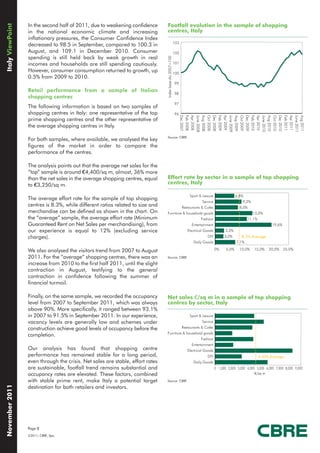
In the second half of 2011, due to weakening confidence       Footfall evolution in the sample of shopping
Italy ViewPoint


                  in the national economic climate and increasing               centres, Italy
                  inflationary pressures, the Consumer Confidence Index
                                                                                                          103
                  decreased to 98.5 in September, compared to 100.3 in
                  August, and 109.1 in December 2010. Consumer                                            102
                  spending is still held back by weak growth in real


                                                                                Index base dic.2007=100
                  incomes and households are still spending cautiously.                                   101

                  However, consumer consumption returned to growth, up                                    100
                  0.5% from 2009 to 2010.
                                                                                                          99
                  Retail performance from a sample of Italian
                                                                                                          98
                  shopping centres
                                                                                                          97
                  The following information is based on two samples of
                  shopping centres in Italy: one representative of the top                                96


                                                                                                                Dec 2007
                                                                                                                Feb 2008
                                                                                                                Apr 2008
                                                                                                                June 2008
                                                                                                                Aug 2008
                                                                                                                Oct 2008
                                                                                                                Dec 2008
                                                                                                                Feb 2009
                                                                                                                Apr 2009
                                                                                                                June 2009
                                                                                                                Aug 2009
                                                                                                                Oct 2009
                                                                                                                Dec 2009
                                                                                                                Feb 2010
                                                                                                                Apr 2010
                                                                                                                June 2010
                                                                                                                Aug 2010
                                                                                                                Oct 2010
                                                                                                                Dec 2010
                                                                                                                Feb 2011
                                                                                                                Apr 2011
                                                                                                                June 2011
                                                                                                                Aug 2011
                  prime shopping centres and the other representative of
                  the average shopping centres in Italy.

                                                                                Source: CBRE
                  For both samples, where available, we analysed the key
                  figures of the market in order to compare the
                  performance of the centres.

                  The analysis points out that the average net sales for the
                  “top” sample is around €4,400/sq m, almost, 36% more
                  than the net sales in the average shopping centres, equal     Effort rate by sector in a sample of top shopping
                  to €3,250/sq m.                                               centres, Italy

                                                                                                                    Sport & Leisure                 6,8%
                  The average effort rate for the sample of top shopping
                                                                                                                            Service                    9,2%
                  centres is 8.3%, while different ratios related to size and                                   Restaurants & Cafés                   8,0%
                  merchandise can be defined as shown in the chart. On          Furniture & household goods                                                   13,0%
                  the “average” sample, the average effort rate (Minimum                                                   Fashion                         11,1%
                  Guaranteed Rent on Net Sales per merchandising), from                                               Entertainment                                       19,6%
                  our experience is equal to 12% (excluding service                                                Electrical Goods         3,2%
                  charges).                                                                                                    DIY          3,0%       8.3% Average
                                                                                                                       Daily Goods                  7,1%

                  We also analysed the visitors trend from 2007 to August                                                             0%     5,0%     10,0%   15,0%     20,0% 25,0%

                  2011. For the “average” shopping centres, there was an        Source: CBRE

                  increase from 2010 to the first half 2011, until the slight
                  contraction in August, testifying to the general
                  contraction in confidence following the summer of
                  financial turmoil.

                  Finally, on the same sample, we recorded the occupancy        Net sales €/sq m in a sample of top shopping
                  level from 2007 to September 2011, which was always           centres by sector, Italy
                  above 90%. More specifically, it ranged between 93.1%
                  in 2007 to 91.5% in September 2011. In our experience,                                            Sport & Leisure
                  vacancy levels are generally low and schemes under                                                        Service
                  construction achieve good levels of occupancy before the                                      Restaurants & Cafés
                                                                                Furniture & household goods
                  completion.
                                                                                                                           Fashion
                                                                                                                      Entertainment
                  Our analysis has found that shopping centre                                                      Electrical Goods
                  performance has remained stable for a long period,                                                           DIY                                 4,439 Average
                  even through the crisis. Net sales are stable, effort rates                                          Daily Goods
                  are sustainable, footfall trend remains substantial and                                                             0 1,000 2,000 3,000 4,000 5,000 6,000 7,000 8,000 9,000
                  occupancy rates are elevated. These factors, combined                                                                                        €/sq m

                  with stable prime rent, make Italy a potential target         Source: CBRE
November 2011


                  destination for both retailers and investors.


                  Page 8
                  ©2011, CBRE, Spa.
Italy ViewPoint
Retail Investment                                                                             Regarding the retail sub-sector distribution, high street retail
                                                                                              has been the most targeted asset, in the first nine months of
The direct Italian real estate investment volume over 2006-
                                                                                              2011 it accounted for 45% of total retail investment volume.
2010 recorded over €37 billion of investment transactions,
mainly concentrated in the boom years of 2006-2007. The
retail sector accounted for 25% each year, on average, with                                   This has mainly been due to one large transaction (La
the lowest share of 19% in 2008 to the highest of 37% in 2009.                                Rinascente Duomo), but investors’ appetite for high street
                                                                                              retail remains strong. Compared to previous years, high
                                                                                              street retail is also becoming attractive for institutional
Over the last decade, the retail sector strengthened its share on
                                                                                              investors, both local and foreign. Shopping centre
overall investment volume, at the expense of the office sector.
                                                                                              investment accounted for 15% of total retail investment in
                                                                                              the first nine months of 2011.
Shopping centre investment accounted for 65% of the total
retail sector, on average yearly. Other retail investments
                                                                                              In Q3, retail investment activity has been boosted by two
were mainly made up of retail parks, FOCs, high street and
                                                                                              portfolio transactions, the largest is the selling of the second
other retail formats (hypermarkets, etc). Foreign investors
                                                                                              part of the METRO Cash & Carry portfolio for almost €300
have been the most active in the retail sector, accounting for
                                                                                              million.
over 50% of total capital invested in the sector during the
boom years 2006-2008. Its share decreased in 2009 to
39%, in 2010 to 51% and in the first nine months of 2011                                      Over the past quarter, interest in the retail sector by local
to almost 40%.                                                                                non-specialist retail investors and new international players
                                                                                              increased. Among the first group of investors, some
                                                                                              institutions (generally office-driven investors with long-term
In the first nine months of 2011, total real estate investment
                                                                                              asset allocation strategies) are targeting the retail sector. For
volume in Italy stood at €3.24 billion an increase of 7.4%
                                                                                              those type of investors, a joint venture acquisition of retail
compared to the same period of 2010. The upward trend
                                                                                              assets, to be shared with a specialist retail investors, could be
recorded over the third quarter reflects, in part, the closing
                                                                                              an opportunity to enter the sector for the first time. In fact, this
of investment transactions that had been under
                                                                                              model allows the non-specialist investors to benefit from the
negotiations for a long time and the closing of few portfolio
                                                                                              expertise and asset management skills of the specialist, who
transactions.
                                                                                              retain a share of the asset. In turn, this structure allows the
                                                                                              specialist to share the risk of the investment and to transact
In Italy, retail remains the sector with the largest volume
                                                                                              large lot sizes.
invested in the first nine months of 2011, amounting to
about €1.8 billion, equal to almost 55% of total real estate
                                                                                              Investors continue to be focused on core assets in all
investment volume, well above the long-term yearly
                                                                                              sectors, thus creating a downward pressure on yields, which
average of 25%. The retail sector continues to be the most
                                                                                              remain low in the high street sector at 5.25%. Prime
attractive to international investors (retail specialists and
                                                                                              shopping centre supply is limited, but is more balanced with
institutions): 73% of foreign capital invested in Italy in the
                                                                                              demand compared to other asset classes (office and
first nine months of 2011 was in the retail sector.
                                                                                              logistics), leading prime yields to stabilise at 6.15% in the
                                                                                              first nine months of 2011.
Investment evolution and retail share compared
to total, Italy                                                                               Prime yield evolution Italy
      12.000

                              24%                                                                                   8,00

      10.000                                                                                                        7,50

                    24%                                                                                             7,00
                                                                                              Prime Gross Yield %


                                             19%                                                                    6,50
            8.000
                                                                                                                    6,00
€ million


                                                                                                                    5,50
            6.000                                                                                                   5,00
                                                             37%         30%                                        4,50

            4.000                                                                                                   4,00
                                                                                     55%
                                                                                                                    3,50
                                                                                                                           Q1 2006
                                                                                                                           Q2 2006
                                                                                                                           Q3 2006
                                                                                                                           Q4 2006
                                                                                                                           Q1 2007
                                                                                                                           Q2 2007
                                                                                                                           Q3 2007
                                                                                                                           Q4 2007
                                                                                                                           Q1 2008
                                                                                                                           Q2 2008
                                                                                                                           Q3 2008
                                                                                                                           Q4 2008
                                                                                                                           Q1 2009
                                                                                                                           Q2 2009
                                                                                                                           Q3 2009
                                                                                                                           Q4 2009
                                                                                                                           Q1 2010
                                                                                                                           Q2 2010
                                                                                                                           Q3 2010
                                                                                                                           Q4 2010
                                                                                                                           Q1 2011
                                                                                                                           Q2 2011
                                                                                                                           Q3 2011


            2.000

                                                                                                                                   ––––Office Prime   ––––Shopping Centre – Secondary
               0
                                                                                                                                                                                                 November 2011


                                                                                                                                   ––––High Street    ––––Shopping Centre – Prime
                    2006     2007           2008             2009        2010       Q3 2011
                                                                                                                    Source: CBRE
                           Total Investment (excl. Retail)      Retail Investment
Source: CBRE


                                                                                                                                                                                        Page 9
                                                                                                                                                                             ©2011, CBRE, Spa.
Italy ViewPoint

                  INTERNATIONAL PLAYERS IN ITALY
                  In the last section of the report, we would like to share quotes from some of the most active international players that own
                  and/or have developed shopping centres in Italy, and continue to believe in this sector and market: Eurocommercial,
                  Westfield, Sonae Sierra.

                  EUROCOMMERCIAL
                  Eurocommercial has €2.5 billion in retail property assets, 38% of which are in Italy, and the remainder in France and
                  Sweden. In September, Eurocommercial bought its 10th shopping centre in Italy, Cremona Po, in Brescia, Lombardy. We
                  asked Tim Santini, Director, why they continue to invest in Italy:

                  "If you are willing to learn about the Italian culture, to be patient and understand the social and economic realities of the
                  market, as Eurocommercial has done, you can make good investments in Italy. We are not overly worried by the
                  demographic and economic changes expected over the next few years. Shopping centres provide considerable
                  opportunities to add value over time through good management. If you are smart in anticipating the coming trends and
                  integrate these new requirements into your centre, you should be a winner."

                  WESTFIELD
                  At the beginning of August, after long negotiations, the agreement between Australian developer Westfield and the Italian
                  firm Percassi to develop the biggest shopping centre in continental Europe (170,000 sqm GLA) was signed, and Westfield
                  officially entered the Italian market for the first time.

                  In an interview for Europroperty, Michael Gutman, MD of Westfield, answered the question: Why Milan and why now?
                  He responded: “The Milan site, its catchment area and demographics make it a very compelling proposition. We have
                  studied very carefully the fundamentals of our trade area and believe that this part of Lombardy has very healthy long-
                  term prospects and a substantial undersupply of quality retail floorspace.”

                  How does Milan compare with other European cities? “In our view, Milan is, and will remain, one of the truly great cities
                  of the world for commerce, industry, tourism and retail.”

                  SONAE SIERRA
                  When asked by an Italian journalist about Sonae Sierra’s commitment in Italy over the next few years, Fernando Guedes
                  de Oliveira, CEO of Sonae Sierra, said: “Italy is always a core market for us. Next march, Sonae will open its fifth Shopping
                  Centre in Italy – Le Terrazze (La Spezia) in JV with ING development – and they want to stay in Italy, strengthening their
                  position. We believe that in Italy there are still several opportunities and, for the future, we are planning to open one
                  shopping centre per year “.
November 2011


                  Page 10
                  ©2011, CBRE, Spa.
Italy ViewPoint
APPENDIX 1: RETAIL MARKET PRACTICE
Opening Hours
            • Italian law allows retailers to open no longer than 13 hours per day, between 07.00 and 22.00, and
              retailers must choose their opening hours according to local government restrictions. National legislation
              deems that retailers cannot stay open 24 hours per day.

            • Local governments dictate the days on which shops must stay closed, as well as decide whether retailers
              can stay open on Sundays and holidays.

            • National legislation deems that retailers should close on Sundays and an additional half day per week,
              which can only be derogated from local governments.

            • Retailers located in tourist areas can decide their own opening and closing times, even on Sundays
              and holidays.

Retail Landscape
            • The Italian population is mainly urban: 73% of Italian households were urban in 2010, up from 69% in
              1990.

            • There is a long tradition of small supermarkets and convenience stores, initially making it difficult for
              hypermarkets to succeed. Although declining, independent stores remained dominant in towns in 2010,
              particularly in non-grocery retailing like health and beauty, clothing and footwear, pet shops, home
              furniture, and leisure and personal goods.

            • Luxury retailers are typically situated in pedestrianised zones and high streets.

            • In 2010, there were nearly 250 shopping centres in Italy with a GLA of more than 20,000 sq m. There
              has been much consolidation over the past decade, with a few large retailers buying out independent
              stores. Shopping centres are generally anchored by well-known supermarkets or hypermarkets.

Barriers to entry
            • Barriers to entry are predominately administrative and can be traced back to a complicated permit process
              which must be completed in order to develop either a shopping centre or large retail park. In this case
              there are three levels of decision making (Municipality, Province and Region) which must give their consent
              and within these levels, various other entities which control diverse activities - Fire Department, Sanitary
              Services, Environmental control etc. Before the implementation of the Bersani Law (December 1998), the
              authorisation procedure involved an “average” time between the request to realise a shopping
              centre/retail park and the opening of 8 to 10 years and in some cases over 15 years.

            • The national commercial legislation was reformed with Legislative Decree No. 114 dated 31 March 1998
              which gives Regions the job of defining the general guidelines for the settlement of the commercial
              activities and commits the municipalities to bring their general and implementing town planning tools in
              line with these guidelines. The old “commercial planning” evolves into “commercial programming” whose
              choices mainly relate to identifying the free localization of the various types of sales structures
              (neighbourhood businesses, retail, medium and large-sized sales structures).

            • The legislation provides that the opening of neighbourhood businesses or medium sized sales structures
              not within a shopping centre or retail park is exclusively subject to decision of the Municipality:

               • neighbourhood businesses (esercizi di vicinato) with selling surfaces below 150 sq m in municipalities
                 with less than 10,000 inhabitants and below 250 sq m in municipalities with over 10,000 inhabitants;

               • medium-sized sales structures (medie strutture di vendita) with selling surfaces greater than the limits
                                                                                                                                  November 2011


                 specified above and up to 1,500 sq m in municipalities with less than 10,000 inhabitants and up to
                 2,500 sq m in municipalities with over 10,000 inhabitants.


                                                                                                                      Page 11
                                                                                                              ©2011, CBRE, Spa.
APPENDIX 2: RETAIL MARKET PRACTICE
Italy ViewPoint

                                      • Obtaining a permit to open a store with a sales area of up to 2,500 sq m in municipalities with over
                                        10,000 inhabitants involves, as already mentioned, only one level of decision making (Municipality). The
                                        Municipality has a maximum of 90 days to deny the permit otherwise it is automatically authorised.

                                      • A more complicated process is foreseen for large-size “sales areas” with a selling surface greater than
                                        2,500 sq m. In Italy, according to the legislation, the sales area of a commercial business (superficie di
                                        vendita) is defined as the area designated to sales, including space occupied by counters and shelves.
                                        Sales area does not include storerooms, deposits, workshops, offices and bathrooms.


                  CONTACTS

                  Raffaella Pinto
                  Head of Research, Italy Research
                  CBRE
                  Via del Lauro 5/7
                  Milan 20121
                  t: +39 02 30377738
                  e: raffaella.pinto@cbre.com


                  Shelby Loren Catino
                  Analyst, Italy Research
                  CBRE
                  Via del Lauro 5/7
                  Milan 20121
                  t: +39 02 30377794
                  e: shelbyloren.catino@cbre.com
November 2011


                  Disclaimer
                  CBRE Spa confirms that information contained herein, including projections, has been obtained from sources believed to be reliable. While we do not doubt their
                  accuracy, we have not verified them and make no guarantee, warranty or representation about them. It is your responsibility to confirm independently their accuracy and
                  completeness. This information is presented exclusively for use by CBRE clients and professionals and all rights to the material are reserved and cannot be reproduced
                  ©2011, CBRE, Spa.


                  Page 12
                  ©2011, CBRE, Spa.

Italy view point 2011

  • 1.
    CBRE Italy ViewPoint www.cbre.it/research November 2011 Italy: Is a retail upturn possible? By Mario Taccini & Raffaella Pinto OVERVIEW Given Italy’s role as the nominated country of honour at MAPIC 2011 – the annual international retail property show – CBRE has created a special report on Italy to show international players that, behind the newspaper headlines and speculation of recent months, lies a two-fold economy and economical players: more sound households and a less reliable political system. The next couple of years will be difficult, but we must remember Albert Einstein’s words: “Let's not pretend that things will change if we keep doing the same things. A crisis can be a real blessing to any person, to any nation. For all crises bring progress.” With this report, CBRE aims to bring the insider aspects of Italy to the attention of international retailers. Despite a challenging economic outlook and an ageing population, a strong development pipeline, structural market characteristics and resilient consumer base are providing exciting opportunities for international retailers to expand. KEY THEMES • Italy is one of the most populated countries in Europe • Italian households are sound and are among the wealthiest and the least in debt in Europe • Italian households have a high level of consumption • The Italian retail market is highly fragmented and the modern retail penetration rate is one of the lowest in Europe (48% versus an average of 65%) • Barriers to entry prevent the risk of over-supply • Market fundamentals are sound: rents and retail trade are stable, vacancy levels remain low • The development pipeline is stable and sustainable • In CBRE’s How Active are Retailers in EMEA? survey, which examines expansion plans of leading retailers across the region, Italy took top spot. Almost half (47%) of the retailers surveyed are looking to expand there in 2012. These factors lead us to believe that Italy should be a potential target destination for both retailers and investors. ECONOMIC FUNDAMENTALS ARE WEAKENING… Late July and early August 2011 saw extreme volatility in the financial markets. This has been reflected most obviously in the substantial movements in stock markets worldwide. Italy is struggling to be kept separate from the other PIIGS countries (Portugal, Ireland, Greece and Spain), as its extremely high debt level is increasingly worrying. Expectations for the future have definitely changed all over the world and economic growth expectations have been cut, standing largely below 1% for Italy over the next couple of years. According to latest official data from The National Institute for Statistics (Istat), Italy's GDP grew by 0.8% in Q2 2011 compared to Q2 2010, and by 0.3% compared to Q1 2011. Over the beginning of Q3, tensions over sovereign debt spread to Italy, increasing fears over the future stability of the country. The Italian GDP/debt ratio remains high, and the government swiftly passed a budget plan in July to balance the budget by 2014. Due to low confidence in the national economic climate and increasing inflationary pressures, the Consumer Confidence Index weakened again in September, standing at 98.5, down from 100.3 in August, continuing the declining trend since December 2010 when it had slightly improved to 109.1. In July 2011, the seasonally adjusted retail trade index according to Istat decreased by 0.1% over June, with food goods decreasing by 0.3% and non-food goods by 0.1%. The average of the last three months compared to the previous three months decreased by 0.4%. ©2011, CBRE, Spa.
  • 2.
    Italy ViewPoint …BUT THE REGIONAL GAP IS STILL WIDE Regional population and unemployment, Italy Despite the current economic situation, Italy remains as one of the largest countries in the world and the fifth most 3.5 103 industrialised country, contributing to almost 4% of global 5.7 123 manufacturing output. 5.6 983 4.4 13 Italy is characterised by different regional economic Unemployment rate 5.8 491 fundamentals, with the northern regions closer to European 0.0 2010, % 5.7 439 traits in terms of economics and wealth. According to 7.6 445 Population 0.0 Oxford Economics, the Italian GDP growth of 1.2% in 2010 2010, in 10,000s was mostly affected by the better performances of the 6.5 161 6.1 373 5.7 156 northern and central regions: 1.7% growth in the northwest, 2.1% in the northeast, and 1.2% in the centre, 8.8 134 compared to a weaker south with growth of 0.2%. The 6.6 90 Bank of Italy confirms that for the past 30 years, GDP per 8.4 32 person has been 40% lower in the south as opposed to the 9.3 568 13.5 408 north and centre. 14.0 582 The regional unemployment rate in Italy, equal to 8.6% in 13.0 59 2010, is below the European average. At a regional level, the northern regions have the lowest unemployment rate 14.1 167 compared to the national average, below 6%, while the 11.9 200 southern regions have a double digit rate at times. These high rates reflect an underdeveloped economy, lower level of industry, reliance on the black market and allegations of widespread corruption. 14.7 504 According to the GDP per capita figures as of 2010, the Source: CBRE on Istat, map from Sincron Italian average is lower than other major European economies: 10% below the eurozone, 18% below More importantly, the population groups and type of Germany, 16% below the UK, 11% below France and consumers that represent an opportunity are changing. almost in line with Spain. Italy’s 65+ population group is the largest in Europe and, according to Euromonitor, it is expected to grow by a Large population significant 15% over the next 10 years, contributing to 2.5% Italy has one of the largest populations (60 million of Italy’s overall population growth, during which the inhabitants in 2010) in Europe and ranks 23rd in the median age will shift from 43 to 47 years old. world, according to the US Census Bureau. Sound households Although the population trend is set to decline gradually over the next 40 years due to low birth rates, ageing Italian households are among the most sound in Europe. population and an increasing number of smaller In 2010, Italian household financial debt reached 66% of households, the large population base represents a disposable income, below the European average of 99%, constant opportunity for new demand. showing the stability of Italian households compared to other European countries. Regional GDP as % of all overall GDP 2010 , In addition, unlike many households in Spain or the Irish 25% Republic, Italians do not have large mortgages, and 20% generally maintain very little debt. 15% Regional differences of GDP per capita are wide, and the 10% richest provinces have an income per capita that is more than the double that of the poorest provinces. 5% 0% Centre* Emilia-Romagna Islands* Lombardia Piemonte South* Veneto November 2011 Regional GDP as % of all overall GDP 2010 , Source: Oxford Economics Centre: Toscana, Umbria, Marche, Lazio South: Abruzzo, Molise, Campania, Puglia, Calabria, Basilicata Islands: Sicilia, Sardegna Page 2 ©2011, CBRE, Spa.
  • 3.
    Italy ViewPoint For example,Milan and Bolzan have a GDP per capita in On the same note, since marriage seems to be occurring the range of €35-40,000, which is more than double that at a later age, unmarried men have higher disposable of some southern provinces with a GDP per capita in the incomes to spend on indulgences like fashion, technology range of €15-20,000 per capita. and music. The toll of the recession on Italy’s economy is likely to lead Age group spending habits to higher income inequalities as top income earners are Italians have always been passionate about fashion, expected to show the highest growth over the next five believing that quality and elegance define their history, and years. Per capita annual disposable income is expected to the recession has not changed this. In 2009, Italian slightly increase but remain behind the UK and France. spending on clothing (including footwear) as a percentage of total consumption was 7.6%, the highest recorded in Over the next few years, Italy will continue to feel the effects Europe (it was around 5% in the UK, Germany and Spain, of the recession, however, high income earners are unlikely 4-4.5% in France, and below 4% in Poland, Romania and to change their spending habits significantly, despite having Hungary). their wealth reduced. % of Age % change Retail Consumers lifestyle population group by 2020 opportunity 2009 Italy’s demographics are expected to shift over the next few years, most notably in the form of three trends: an ageing Luxury cosmetics, 65+ 20.2% +15.3% health goods population, an increase in the number of one- and two- person households and lower birth rates. Luxury fashion and cosmetics, Middle-aged 34.5% +8.5% From 2010 to 2020, consumer expenditure is expected to household goods, hobbies grow at a slower pace (around 1% yearly), mostly due to inflation rather than an increase in demand. Low-cost 30s 15% N/A household goods, Considering this slow recovery, consumers are expected to electronics remain value-conscious in the short-term, through 2015. Lower cost While most Italians will continue to shop in traditional 20s 11% -6% branded clothing supermarkets and street markets, many will be looking to Clothing, spend less, building upon the thrifty habits they gained footwear, during the recession. Teenagers 7% +1.4% accessories, electronics This will lead to more people shopping in discount supermarkets and most notably, lead to an increase in Clothing, private label (products that are typically manufactured by Tweenagers* 3.7% +4.5% accessories, mobile phones one company for offer under another company's brand) purchases. Sales of luxury goods and services will continue * Tweenagers are youth between the ages of 10-12, to be affected, which should benefit low- to mid-range who are no longer children but are not yet teenagers Source: Euromonitor products that can now reach a wider target market. Increasing use of the Internet Despite the general slowdown, demographic changes will create a different consumer lifestyle that will alter the way According to Euromonitor, around 22 million people in Italians spend. For example, since women are playing an Italy currently use the internet, of which 6 million regularly increasing role in the labour market and delaying starting shop online because of its convenience, efficiency and a family, they will have more disposable income to spend lower price, despite the recession. 54% of people on clothing. purchasing online are under the age of 35. As it stands, internet retailing in Italy is very under-exploited and highly fragmented. It mostly consists of price- competitive, small-to-medium-sized retailers specialising in niche or low-cost products. Store-based retailers will continue to experience competition from the internet, with online and discount retailers expected to perform the best. Store-based retail for electronics is expected to feel the most competition from the internet. Clothing and footwear is one of the largest product November 2011 categories in terms of retail value sales on the internet. In fact, Italy’s online spend in clothing and footwear is 7%, compared to 4% in most other categories. Page 3 ©2011, CBRE, Spa.
  • 4.
    Italy ViewPoint However, internet retailing is unlikely to overcome in-store Italy’s clothing and footwear sector is deeply fragmented, retail value sales because not all Italians are converting to and according to estimates by Euromonitor, the 10 leading this method of shopping so willingly. Many customers clothing and footwear brands accounted for just 9% of prefer the fun and experience of in-store shopping and feel retail value sales in 2010, with shares of 4% or lower. the need to try items on. Because many Italians view shopping as a social experience, demand is weakened in The picture is similar in Spain, with the three biggest this channel. Furthermore, Italy is a cash-driven culture and national clothing and footwear brands only representing many of the Italians who actually own a credit card are 9% of the total sales within the market, and the three wary of online security. biggest international clothing and footwear brands representing 7%. Internet retailing by category, Italy On the other hand, some Italian retailers like Coin Group have increased their market position over the past few 800 years, thanks to the acquisition and repositioning of 700 different brands. 600 In fact, the mixed retail sector (i.e. department stores) is € million 500 400 dominated by Italian companies, and Coin Group leads 300 with a value share of 47% in 2010. Therefore, this format 200 is not very competitive because independent retailers 100 dominate the arena. As shown by Coin, mixed retailers 0 must adapt to the increasingly price-aware attitude of 2005 2006 2007 2008 2009 2010 consumers – only then will they see value growth in sales. Beauty and Personal Care Clothing and Footwear Consumer Electronics Housewares and Home Furnishings Source: Euromonitor Clothing and footwear retailers brand shares, % value in Italy CBRE commissioned a survey of 10,000 consumers in Brand 2009 2010 10 European countries in May 2011 to better understand consumers’ attitudes to shopping online. The results of Benetton 3.8 3.8 the survey are reported in CBRE’s ’Europe’s Online H&M 0.7 1.1 Consumer’ report, which showed that the internet is now a key part of the shopping experience. 38% of Italians Original Marines 0.8 0.8 aged 16-65 years use the internet to buy products Foot Locker 0.7 0.7 and/or services online and 43% use it for browsing goods. The survey also revealed that, in future, 44% of Zara 0.5 0.5 Italians plan to use the internet for shopping more/much Combipel 0.5 0.5 more than they currently do. Stefanel 0.5 0.4 RETAIL SECTOR IN ITALY Giorgio Armani 0.4 0.4 Modern distribution is fragmented Undercolors of Benetton 0.3 0.3 Distribution is extremely fragmented in Italy, creating Bershka 0.2 0.2 opportunities for retailers to expand. In 2010, there were Kiabi 0.1 0.1 only about 600 department stores and almost 250 shopping centres with a Gross Lettable Area (GLA) above Others 91.6 91.1 20,000 sq m. Source: Euromonitor Large scale distribution, both food and non-food, represented 55% on the total, which decreases to 38% when considering only the non-food sector. Traditional shops in this sector still show the largest penetration, at 47%. Foreign retailers have seen this opportunity, and brands such as Eurospin, Lidl, Hennes & Mauritz (H&M), Leroy Merlin and IKEA are planning to further expand their presence in Italy, creating significant competition for domestic brands. November 2011 Page 4 ©2011, CBRE, Spa.
  • 5.
    Italy ViewPoint Supply: Shoppingcentres, factory outlet centres, Italian shopping centre density vs population density* retail parks Retail space in Italy stands at almost 16 million sq m GLA, 171 85 with shopping centres accounting for 90%, while only 3% of 326 348 397 1,997 the stock is made up of Factory Outlet Centres (FOCs) and 326 1,117 7% of Retail Parks. Modern distribution began to develop late 250 336 354 266 in Italy compared to other European countries, and in 2011 the schemes above 20,000 sq m represent only 60% of the 95 480 total retail stock. Shopping centre expansion began in the 251 282 1970s and was centred in the more prosperous northern 214 247 regions of the country. Consequently, the majority of the 296 105 country’s shopping centres are located in the northern 373 61 region, close to cities such as Milan, Bologna, Brescia, Bergamo and Turin. Despite this, northern regions still lack 220 772 574 80 modern supply of regional shopping centres. FOC and retail 254 312 park development began only at the beginning of the 21st 106 2,630 83 59 century, so the geographical distribution is more balanced compared to shopping centres, mainly for FOC. 334 123 Retail stock by format and area, % on the total 158 154 Shopping centre 0.0 density 100% 111 GLA sq m/1,000 capita 250 90% 0.0 Population density 80% Inhab/sq km 2009 (31-12) 70% Source: CBRE, Istat *Data refers to the main region’s province (capoluogo di provincia) 60% 50% In terms of retail space per capita, regional differences 40% are still large in Italy, reflecting the structural imbalance 30% that characterises the Italian regional economy. In fact, 20% northern regions record figures above the European 10% average. 0% Shopping Centre FOC Retail Park The map above points out that there are some Centre Islands South North-west North-east metropolitan areas with high density of population, like Source: CBRE Naples and Palermo in the south that still have a low stock of shopping centres. The shopping centre evolution for the schemes above 20,000 sq m GLA over the last decade have underscored a strong A weaker consumer per capita level in these markets does level of completions since 2000, for a yearly average of 12 not mean that retail market is weak. In fact, the level of schemes until 2010. This figure was only six in previous per capita consumption is only one of many variables years. Shopping centre completions declined after 2007, affecting the performance of a shopping centre, and often until the lowest peak was reached in 2010, with only seven it is one of the least relevant, as shown by the exciting new openings. performance of some centres in the south or islands, which is in some cases difficult to find in the northern In the first nine months of 2011, two new shopping centre markets’ schemes. openings (over 20,000 sq m) were recorded in Italy, for a total GLA of almost 90,000 sq m. Despite the trend of slowing completions, future completions in Italy are expected to be one of the highest Nevertheless, the Italian shopping centre stock, in terms of sq in Europe. Based on current data, aggregate shopping m per capita, is equal to 235 sq m/1,000 inhabitants in Q3 centres (with a GLA over 20,000 sq m) currently under 2011, below the European average (248 sq m/1,000 construction due to be completed over 2011-2013 inhabitants). If we consider stock above 20,000 sq m GLA, amount to 20, a total of approximately 762,000 sq m density is even lower, equal to 135 sq m/1,000 inhabitants. GLA. There is further potential for 800,000 sq m GLA (equal to November 2011 18 schemes) to be developed and completed between 2012-2015. Page 5 ©2011, CBRE, Spa.
  • 6.
    Italy ViewPoint The newly announced Westfield Milan, Parma Urban Barriers to entry District in Parma and the new IKEA shopping center (See the Appendix for more detailed information). Over the (Villesse) are among these planned schemes, with a GLA past years, Italy’s market has been characterised by a of 170,000 sq m, 90,000 sq m and 90,000 sq m restrictive planning regime, negatively affecting the respectively. These schemes will help to equip the northern development of large schemes like shopping centres or region with modern regional shopping centres. retail parks. Italy’s strong pipeline compared to other countries could Despite the introduction of the Bersani Law, designed to create opportunities for retailers that have been kept out of accelerate and streamline development procedures, the Italy due to the lack of a suitable product. In fact, high- situation has not improved much. In fact, the Bersani Law quality new projects continue to be in strong demand by gives more power to the Regions and they tend to mediate tenants. the interests of the Municipalities, exerting a powerful role over planning, and often their decisions are influenced by For example, all the new shopping centres completed in the political situation. 2011 were either fully let upon the opening date or had an occupancy rate of at least 90%, and some of the schemes It is clear that the barriers to entry, which have operated to due for completion at the end of 2011 have a similar date, will remain in effect for a considerable time to come. occupancy rate. In any case, these barriers are less strict for high street units, where it is easier for retailers to get Regarding the markets where future schemes will be licences. Furthermore, the structure of supply in Italy is completed, the centre, south and islands are almost in line extremely fragmented (for example, Italy still has more with the strongest northern regions. than 800,000 commercial licenses), which has hindered the expansion of new developments. This demonstrates an intense interest in shopping centres, especially in central and southern Italy, where there are For all these reasons, despite the current pipeline level, more opportunities for development, mainly in Sicily and there is no foreseeable risk of over-supply in Italy. Campania. These policies of development will start to bridge the gap between the north and centre-south of Italy Rent in terms of retail space. Prime rents in Italian shopping centres have increased Shopping centre schemes under construction due steadily from 2000-2007, at almost 9% on yearly average, to be completed 2011-2013, Italy remaining almost stable over the following periods. The increasing trend at the beginning of the 21st century was Belluno Catanzaro the result of the combination of strong demand and low Ragusa supply of quality stock. Caltanissetta Bergamo Agrigento The years following the global crisis in 2008 that weakened Milan demand and the finance for new development, represent the Turin turning point for the market, with prime rents stabilising on Naples Trento €760/sq m and development pipeline falling. On average, Salerno rental levels have remained almost flat over the last two Udine Verona years across Italy, below the major European markets. Florence Foggia Prime rental evolution of shopping centres, Parma Italy vs Europe Rome Palermo 1.800,00 La Spezia Gorizia 1.600,00 €/sq m/year 0 20.000 40.000 60.000 80.000 100.000 1.400,00 *GLA above 20,000 sq m 1.200,00 Source: CBRE 800,00 600,00 400,00 Q4 2004 Q1 2005 Q2 2005 Q3 2005 Q4 2005 Q1 2006 Q2 2006 Q3 2006 Q4 2006 Q1 2007 Q2 2007 Q3 2007 Q4 2007 Q1 2008 Q2 2008 Q3 2008 Q4 2008 Q1 2009 Q2 2009 Q3 2009 Q4 2009 Q1 2010 Q2 2010 Q3 2010 Q4 2010 Q1 2011 Q2 2011 November 2011 ––––Dublin ––––Milan ––––Amsterdam ––––Lisbon ––––Barcelona ––––Madrid Source: CBRE Page 6 ©2011, CBRE, Spa.
  • 7.
    Italy ViewPoint In thecurrent market, negotiating power is shared fairly Meanwhile, some existing international brands have evenly between landlords and tenants, with rents showing strengthened their presence in Italy by opening new stores, little change year-on-year. Landlords are, however, proving like Foot Locker in Corso V. Emanuele, Milan’s prime high more accommodating to retailer requests for better terms street location, Desigual in Corso Buenos Aires in Milan and conditions, such as step rent, break options and and Zara in the former Rinascente building in Via del contributions to store fit-outs, but only the most dynamic Corso, Rome. brands in the market are able to secure turnover-based rents instead of the more common minimum guaranteed Some other retailers already foresee a development plan rents. that on one hand seeks to complete their diffused sales organisation covering the markets where they are still Prime rental level by unit size in shopping absent, and on the other hand seeks to improve and centres in Italy, from a sample of top centres strengthen the markets that they have already penetrated. Some examples of retailers that are planning expansion are 1.000 McDonalds’, IKEA, Zara and H&M. 900 800 Retail performance 700 According to the Italian retail trade analysis over 2008- 2010, the weakest period for retail trade was 2009. The €/sq m/year 600 uncertainties regarding both economy and household 500 financial situation, combined with increasing inflationary 400 pressures, all influenced the poor results for 2009. In 2010, 300 the retail trade showed a slight improvement and slowing of the decreasing trend. 200 100 In 2010, total national retail trade increased 0.1% 0 compared to 2009. The retail trade trend has been two- 0-50 50-100 100-200 200-500 500-1000 1000-2000 >2000 fold, with northern regions performing positively in 2010, Source: CBRE reporting a yearly increase in retail trade of 0.6% (northeast) and +0.4% (northwest), while the central and Over the coming years, we believe that prime rental level southern regions stood behind with a decrease of 0.2% will continue to be stable, sustained by more balanced (centre) and 0.4% (south), according to Osservatorio del supply and demand. Commercio. Retailers 2010 confirmed the double trend in the retail distribution in Italy, with an increasing gap between modern trade and Retailers, both new and existing, international and local, traditional shops. In fact, modern trade turnover increased remain interested in the Italian market. After a weak 2009 by 0.7% over 2010, against a decreasing value of 0.3% in and the cautious approach toward new developments the traditional shops. over 2010, retailers’ demand improved during the first half of 2011. Even though their approach is still more Retail Trade Index, seasonally adjusted and cautious, new retailers are planning an expansion strategy Consumer Confidence Index, Italy in Italy. 102.0 116.0 101.5 114.0 On the other hand, some retailers are very active, despite 112.0 Consumer Confidence Index 101.0 the uncertain economic outlook. Among them, Coin 110.0 Retail Trade Index 100.5 108.0 Group, which is busily reconfiguring stores of its recently 100.0 106.0 acquired brands OVS and UPIM, as well as planning new 104.0 99.5 stores in both high street and shopping centre environments 102.0 99.0 within the next three years. Another active domestic player 100.0 98.5 98.0 is Calzedonia Group, which continues to roll out its brands 96.0 Intimissimi, Calzedonia and Tezenis. 98.0 94.0 97.5 92.0 While there have been no major international names 97.0 90.0 July 2009 Aug 2009 Sept 2009 Oct 2009 Nov 2009 Dec 2009 Jan 2010 Feb 2010 Mar 2010 Apr 2010 May 2010 June 2010 July 2010 Aug 2010 Sep 2010 Oct 2010 Nov 2010 Dec 2010 Jan 2011 Feb 2011 Mar 2011 Apr 2011 May 2011 June 2011 July 2011 Aug 2011 Sep 2011 entering the Italian market in 2011, several companies that have arrived within the past two or three years—including Gap, Banana Republic, C&A and Takko—are now looking November 2011 Retail Trade Index Consumer Confidence Index to accelerate their growth. Source: Istat, July data are preliminary Page 7 ©2011, CBRE, Spa.
  • 8.
    In the secondhalf of 2011, due to weakening confidence Footfall evolution in the sample of shopping Italy ViewPoint in the national economic climate and increasing centres, Italy inflationary pressures, the Consumer Confidence Index 103 decreased to 98.5 in September, compared to 100.3 in August, and 109.1 in December 2010. Consumer 102 spending is still held back by weak growth in real Index base dic.2007=100 incomes and households are still spending cautiously. 101 However, consumer consumption returned to growth, up 100 0.5% from 2009 to 2010. 99 Retail performance from a sample of Italian 98 shopping centres 97 The following information is based on two samples of shopping centres in Italy: one representative of the top 96 Dec 2007 Feb 2008 Apr 2008 June 2008 Aug 2008 Oct 2008 Dec 2008 Feb 2009 Apr 2009 June 2009 Aug 2009 Oct 2009 Dec 2009 Feb 2010 Apr 2010 June 2010 Aug 2010 Oct 2010 Dec 2010 Feb 2011 Apr 2011 June 2011 Aug 2011 prime shopping centres and the other representative of the average shopping centres in Italy. Source: CBRE For both samples, where available, we analysed the key figures of the market in order to compare the performance of the centres. The analysis points out that the average net sales for the “top” sample is around €4,400/sq m, almost, 36% more than the net sales in the average shopping centres, equal Effort rate by sector in a sample of top shopping to €3,250/sq m. centres, Italy Sport & Leisure 6,8% The average effort rate for the sample of top shopping Service 9,2% centres is 8.3%, while different ratios related to size and Restaurants & Cafés 8,0% merchandise can be defined as shown in the chart. On Furniture & household goods 13,0% the “average” sample, the average effort rate (Minimum Fashion 11,1% Guaranteed Rent on Net Sales per merchandising), from Entertainment 19,6% our experience is equal to 12% (excluding service Electrical Goods 3,2% charges). DIY 3,0% 8.3% Average Daily Goods 7,1% We also analysed the visitors trend from 2007 to August 0% 5,0% 10,0% 15,0% 20,0% 25,0% 2011. For the “average” shopping centres, there was an Source: CBRE increase from 2010 to the first half 2011, until the slight contraction in August, testifying to the general contraction in confidence following the summer of financial turmoil. Finally, on the same sample, we recorded the occupancy Net sales €/sq m in a sample of top shopping level from 2007 to September 2011, which was always centres by sector, Italy above 90%. More specifically, it ranged between 93.1% in 2007 to 91.5% in September 2011. In our experience, Sport & Leisure vacancy levels are generally low and schemes under Service construction achieve good levels of occupancy before the Restaurants & Cafés Furniture & household goods completion. Fashion Entertainment Our analysis has found that shopping centre Electrical Goods performance has remained stable for a long period, DIY 4,439 Average even through the crisis. Net sales are stable, effort rates Daily Goods are sustainable, footfall trend remains substantial and 0 1,000 2,000 3,000 4,000 5,000 6,000 7,000 8,000 9,000 occupancy rates are elevated. These factors, combined €/sq m with stable prime rent, make Italy a potential target Source: CBRE November 2011 destination for both retailers and investors. Page 8 ©2011, CBRE, Spa.
  • 9.
    Italy ViewPoint Retail Investment Regarding the retail sub-sector distribution, high street retail has been the most targeted asset, in the first nine months of The direct Italian real estate investment volume over 2006- 2011 it accounted for 45% of total retail investment volume. 2010 recorded over €37 billion of investment transactions, mainly concentrated in the boom years of 2006-2007. The retail sector accounted for 25% each year, on average, with This has mainly been due to one large transaction (La the lowest share of 19% in 2008 to the highest of 37% in 2009. Rinascente Duomo), but investors’ appetite for high street retail remains strong. Compared to previous years, high street retail is also becoming attractive for institutional Over the last decade, the retail sector strengthened its share on investors, both local and foreign. Shopping centre overall investment volume, at the expense of the office sector. investment accounted for 15% of total retail investment in the first nine months of 2011. Shopping centre investment accounted for 65% of the total retail sector, on average yearly. Other retail investments In Q3, retail investment activity has been boosted by two were mainly made up of retail parks, FOCs, high street and portfolio transactions, the largest is the selling of the second other retail formats (hypermarkets, etc). Foreign investors part of the METRO Cash & Carry portfolio for almost €300 have been the most active in the retail sector, accounting for million. over 50% of total capital invested in the sector during the boom years 2006-2008. Its share decreased in 2009 to 39%, in 2010 to 51% and in the first nine months of 2011 Over the past quarter, interest in the retail sector by local to almost 40%. non-specialist retail investors and new international players increased. Among the first group of investors, some institutions (generally office-driven investors with long-term In the first nine months of 2011, total real estate investment asset allocation strategies) are targeting the retail sector. For volume in Italy stood at €3.24 billion an increase of 7.4% those type of investors, a joint venture acquisition of retail compared to the same period of 2010. The upward trend assets, to be shared with a specialist retail investors, could be recorded over the third quarter reflects, in part, the closing an opportunity to enter the sector for the first time. In fact, this of investment transactions that had been under model allows the non-specialist investors to benefit from the negotiations for a long time and the closing of few portfolio expertise and asset management skills of the specialist, who transactions. retain a share of the asset. In turn, this structure allows the specialist to share the risk of the investment and to transact In Italy, retail remains the sector with the largest volume large lot sizes. invested in the first nine months of 2011, amounting to about €1.8 billion, equal to almost 55% of total real estate Investors continue to be focused on core assets in all investment volume, well above the long-term yearly sectors, thus creating a downward pressure on yields, which average of 25%. The retail sector continues to be the most remain low in the high street sector at 5.25%. Prime attractive to international investors (retail specialists and shopping centre supply is limited, but is more balanced with institutions): 73% of foreign capital invested in Italy in the demand compared to other asset classes (office and first nine months of 2011 was in the retail sector. logistics), leading prime yields to stabilise at 6.15% in the first nine months of 2011. Investment evolution and retail share compared to total, Italy Prime yield evolution Italy 12.000 24% 8,00 10.000 7,50 24% 7,00 Prime Gross Yield % 19% 6,50 8.000 6,00 € million 5,50 6.000 5,00 37% 30% 4,50 4.000 4,00 55% 3,50 Q1 2006 Q2 2006 Q3 2006 Q4 2006 Q1 2007 Q2 2007 Q3 2007 Q4 2007 Q1 2008 Q2 2008 Q3 2008 Q4 2008 Q1 2009 Q2 2009 Q3 2009 Q4 2009 Q1 2010 Q2 2010 Q3 2010 Q4 2010 Q1 2011 Q2 2011 Q3 2011 2.000 ––––Office Prime ––––Shopping Centre – Secondary 0 November 2011 ––––High Street ––––Shopping Centre – Prime 2006 2007 2008 2009 2010 Q3 2011 Source: CBRE Total Investment (excl. Retail) Retail Investment Source: CBRE Page 9 ©2011, CBRE, Spa.
  • 10.
    Italy ViewPoint INTERNATIONAL PLAYERS IN ITALY In the last section of the report, we would like to share quotes from some of the most active international players that own and/or have developed shopping centres in Italy, and continue to believe in this sector and market: Eurocommercial, Westfield, Sonae Sierra. EUROCOMMERCIAL Eurocommercial has €2.5 billion in retail property assets, 38% of which are in Italy, and the remainder in France and Sweden. In September, Eurocommercial bought its 10th shopping centre in Italy, Cremona Po, in Brescia, Lombardy. We asked Tim Santini, Director, why they continue to invest in Italy: "If you are willing to learn about the Italian culture, to be patient and understand the social and economic realities of the market, as Eurocommercial has done, you can make good investments in Italy. We are not overly worried by the demographic and economic changes expected over the next few years. Shopping centres provide considerable opportunities to add value over time through good management. If you are smart in anticipating the coming trends and integrate these new requirements into your centre, you should be a winner." WESTFIELD At the beginning of August, after long negotiations, the agreement between Australian developer Westfield and the Italian firm Percassi to develop the biggest shopping centre in continental Europe (170,000 sqm GLA) was signed, and Westfield officially entered the Italian market for the first time. In an interview for Europroperty, Michael Gutman, MD of Westfield, answered the question: Why Milan and why now? He responded: “The Milan site, its catchment area and demographics make it a very compelling proposition. We have studied very carefully the fundamentals of our trade area and believe that this part of Lombardy has very healthy long- term prospects and a substantial undersupply of quality retail floorspace.” How does Milan compare with other European cities? “In our view, Milan is, and will remain, one of the truly great cities of the world for commerce, industry, tourism and retail.” SONAE SIERRA When asked by an Italian journalist about Sonae Sierra’s commitment in Italy over the next few years, Fernando Guedes de Oliveira, CEO of Sonae Sierra, said: “Italy is always a core market for us. Next march, Sonae will open its fifth Shopping Centre in Italy – Le Terrazze (La Spezia) in JV with ING development – and they want to stay in Italy, strengthening their position. We believe that in Italy there are still several opportunities and, for the future, we are planning to open one shopping centre per year “. November 2011 Page 10 ©2011, CBRE, Spa.
  • 11.
    Italy ViewPoint APPENDIX 1:RETAIL MARKET PRACTICE Opening Hours • Italian law allows retailers to open no longer than 13 hours per day, between 07.00 and 22.00, and retailers must choose their opening hours according to local government restrictions. National legislation deems that retailers cannot stay open 24 hours per day. • Local governments dictate the days on which shops must stay closed, as well as decide whether retailers can stay open on Sundays and holidays. • National legislation deems that retailers should close on Sundays and an additional half day per week, which can only be derogated from local governments. • Retailers located in tourist areas can decide their own opening and closing times, even on Sundays and holidays. Retail Landscape • The Italian population is mainly urban: 73% of Italian households were urban in 2010, up from 69% in 1990. • There is a long tradition of small supermarkets and convenience stores, initially making it difficult for hypermarkets to succeed. Although declining, independent stores remained dominant in towns in 2010, particularly in non-grocery retailing like health and beauty, clothing and footwear, pet shops, home furniture, and leisure and personal goods. • Luxury retailers are typically situated in pedestrianised zones and high streets. • In 2010, there were nearly 250 shopping centres in Italy with a GLA of more than 20,000 sq m. There has been much consolidation over the past decade, with a few large retailers buying out independent stores. Shopping centres are generally anchored by well-known supermarkets or hypermarkets. Barriers to entry • Barriers to entry are predominately administrative and can be traced back to a complicated permit process which must be completed in order to develop either a shopping centre or large retail park. In this case there are three levels of decision making (Municipality, Province and Region) which must give their consent and within these levels, various other entities which control diverse activities - Fire Department, Sanitary Services, Environmental control etc. Before the implementation of the Bersani Law (December 1998), the authorisation procedure involved an “average” time between the request to realise a shopping centre/retail park and the opening of 8 to 10 years and in some cases over 15 years. • The national commercial legislation was reformed with Legislative Decree No. 114 dated 31 March 1998 which gives Regions the job of defining the general guidelines for the settlement of the commercial activities and commits the municipalities to bring their general and implementing town planning tools in line with these guidelines. The old “commercial planning” evolves into “commercial programming” whose choices mainly relate to identifying the free localization of the various types of sales structures (neighbourhood businesses, retail, medium and large-sized sales structures). • The legislation provides that the opening of neighbourhood businesses or medium sized sales structures not within a shopping centre or retail park is exclusively subject to decision of the Municipality: • neighbourhood businesses (esercizi di vicinato) with selling surfaces below 150 sq m in municipalities with less than 10,000 inhabitants and below 250 sq m in municipalities with over 10,000 inhabitants; • medium-sized sales structures (medie strutture di vendita) with selling surfaces greater than the limits November 2011 specified above and up to 1,500 sq m in municipalities with less than 10,000 inhabitants and up to 2,500 sq m in municipalities with over 10,000 inhabitants. Page 11 ©2011, CBRE, Spa.
  • 12.
    APPENDIX 2: RETAILMARKET PRACTICE Italy ViewPoint • Obtaining a permit to open a store with a sales area of up to 2,500 sq m in municipalities with over 10,000 inhabitants involves, as already mentioned, only one level of decision making (Municipality). The Municipality has a maximum of 90 days to deny the permit otherwise it is automatically authorised. • A more complicated process is foreseen for large-size “sales areas” with a selling surface greater than 2,500 sq m. In Italy, according to the legislation, the sales area of a commercial business (superficie di vendita) is defined as the area designated to sales, including space occupied by counters and shelves. Sales area does not include storerooms, deposits, workshops, offices and bathrooms. CONTACTS Raffaella Pinto Head of Research, Italy Research CBRE Via del Lauro 5/7 Milan 20121 t: +39 02 30377738 e: raffaella.pinto@cbre.com Shelby Loren Catino Analyst, Italy Research CBRE Via del Lauro 5/7 Milan 20121 t: +39 02 30377794 e: shelbyloren.catino@cbre.com November 2011 Disclaimer CBRE Spa confirms that information contained herein, including projections, has been obtained from sources believed to be reliable. While we do not doubt their accuracy, we have not verified them and make no guarantee, warranty or representation about them. It is your responsibility to confirm independently their accuracy and completeness. This information is presented exclusively for use by CBRE clients and professionals and all rights to the material are reserved and cannot be reproduced ©2011, CBRE, Spa. Page 12 ©2011, CBRE, Spa.