The Orphan DrugAccelerator
Orphanetics: Rare and Ultra Rare Disease Innovation
Our charter emphasizes scientific and operational expertise to enable subsequent financing and
formation of new companies focused on the treatment of rare and ultra rare diseases.
This model positions Orphanetics to create new biotechnology companies focused on addressing
critical unmet medical needs.
To achieve this goal, Orphanetics:
• Evaluates opportunities across therapeutic areas in rare diseases
• Considers opportunities across diverse platform technologies (e.g., small molecule, protein,
peptide and AAV)
• Focuses on rare diseases with a characterized genetic etiology
• Conducts de-risking experiments utilizing CROs or academic laboratories with expertise in the
proposed studies
• Performs de-risking experiments that include pharmacology, toxicology or clinical studies
• Seeks lead candidates compatible with our approach
Orphanetics: A New Model for Drug Development & Collaboration
Orphanetics enters into collaborations with academic centers, patient foundations and biopharmaceutical
companies with the goal of enabling drug development and new company creation to develop therapeutics
for rare diseases.
Orphanetics is utilizing an externally focused, highly collaborative, transparent and capital efficient model:
• Orphanetics works with organizations and foundations to identify assets that fit our development model
and builds long-term relationships to maximize value.
• Orphanetics works closely with scientists, clinicians and non-profit or industry research organizations to
de-risk programs and accelerate “go” / “no-go” development decisions.
• De-risking data takes into account development and regulatory requirements to enable a seamless
transition into a new, venture capital-funded company and/or for partnering with a biopharmaceutical
company.
• Orphanetics welcomes working with biopharma for assets that cannot be accommodated with internal
resources or due to changes in priorities.
• Orphanetics impacts the development of new treatments for rare diseases by operating in a milestone-
driven, capital efficient manner
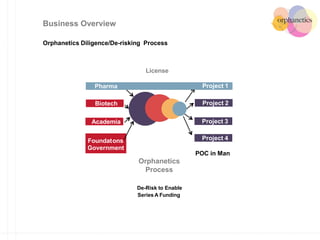
Orphanetics Diligence/De-risking Process
Orphanetics
Process
De-Risk to Enable
Series A Funding
POC in Man
Pharma Project 1
Biotech
Academia
Foundatons
Government
Project 2
Project 3
Project 4
License
Business Overview
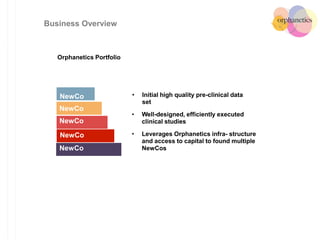
NewCo
NewCo
NewCo
NewCo
• Initial high quality pre-clinical data
set
• Well-designed, efficiently executed
clinical studies
• Leverages Orphanetics infra- structure
and access to capital to found multiple
NewCos
Orphanetics Portfolio
NewCo
Business Overview
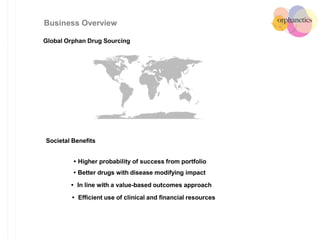
Societal Benefits
• Higher probability of success from portfolio
• Better drugs with disease modifying impact
• In line with a value-based outcomes approach
• Efficient use of clinical and financial resources
Global Orphan Drug Sourcing
Business Overview
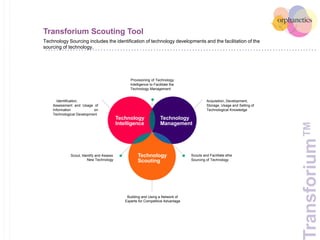
Transforium Scouting Tool
Technology Sourcing includes the identification of technology developments and the facilitation of the
sourcing of technology.
Provisioning of Technology
Intelligence to Facilitate the
Technology Management
Building and Using a Network of
Experts for Competitive Advantage
Scouts and Facilitate sthe
Sourcing of Technology
Acquisition, Development,
Storage, Usage and Selling of
Technological Knowledge
Identificaiton,
Assessment and Usage of
Information on
Technological Development
Scout, Identify and Assess
New Technology
Technology
Intelligence
Technology
Scouting
Technology
Management
ransforium™
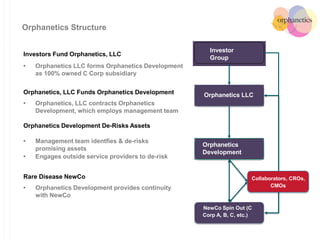
Investors Fund Orphanetics, LLC
• Orphanetics LLC forms Orphanetics Development
as 100% owned C Corp subsidiary
Orphanetics, LLC Funds Orphanetics Development
• Orphanetics, LLC contracts Orphanetics
Development, which employs management team
Orphanetics Development De-Risks Assets
• Management team identfies & de-risks
promising assets
• Engages outside service providers to de-risk
Rare Disease NewCo
• Orphanetics Development provides continuity
with NewCo
Investor
Group
Orphanetics LLC
Orphanetics
Development
NewCo Spin Out (C
Corp A, B, C, etc.)
Collaborators, CROs,
CMOs
Orphanetics Structure
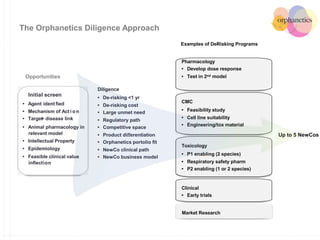
Diligence
• De-risking <1 yr
• De-risking cost
• Large unmet need
• Regulatory path
• Competitive space
• Product differentiation
• Orphanetics portolio fit
• NewCo clinical path
• NewCo business model
Up to 5 NewCos
Initial screen
• Agent ident fied
• Mechanism of Act i o n
• Target-‐> disease link
• Animal pharmacology in
relevant model
• Intellectual Property
• Epidemiology
• Feasible clinical value
inflection
Examples of De‐Risking Programs
Pharmacology
• Develop dose response
• Test in 2nd model
Toxicology
• P1 enabling (2 species)
• Respiratory safety pharm
• P2 enabling (1 or 2 species)
CMC
• Feasibility study
• Cell line suitability
• Engineering/tox material
Clinical
• Early trials
Market Research
Opportunities
The Orphanetics Diligence Approach
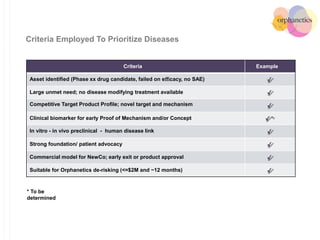
Criteria Example
Asset identified (Phase xx drug candidate, failed on efficacy, no SAE) ✔
Large unmet need; no disease modifying treatment available ✔
Competitive Target Product Profile; novel target and mechanism ✔
Clinical biomarker for early Proof of Mechanism and/or Concept ✔ *
In vitro - in vivo preclinical - human disease link ✔
Strong foundation/ patient advocacy ✔
Commercial model for NewCo; early exit or product approval ✔
Suitable for Orphanetics de-risking (<=$2M and ~12 months) ✔
* To be
determined
Criteria Employed To Prioritize Diseases
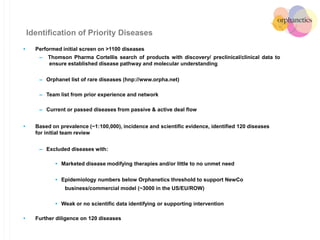
• Performed initial screen on >1100 diseases
– Thomson Pharma Cortellis search of products with discovery/ preclinical/clinical data to
ensure established disease pathway and molecular understanding
– Orphanet list of rare diseases (hnp://www.orpha.net)
– Team list from prior experience and network
– Current or passed diseases from passive & active deal flow
• Based on prevalence (~1:100,000), incidence and scientific evidence, identified 120 diseases
for initial team review
– Excluded diseases with:
• Marketed disease modifying therapies and/or little to no unmet need
• Epidemiology numbers below Orphanetics threshold to support NewCo
business/commercial model (~3000 in the US/EU/ROW)
• Weak or no scientific data identifying or supporting intervention
• Further diligence on 120 diseases
Identification of Priority Diseases
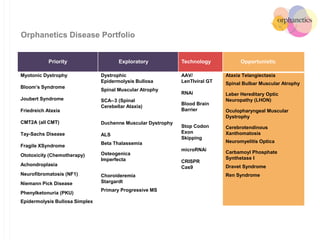
Priority Exploratory Technology Opportunistic
Myotonic Dystrophy
Bloom’s Syndrome
Joubert Syndrome
Friedreich Ataxia
CMT2A (all CMT)
Tay-Sachs Disease
Fragile XSyndrome
Ototoxicity (Chemotherapy)
Achondroplasia
Neurofibromatosis (NF1)
Niemann Pick Disease
Phenylketonuria (PKU)
Epidermolysis Bullosa Simplex
Dystrophic
Epidermolysis Bullosa
Spinal Muscular Atrophy
SCA-‐3 (Spinal
Cerebellar Ataxia)
Duchenne Muscular Dystrophy
ALS
Beta Thalassemia
Osteogenica
Imperfecta
Choroideremia
Stargardt
Primary Progressive MS
AAV/
LenTIviral GT
RNAi
Blood Brain
Barrier
Stop Codon
Exon
Skipping
microRNAi
CRISPR
Cas9
Ataxia Telangiectasia
Spinal Bulbar Muscular Atrophy
Leber Hereditary Optic
Neuropathy (LHON)
Oculopharyngeal Muscular
Dystrophy
Cerebrotendinous
Xanthomatosis
Neuromyelitis Optica
Carbamoyl Phosphate
Synthetase I
Dravet Syndrome
Ren Syndrome
Orphanetics Disease Portfolio
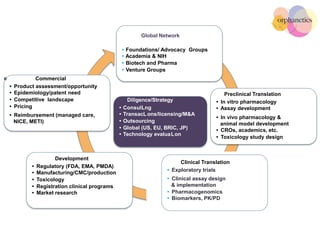
Global Network
• Foundations/ Advocacy Groups
• Academia & NIH
• Biotech and Pharma
• Venture Groups
Preclinical Translation
• In vitro pharmacology
• Assay development
• In vivo pharmacology &
animal model development
• CROs, academics, etc.
• Toxicology study design
Clinical Translation
• Exploratory trials
• Clinical assay design
& implementation
• Pharmacogenomics
• Biomarkers, PK/PD
Development
• Regulatory (FDA, EMA, PMDA)
• Manufacturing/CMC/production
• Toxicology
• Registration clinical programs
• Market research
e Commercial
• Product assessment/opportunity
• Epidemiology/patent need
• Competitive landscape
• Pricing
• Reimbursement (managed care,
NICE, METI)
Diligence/Strategy
• ConsulLng
• TransacLons/licensing/M&A
• Outsourcing
• Global (US, EU, BRIC, JP)
• Technology evaluaLon
Contact:
Bill Smith
Managing Director
19 Leonard Street
1W
New York, NY 10013
Phone: 646-598-4042

Orphanetics Presentation

  • 1.
  • 2.
    Orphanetics: Rare andUltra Rare Disease Innovation Our charter emphasizes scientific and operational expertise to enable subsequent financing and formation of new companies focused on the treatment of rare and ultra rare diseases. This model positions Orphanetics to create new biotechnology companies focused on addressing critical unmet medical needs. To achieve this goal, Orphanetics: • Evaluates opportunities across therapeutic areas in rare diseases • Considers opportunities across diverse platform technologies (e.g., small molecule, protein, peptide and AAV) • Focuses on rare diseases with a characterized genetic etiology • Conducts de-risking experiments utilizing CROs or academic laboratories with expertise in the proposed studies • Performs de-risking experiments that include pharmacology, toxicology or clinical studies • Seeks lead candidates compatible with our approach
  • 3.
    Orphanetics: A NewModel for Drug Development & Collaboration Orphanetics enters into collaborations with academic centers, patient foundations and biopharmaceutical companies with the goal of enabling drug development and new company creation to develop therapeutics for rare diseases. Orphanetics is utilizing an externally focused, highly collaborative, transparent and capital efficient model: • Orphanetics works with organizations and foundations to identify assets that fit our development model and builds long-term relationships to maximize value. • Orphanetics works closely with scientists, clinicians and non-profit or industry research organizations to de-risk programs and accelerate “go” / “no-go” development decisions. • De-risking data takes into account development and regulatory requirements to enable a seamless transition into a new, venture capital-funded company and/or for partnering with a biopharmaceutical company. • Orphanetics welcomes working with biopharma for assets that cannot be accommodated with internal resources or due to changes in priorities. • Orphanetics impacts the development of new treatments for rare diseases by operating in a milestone- driven, capital efficient manner
  • 4.
    Orphanetics Diligence/De-risking Process Orphanetics Process De-Riskto Enable Series A Funding POC in Man Pharma Project 1 Biotech Academia Foundatons Government Project 2 Project 3 Project 4 License Business Overview
  • 5.
    NewCo NewCo NewCo NewCo • Initial highquality pre-clinical data set • Well-designed, efficiently executed clinical studies • Leverages Orphanetics infra- structure and access to capital to found multiple NewCos Orphanetics Portfolio NewCo Business Overview
  • 6.
    Societal Benefits • Higherprobability of success from portfolio • Better drugs with disease modifying impact • In line with a value-based outcomes approach • Efficient use of clinical and financial resources Global Orphan Drug Sourcing Business Overview
  • 7.
    Transforium Scouting Tool TechnologySourcing includes the identification of technology developments and the facilitation of the sourcing of technology. Provisioning of Technology Intelligence to Facilitate the Technology Management Building and Using a Network of Experts for Competitive Advantage Scouts and Facilitate sthe Sourcing of Technology Acquisition, Development, Storage, Usage and Selling of Technological Knowledge Identificaiton, Assessment and Usage of Information on Technological Development Scout, Identify and Assess New Technology Technology Intelligence Technology Scouting Technology Management ransforium™
  • 8.
    Investors Fund Orphanetics,LLC • Orphanetics LLC forms Orphanetics Development as 100% owned C Corp subsidiary Orphanetics, LLC Funds Orphanetics Development • Orphanetics, LLC contracts Orphanetics Development, which employs management team Orphanetics Development De-Risks Assets • Management team identfies & de-risks promising assets • Engages outside service providers to de-risk Rare Disease NewCo • Orphanetics Development provides continuity with NewCo Investor Group Orphanetics LLC Orphanetics Development NewCo Spin Out (C Corp A, B, C, etc.) Collaborators, CROs, CMOs Orphanetics Structure
  • 9.
    Diligence • De-risking <1yr • De-risking cost • Large unmet need • Regulatory path • Competitive space • Product differentiation • Orphanetics portolio fit • NewCo clinical path • NewCo business model Up to 5 NewCos Initial screen • Agent ident fied • Mechanism of Act i o n • Target-‐> disease link • Animal pharmacology in relevant model • Intellectual Property • Epidemiology • Feasible clinical value inflection Examples of De‐Risking Programs Pharmacology • Develop dose response • Test in 2nd model Toxicology • P1 enabling (2 species) • Respiratory safety pharm • P2 enabling (1 or 2 species) CMC • Feasibility study • Cell line suitability • Engineering/tox material Clinical • Early trials Market Research Opportunities The Orphanetics Diligence Approach
  • 10.
    Criteria Example Asset identified(Phase xx drug candidate, failed on efficacy, no SAE) ✔ Large unmet need; no disease modifying treatment available ✔ Competitive Target Product Profile; novel target and mechanism ✔ Clinical biomarker for early Proof of Mechanism and/or Concept ✔ * In vitro - in vivo preclinical - human disease link ✔ Strong foundation/ patient advocacy ✔ Commercial model for NewCo; early exit or product approval ✔ Suitable for Orphanetics de-risking (<=$2M and ~12 months) ✔ * To be determined Criteria Employed To Prioritize Diseases
  • 11.
    • Performed initialscreen on >1100 diseases – Thomson Pharma Cortellis search of products with discovery/ preclinical/clinical data to ensure established disease pathway and molecular understanding – Orphanet list of rare diseases (hnp://www.orpha.net) – Team list from prior experience and network – Current or passed diseases from passive & active deal flow • Based on prevalence (~1:100,000), incidence and scientific evidence, identified 120 diseases for initial team review – Excluded diseases with: • Marketed disease modifying therapies and/or little to no unmet need • Epidemiology numbers below Orphanetics threshold to support NewCo business/commercial model (~3000 in the US/EU/ROW) • Weak or no scientific data identifying or supporting intervention • Further diligence on 120 diseases Identification of Priority Diseases
  • 12.
    Priority Exploratory TechnologyOpportunistic Myotonic Dystrophy Bloom’s Syndrome Joubert Syndrome Friedreich Ataxia CMT2A (all CMT) Tay-Sachs Disease Fragile XSyndrome Ototoxicity (Chemotherapy) Achondroplasia Neurofibromatosis (NF1) Niemann Pick Disease Phenylketonuria (PKU) Epidermolysis Bullosa Simplex Dystrophic Epidermolysis Bullosa Spinal Muscular Atrophy SCA-‐3 (Spinal Cerebellar Ataxia) Duchenne Muscular Dystrophy ALS Beta Thalassemia Osteogenica Imperfecta Choroideremia Stargardt Primary Progressive MS AAV/ LenTIviral GT RNAi Blood Brain Barrier Stop Codon Exon Skipping microRNAi CRISPR Cas9 Ataxia Telangiectasia Spinal Bulbar Muscular Atrophy Leber Hereditary Optic Neuropathy (LHON) Oculopharyngeal Muscular Dystrophy Cerebrotendinous Xanthomatosis Neuromyelitis Optica Carbamoyl Phosphate Synthetase I Dravet Syndrome Ren Syndrome Orphanetics Disease Portfolio
  • 13.
    Global Network • Foundations/Advocacy Groups • Academia & NIH • Biotech and Pharma • Venture Groups Preclinical Translation • In vitro pharmacology • Assay development • In vivo pharmacology & animal model development • CROs, academics, etc. • Toxicology study design Clinical Translation • Exploratory trials • Clinical assay design & implementation • Pharmacogenomics • Biomarkers, PK/PD Development • Regulatory (FDA, EMA, PMDA) • Manufacturing/CMC/production • Toxicology • Registration clinical programs • Market research e Commercial • Product assessment/opportunity • Epidemiology/patent need • Competitive landscape • Pricing • Reimbursement (managed care, NICE, METI) Diligence/Strategy • ConsulLng • TransacLons/licensing/M&A • Outsourcing • Global (US, EU, BRIC, JP) • Technology evaluaLon
  • 14.
    Contact: Bill Smith Managing Director 19Leonard Street 1W New York, NY 10013 Phone: 646-598-4042