ORGANIZATIONAL
BEHAVIOR AND CULTURE
Social systems and human behavior complement
each other. When people join a work group, they
become part of the organization’s social system. It is
the medium by which they relate themselves to the
world of work. A social system is a complex set of
human relationships interacting in various ways.
There are two points that stand out in the complex
interactions among people in a social system
 The behavior of the individual and his relation to any
other individual.
 The other point revolves around a system’s
boundaries.
EQUILIBRIUM IN THE SOCIAL SYSTEM
A social system is a state of equilibrium when all
the variables in an organization system operate in a
dynamic working balance with its interdependent
parts.
When an organization is in disequilibrium, its
subparts are not working in harmony. It is important
that the entire system and its sub-systems work
together as one.
One major function of management is to
evaluate the actual and proposed changes in
the social system to determine their possible
functional or dysfunctional effects so that
appropriate responses can be anticipated.
Appraising the probable effects on various
groups in the social system e.g. workers,
management, operational policies and the
work environment, is a complex process.
Workers can have tremendous functional effects on
the organization by being:
 Creative
 Enthusiastic
 Productive
 Constantly seek to improve the quality of the
organization’s product or service.
Workers also have dysfunctional effects by being:
 Tardy
 Frequently absent
 Uncooperative
 Poor attitude to share their talents
 Most often, resistant to organizational changes
For workers to be functional they need to receive
clear expectations and promises of rewards and
commitment towards the goals of the organization.
Any individual who joins an organization, makes
an unwritten psychological contract although he is not
aware of doing so. This implied contract is in addition
to the economic contract, where time, effort and
talent are used in exchange of wages and reasonable
working conditions. It is important that management
honors the economic as well as the psychological
contract so that the individual may experience
satisfaction and stay in the organization and perform
well.
Culture and the
Organizational
Development
 Culture has basic manifestations which
may be present everywhere.
 Culture is indispensable to an organization
which is compose of workers who share a
common culture or one that is made up of
different people who are interacting on the
basis of shared beliefs, customs, values,
and activities.
 Culture provides stem of the complex
social system of laws, values and customs
in which organizational behavior occurs
Inside the organization lies powerful force
determining individual and group behavior
 Organizational culture is a set of
assumptions, beliefs, values and norms
that are shared by the members.
 It represents an important element of the
work environment in which workers
perform their tasks.
 It also helps stimulate workers’
enthusiasm for their tasks.
Characteristics of
Organizational Culture
 Distinctive
 Stable
 Implicit
 No one “best”
 Integrated
 Accepted
 A reflection of top management and
varying strength
Socialization of Workers
 The process whereby the individual is
converted into the person. As a process,
the individual learns to conform with the
norms of his social group, acquires a
status and plays a corresponding role.
 Socialization as an educational process
greatly influences the shaping of a
workers personality which is in accordance
with the standard values and norms of his
work environment.
Values and Social
Responsibility
 Values are the expressions of ultimate
ends, goals, or purpose of social action:
these involves the quality or power
expressing one’s attitude and emotion
towards a thing.
 Social responsibility is the recognition
that organizations have significant
influence on the social system. It reflects
the assumptions that the values of the
workers can be potent force in the
accomplishment of organizational goals.
Philippine Value System and
Social Acceptance
Filipinos attach a great value to
“pakikisama” or smooth interpersonal
relations (SIR). Persons resort to SIR
patterns by using polite language, soft
voice, and persuasive and gentle manners to
avoid open disagreement with others even
under difficult circumstances.
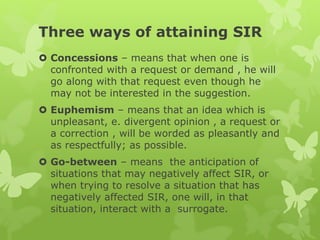
Three ways of attaining SIR
 Concessions – means that when one is
confronted with a request or demand , he will
go along with that request even though he
may not be interested in the suggestion.
 Euphemism – means that an idea which is
unpleasant, e. divergent opinion , a request or
a correction , will be worded as pleasantly and
as respectfully; as possible.
 Go-between – means the anticipation of
situations that may negatively affect SIR, or
when trying to resolve a situation that has
negatively affected SIR, one will, in that
situation, interact with a surrogate.
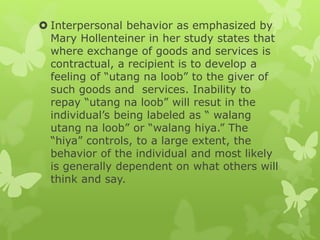
 Interpersonal behavior as emphasized by
Mary Hollenteiner in her study states that
where exchange of goods and services is
contractual, a recipient is to develop a
feeling of “utang na loob” to the giver of
such goods and services. Inability to
repay “utang na loob” will resut in the
individual’s being labeled as “ walang
utang na loob” or “walang hiya.” The
“hiya” controls, to a large extent, the
behavior of the individual and most likely
is generally dependent on what others will
think and say.

Organizational behavior and culture

  • 1.
    ORGANIZATIONAL BEHAVIOR AND CULTURE Socialsystems and human behavior complement each other. When people join a work group, they become part of the organization’s social system. It is the medium by which they relate themselves to the world of work. A social system is a complex set of human relationships interacting in various ways. There are two points that stand out in the complex interactions among people in a social system  The behavior of the individual and his relation to any other individual.  The other point revolves around a system’s boundaries.
  • 2.
    EQUILIBRIUM IN THESOCIAL SYSTEM A social system is a state of equilibrium when all the variables in an organization system operate in a dynamic working balance with its interdependent parts. When an organization is in disequilibrium, its subparts are not working in harmony. It is important that the entire system and its sub-systems work together as one.
  • 3.
    One major functionof management is to evaluate the actual and proposed changes in the social system to determine their possible functional or dysfunctional effects so that appropriate responses can be anticipated. Appraising the probable effects on various groups in the social system e.g. workers, management, operational policies and the work environment, is a complex process.
  • 4.
    Workers can havetremendous functional effects on the organization by being:  Creative  Enthusiastic  Productive  Constantly seek to improve the quality of the organization’s product or service. Workers also have dysfunctional effects by being:  Tardy  Frequently absent  Uncooperative  Poor attitude to share their talents  Most often, resistant to organizational changes
  • 5.
    For workers tobe functional they need to receive clear expectations and promises of rewards and commitment towards the goals of the organization. Any individual who joins an organization, makes an unwritten psychological contract although he is not aware of doing so. This implied contract is in addition to the economic contract, where time, effort and talent are used in exchange of wages and reasonable working conditions. It is important that management honors the economic as well as the psychological contract so that the individual may experience satisfaction and stay in the organization and perform well.
  • 6.
  • 7.
     Culture hasbasic manifestations which may be present everywhere.  Culture is indispensable to an organization which is compose of workers who share a common culture or one that is made up of different people who are interacting on the basis of shared beliefs, customs, values, and activities.  Culture provides stem of the complex social system of laws, values and customs in which organizational behavior occurs
  • 8.
    Inside the organizationlies powerful force determining individual and group behavior  Organizational culture is a set of assumptions, beliefs, values and norms that are shared by the members.  It represents an important element of the work environment in which workers perform their tasks.  It also helps stimulate workers’ enthusiasm for their tasks.
  • 9.
    Characteristics of Organizational Culture Distinctive  Stable  Implicit  No one “best”  Integrated  Accepted  A reflection of top management and varying strength
  • 10.
    Socialization of Workers The process whereby the individual is converted into the person. As a process, the individual learns to conform with the norms of his social group, acquires a status and plays a corresponding role.  Socialization as an educational process greatly influences the shaping of a workers personality which is in accordance with the standard values and norms of his work environment.
  • 11.
    Values and Social Responsibility Values are the expressions of ultimate ends, goals, or purpose of social action: these involves the quality or power expressing one’s attitude and emotion towards a thing.  Social responsibility is the recognition that organizations have significant influence on the social system. It reflects the assumptions that the values of the workers can be potent force in the accomplishment of organizational goals.
  • 12.
    Philippine Value Systemand Social Acceptance Filipinos attach a great value to “pakikisama” or smooth interpersonal relations (SIR). Persons resort to SIR patterns by using polite language, soft voice, and persuasive and gentle manners to avoid open disagreement with others even under difficult circumstances.
  • 13.
    Three ways ofattaining SIR  Concessions – means that when one is confronted with a request or demand , he will go along with that request even though he may not be interested in the suggestion.  Euphemism – means that an idea which is unpleasant, e. divergent opinion , a request or a correction , will be worded as pleasantly and as respectfully; as possible.  Go-between – means the anticipation of situations that may negatively affect SIR, or when trying to resolve a situation that has negatively affected SIR, one will, in that situation, interact with a surrogate.
  • 14.
     Interpersonal behavioras emphasized by Mary Hollenteiner in her study states that where exchange of goods and services is contractual, a recipient is to develop a feeling of “utang na loob” to the giver of such goods and services. Inability to repay “utang na loob” will resut in the individual’s being labeled as “ walang utang na loob” or “walang hiya.” The “hiya” controls, to a large extent, the behavior of the individual and most likely is generally dependent on what others will think and say.