Organic Food Value:
Educating Buyers of America
          By: Kelsey Lafferty
       Biology 100, Section 007
What are Organic Foods?

Organic Foods have a list of prerequisites they must meet
to be qualified as organic foods…
    No pesticides can be used currently or in the past three
    years
    No growth hormones
    Pests, weeds and diseases are managed by biological or
    physical controls
    Animals must be provided with access to outside
    Organic farmers must apply for certification from the
    government
History of Organic Farming

The term organic farming came from Lord
Northbourne’s book, Look to the Land in 1940
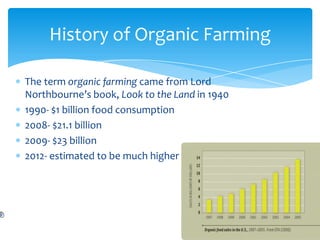
1990- $1 billion food consumption
2008- $21.1 billion
2009- $23 billion
2012- estimated to be much higher
Question
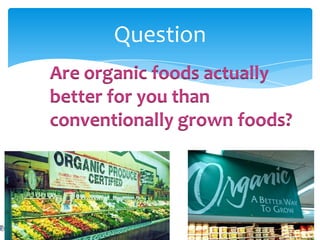
Are organic foods actually
better for you than
conventionally grown foods?
What people think about Organic
           Foods..
Benefits of Organic Foods

Less pesticides found
Higher levels of vitamin C, iron, magnesium and
phosphorous - reported by a study done by Worthington
(2001)
Greater levels of antioxidant chemicals
Consumption of diary makes significant difference in
health outcomes for allergic dermatitis
1/3 of chemical residues compared to conventionally
raised foods
Pesticides

70% of consumers have said they purchased organic foods
to avoid pesticides
Less pesticides found in organic than conventionally
raised foods
Pesticides can kill plants; people do not want to be
consuming them
Studies show most pesticides do not lead to health
concern
Occupational exposure present a greater health risk than
consumer exposure to pesticides
Negatives

Results are greatly affected by the length of time a plot is
organically farmed
 Local geography
 Weather patterns
 Ground cover
 More land required
Studies that prove health benefits are scarce; implied
health benefit
Price is much HIGHER than conventionally grown foods
Organic foods, why people don’t buy


  Cost
  Convenience
  Availability
  Food is not as appealing because they do not
  get polished and may spoil quicker
Studies about Organic Foods
Woese and others reported on 150 studies of many different
foods that there were no major nutrient level differences
between organic and conventionally grown foods

Lockie claimed from his study that organic foods have less
pesticide residue, but has no added vitamin or mineral
content

Lockie study found that people with higher education and
higher incomes tend to purchase organic
What to consider when shopping
Organic foods                Conventionally grown
 Easier to get in season     foods:
 from a local farmer         ✳Less expensive
 Reduction of pesticides     ✳Available all season
 More costly                 ✳Potential for more
 May not look as appealing    pesticide use and residue
 (less shiny apples) but     ✳Contains primarily same
 does not mean it is not       nutritional value as
 delicious                   organic
Conclusions

Organic foods are healthy, but the benefits do not
completely outweigh conventional food
There have not been enough tests to prove that
organic food has a statistically significant health benefit
compared to conventionally grown food
Organic foods are not necessarily better for you and do
not give you any more nutrients than conventional
foods
 It is the perception that organic provides added health
 benefits that gets people to buy them
Works Cited

http://www.altmedrev.com/publications/15/1/4.pdf
      Walter J. Crinnion, ND
http://pediatrics.aappublications.org/content/130/5/e1406.full.
pdf+html
      Joel Forman, Janet Silverstein
http://onlinelibrary.wiley.com/doi/10.1111/j.1750-
3841.2006.00196.x/full
      Carl K. Winter, Sarah F. Davis
http://europepmc.org/abstract/MED/20359265/reload=0;jsessi
onid=F4BeOLVWYlUYesfISLdQ.4
      Clinton WJ

Organic Food Value

  • 1.
    Organic Food Value: EducatingBuyers of America By: Kelsey Lafferty Biology 100, Section 007
  • 2.
    What are OrganicFoods? Organic Foods have a list of prerequisites they must meet to be qualified as organic foods… No pesticides can be used currently or in the past three years No growth hormones Pests, weeds and diseases are managed by biological or physical controls Animals must be provided with access to outside Organic farmers must apply for certification from the government
  • 3.
    History of OrganicFarming The term organic farming came from Lord Northbourne’s book, Look to the Land in 1940 1990- $1 billion food consumption 2008- $21.1 billion 2009- $23 billion 2012- estimated to be much higher
  • 4.
    Question Are organic foodsactually better for you than conventionally grown foods?
  • 5.
    What people thinkabout Organic Foods..
  • 6.
    Benefits of OrganicFoods Less pesticides found Higher levels of vitamin C, iron, magnesium and phosphorous - reported by a study done by Worthington (2001) Greater levels of antioxidant chemicals Consumption of diary makes significant difference in health outcomes for allergic dermatitis 1/3 of chemical residues compared to conventionally raised foods
  • 7.
    Pesticides 70% of consumershave said they purchased organic foods to avoid pesticides Less pesticides found in organic than conventionally raised foods Pesticides can kill plants; people do not want to be consuming them Studies show most pesticides do not lead to health concern Occupational exposure present a greater health risk than consumer exposure to pesticides
  • 8.
    Negatives Results are greatlyaffected by the length of time a plot is organically farmed  Local geography  Weather patterns  Ground cover  More land required Studies that prove health benefits are scarce; implied health benefit Price is much HIGHER than conventionally grown foods
  • 9.
    Organic foods, whypeople don’t buy Cost Convenience Availability Food is not as appealing because they do not get polished and may spoil quicker
  • 10.
    Studies about OrganicFoods Woese and others reported on 150 studies of many different foods that there were no major nutrient level differences between organic and conventionally grown foods Lockie claimed from his study that organic foods have less pesticide residue, but has no added vitamin or mineral content Lockie study found that people with higher education and higher incomes tend to purchase organic
  • 11.
    What to considerwhen shopping Organic foods Conventionally grown Easier to get in season foods: from a local farmer ✳Less expensive Reduction of pesticides ✳Available all season More costly ✳Potential for more May not look as appealing pesticide use and residue (less shiny apples) but ✳Contains primarily same does not mean it is not nutritional value as delicious organic
  • 12.
    Conclusions Organic foods arehealthy, but the benefits do not completely outweigh conventional food There have not been enough tests to prove that organic food has a statistically significant health benefit compared to conventionally grown food Organic foods are not necessarily better for you and do not give you any more nutrients than conventional foods  It is the perception that organic provides added health benefits that gets people to buy them
  • 13.
    Works Cited http://www.altmedrev.com/publications/15/1/4.pdf Walter J. Crinnion, ND http://pediatrics.aappublications.org/content/130/5/e1406.full. pdf+html Joel Forman, Janet Silverstein http://onlinelibrary.wiley.com/doi/10.1111/j.1750- 3841.2006.00196.x/full Carl K. Winter, Sarah F. Davis http://europepmc.org/abstract/MED/20359265/reload=0;jsessi onid=F4BeOLVWYlUYesfISLdQ.4 Clinton WJ