National institution of technology
puducherry
ORGANIC COMPOUNDS
NOMENCLATURE AND CLASSIFICATIONS
department of education
Submitted by :monisha.v
ed24b1025
bsc.bed (itep)physics major
submitted to: MR. detchanamurthy .s
chemistry faculty
department of EDUCATION
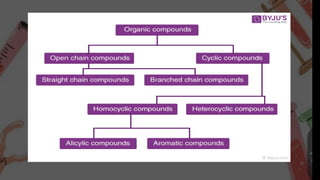
CLASSIFICATION OF ORGANIC COMPOUND;
THE ORGANIC COMPOUND BROADLY CLASSIFIED INTO TWO CATEGORIES;
• ACYCLIC COMPOUND OR OPEN CHAIN COMPOUND
• CYCLIC COMPOUND OR CLOSED CHAIN COMPOUND
ACYCLIC COMPOUND OR OPEN CHAIN COMPOUND
• The very first classification of organic compounds is open-chain organic compounds. The organic
compounds whose structural formula is straight are open-chain organic compounds. Open chain
organic compounds are also known as acyclic compounds. Acyclic compounds are those compounds
whose structural formula is not cyclic. For instance: methane, ethane, acetone, methanol etc.
• Open chain compounds (aliphatic compounds) can be classified broadly into two categories which
such as:
• Saturated Compounds[Don’t have double or triple bond between carbon and hydrogen e.g.Alkaens]
• Unsaturated Compounds[have double or triple bond between carbon and hydrogen
e.g.Alkene,Alkynes]
CLOSED CHAIN COMPOUND ;
• Organic compounds are also classified as closed chain organic compounds. The compound in which
carbon is enclosed within a closed chain is known as a closed chain organic compound. Closed chain
organic compounds are also known as cyclic compounds or ring compounds.
• Cyclic compounds are those compounds in which the carbon chain forms a cycle or ring. Such
compounds can also be referred to as ring compounds.
• Cyclic compounds can be classified into two categories which are-
• Homocycliccompounds
• Heterocyclic compounds
* Homocyclic compounds are those cyclic compounds that are purely composed of a carbon
chain. No other functional group is attached to the ring. Such compounds are known as
homocyclic compounds. Homocyclic compounds are nonpolar because they are only
composed of carbon and hydrogen atoms. For instance: cyclo-propane, cyclo-butane etc.
• Homocyclic compounds are further divided into the following categories:
• Alicyclic compounds[ Don’t have double or triple bond between carbon and hydrogen ]
• Aromatic compounds[ Have double or triple bond between carbon and hydrogen ]
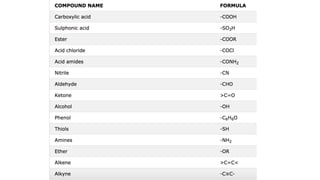
IUPAC NOMENCLATURE OF A FEW IMPORTANT ALIPHATIC COMPUNDS
The IUPAC nomenclature of alkanes, alkenes, and alkynes are discussed in the subsections below.
1. Alkanes
The General formula of alkanes corresponds to CnH2n+2
The suffix ‘ane’ is generally used to describe alkanes. Examples for the nomenclature of alkanes as
per IUPAC guidelines include methane for the compound CH4 and Butane for the compound C4H10
2. Alkenes
The General formula of alkenes is described as CnH2n
The suffix ‘ene’ is used to describe alkenes via IUPAC norms. Examples for the nomenclature of
alkenes include the name ethene used to describe the compound given by C2H4 and Propene used to
describe the compound given by C3H6
3. Alkynes
The General formula of alkynes is CnH2n-2
The suffix ‘yne’ is generally used to describe alkynes. An example of the IUPAC nomenclature of
alkynes is: ethyne used to describe the compound given by C2H2
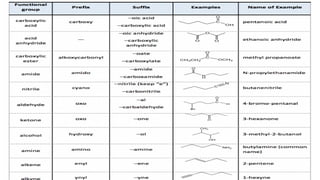
NOMENCLATURE:
Chemical nomenclature is a set of rules to generate systematic names for chemical compounds.
IUPAC NOMENCLATURE SHOULD FOLLOW THIS RULES ;
1. The Longest Chain Rule: The parent hydrocarbon must be identified and subsequently
named. The parent chain belonging to the compound in question is generally the longest
chain of carbon atoms, be it in the form of a straight chain or a chain of any other shape.
2. The Lowest Set of Locants: The carbon atoms belonging to the parent hydrocarbon chain
must be numbered using natural numbers and beginning from the end in which the lowest
number is assigned to the carbon atom which carries the substituents.
3. Multiple instances of the same substituent: Prefixes which indicate the total number
of the same substituent in the given organic compounds are given, such as di, tri, etc.
4. Naming of different substituents: In the organic compounds containing multiple
substituents, the corresponding substituents are arranged in alphabetical order of names in
the IUPAC nomenclature of organic compounds in question.
5. The naming of different substituents present at the same positions: In the scenario
wherein two differing substituent groups are present at the same position of the organic
compound, the substituents are named in ascending alphabetical order.
6.Naming Complex Substituents: Complex substituents of organic compounds having
branched structures must be named as substituted alkyl groups whereas the carbon
which is attached to the substituent group is numbered as one. These branched and
complex substituents must be written in brackets in the IUPAC nomenclature of the
corresponding compounds.
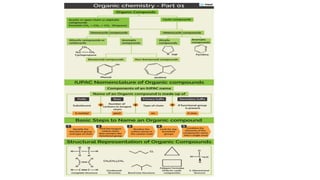
The format of the IUPAC Name of the Compound can be written as: Root + Suffix+Prefix.
ROOT : Total no of carbons in the chain.
Suffix : Functional group .
Prefix : substitute or side chain .
IUPAC NOMENCLATURE METHOD;
1. Compositional Nomenclature
Compositional Nomenclature is used to name compounds based on the
composition of the species or substances against systems involving structural
information or composition, in accordance with IUPAC nomenclature.
The generalized stoichiometric name is involved in the compositional
nomenclature of compounds. Substances are named using multiple prefixes so that
the overall stoichiometry of the compound is made clear from the name.
In cases wherein multiple components are present, the components are divided
into two classes – electronegative components and electropositive components.
These names are similar to the names of salts. However, this does not predict or
suggest the behaviour or chemical nature of the species named in such a way.
The usage of multiple prefixes along with the ordering of components and the
usage of the more electronegative component towards the end of the name must
be kept in mind while naming these compounds via IUPAC norms. An example of
such a name for a compound would be the name phosphorus trichloride used to
refer to the compound PCl3
• 2. Substitutive Nomenclature
• Substitutive Nomenclature is used in the IUPAC nomenclature of compounds
wherein the parent hydride is altered by the replacement of hydrogen atoms
with a substituent group.
• In this nomenclature system, organic compounds are named with the use of
functional groups as the prefix or suffix to the parent compounds name.
• Compounds derived from the hydrides of specific elements can also be named
using this method. These elements may also from ring structured or chain
structured compounds
• Hydrides that belong to groups 13 to 17 of the modern periodic table are
named with the suffix ‘ane’. Examples of this include Borane, Phosphane, and
oxidane, etc.
• An example of the use of substitutive nomenclature can be observed in the
usage of the name Trichlorophosphine to refer to the compound PCl3
• 3. Additive Nomenclature
• This method was formulated primarily for its applications in
the nomenclature of coordination compounds. It has a wide range
of applications. An example for such nomenclature can be
observed in the name Penta-ammine-chloro-cobalt(III) chloride
used to describe the coordination compound given by the chemical
formula [CoCl(NH3)5]Cl2.
• “The prefix ‘chloro’ corresponds to a Chloride, whereas the prefix
‘chlorido’ corresponds to the ligand.”
• An example of this nomenclature can be observed in the name tri-
chlorido-phosphorus which is used to describe the compound with
the formula PCl3
CONCLUSIONS
• Organic compound in chemistry is the class of chemical compounds that
have carbon-hydrogen chemical bonding. Carbon has the ability to
combine with other carbon atoms to form a long chain. Therefore, it
creates more than 3 million chemical compounds. From a popular
definition, organic chemistry is the chemistry of carbon compounds or
molecules. The concept encompasses compounds like carbon monoxide,
carbon dioxide, carbonates, carbon disulfide, etc. These are the kingdom
of inorganic series. In learning chemistry, the definition or categorization
of chemical compounds such as organic and inorganic compounds is
quite difficult. Hydrocarbons (alkanes, alkenes, acetylene), aldehyde,
ketone, alcohol, ether, carboxylic acid are the most frequent class of
organic compounds.

ORGANIC CHEMISTRY NOMENCLEATURE , CLASSIFICATION.

  • 1.
    National institution oftechnology puducherry ORGANIC COMPOUNDS NOMENCLATURE AND CLASSIFICATIONS department of education Submitted by :monisha.v ed24b1025 bsc.bed (itep)physics major submitted to: MR. detchanamurthy .s chemistry faculty department of EDUCATION
  • 2.
    CLASSIFICATION OF ORGANICCOMPOUND; THE ORGANIC COMPOUND BROADLY CLASSIFIED INTO TWO CATEGORIES; • ACYCLIC COMPOUND OR OPEN CHAIN COMPOUND • CYCLIC COMPOUND OR CLOSED CHAIN COMPOUND ACYCLIC COMPOUND OR OPEN CHAIN COMPOUND • The very first classification of organic compounds is open-chain organic compounds. The organic compounds whose structural formula is straight are open-chain organic compounds. Open chain organic compounds are also known as acyclic compounds. Acyclic compounds are those compounds whose structural formula is not cyclic. For instance: methane, ethane, acetone, methanol etc. • Open chain compounds (aliphatic compounds) can be classified broadly into two categories which such as: • Saturated Compounds[Don’t have double or triple bond between carbon and hydrogen e.g.Alkaens] • Unsaturated Compounds[have double or triple bond between carbon and hydrogen e.g.Alkene,Alkynes]
  • 3.
    CLOSED CHAIN COMPOUND; • Organic compounds are also classified as closed chain organic compounds. The compound in which carbon is enclosed within a closed chain is known as a closed chain organic compound. Closed chain organic compounds are also known as cyclic compounds or ring compounds. • Cyclic compounds are those compounds in which the carbon chain forms a cycle or ring. Such compounds can also be referred to as ring compounds. • Cyclic compounds can be classified into two categories which are- • Homocycliccompounds • Heterocyclic compounds * Homocyclic compounds are those cyclic compounds that are purely composed of a carbon chain. No other functional group is attached to the ring. Such compounds are known as homocyclic compounds. Homocyclic compounds are nonpolar because they are only composed of carbon and hydrogen atoms. For instance: cyclo-propane, cyclo-butane etc. • Homocyclic compounds are further divided into the following categories: • Alicyclic compounds[ Don’t have double or triple bond between carbon and hydrogen ] • Aromatic compounds[ Have double or triple bond between carbon and hydrogen ]
  • 5.
    IUPAC NOMENCLATURE OFA FEW IMPORTANT ALIPHATIC COMPUNDS The IUPAC nomenclature of alkanes, alkenes, and alkynes are discussed in the subsections below. 1. Alkanes The General formula of alkanes corresponds to CnH2n+2 The suffix ‘ane’ is generally used to describe alkanes. Examples for the nomenclature of alkanes as per IUPAC guidelines include methane for the compound CH4 and Butane for the compound C4H10 2. Alkenes The General formula of alkenes is described as CnH2n The suffix ‘ene’ is used to describe alkenes via IUPAC norms. Examples for the nomenclature of alkenes include the name ethene used to describe the compound given by C2H4 and Propene used to describe the compound given by C3H6 3. Alkynes The General formula of alkynes is CnH2n-2 The suffix ‘yne’ is generally used to describe alkynes. An example of the IUPAC nomenclature of alkynes is: ethyne used to describe the compound given by C2H2
  • 7.
    NOMENCLATURE: Chemical nomenclature isa set of rules to generate systematic names for chemical compounds. IUPAC NOMENCLATURE SHOULD FOLLOW THIS RULES ; 1. The Longest Chain Rule: The parent hydrocarbon must be identified and subsequently named. The parent chain belonging to the compound in question is generally the longest chain of carbon atoms, be it in the form of a straight chain or a chain of any other shape. 2. The Lowest Set of Locants: The carbon atoms belonging to the parent hydrocarbon chain must be numbered using natural numbers and beginning from the end in which the lowest number is assigned to the carbon atom which carries the substituents. 3. Multiple instances of the same substituent: Prefixes which indicate the total number of the same substituent in the given organic compounds are given, such as di, tri, etc. 4. Naming of different substituents: In the organic compounds containing multiple substituents, the corresponding substituents are arranged in alphabetical order of names in the IUPAC nomenclature of organic compounds in question.
  • 8.
    5. The namingof different substituents present at the same positions: In the scenario wherein two differing substituent groups are present at the same position of the organic compound, the substituents are named in ascending alphabetical order. 6.Naming Complex Substituents: Complex substituents of organic compounds having branched structures must be named as substituted alkyl groups whereas the carbon which is attached to the substituent group is numbered as one. These branched and complex substituents must be written in brackets in the IUPAC nomenclature of the corresponding compounds. The format of the IUPAC Name of the Compound can be written as: Root + Suffix+Prefix. ROOT : Total no of carbons in the chain. Suffix : Functional group . Prefix : substitute or side chain .
  • 9.
    IUPAC NOMENCLATURE METHOD; 1.Compositional Nomenclature Compositional Nomenclature is used to name compounds based on the composition of the species or substances against systems involving structural information or composition, in accordance with IUPAC nomenclature. The generalized stoichiometric name is involved in the compositional nomenclature of compounds. Substances are named using multiple prefixes so that the overall stoichiometry of the compound is made clear from the name. In cases wherein multiple components are present, the components are divided into two classes – electronegative components and electropositive components. These names are similar to the names of salts. However, this does not predict or suggest the behaviour or chemical nature of the species named in such a way. The usage of multiple prefixes along with the ordering of components and the usage of the more electronegative component towards the end of the name must be kept in mind while naming these compounds via IUPAC norms. An example of such a name for a compound would be the name phosphorus trichloride used to refer to the compound PCl3
  • 10.
    • 2. SubstitutiveNomenclature • Substitutive Nomenclature is used in the IUPAC nomenclature of compounds wherein the parent hydride is altered by the replacement of hydrogen atoms with a substituent group. • In this nomenclature system, organic compounds are named with the use of functional groups as the prefix or suffix to the parent compounds name. • Compounds derived from the hydrides of specific elements can also be named using this method. These elements may also from ring structured or chain structured compounds • Hydrides that belong to groups 13 to 17 of the modern periodic table are named with the suffix ‘ane’. Examples of this include Borane, Phosphane, and oxidane, etc. • An example of the use of substitutive nomenclature can be observed in the usage of the name Trichlorophosphine to refer to the compound PCl3
  • 11.
    • 3. AdditiveNomenclature • This method was formulated primarily for its applications in the nomenclature of coordination compounds. It has a wide range of applications. An example for such nomenclature can be observed in the name Penta-ammine-chloro-cobalt(III) chloride used to describe the coordination compound given by the chemical formula [CoCl(NH3)5]Cl2. • “The prefix ‘chloro’ corresponds to a Chloride, whereas the prefix ‘chlorido’ corresponds to the ligand.” • An example of this nomenclature can be observed in the name tri- chlorido-phosphorus which is used to describe the compound with the formula PCl3
  • 14.
    CONCLUSIONS • Organic compoundin chemistry is the class of chemical compounds that have carbon-hydrogen chemical bonding. Carbon has the ability to combine with other carbon atoms to form a long chain. Therefore, it creates more than 3 million chemical compounds. From a popular definition, organic chemistry is the chemistry of carbon compounds or molecules. The concept encompasses compounds like carbon monoxide, carbon dioxide, carbonates, carbon disulfide, etc. These are the kingdom of inorganic series. In learning chemistry, the definition or categorization of chemical compounds such as organic and inorganic compounds is quite difficult. Hydrocarbons (alkanes, alkenes, acetylene), aldehyde, ketone, alcohol, ether, carboxylic acid are the most frequent class of organic compounds.