LINKEDIN
COMMUNICATION
ARCHITECTURE
Ruslan Belkin, Sean Dawson
Learn how LinkedIn built and evolved
scalable communication platform for the
world’s largest professional network
Agenda
 LinkedIn Communication Platform at a glance
Evolution of LinkedIn Communication System
Evolution of the Network Updates System
 Scaling the system: from 0 to 23M members
 Q&A
Communication Platform – Quick Tour
Communication Platform – The Numbers
 23M members
 130M connections
 2M email messages per day
 250K invitations per day
Communication Platform – The Setup
 Sun™ x86 platform and Sparc production hardware running Solaris™
Operating System
 100% Java programming language
 Tomcat and Jetty as application servers
 Oracle and MySQL as DBs
 ActiveMQ for JMS
 Lucene as a foundation for search
 Spring as a glue
 Spring HTTP-RPC as communication protocol
 Mac for development
Communication Platform – Overview
 The Communication Service
Permanent Message storage
InBox messages
Emails
Batching, delayed delivery
Bounce, cancellation
Actionable content
Rich email content
 The network updates service
Short-lived notifications (events)
Distribution across various affiliations
and groups
Time decay
Events grouping and prioritization
Communication Service
 How is it different:
Workflow oriented
Messages reference other objects in the system
Incorporates email delivery
Batching of messages
Message cancellation
Delayed delivery, customer service review queues, abuse controls
Supports reminders and bounce notifications to users
 Has undergone continuous improvements throughout life of LinkedIn
Message Creation
Message Delivery
Communication Service
 Message Creation
Clients post messages via asynchronous
Java Communications API using JMS
Messages then are routed via routing
service to the appropriate mailbox or directly
for email processing
Multiple member or guest databases are
supported
 Message Delivery
Message delivery is triggered by clients or
by scheduled processes
Delivery actions are asynchronous
Messages can be batched for delivery into a
single email message
Message content is processed through the
JavaServer Page™ (JSP™) technology for
pretty formatting
The scheduler can take into account the
time, delivery preferences, system load
Bounced messages are processed and
redelivered if needed
Reminder system works the same way as
message delivery system
Communication Service – Scheduler
Network Updates Service – Motivation
 Homepage circa 2007
 Poor UI
Cluttered
Where does new content go?
 Poor Backend Integration
Many different service calls
Takes a long time to gather all
of the data
Network Updates Service – Motivation
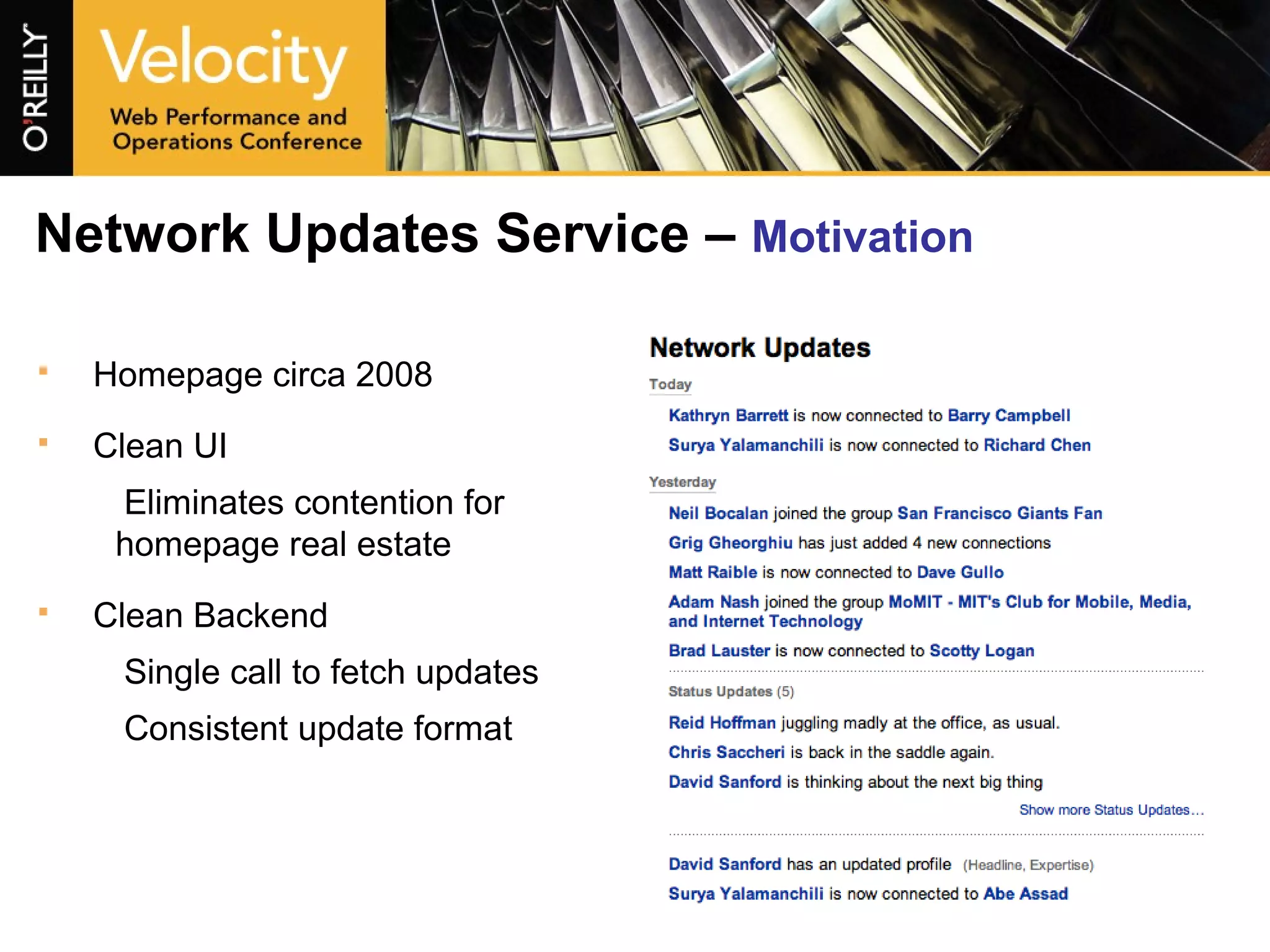
 Homepage circa 2008
 Clean UI
Eliminates contention for
homepage real estate
 Clean Backend
Single call to fetch updates
Consistent update format
Network Updates Service – Iteration 1 API
 Pull-based architecture
 Collectors
Responsible for gathering data
Parallel collection to improve performance
 Resolvers
Fetch state, batch lookup queries, etc…
Use EHCache to cache global data (e.g., member info)
 Rendering
Transform each object into its XML representation
Network Updates Service – Iteration 1
 Lessons learned:
Centralizing updates into a single service leaves a single point of
failure
Be prepared to spend time tuning the HttpConnectionManager
(timeouts, max connections)
While the system was stabilizing, it was affecting all users; should have
rolled the new service out to a small subset!
Don’t use “Least Frequently Used” (LFU) in a large EHCache—very
bad performance!
Network Updates Service – Iteration 2
 Hollywood Principle: “Don’t call me, I’ll call you”
 Push update when an event occurs
 Reading is much quicker since we don’t have to search for the data!
 Tradeoffs
Distributed updates may never be read
More storage space needed
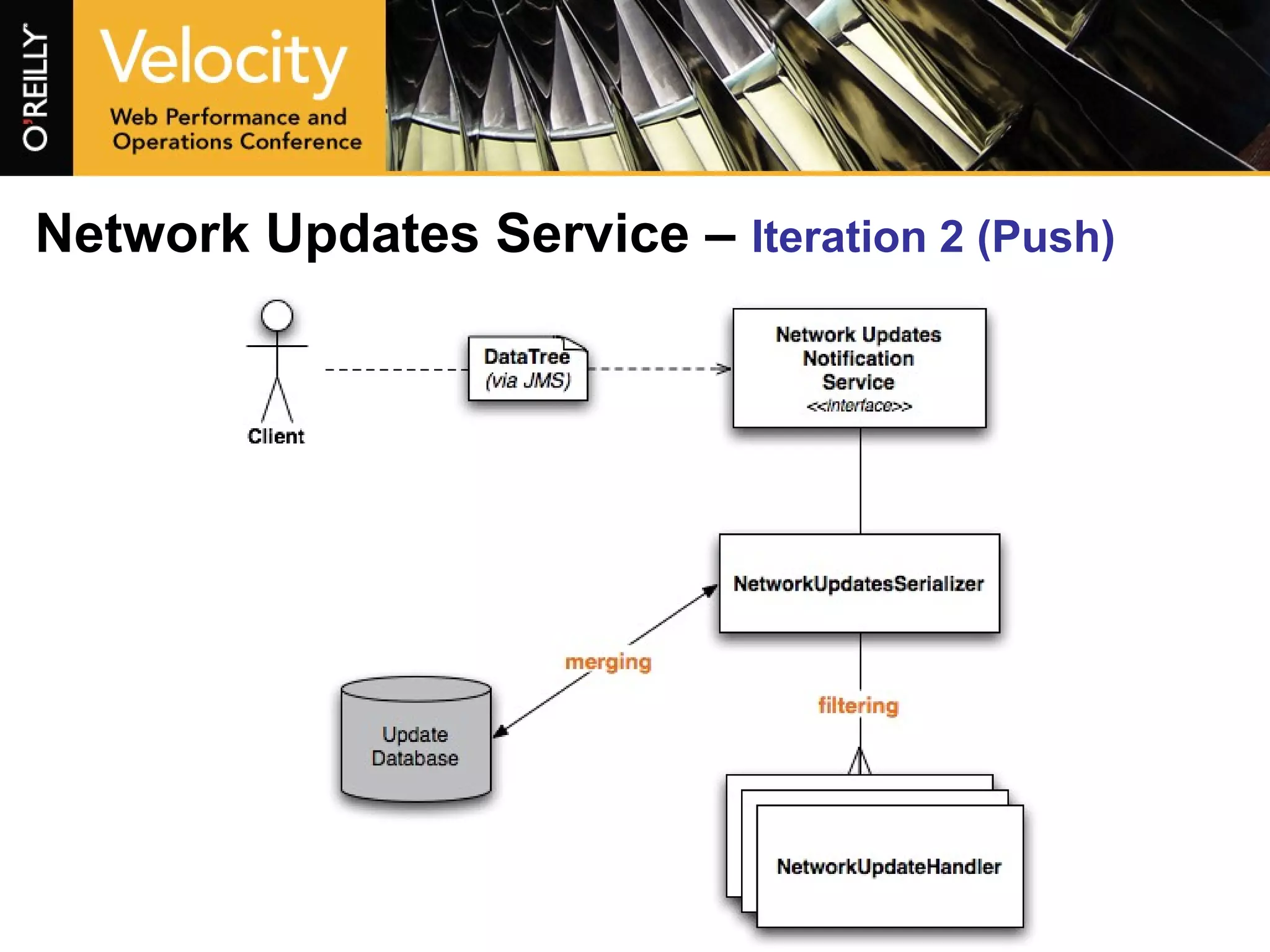
Network Updates Service – Iteration 2 (Push)
Network Updates Service – Iteration 2 (Read)
Network Updates Service – Iteration 2
 Pushing Updates
Updates are delivered via JMS
Aggregate data stored in 1 CLOB column for each target user
Incoming updates are merged into the aggregate structure using
optimistic locking to avoid lock contention
 Reading Updates
Add a new collector that reads from the Update Database
Use Digesters to perform arbitrary transformations on the stream of
updates (e.g, collapse 10 updates from a user into 1)
Network Updates Service – Iteration 2
 Lessons learned:
Underestimated the volume of updates to be processed
CLOB block size was set to 8k, leading to a lot of wasted space (which
isn’t reclaimed!)
Real-time monitoring/configuration with Java Management Extension
(JMX™) specification was extremely helpful
Network Updates Service – JMX Monitoring
 We use JMX™ extensively for monitoring and runtime configuration
 For the Network Updates Service, we have statistics for:
EHCache (cache hits, misses)
ThreadPoolExecutor health (number of concurrent threads)
ActiveMQ (queue size, load)
Detailed timing information for update persistence
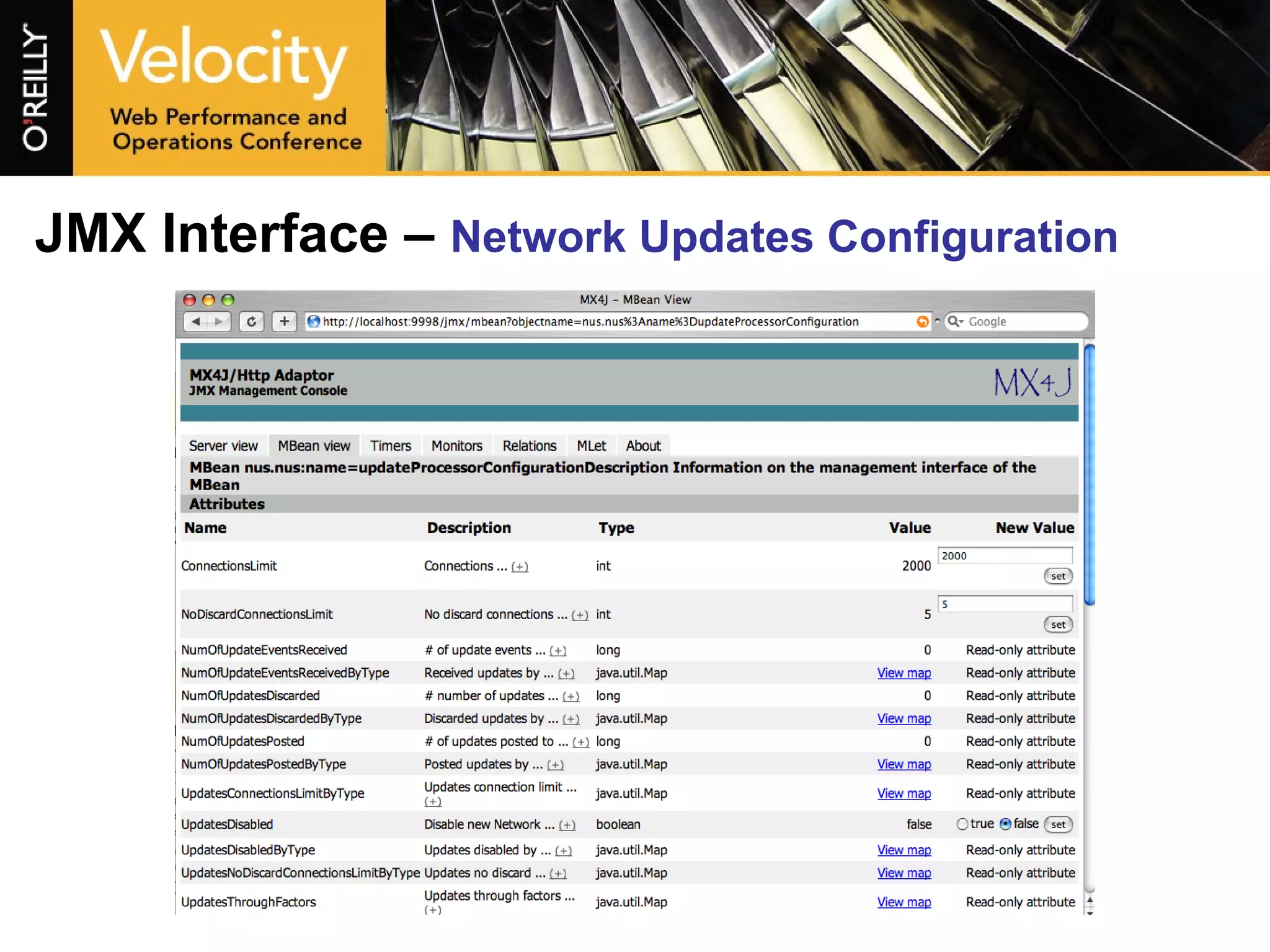
 Extensive runtime configuration:
Ability to tune update thresholds
Ability to randomly throw out (or disable) updates when load is high
(configurable by type)
JMX Interface – Cache Monitoring
JMX Interface – Network Updates Configuration
Network Updates Service – Iteration 3
 Updating a CLOB is expensive
 Goal: Minimize the number of CLOB updates
Use an overflow buffer
Reduce the size of the updates
Network Updates Service – Iteration 3
 Add VARCHAR(4000) column
that acts as a buffer
 When the buffer is full, dump it
to the CLOB and reset
 Avoids over 90% of CLOB
updates (depending on type),
while still retaining the flexibility
for more storage
Scaling the system
 What you learn as you scale:
A single database does not work
Referential integrity will not be possible
Cost becomes a factor: databases,
hardware, licenses, storage, power
Any data loss is a problem
Data warehousing and analytics
becomes a problem
Your system becomes a target for
spamming exploits, data scraping, etc.
 What to do:
Partition everything:
by user groups
by domain
by function
Caching is good even when it’s only
modestly effective
Give up on 100% data integrity
Build for asynchronous flows
Build with reporting in mind
Expect your system to fail at any point
Never underestimate growth trajectory
LinkedIn Communication Architecture
Ruslan Belkin
http://www.linkedin.com/in/rbelkin
Sean Dawson
http://www.linkedin.com/in/seandawson
Slides will be posted at http://blog.linkedin.com
We are hiring, join our team!
LinkedIn Spring Extensions
 Automatic context instantiation
from multiple spring files
 LinkedIn Spring Components
 Property expansion
 Automatic termination handling
 Support for Builder Pattern
 Custom property editors:
Timespan (30s, 4h34m, etc.)
Memory Size, etc.

O'Reilly Velocity Conference 2008

  • 1.
  • 2.
    Learn how LinkedInbuilt and evolved scalable communication platform for the world’s largest professional network
  • 3.
    Agenda  LinkedIn CommunicationPlatform at a glance Evolution of LinkedIn Communication System Evolution of the Network Updates System  Scaling the system: from 0 to 23M members  Q&A
  • 4.
  • 5.
  • 6.
    Communication Platform –The Numbers  23M members  130M connections  2M email messages per day  250K invitations per day
  • 7.
    Communication Platform –The Setup  Sun™ x86 platform and Sparc production hardware running Solaris™ Operating System  100% Java programming language  Tomcat and Jetty as application servers  Oracle and MySQL as DBs  ActiveMQ for JMS  Lucene as a foundation for search  Spring as a glue  Spring HTTP-RPC as communication protocol  Mac for development
  • 8.
    Communication Platform –Overview  The Communication Service Permanent Message storage InBox messages Emails Batching, delayed delivery Bounce, cancellation Actionable content Rich email content  The network updates service Short-lived notifications (events) Distribution across various affiliations and groups Time decay Events grouping and prioritization
  • 9.
    Communication Service  Howis it different: Workflow oriented Messages reference other objects in the system Incorporates email delivery Batching of messages Message cancellation Delayed delivery, customer service review queues, abuse controls Supports reminders and bounce notifications to users  Has undergone continuous improvements throughout life of LinkedIn
  • 10.
  • 11.
  • 12.
    Communication Service  MessageCreation Clients post messages via asynchronous Java Communications API using JMS Messages then are routed via routing service to the appropriate mailbox or directly for email processing Multiple member or guest databases are supported  Message Delivery Message delivery is triggered by clients or by scheduled processes Delivery actions are asynchronous Messages can be batched for delivery into a single email message Message content is processed through the JavaServer Page™ (JSP™) technology for pretty formatting The scheduler can take into account the time, delivery preferences, system load Bounced messages are processed and redelivered if needed Reminder system works the same way as message delivery system
  • 13.
  • 14.
    Network Updates Service– Motivation  Homepage circa 2007  Poor UI Cluttered Where does new content go?  Poor Backend Integration Many different service calls Takes a long time to gather all of the data
  • 15.
    Network Updates Service– Motivation  Homepage circa 2008  Clean UI Eliminates contention for homepage real estate  Clean Backend Single call to fetch updates Consistent update format
  • 16.
    Network Updates Service– Iteration 1 API
  • 17.
    Network Updates Service– Iteration 1 API  Pull-based architecture  Collectors Responsible for gathering data Parallel collection to improve performance  Resolvers Fetch state, batch lookup queries, etc… Use EHCache to cache global data (e.g., member info)  Rendering Transform each object into its XML representation
  • 18.
    Network Updates Service– Iteration 1  Lessons learned: Centralizing updates into a single service leaves a single point of failure Be prepared to spend time tuning the HttpConnectionManager (timeouts, max connections) While the system was stabilizing, it was affecting all users; should have rolled the new service out to a small subset! Don’t use “Least Frequently Used” (LFU) in a large EHCache—very bad performance!
  • 19.
    Network Updates Service– Iteration 2  Hollywood Principle: “Don’t call me, I’ll call you”  Push update when an event occurs  Reading is much quicker since we don’t have to search for the data!  Tradeoffs Distributed updates may never be read More storage space needed
  • 20.
    Network Updates Service– Iteration 2 (Push)
  • 21.
    Network Updates Service– Iteration 2 (Read)
  • 22.
    Network Updates Service– Iteration 2  Pushing Updates Updates are delivered via JMS Aggregate data stored in 1 CLOB column for each target user Incoming updates are merged into the aggregate structure using optimistic locking to avoid lock contention  Reading Updates Add a new collector that reads from the Update Database Use Digesters to perform arbitrary transformations on the stream of updates (e.g, collapse 10 updates from a user into 1)
  • 23.
    Network Updates Service– Iteration 2  Lessons learned: Underestimated the volume of updates to be processed CLOB block size was set to 8k, leading to a lot of wasted space (which isn’t reclaimed!) Real-time monitoring/configuration with Java Management Extension (JMX™) specification was extremely helpful
  • 24.
    Network Updates Service– JMX Monitoring  We use JMX™ extensively for monitoring and runtime configuration  For the Network Updates Service, we have statistics for: EHCache (cache hits, misses) ThreadPoolExecutor health (number of concurrent threads) ActiveMQ (queue size, load) Detailed timing information for update persistence  Extensive runtime configuration: Ability to tune update thresholds Ability to randomly throw out (or disable) updates when load is high (configurable by type)
  • 25.
    JMX Interface –Cache Monitoring
  • 26.
    JMX Interface –Network Updates Configuration
  • 27.
    Network Updates Service– Iteration 3  Updating a CLOB is expensive  Goal: Minimize the number of CLOB updates Use an overflow buffer Reduce the size of the updates
  • 28.
    Network Updates Service– Iteration 3  Add VARCHAR(4000) column that acts as a buffer  When the buffer is full, dump it to the CLOB and reset  Avoids over 90% of CLOB updates (depending on type), while still retaining the flexibility for more storage
  • 29.
    Scaling the system What you learn as you scale: A single database does not work Referential integrity will not be possible Cost becomes a factor: databases, hardware, licenses, storage, power Any data loss is a problem Data warehousing and analytics becomes a problem Your system becomes a target for spamming exploits, data scraping, etc.  What to do: Partition everything: by user groups by domain by function Caching is good even when it’s only modestly effective Give up on 100% data integrity Build for asynchronous flows Build with reporting in mind Expect your system to fail at any point Never underestimate growth trajectory
  • 30.
    LinkedIn Communication Architecture RuslanBelkin http://www.linkedin.com/in/rbelkin Sean Dawson http://www.linkedin.com/in/seandawson Slides will be posted at http://blog.linkedin.com We are hiring, join our team!
  • 31.
    LinkedIn Spring Extensions Automatic context instantiation from multiple spring files  LinkedIn Spring Components  Property expansion  Automatic termination handling  Support for Builder Pattern  Custom property editors: Timespan (30s, 4h34m, etc.) Memory Size, etc.

Editor's Notes

  • #9 The contrast between permanent messages and short-lived updates
  • #13 The contrast between permanent messages and short-lived updates
  • #16 Clean UI: Sorted by date, Eliminates contention for homepage real estate Clean backend: Single call to fetch updates, consistent format for updates, service can be brought down gracefully
  • #18 Be sure to differentiate between collectors and resolvers
  • #20 Principle shamelessly taken from its most common usage, Dependendcy injection / Inversion of Control, but it applies!
  • #22 The nice part is that we don’t have to change the clients! Totally backward compatible Point out why we still need resolvers (we may not…)
  • #25 We are not Twitter; if we have to tone down the flow of updates to keep the quality of the main site high, that’s what we will do. These updates are not our core business, they merely serve to drive usage/engagement