Data Infrastructure at Linkedin
Jun Rao and Sam Shah
LinkedIn Confidential ©2013 All Rights Reserved
Outline
LinkedIn Confidential ©2013 All Rights Reserved 2
1. LinkedIn introduction
2. Online/nearline infrastructure overview
3. Infrastructure for data mining
4. Conclusion
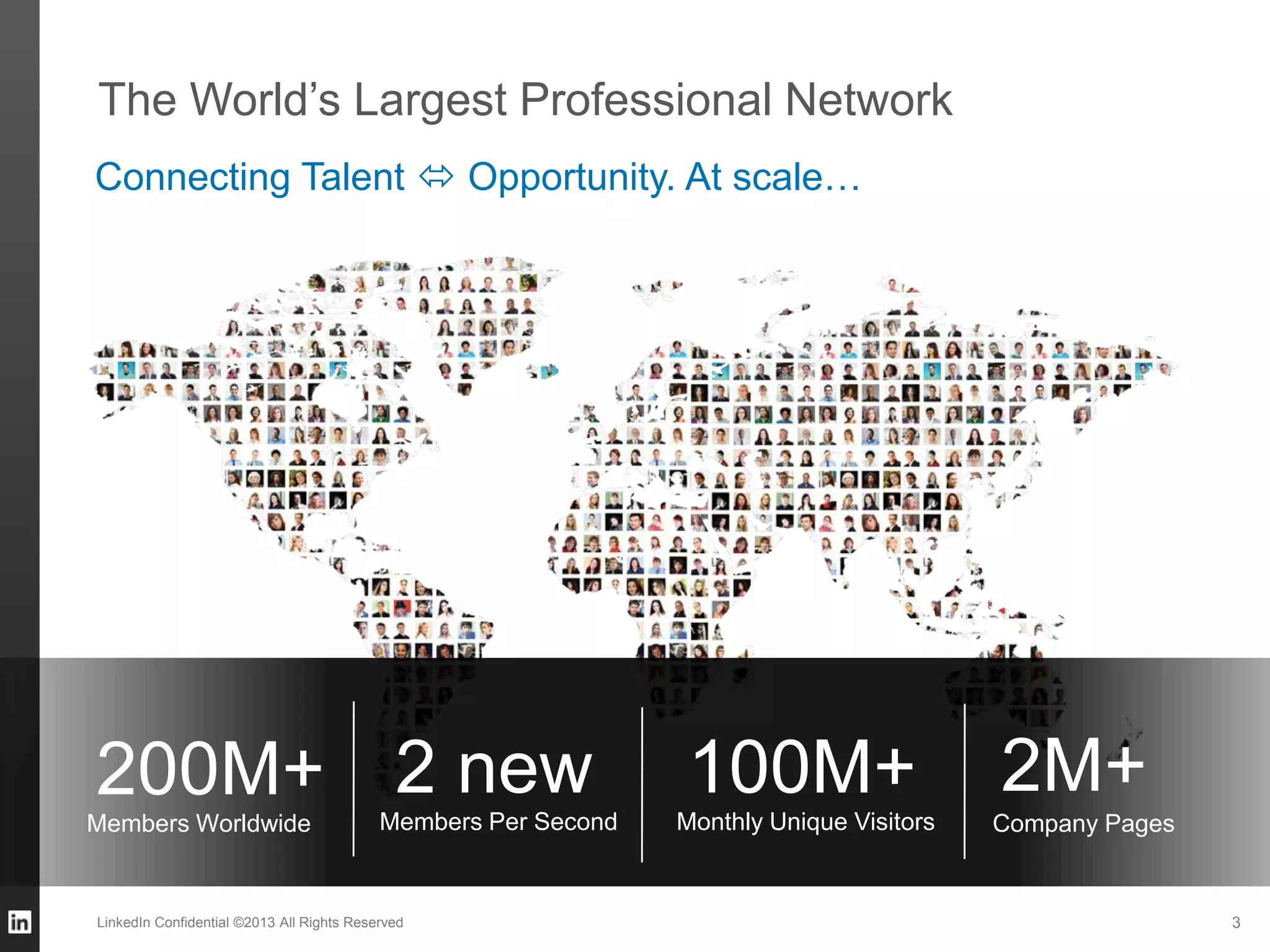
The World‟s Largest Professional Network
Members Worldwide
2 new
Members Per Second
100M+
Monthly Unique Visitors
200M+ 2M+
Company Pages
Connecting Talent  Opportunity. At scale…
LinkedIn Confidential ©2013 All Rights Reserved 3
4
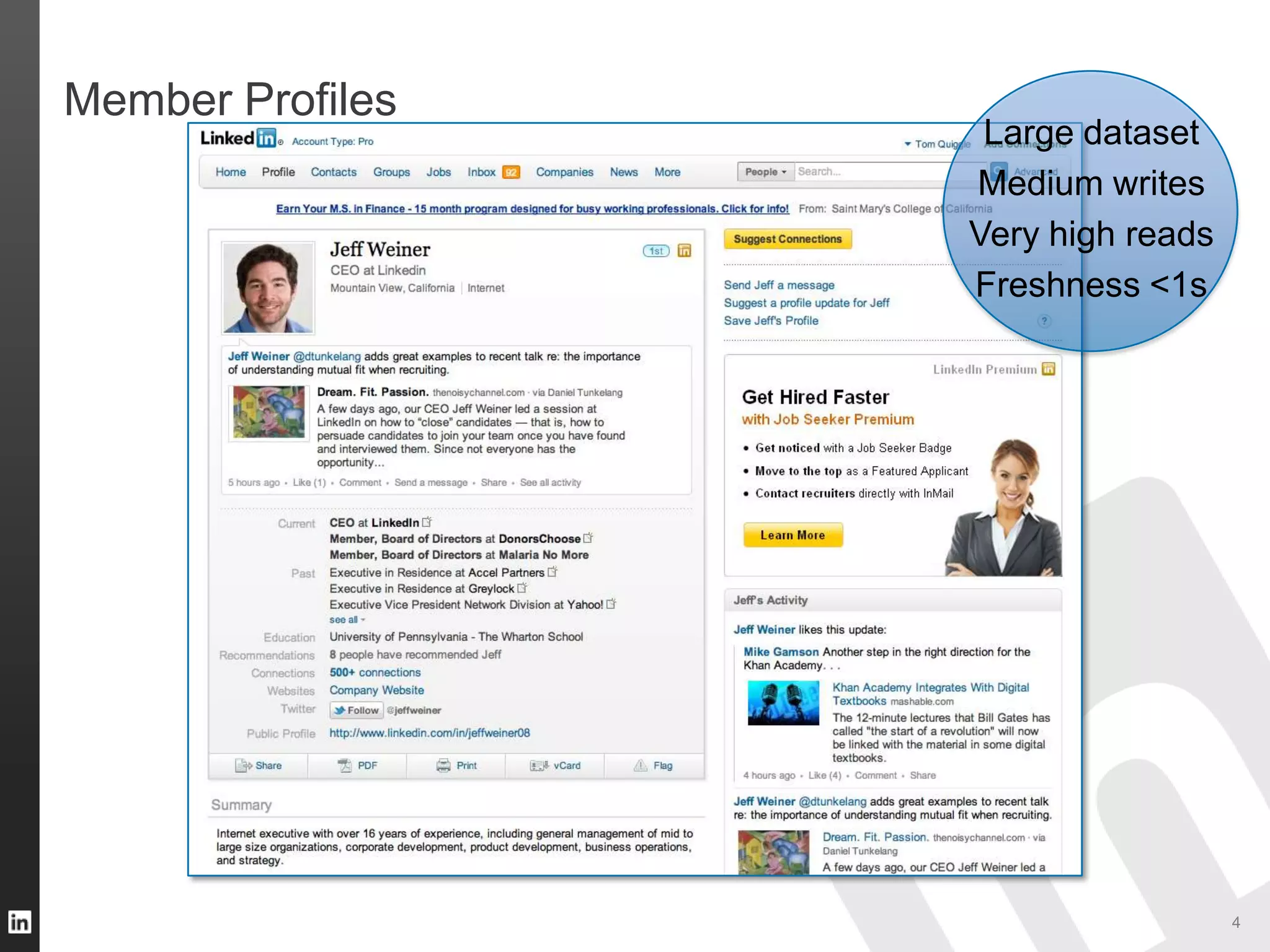
Member Profiles
Large dataset
Medium writes
Very high reads
Freshness <1s
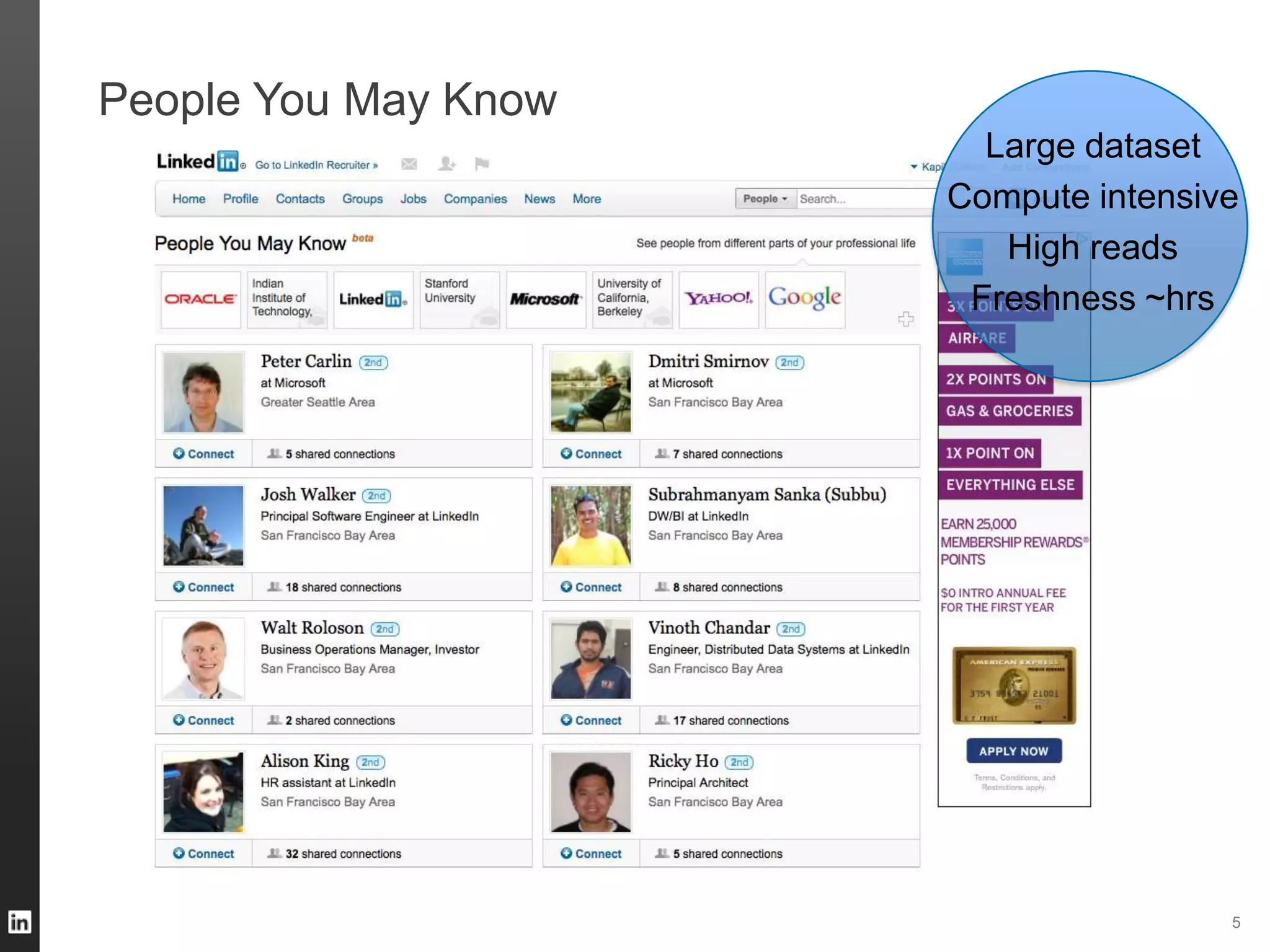
People You May Know
5
Large dataset
Compute intensive
High reads
Freshness ~hrs
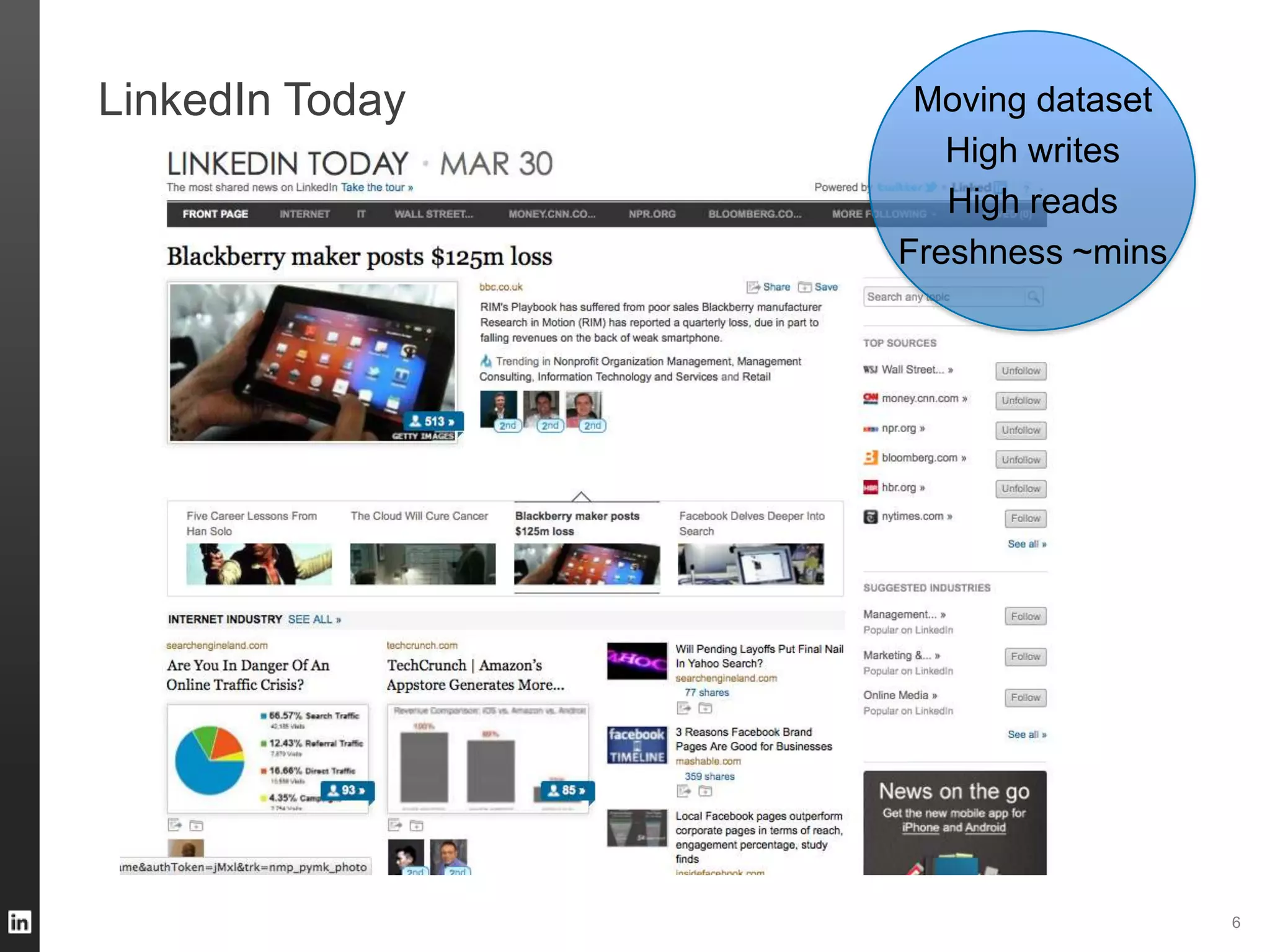
LinkedIn Today
6
Moving dataset
High writes
High reads
Freshness ~mins
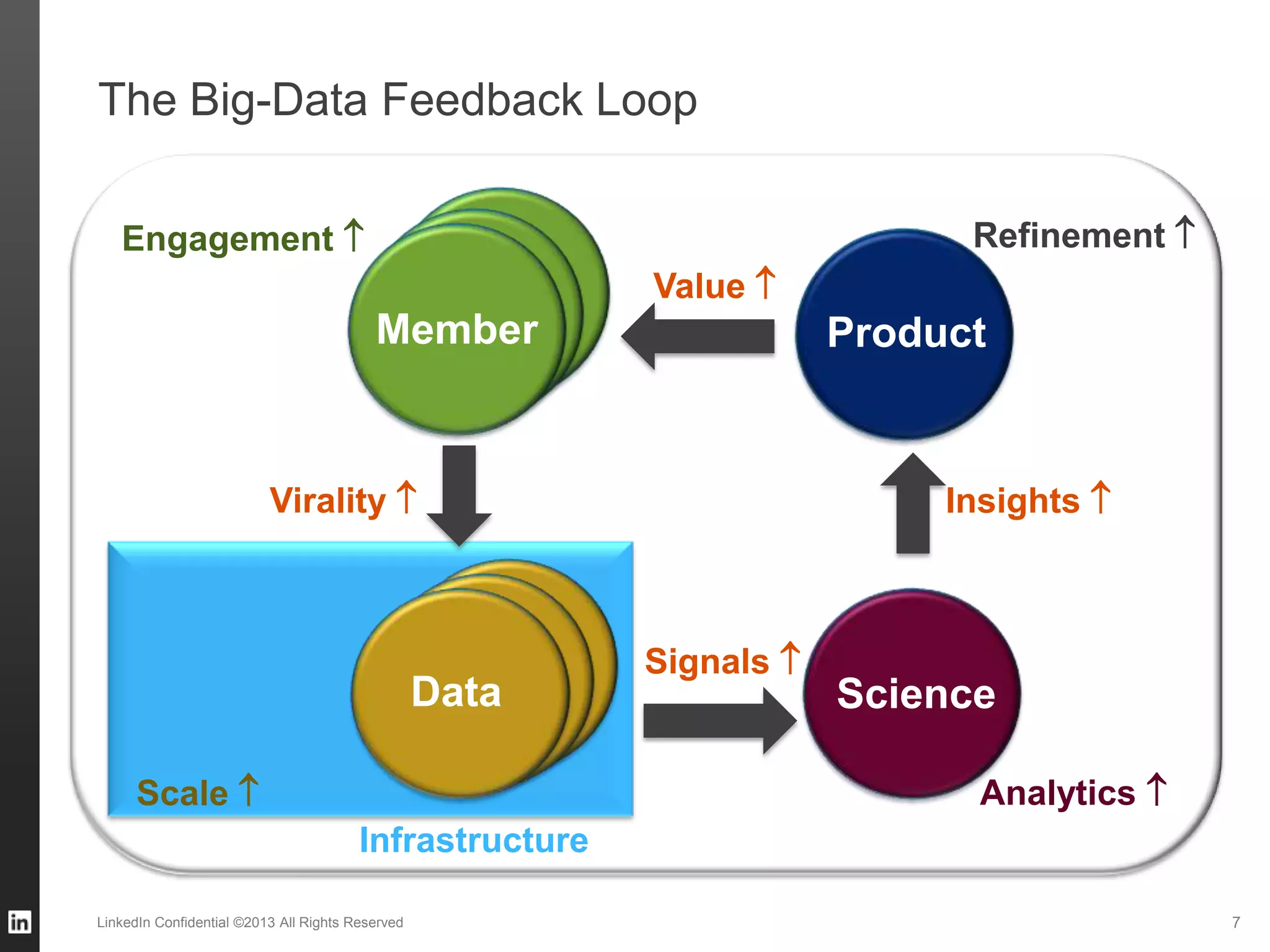
The Big-Data Feedback Loop
LinkedIn Confidential ©2013 All Rights Reserved 7
Value 
Insights 
Scale 
Product
ScienceData
Member
Engagement 
Virality 
Signals 
Refinement 
Infrastructure
Analytics 
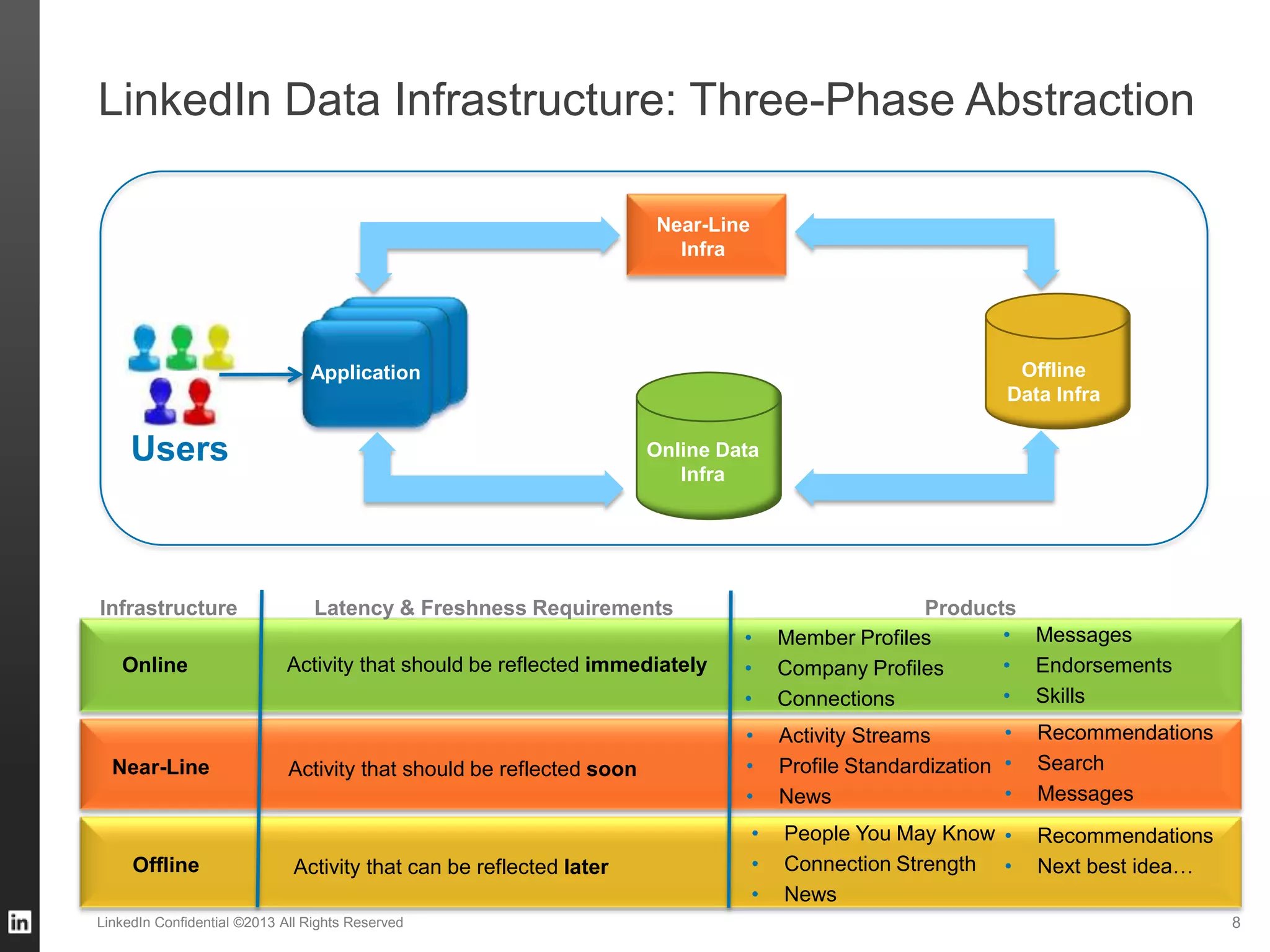
LinkedIn Data Infrastructure: Three-Phase Abstraction
LinkedIn Confidential ©2013 All Rights Reserved 8
Users Online Data
Infra
Near-Line
Infra
Application Offline
Data Infra
Infrastructure Latency & Freshness Requirements Products
Online Activity that should be reflected immediately
• Member Profiles
• Company Profiles
• Connections
• Messages
• Endorsements
• Skills
Near-Line Activity that should be reflected soon
• Activity Streams
• Profile Standardization
• News
• Recommendations
• Search
• Messages
Offline Activity that can be reflected later
• People You May Know
• Connection Strength
• News
• Recommendations
• Next best idea…
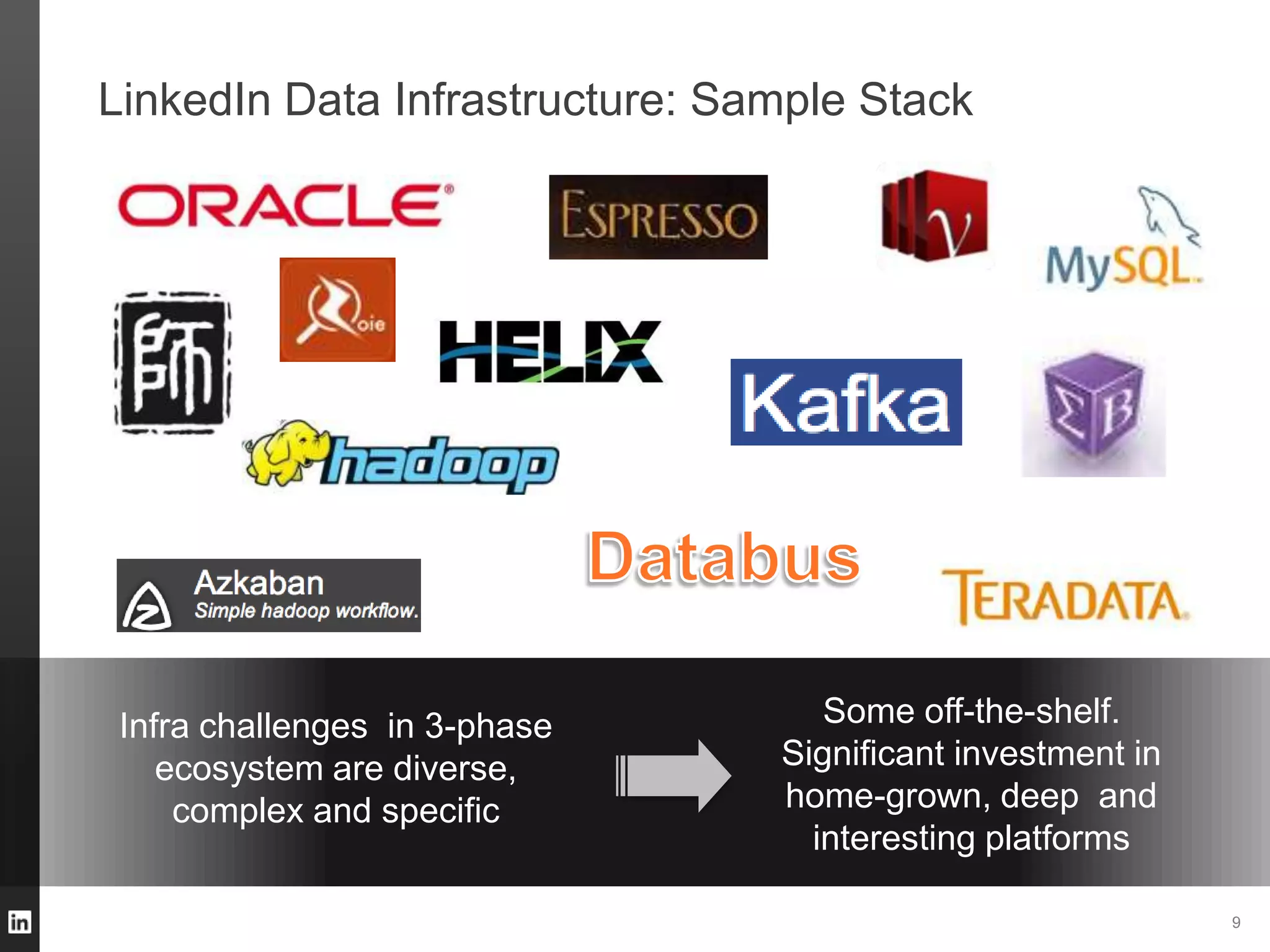
LinkedIn Data Infrastructure: Sample Stack
9
Infra challenges in 3-phase
ecosystem are diverse,
complex and specific
Some off-the-shelf.
Significant investment in
home-grown, deep and
interesting platforms
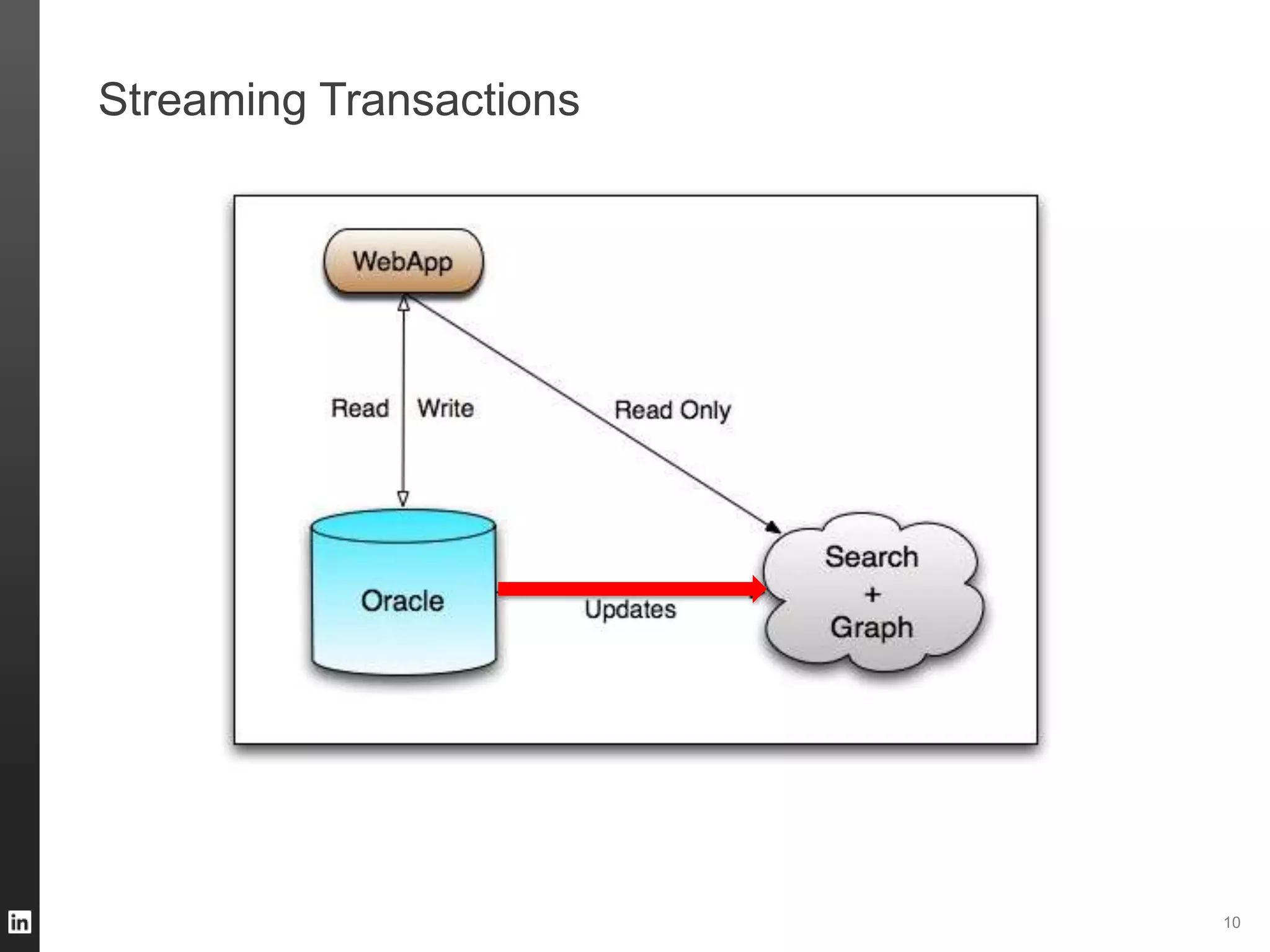
Streaming Transactions
10
Databus : Timeline-Consistent
Change Data Capture
LinkedIn Data Infrastructure Solutions
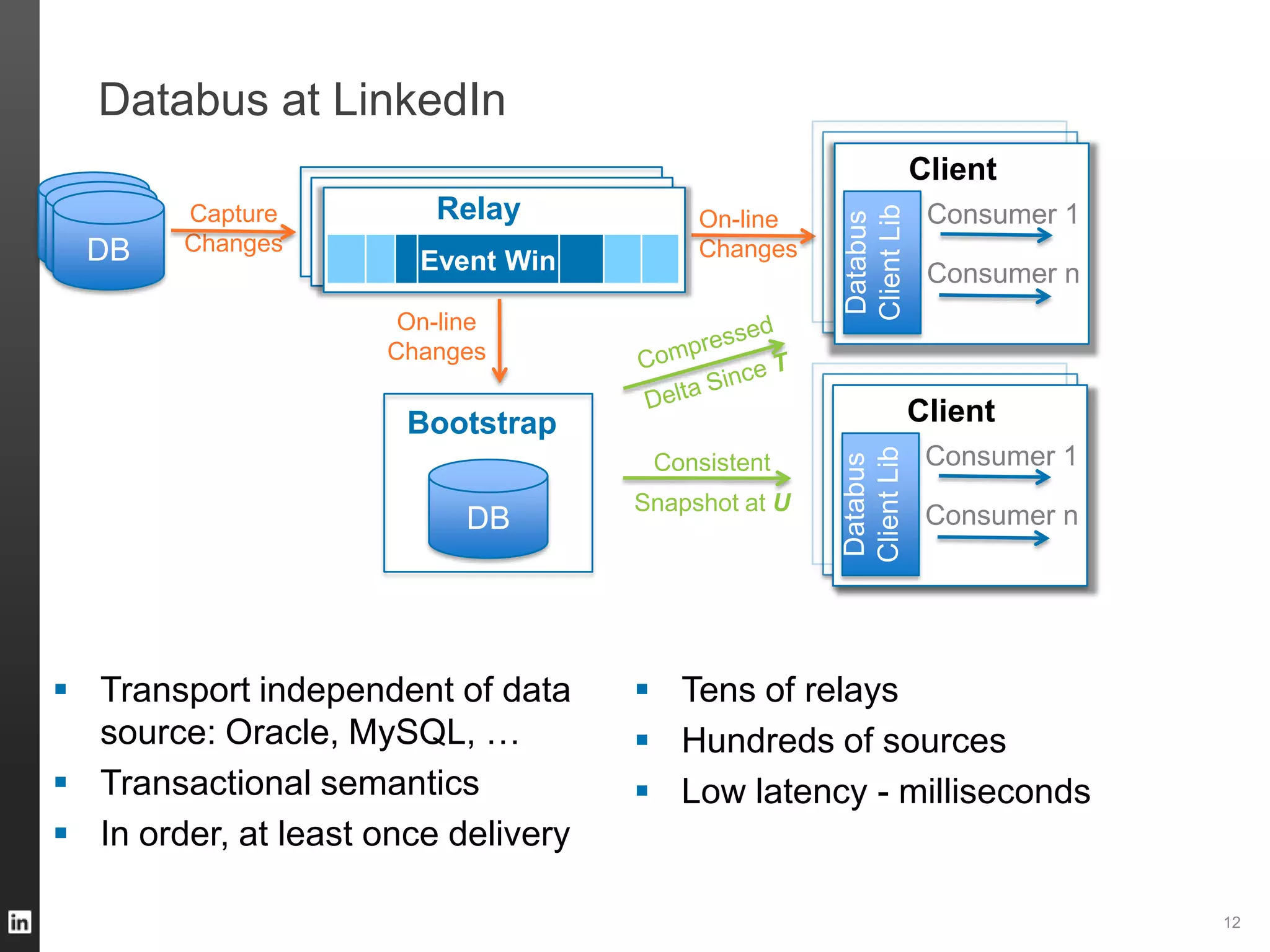
Databus at LinkedIn
12
DB
Bootstrap
Capture
Changes
On-line
Changes
On-line
Changes
DB
Consistent
Snapshot at U
 Transport independent of data
source: Oracle, MySQL, …
 Transactional semantics
 In order, at least once delivery
 Tens of relays
 Hundreds of sources
 Low latency - milliseconds
Consumer 1
Consumer n
Client
Databus
ClientLib
Consumer 1
Consumer n
Databus
ClientLib
Client
Relay
Event Win
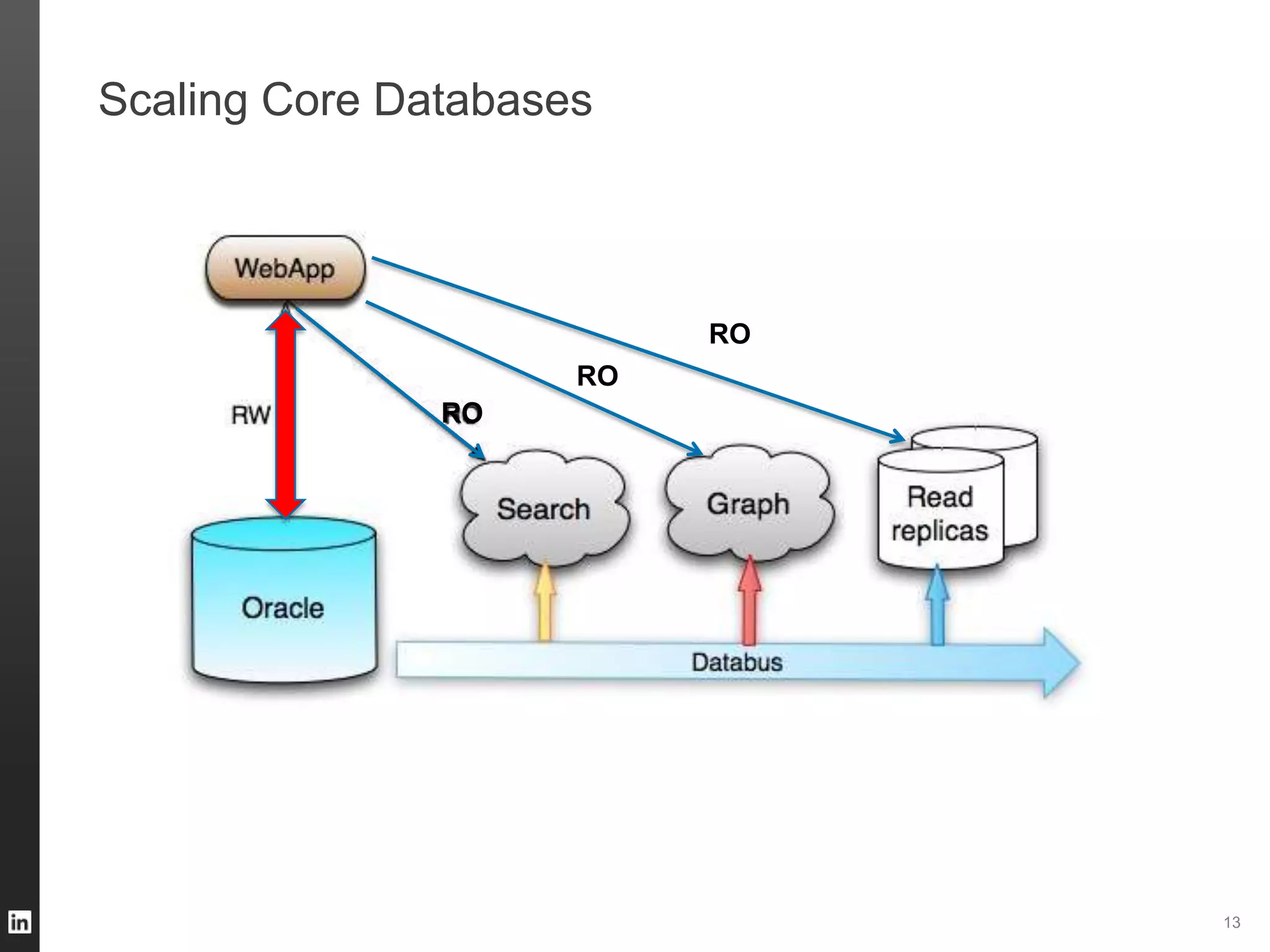
Scaling Core Databases
13
RO
RO
RO
Voldemort: Highly-Available
Distributed KV Store
LinkedIn Data Infrastructure Solutions
14
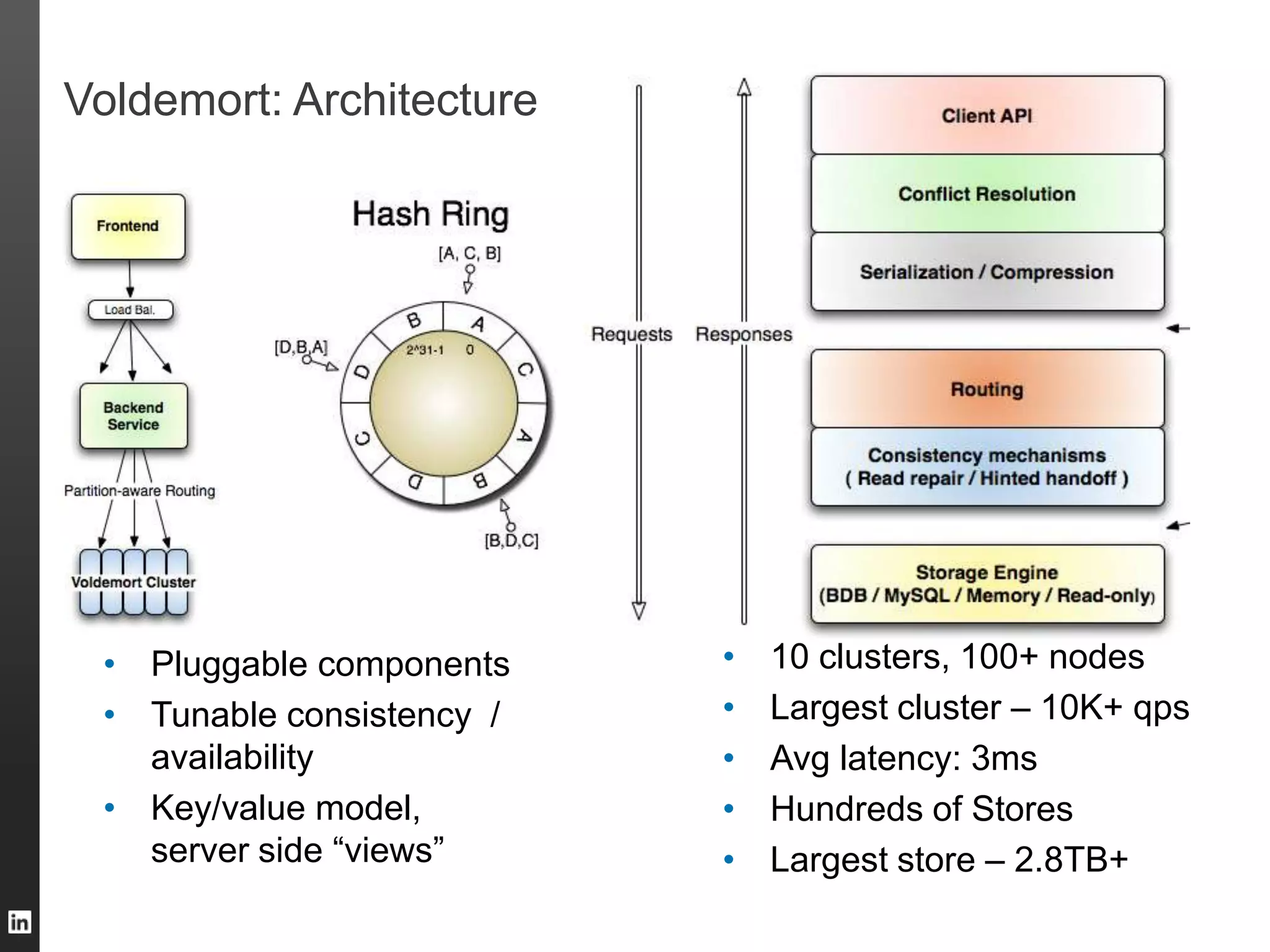
• Pluggable components
• Tunable consistency /
availability
• Key/value model,
server side “views”
• 10 clusters, 100+ nodes
• Largest cluster – 10K+ qps
• Avg latency: 3ms
• Hundreds of Stores
• Largest store – 2.8TB+
Voldemort: Architecture
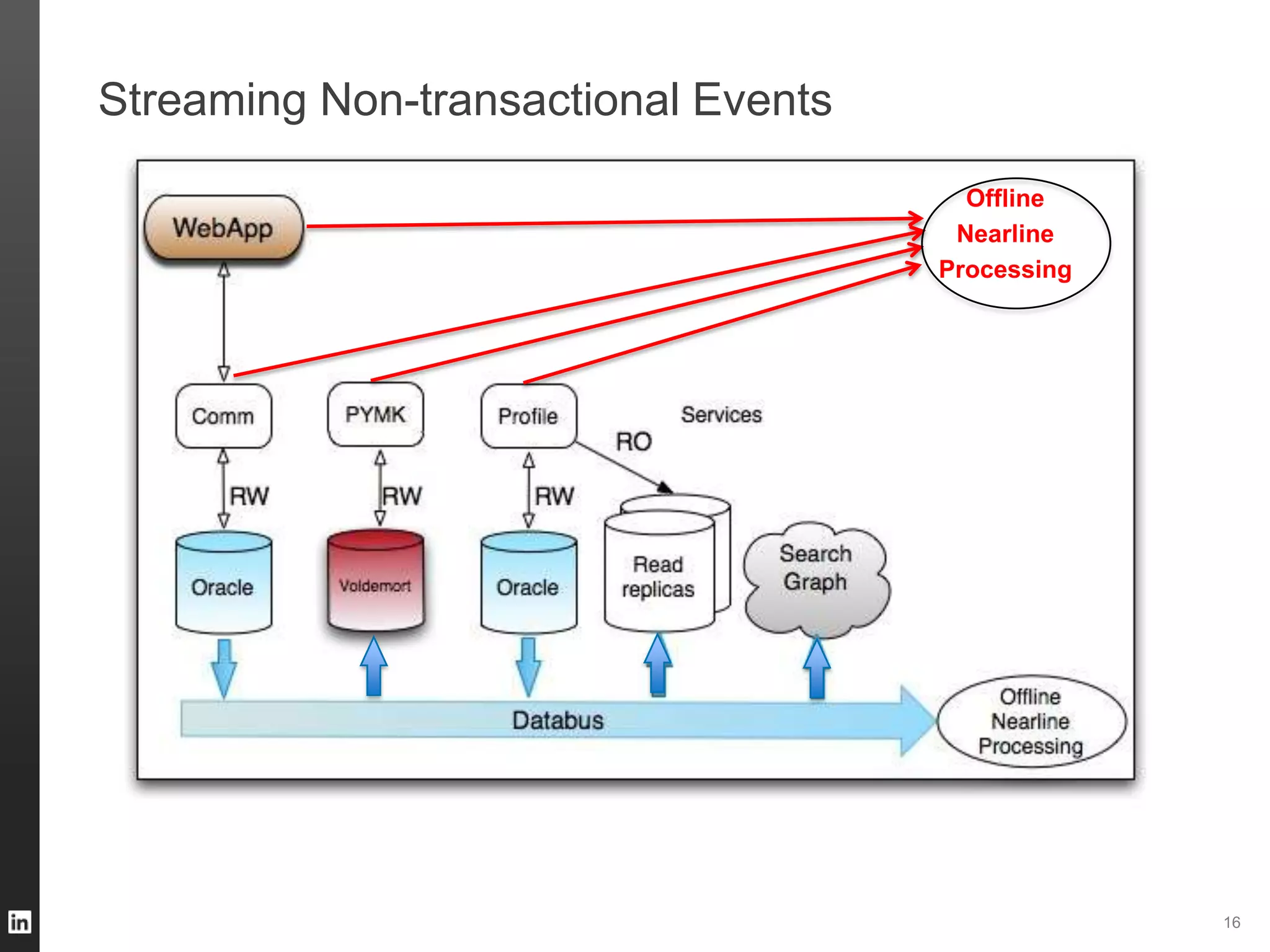
Streaming Non-transactional Events
16
Offline
Nearline
Processing
Kafka: High-Volume Low-Latency
Messaging System
LinkedIn Data Infrastructure Solutions
17
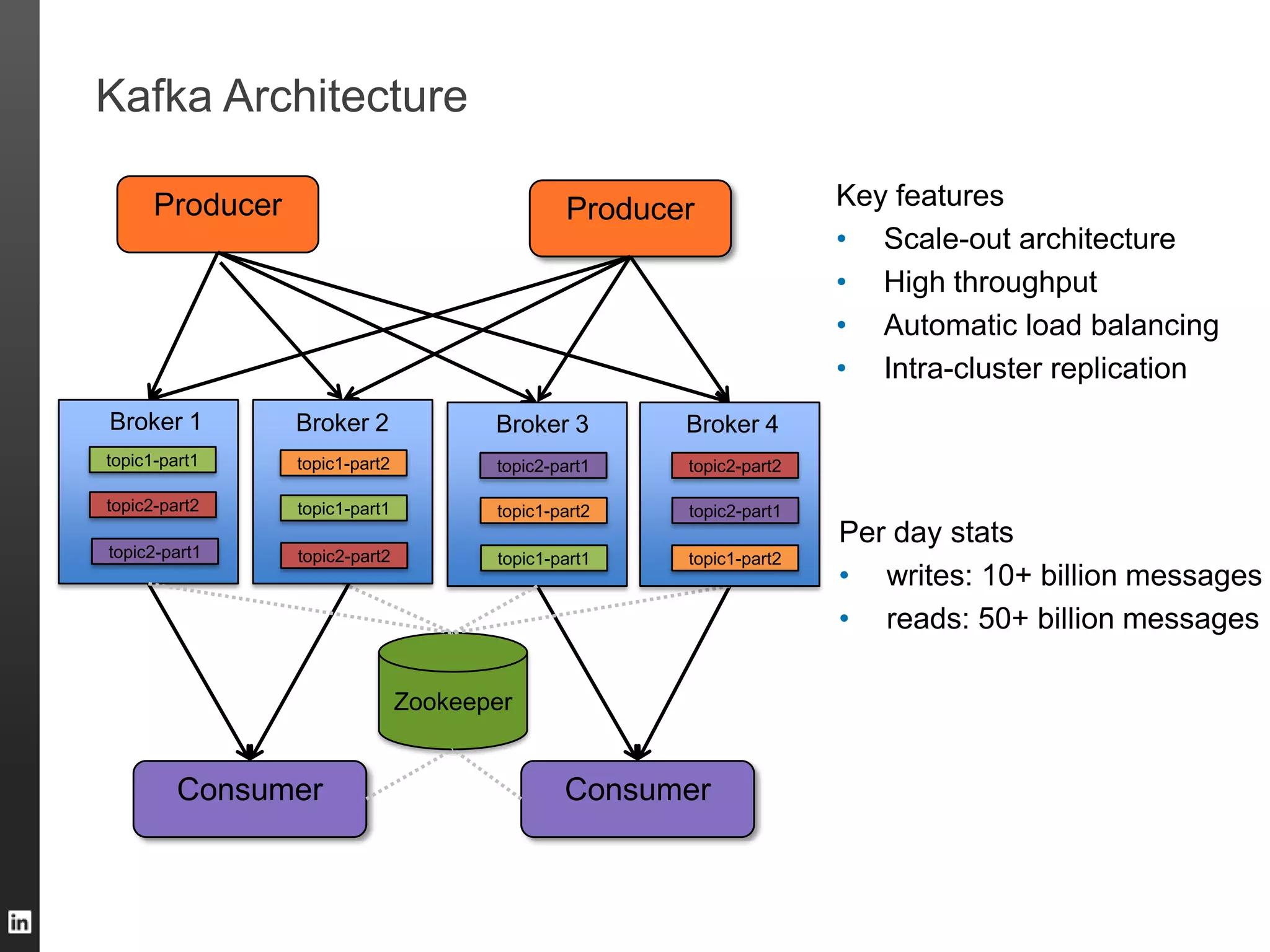
Kafka Architecture
Producer
Consumer
Producer
Consumer
Zookeeper
topic1-part1
topic2-part2
topic2-part1
topic1-part2
topic2-part2
topic2-part1
topic1-part1 topic1-part2
topic2-part2
topic2-part1
Broker 1 Broker 2 Broker 3 Broker 4
Key features
• Scale-out architecture
• High throughput
• Automatic load balancing
• Intra-cluster replication
Per day stats
• writes: 10+ billion messages
• reads: 50+ billion messages
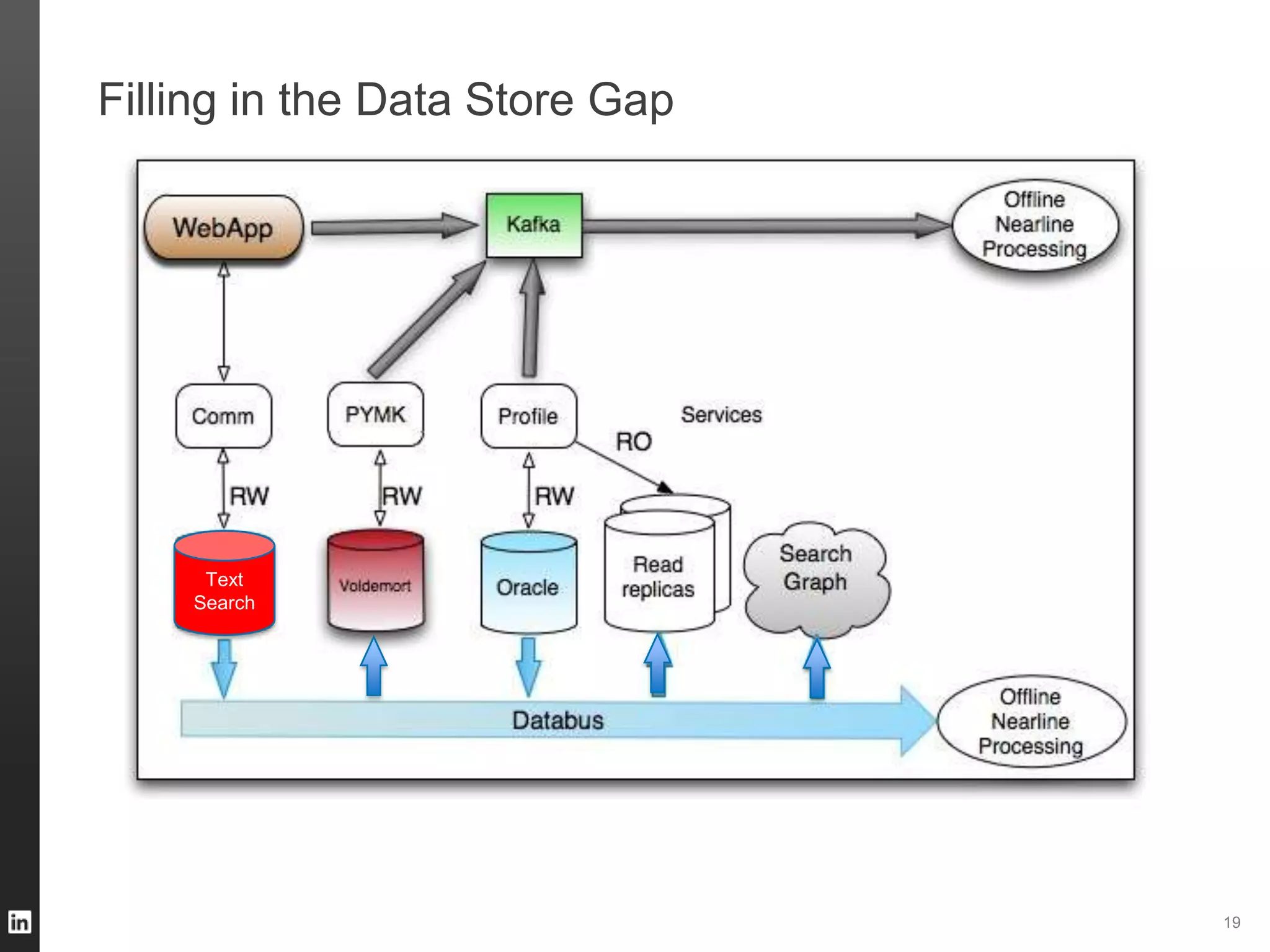
Filling in the Data Store Gap
19
Text
Search
Espresso: Indexed Timeline-Consistent
Distributed Data Store
LinkedIn Data Infrastructure Solutions
20
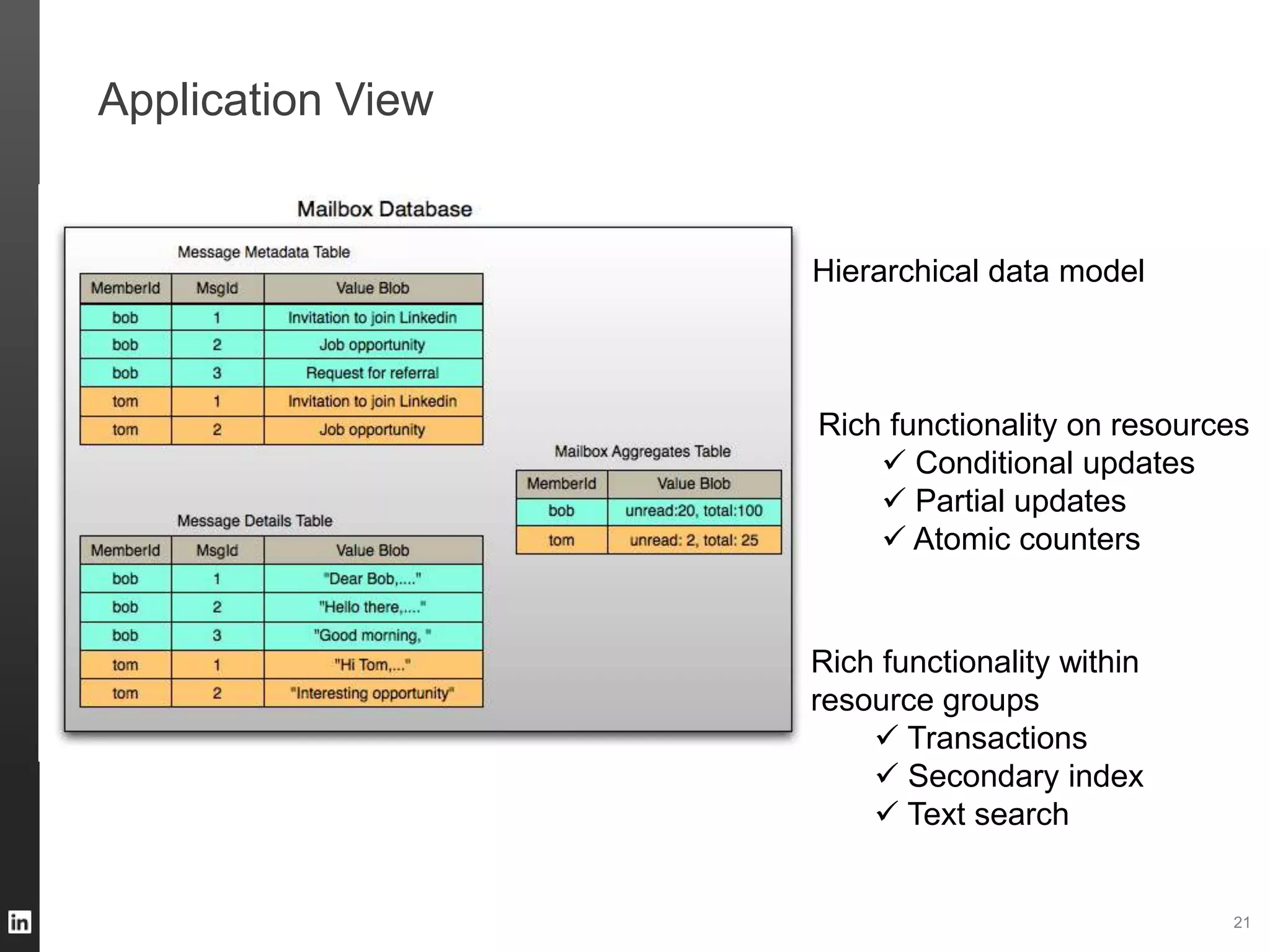
Application View
21
Hierarchical data model
Rich functionality on resources
 Conditional updates
 Partial updates
 Atomic counters
Rich functionality within
resource groups
 Transactions
 Secondary index
 Text search
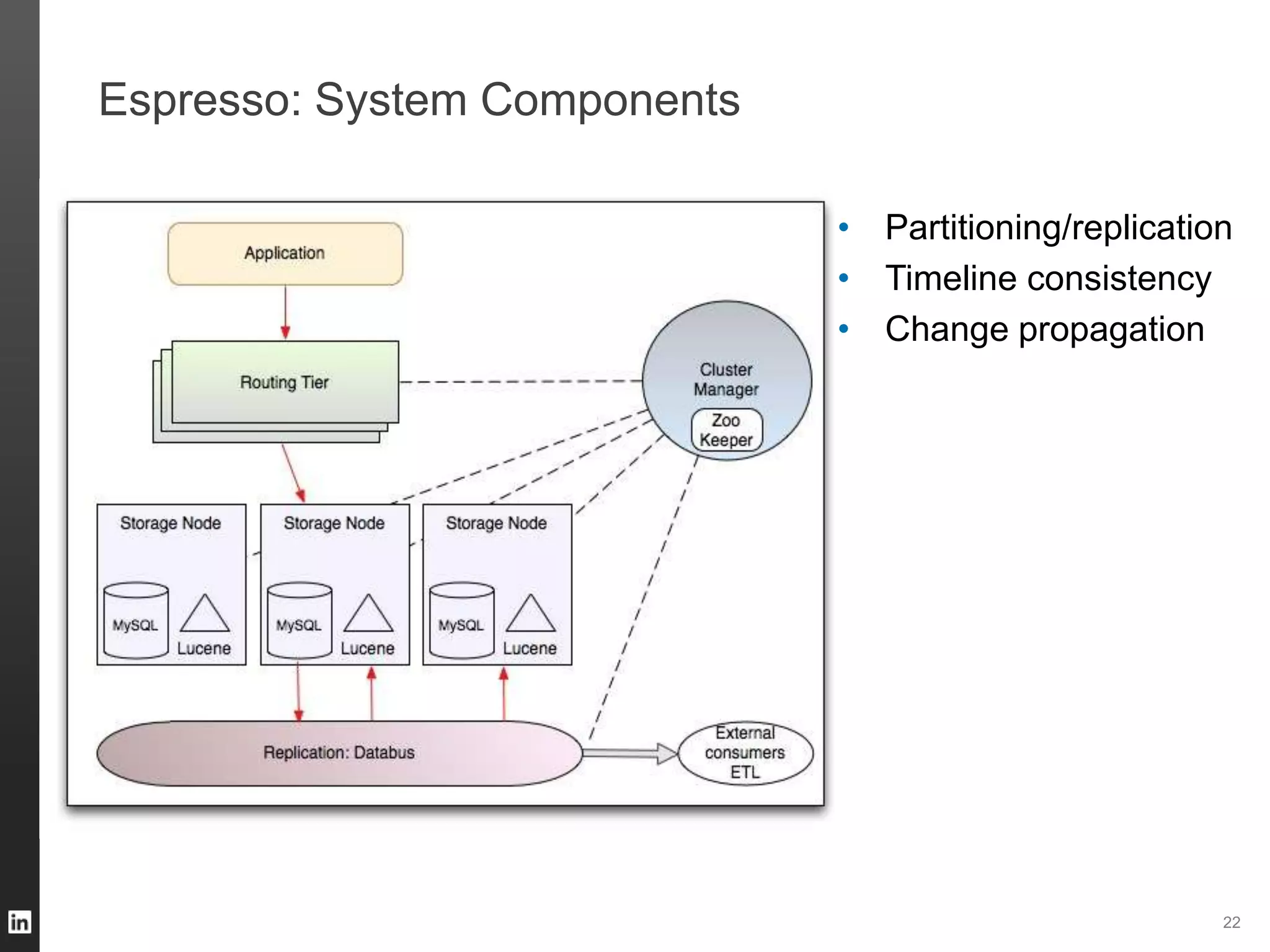
Espresso: System Components
22
• Partitioning/replication
• Timeline consistency
• Change propagation
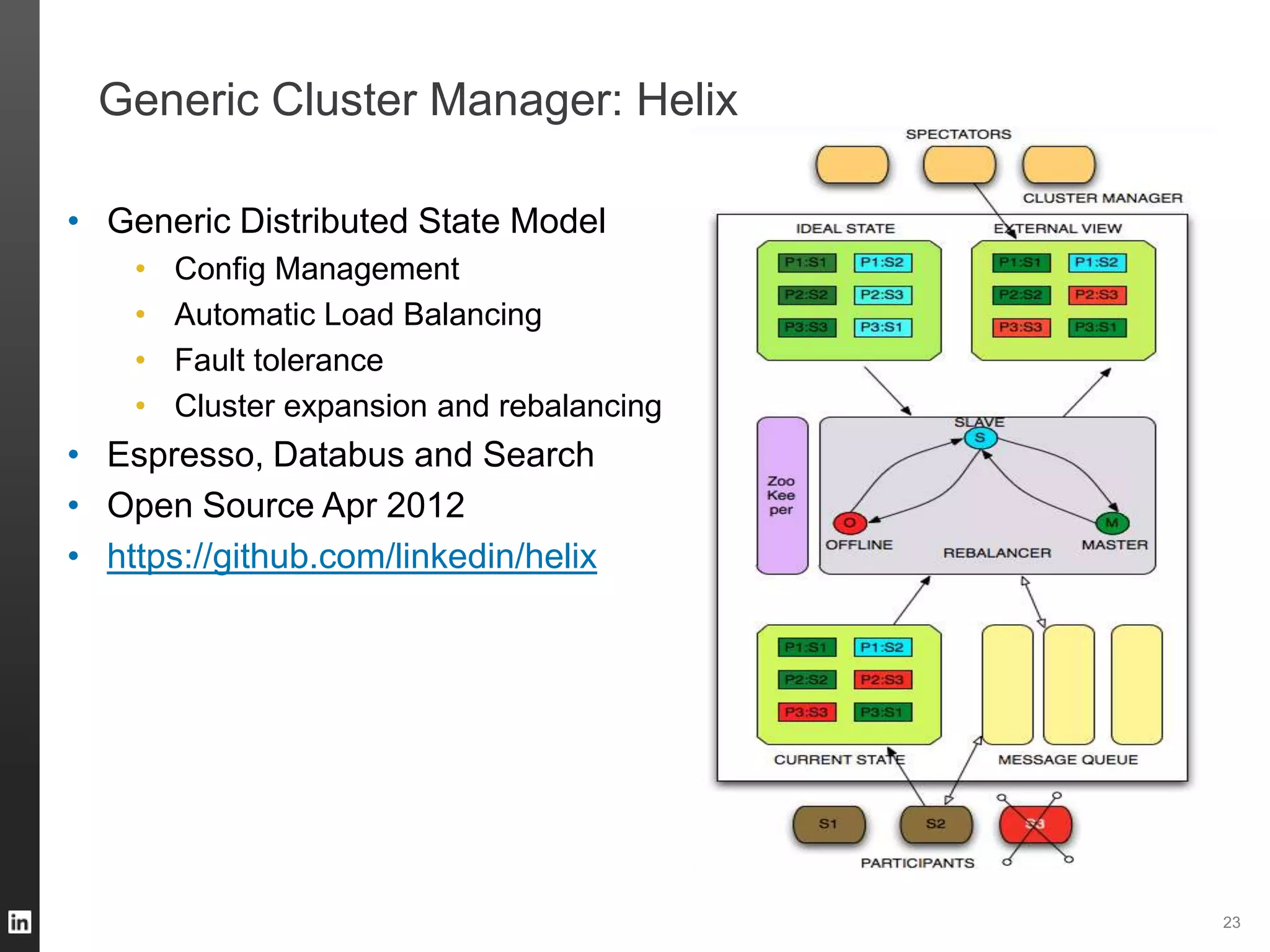
Generic Cluster Manager: Helix
• Generic Distributed State Model
• Config Management
• Automatic Load Balancing
• Fault tolerance
• Cluster expansion and rebalancing
• Espresso, Databus and Search
• Open Source Apr 2012
• https://github.com/linkedin/helix
23
Infrastructure challenges in
large-scale data mining
Putting it together
Top complaints from data scientists
1 Getting the data in (Ingress ETL)
2 Getting the data out (Egress)
3 Workflow management
4 Model of computation
5 …
Top complaints from data scientists
1 Getting the data in (Ingress ETL)
2 Getting the data out (Egress)
3 Workflow management
4 Model of computation
5 …
LinkedIn circa 2010
LinkedIn Confidential ©2013 All Rights Reserved 27
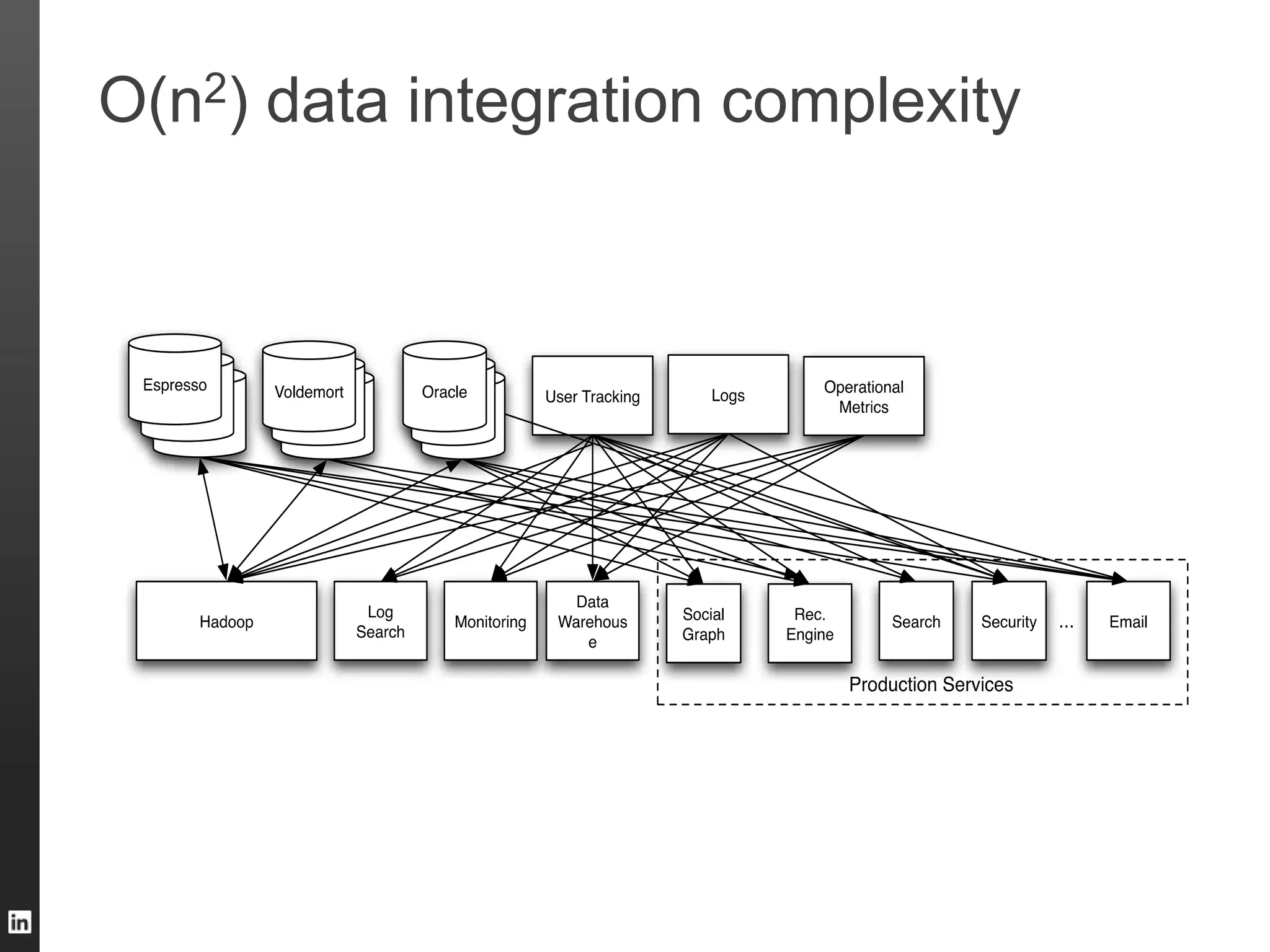
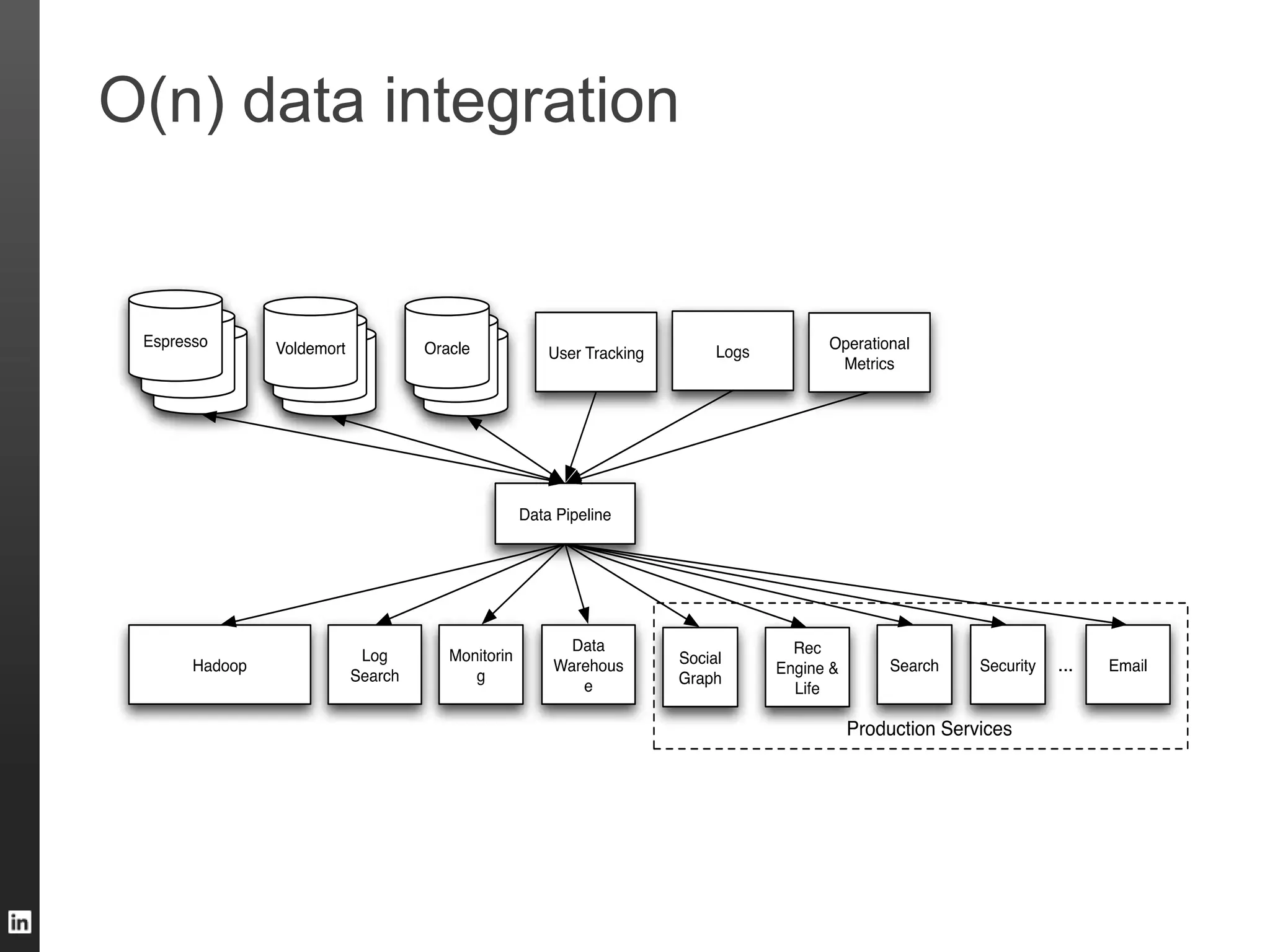
O(n2) data integration complexity
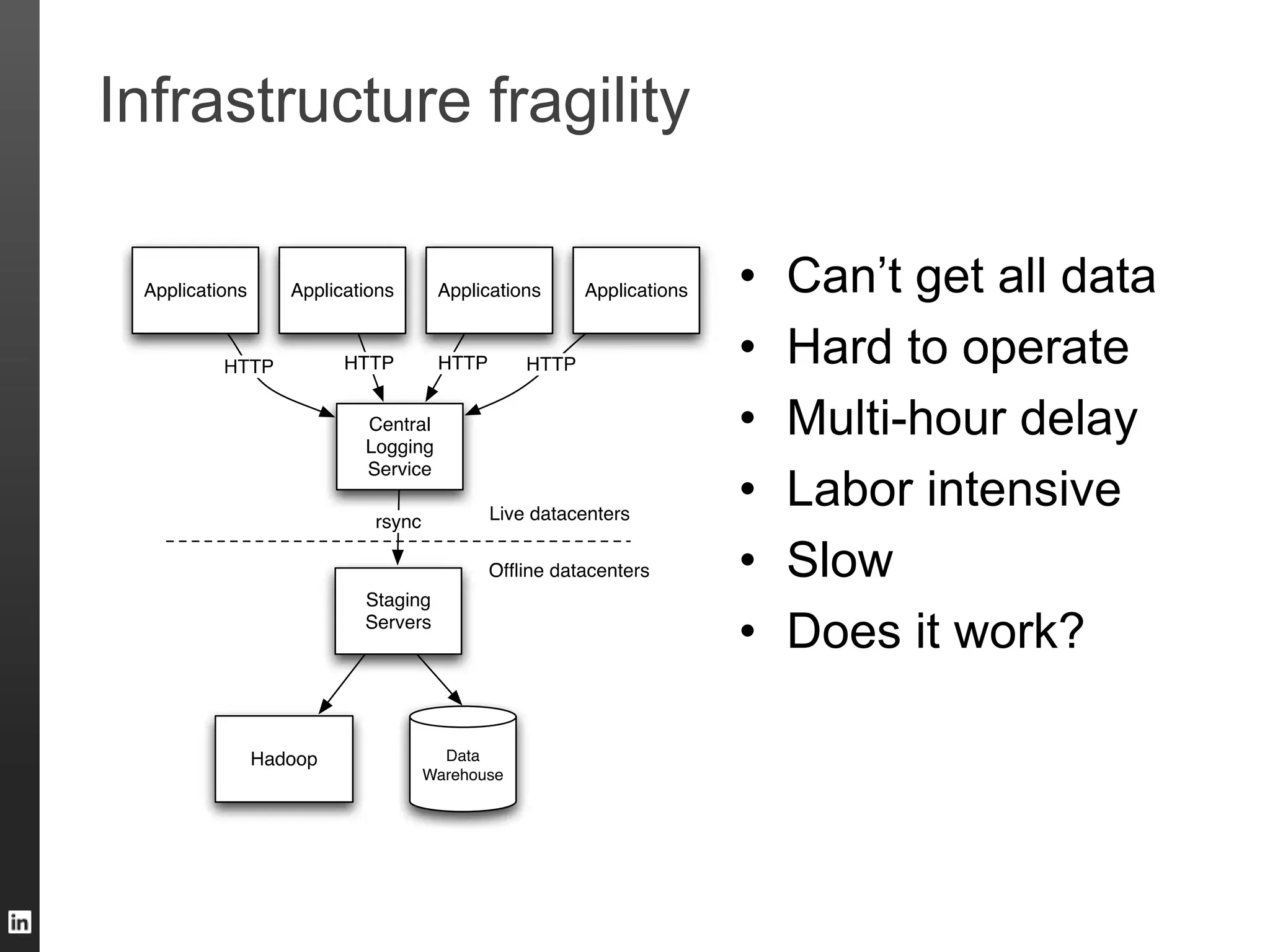
Infrastructure fragility
• Can‟t get all data
• Hard to operate
• Multi-hour delay
• Labor intensive
• Slow
• Does it work?
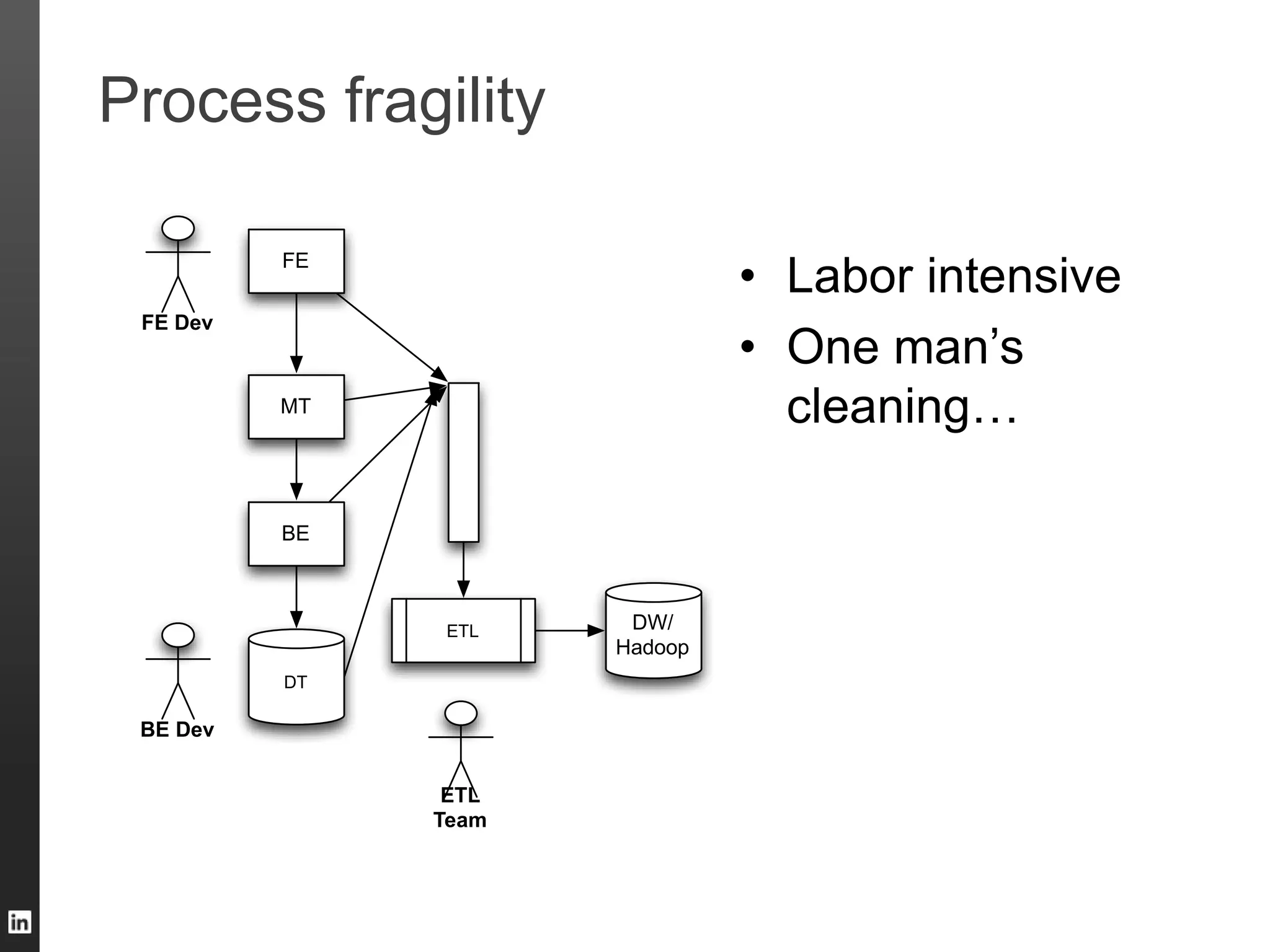
Process fragility
• Labor intensive
• One man‟s
cleaning…
FE
MT
BE
DT
FE Dev
BE Dev
ETL
Team
ETL DW/
Hadoop
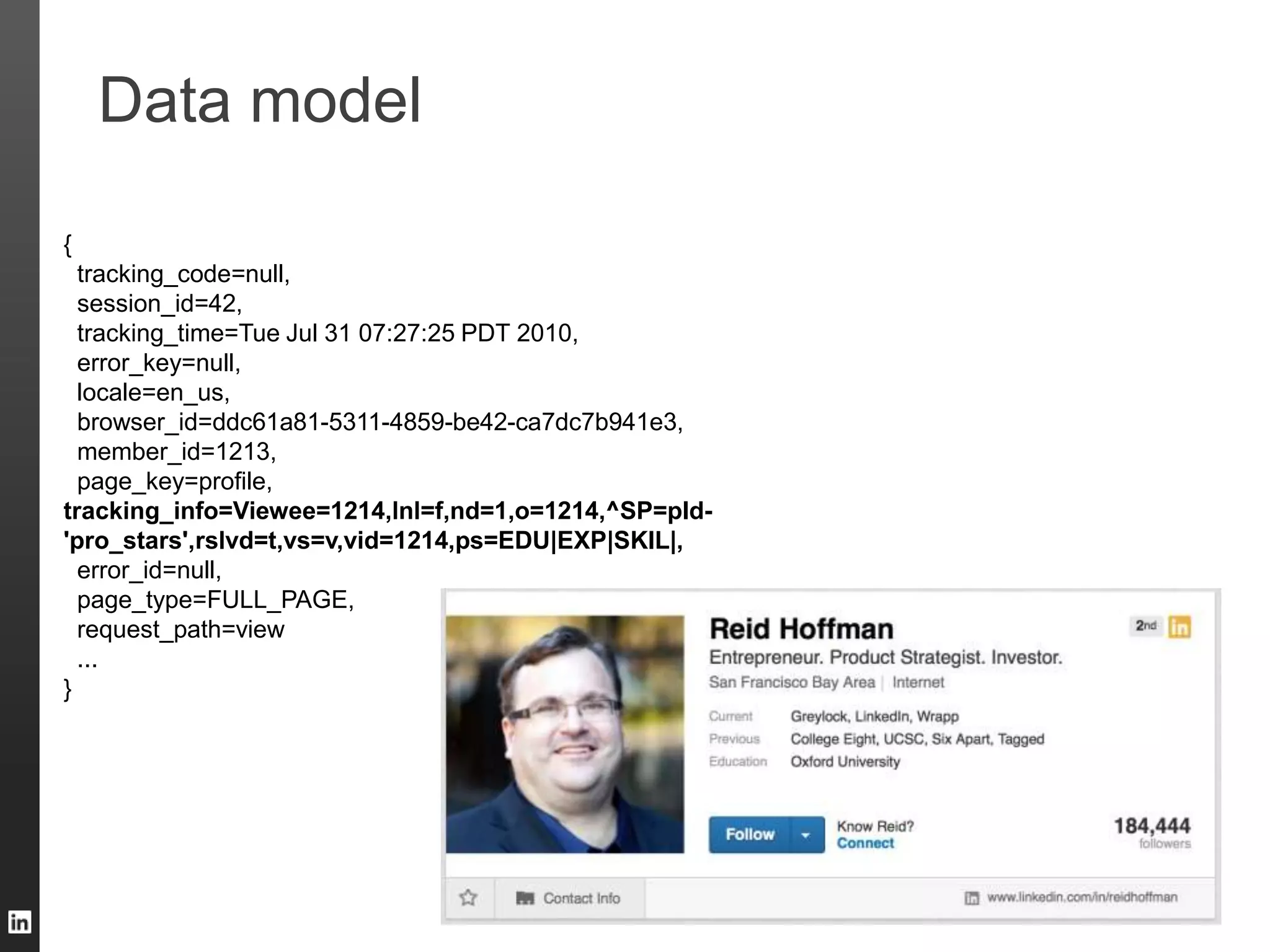
Data model
{
tracking_code=null,
session_id=42,
tracking_time=Tue Jul 31 07:27:25 PDT 2010,
error_key=null,
locale=en_us,
browser_id=ddc61a81-5311-4859-be42-ca7dc7b941e3,
member_id=1213,
page_key=profile,
tracking_info=Viewee=1214,lnl=f,nd=1,o=1214,^SP=pId-
'pro_stars',rslvd=t,vs=v,vid=1214,ps=EDU|EXP|SKIL|,
error_id=null,
page_type=FULL_PAGE,
request_path=view
...
}
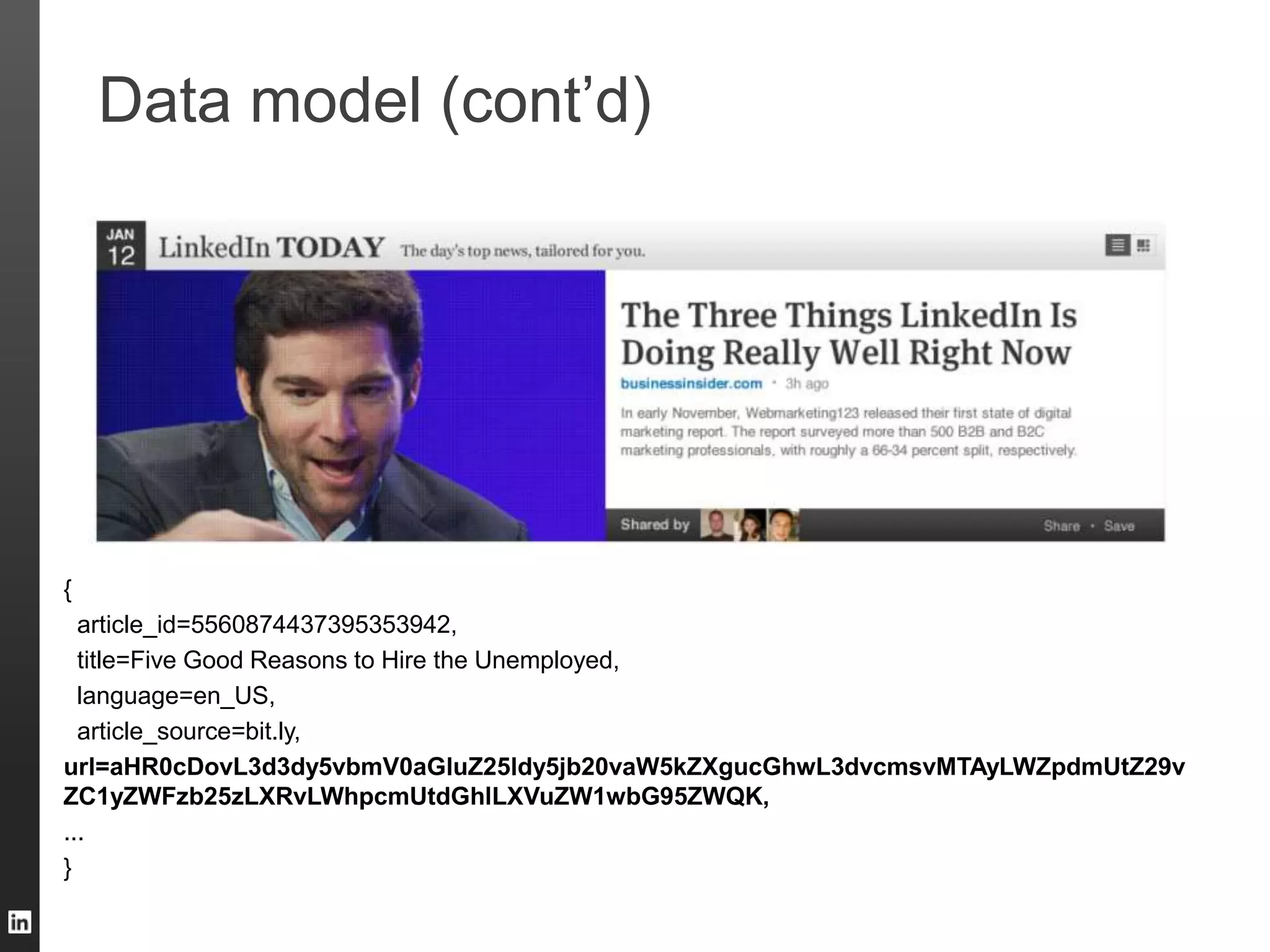
Data model (cont‟d)
{
article_id=5560874437395353942,
title=Five Good Reasons to Hire the Unemployed,
language=en_US,
article_source=bit.ly,
url=aHR0cDovL3d3dy5vbmV0aGluZ25ldy5jb20vaW5kZXgucGhwL3dvcmsvMTAyLWZpdmUtZ29v
ZC1yZWFzb25zLXRvLWhpcmUtdGhlLXVuZW1wbG95ZWQK,
...
}
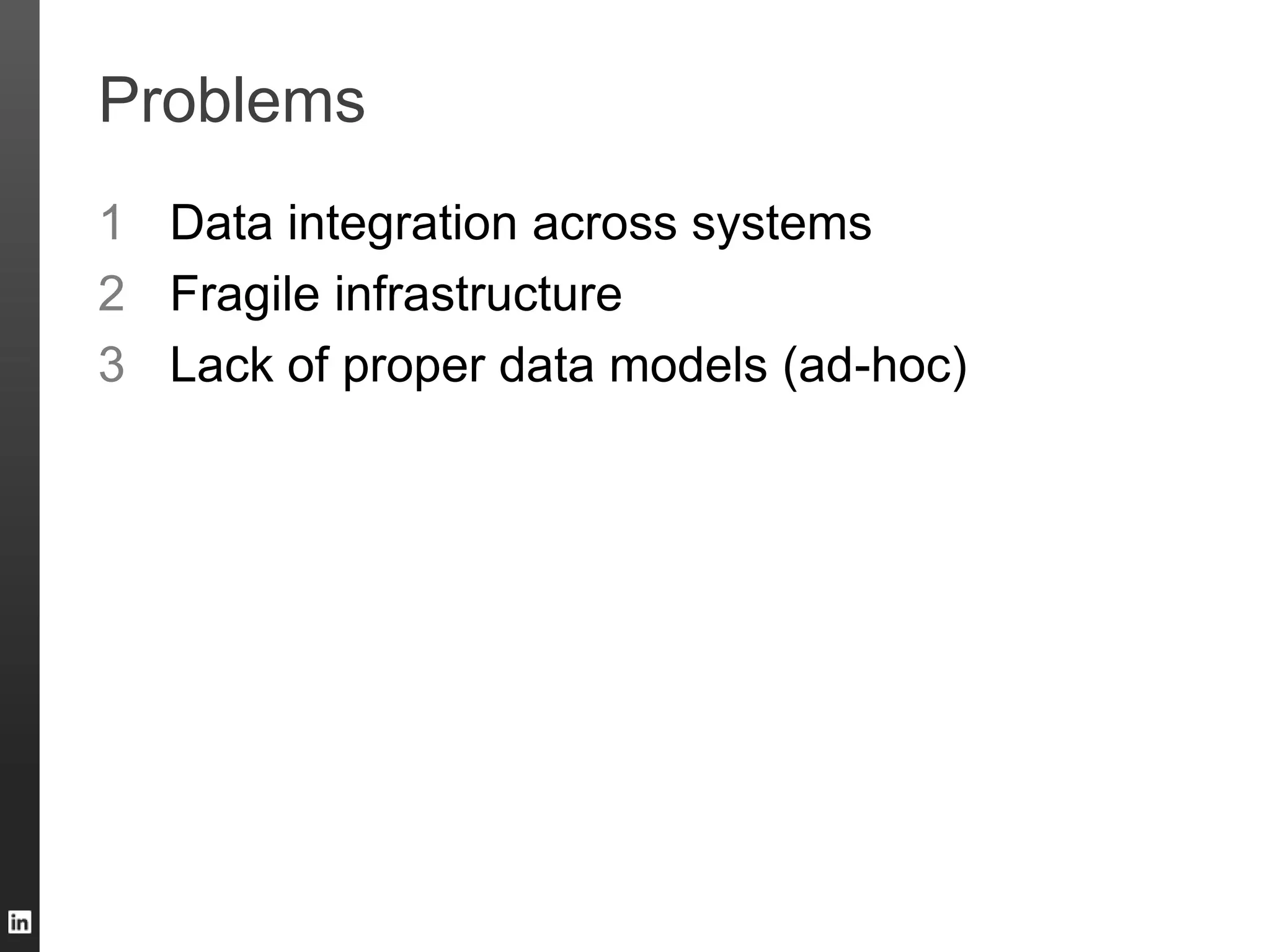
Problems
1 Data integration across systems
2 Fragile infrastructure
3 Lack of proper data models (ad-hoc)
LinkedIn 2013
LinkedIn Confidential ©2013 All Rights Reserved 34
O(n) data integration
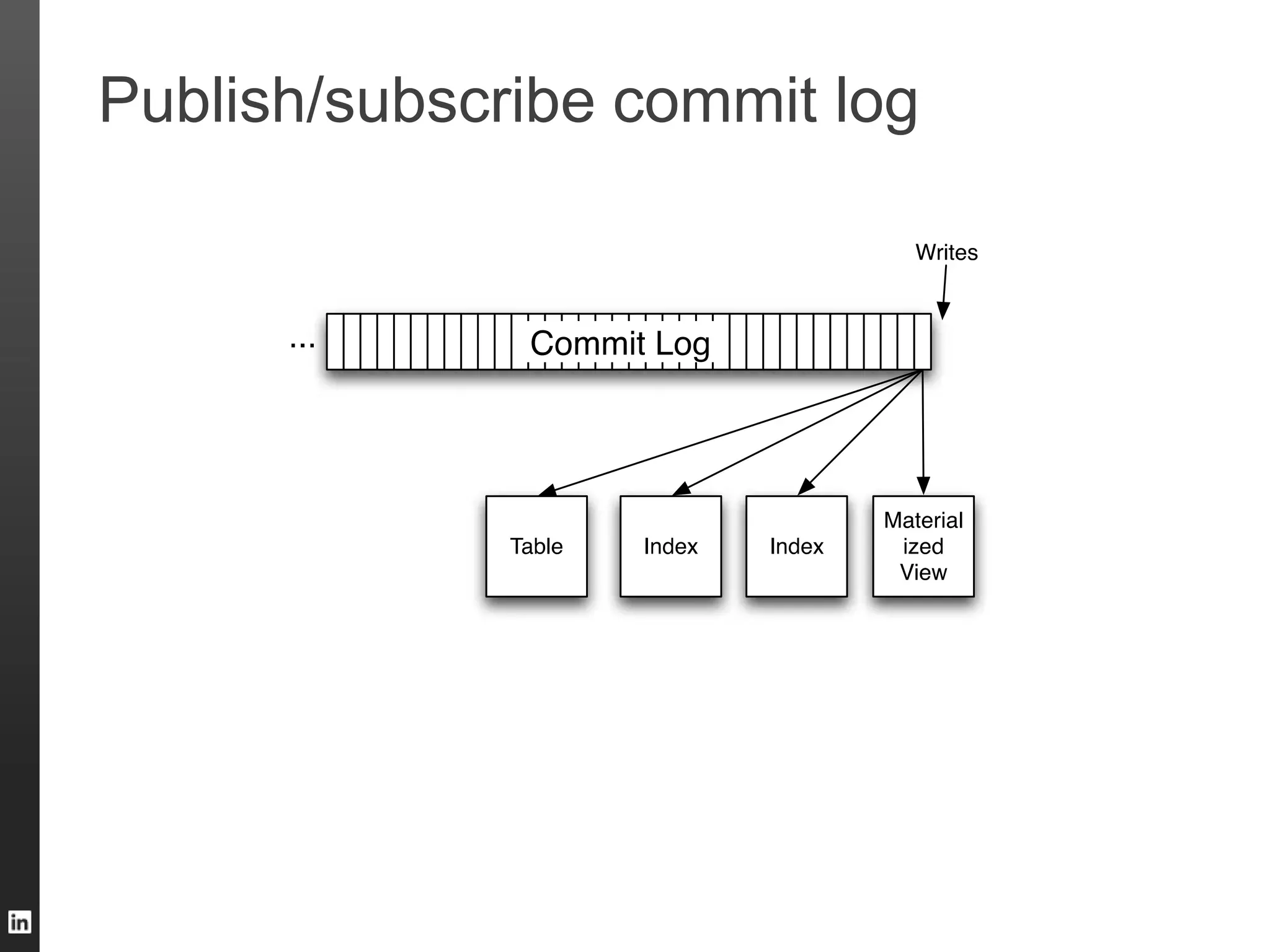
Publish/subscribe commit log
Data model
 Hundreds of message types
 Thousands of fields
 What do they all mean?
 What happens when they change?
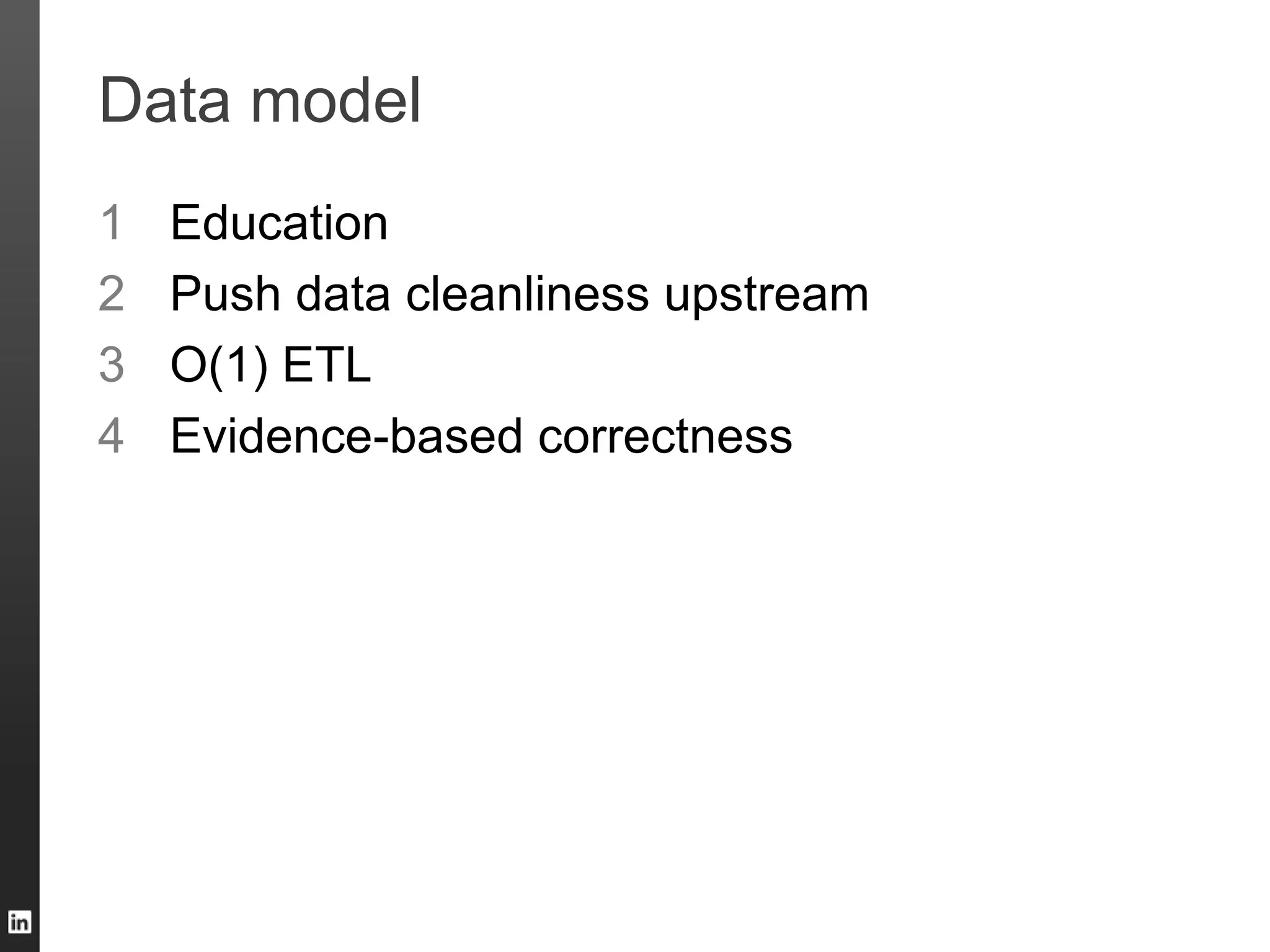
Data model
1 Education
2 Push data cleanliness upstream
3 O(1) ETL
4 Evidence-based correctness
Data model
 DDL for data definition and schema
 Central versioned registry of all schemas
 Schema review
 Programmatic compatibility model
– Schema changes handled transparently
Workflow
1 Check in schema
2 Code review
3 Ship
Seamless data load into downstream systems
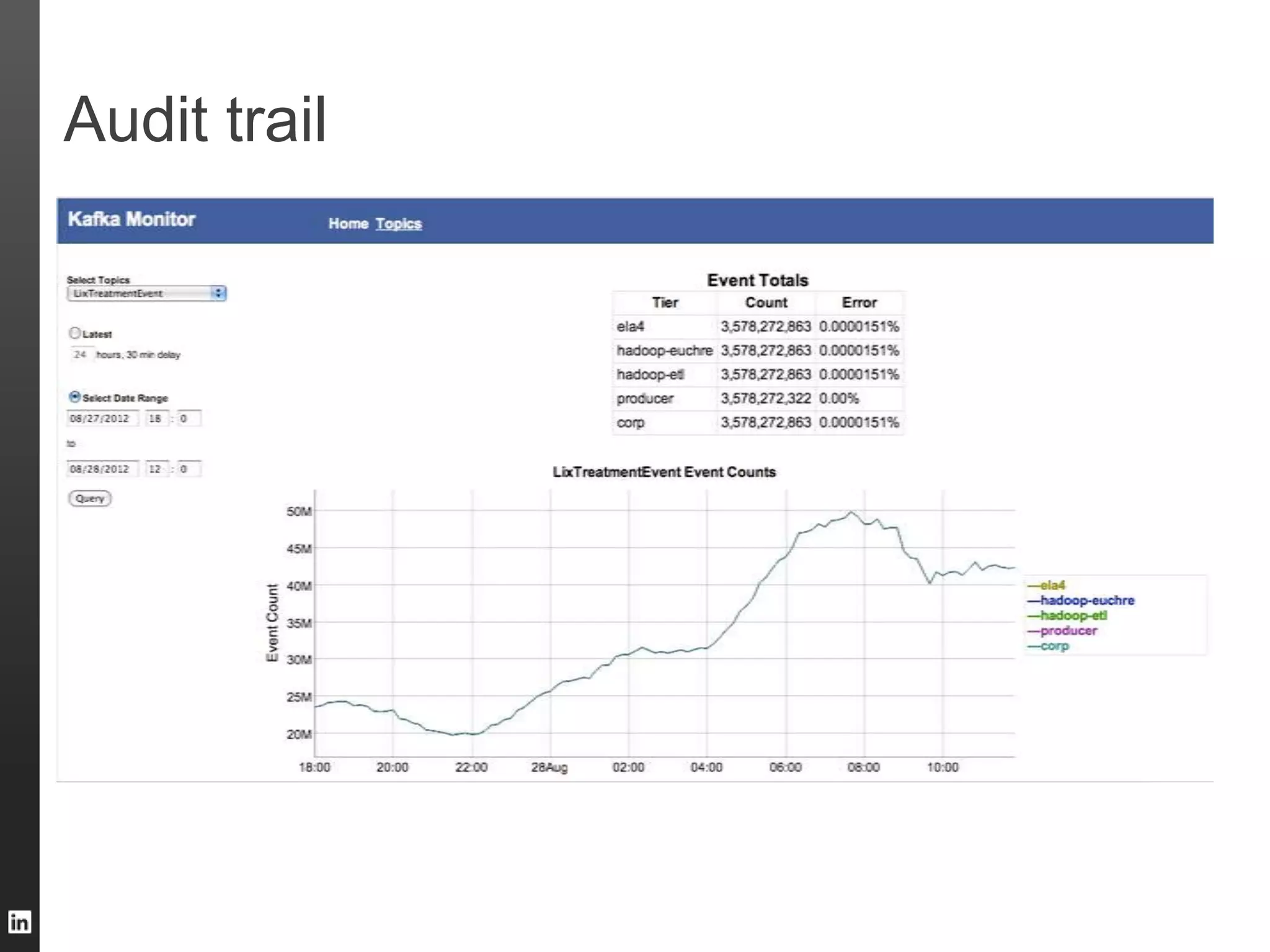
Audit trail
Result: complete, verified copy of all
data available
Top complaints from data scientists
1 Getting the data in (Ingress ETL)
2 Getting the data out (Egress)
3 Workflow management
4 Model of computation
5 …
Egress
store DATA into „kafka://…‟ using Stream();
Top complaints from data scientists
1 Getting the data in (Ingress ETL)
2 Getting the data out (Egress)
3 Workflow management
4 Model of computation
5 …
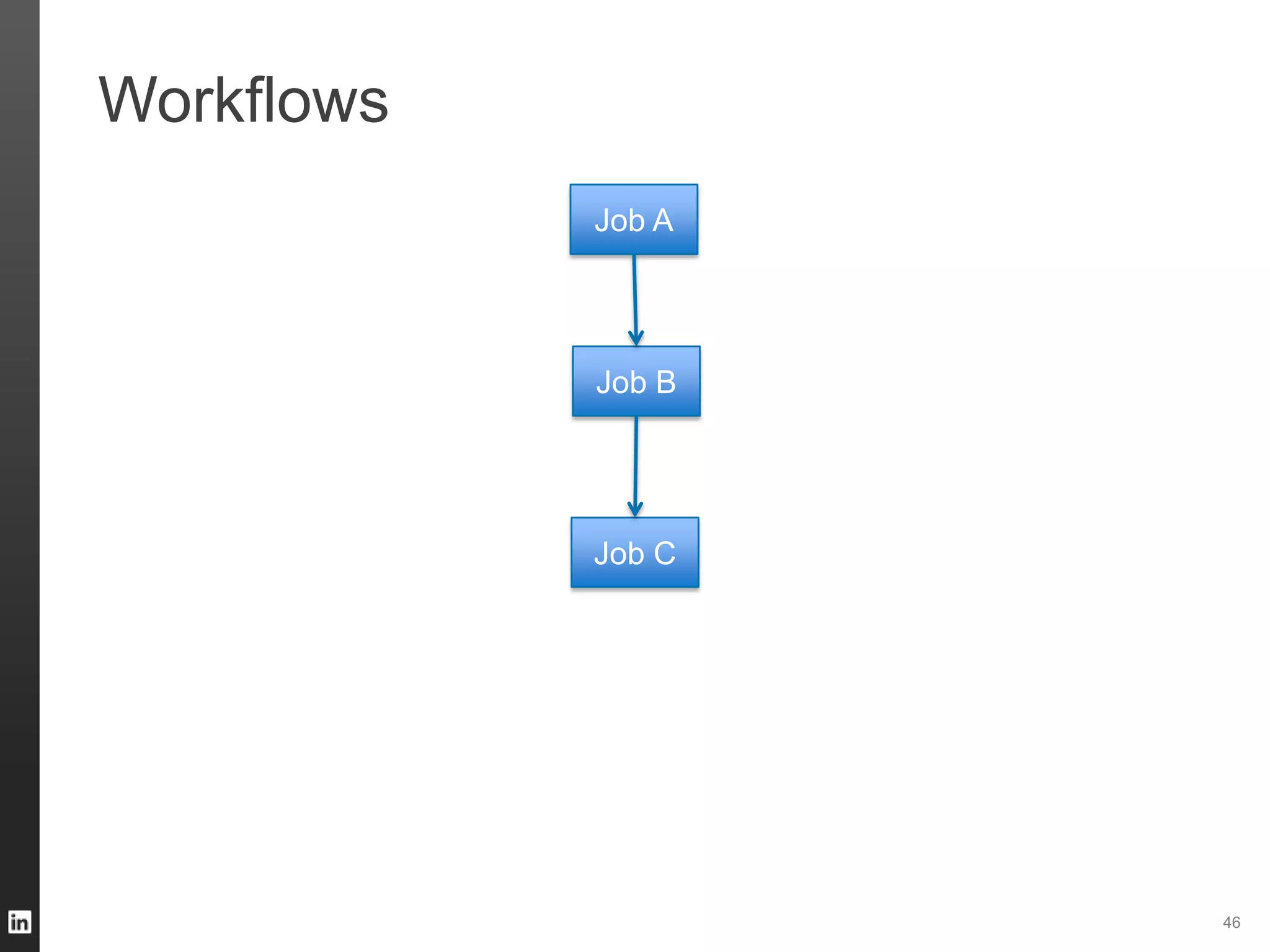
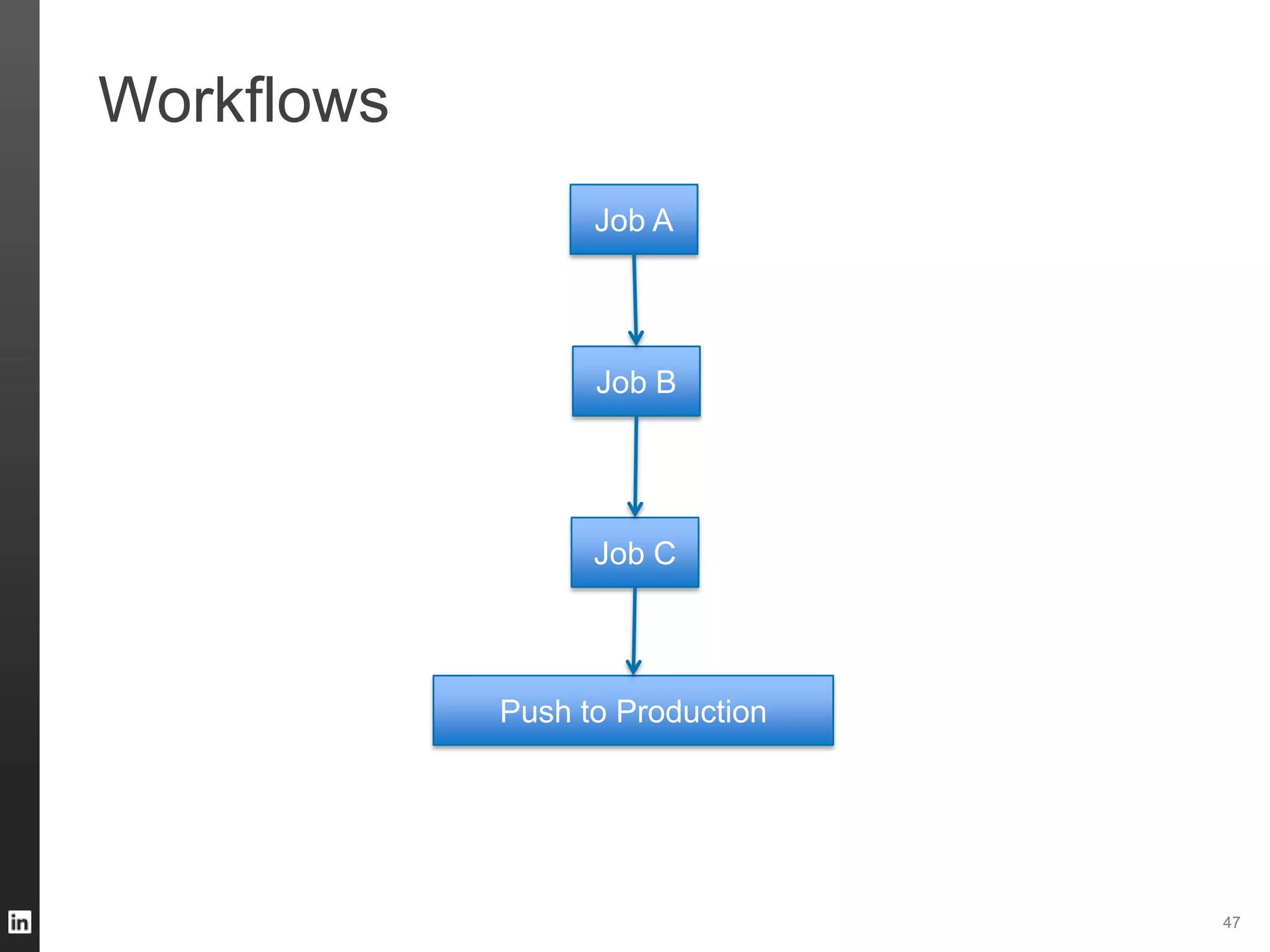
Workflows
46
Job A
Job B
Job C
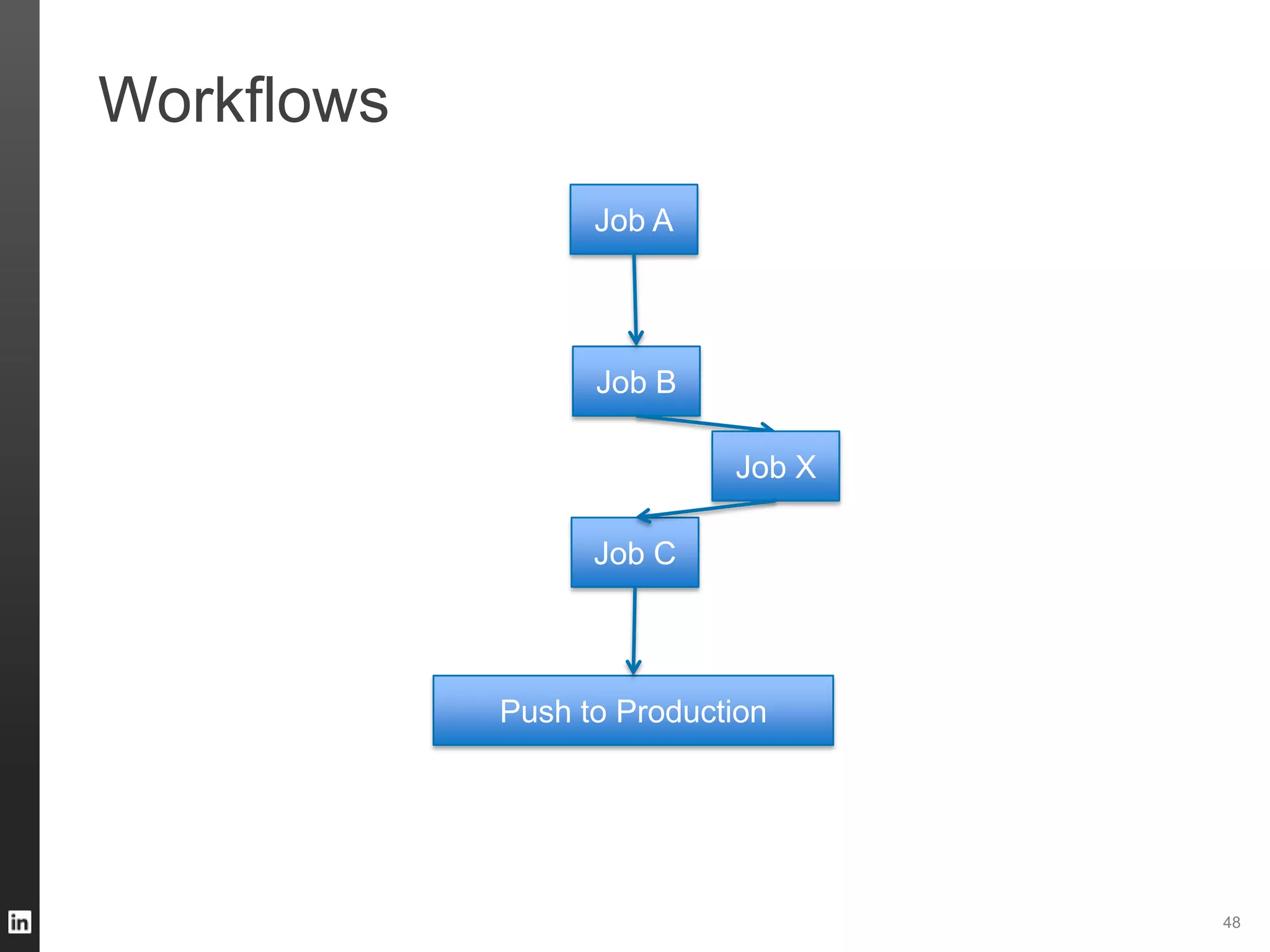
Workflows
47
Job A
Job B
Job C
Push to Production
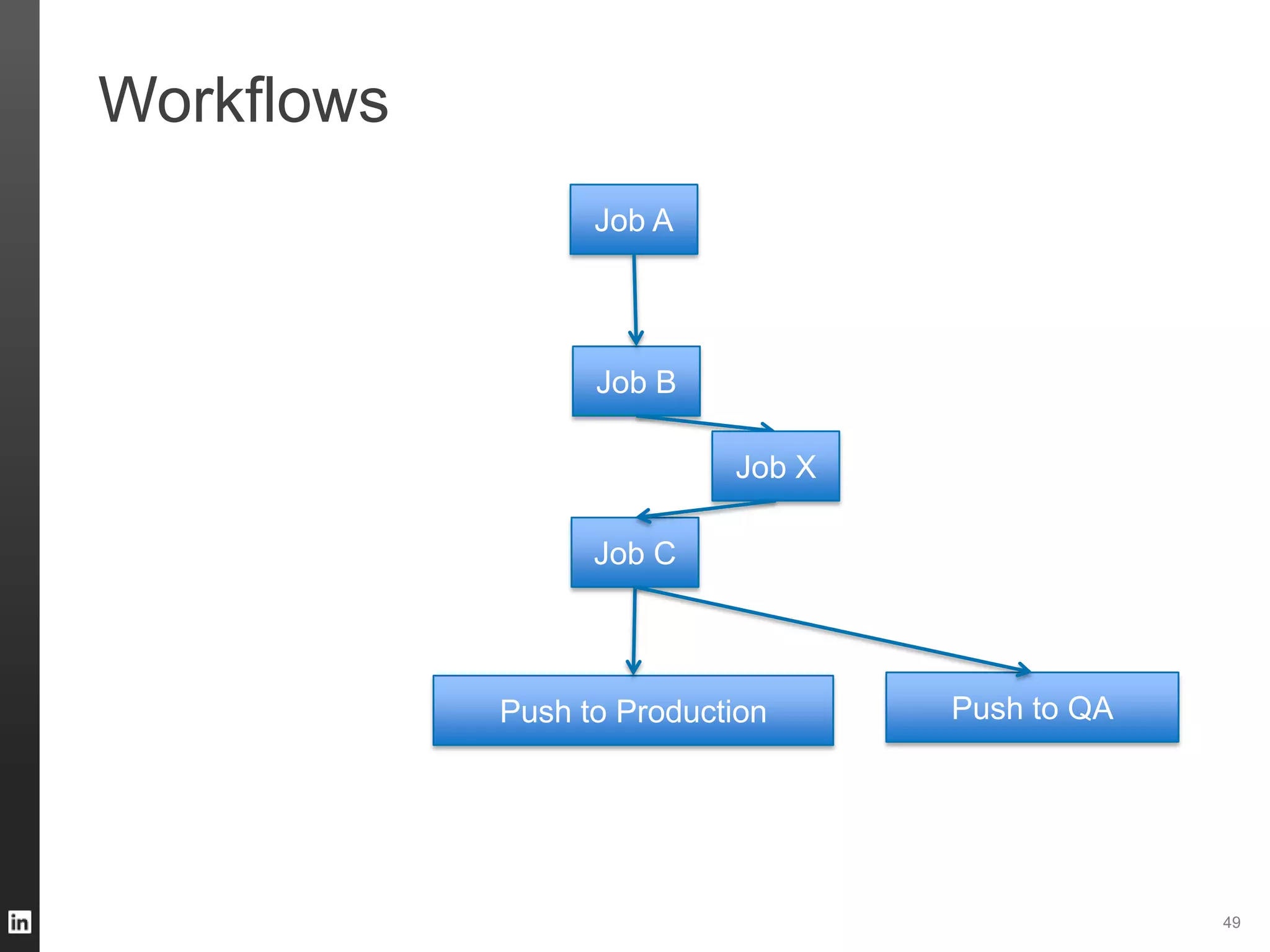
Workflows
48
Job A
Job B
Job C
Push to Production
Job X
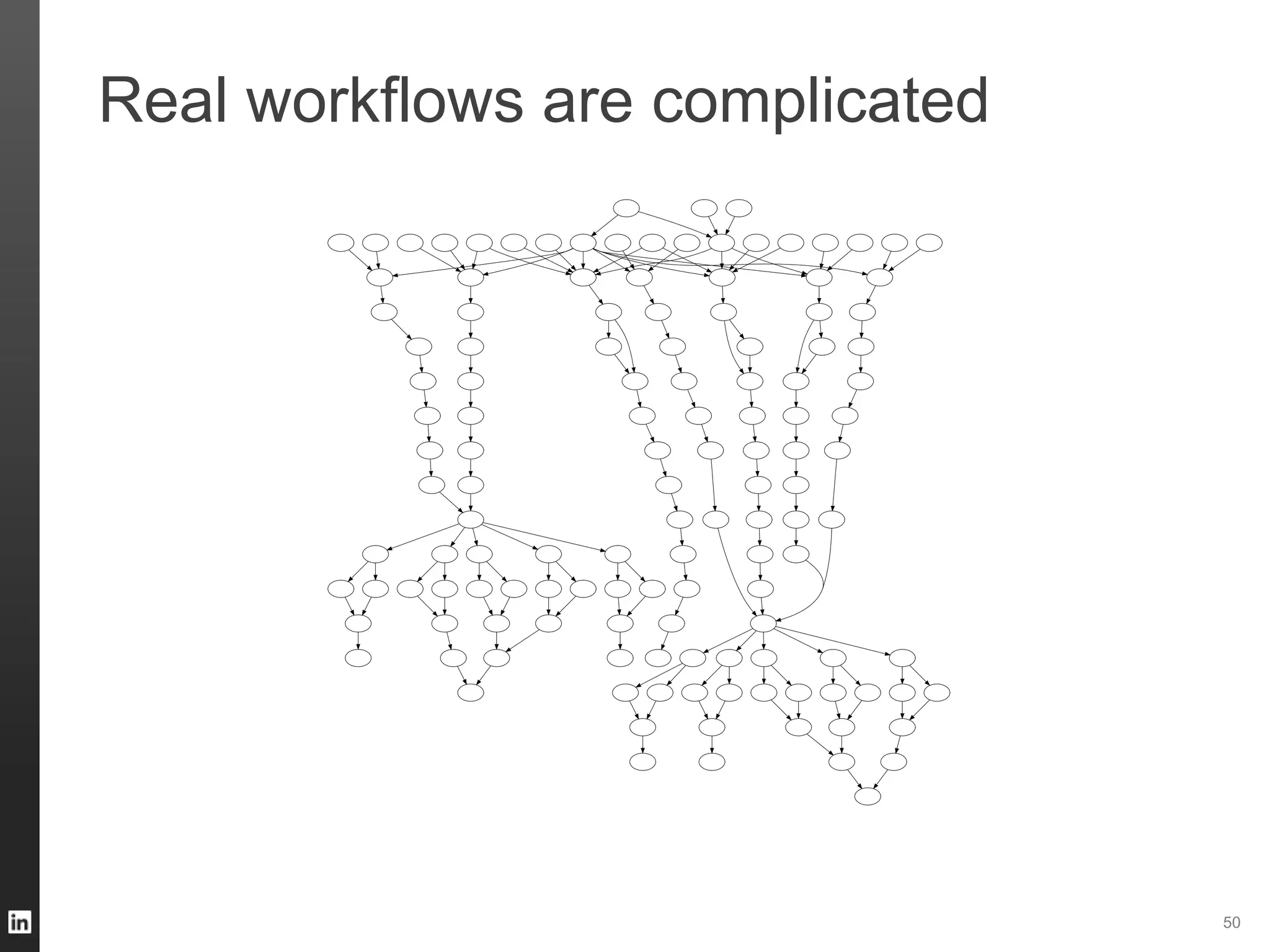
Workflows
49
Job A
Job B
Job C
Push to Production
Job X
Push to QA
Real workflows are complicated
50
Workflow management: Azkaban
51
 Dependency management
 Diverse job types (Pig, Hive, Java, . . . )
 Scheduling
 Monitoring
 Configuration
 Retry/restart on failure
 Resource locking
 Log collection
 Historical information
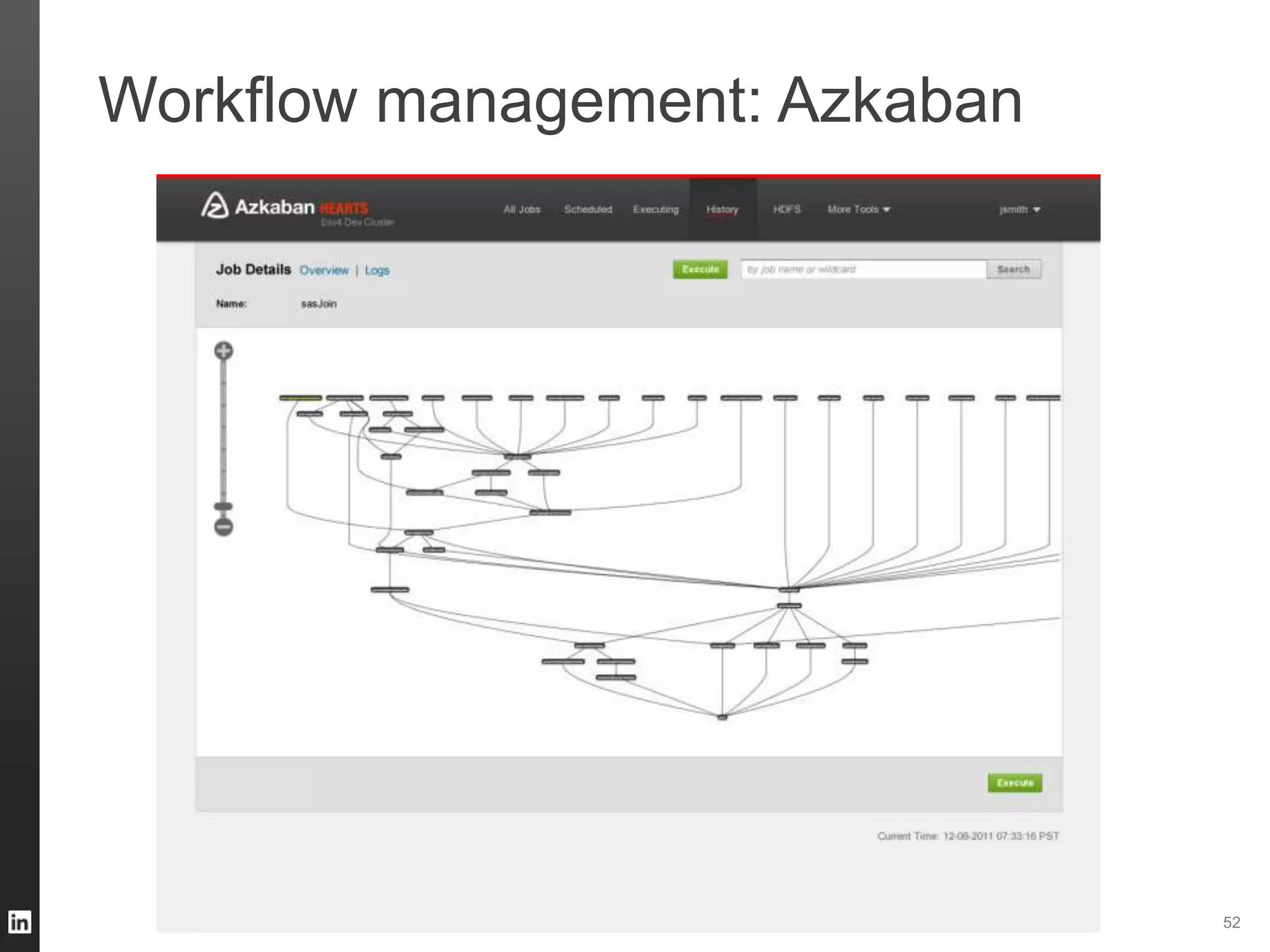
Workflow management: Azkaban
52
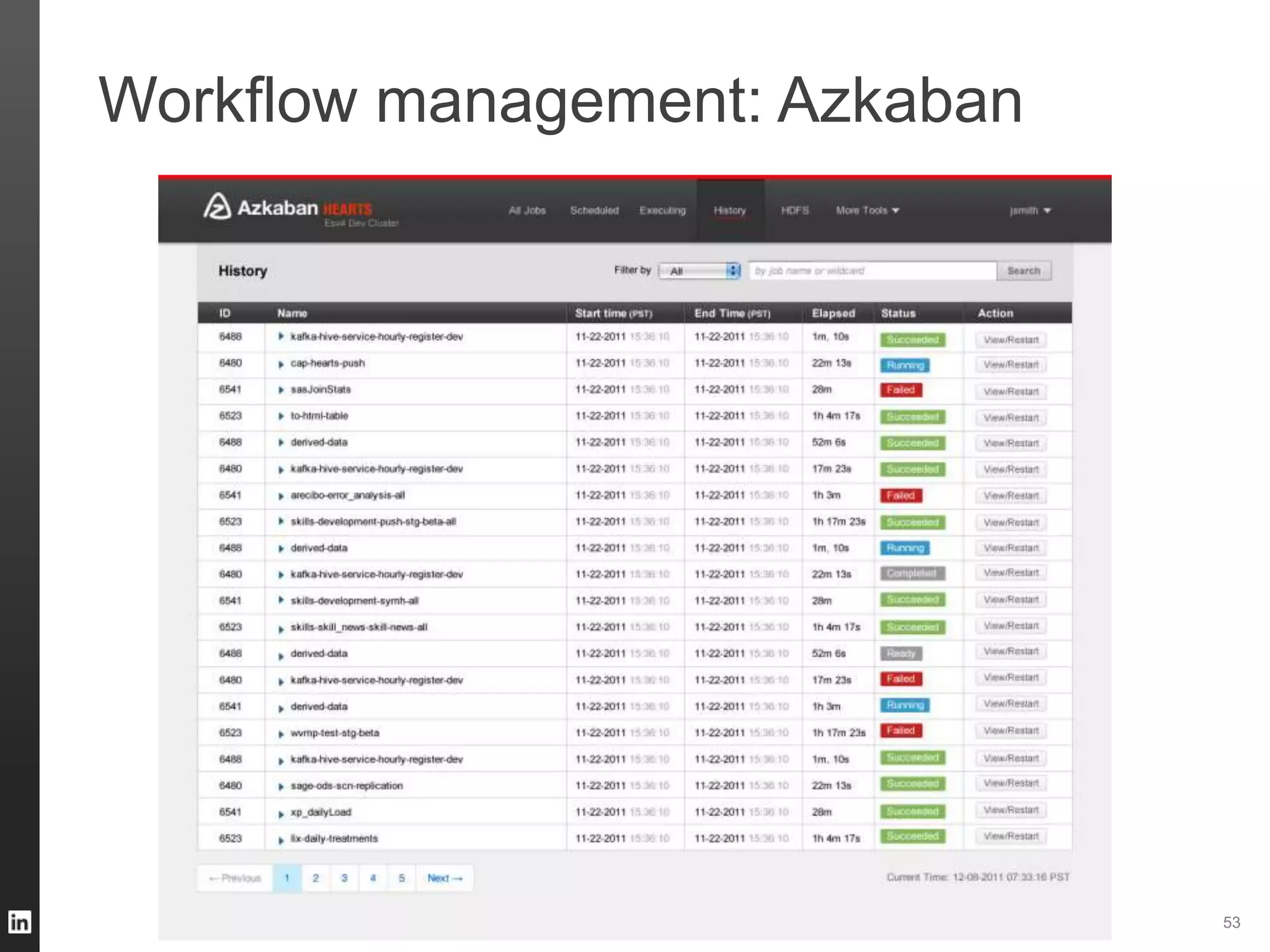
Workflow management: Azkaban
53
Top complaints from data scientists
1 Getting the data in (Ingress ETL)
2 Getting the data out (Egress)
3 Workflow management
4 Model of computation
5 …
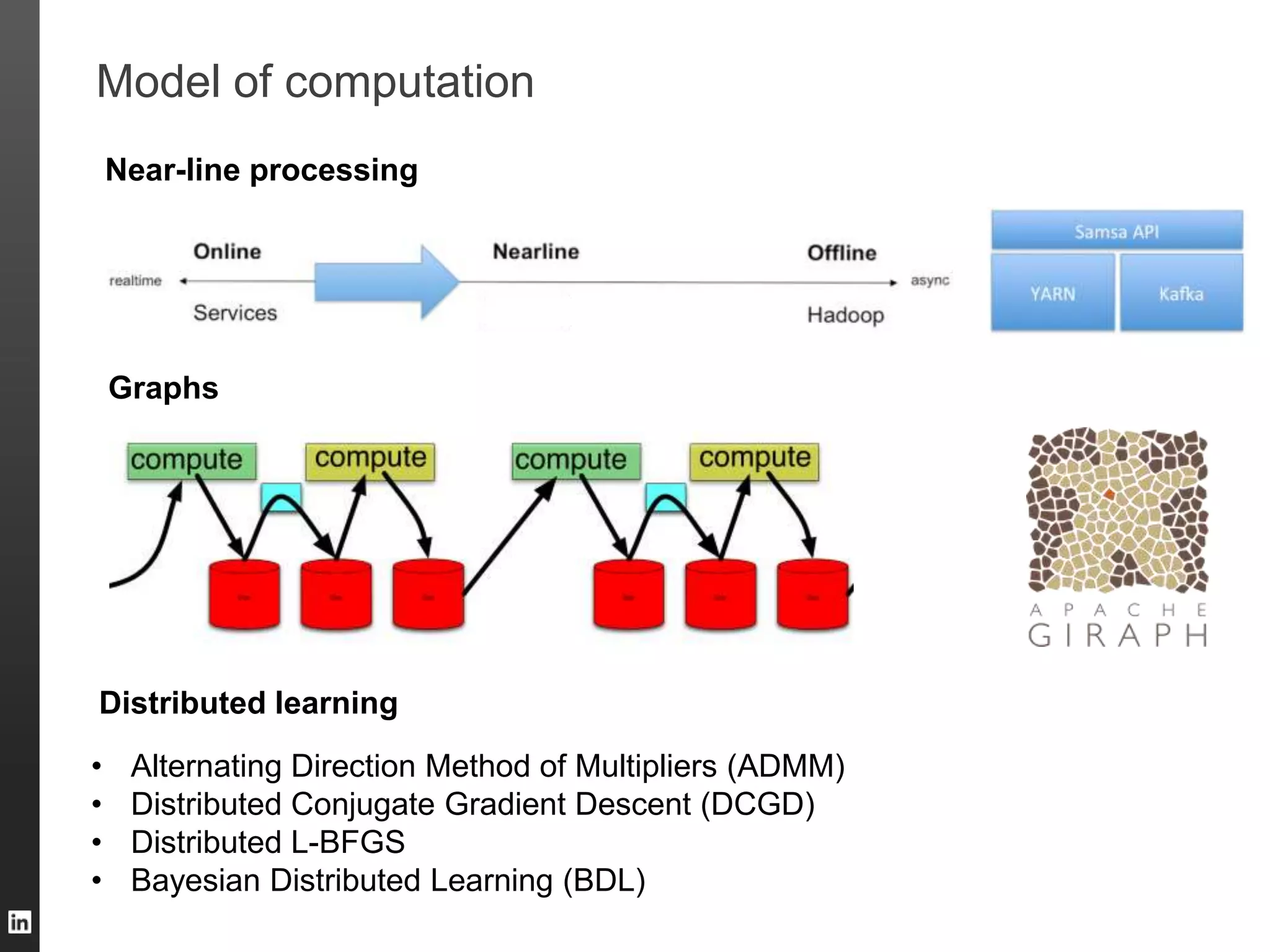
Model of computation
• Alternating Direction Method of Multipliers (ADMM)
• Distributed Conjugate Gradient Descent (DCGD)
• Distributed L-BFGS
• Bayesian Distributed Learning (BDL)
Graphs
Distributed learning
Near-line processing
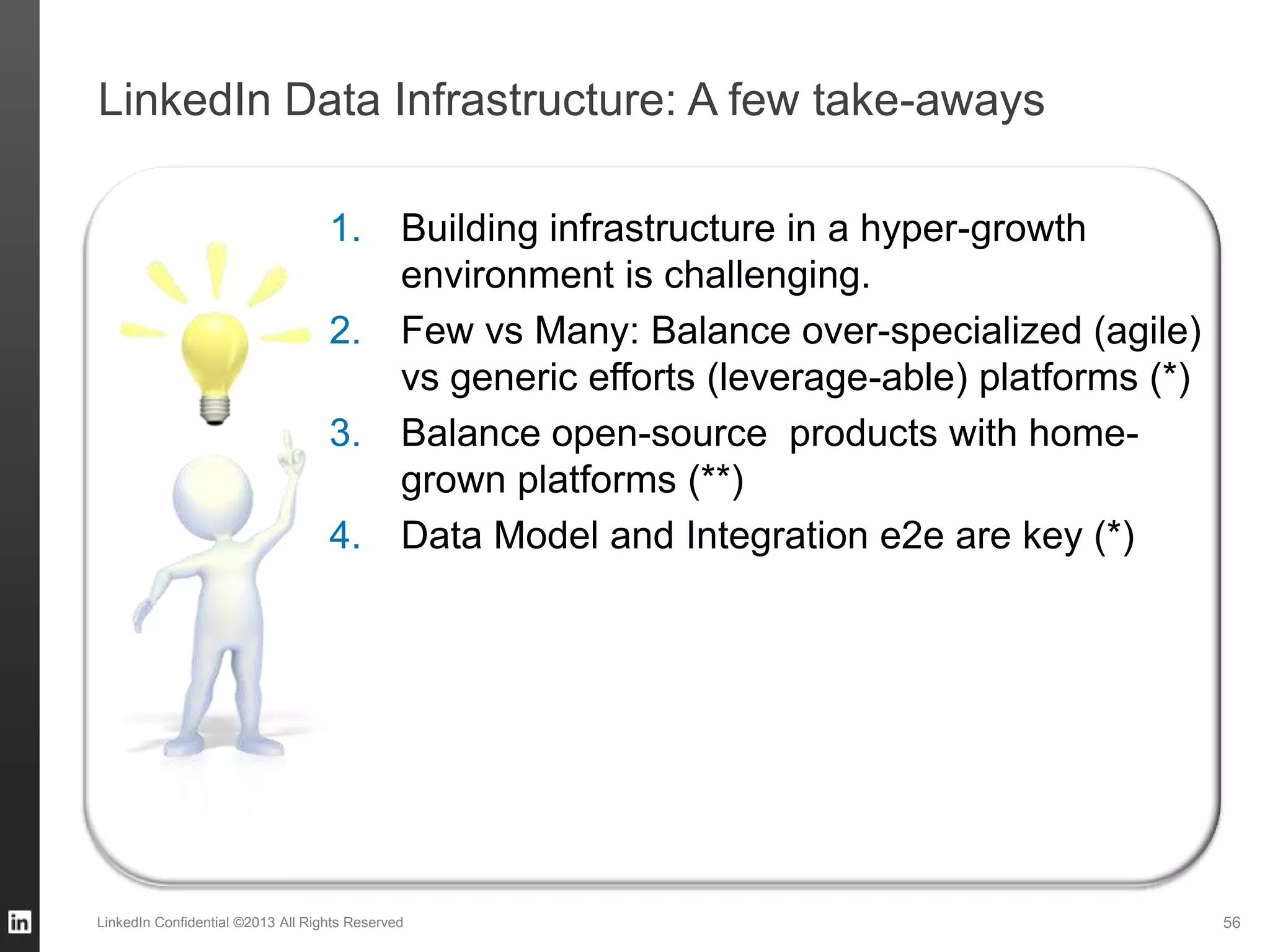
LinkedIn Data Infrastructure: A few take-aways
LinkedIn Confidential ©2013 All Rights Reserved 56
1. Building infrastructure in a hyper-growth
environment is challenging.
2. Few vs Many: Balance over-specialized (agile)
vs generic efforts (leverage-able) platforms (*)
3. Balance open-source products with home-
grown platforms (**)
4. Data Model and Integration e2e are key (*)
57
Learning more
data.linkedin.com

Data Infrastructure at LinkedIn

Editor's Notes

  • #9 Transition needs to be goodProducts =&gt; data infrastructure requirements in previous slideAll products don’t make the same latency and freshness requirements from our data infrastructureThe way we bucketize this is….News and recommendations show up in both nearline and offline
  • #40 Not part of kafka
  • #52 - Others: Oozie
  • #57 Data Integration is hard. Having sane and same metadata across systems. Have a schema which works across the 3 phases. Want a rich evolving schemas and make the conforming push as much of data cleaning to source and upstream as much as possible so near-line and off-line helpsSessionization logic is in WH which makes it hard for near-line systems to useExtensible system where changing schema in one phase does not break downstream systemsDon’t build over-specialized systems: e.g. a monitoring system for PYMK – build Azkaban