Historical Look at Oregon’s
Wood Products Industry
September 2017
Oregon Office of Economic Analysis
Oregon Office of
Economic Analysis
2
Historical Employment
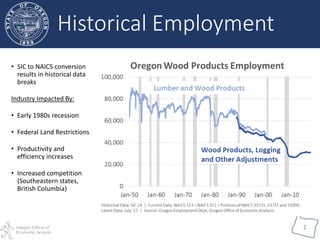
• SIC to NAICS conversion
results in historical data
breaks
Industry Impacted By:
• Early 1980s recession
• Federal Land Restrictions
• Productivity and
efficiency increases
• Increased competition
(Southeastern states,
British Columbia)
Oregon Office of
Economic Analysis
3
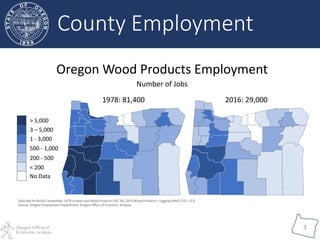
Oregon Wood Products Employment
Data Not Perfectly Compatible: 1978 Lumber and Wood Products (SIC 24), 2015 Wood Products + Logging (NAICS 321, 113)
Source: Oregon Employment Department, Oregon Office of Economic Analysis
1978: 81,400
500 - 1,000
> 5,000
3 – 5,000
1 - 3,000
200 - 500
< 200
No Data
2016: 29,000
Number of Jobs
County Employment
Oregon Office of
Economic Analysis
4
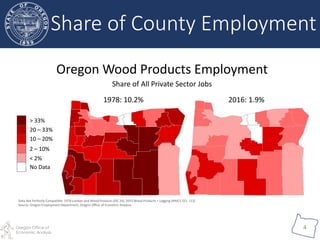
Oregon Wood Products Employment
Share of All Private Sector Jobs
Data Not Perfectly Compatible: 1978 Lumber and Wood Products (SIC 24), 2015 Wood Products + Logging (NAICS 321, 113)
Source: Oregon Employment Department, Oregon Office of Economic Analysis
1978: 10.2%
> 33%
20 – 33%
10 – 20%
2 – 10%
< 2%
No Data
2016: 1.9%
Share of County Employment
Oregon Office of
Economic Analysis
5
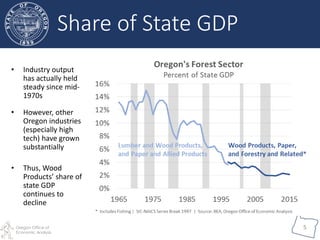
Share of State GDP
• Industry output
has actually held
steady since mid-
1970s
• However, other
Oregon industries
(especially high
tech) have grown
substantially
• Thus, Wood
Products’ share of
state GDP
continues to
decline
Oregon Office of
Economic Analysis
6
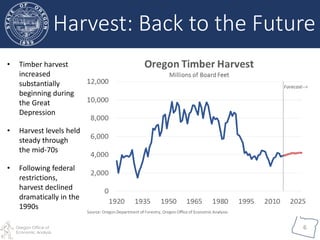
Harvest: Back to the Future
• Timber harvest
increased
substantially
beginning during
the Great
Depression
• Harvest levels held
steady through
the mid-70s
• Following federal
restrictions,
harvest declined
dramatically in the
1990s
Oregon Office of
Economic Analysis
7
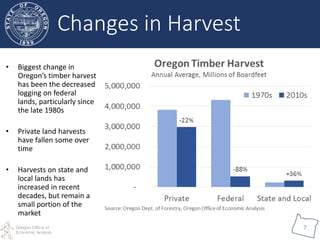
Changes in Harvest
• Biggest change in
Oregon’s timber harvest
has been the decreased
logging on federal
lands, particularly since
the late 1980s
• Private land harvests
have fallen some over
time
• Harvests on state and
local lands has
increased in recent
decades, but remain a
small portion of the
market
8
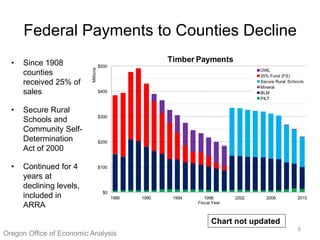
Federal Payments to Counties Decline
• Since 1908
counties
received 25% of
sales
• Secure Rural
Schools and
Community Self-
Determination
Act of 2000
• Continued for 4
years at
declining levels,
included in
ARRA
Oregon Office of Economic Analysis
$0
$100
$200
$300
$400
$500
1986 1990 1994 1998 2002 2006 2010
Millions
Fiscal Year
Timber Payments
OWL
25% Fund (FS)
Secure Rural Schools
Mineral
BLM
PILT
Chart not updated
Oregon Office of
Economic Analysis
9
Flat Wages, Falling Premium
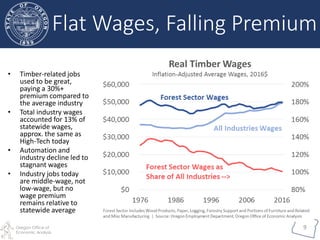
• Timber-related jobs
used to be great,
paying a 30%+
premium compared to
the average industry
• Total industry wages
accounted for 13% of
statewide wages,
approx. the same as
High-Tech today
• Automation and
industry decline led to
stagnant wages
• Industry jobs today
are middle-wage, not
low-wage, but no
wage premium
remains relative to
statewide average
Oregon Office of
Economic Analysis
10
Increased Competition for
Scarce Supply of Logs
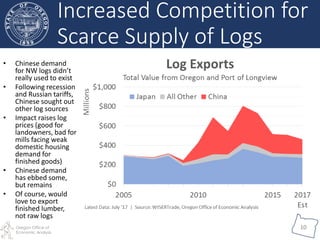
• Chinese demand
for NW logs didn’t
really used to exist
• Following recession
and Russian tariffs,
Chinese sought out
other log sources
• Impact raises log
prices (good for
landowners, bad for
mills facing weak
domestic housing
demand for
finished goods)
• Chinese demand
has ebbed some,
but remains
• Of course, would
love to export
finished lumber,
not raw logs
Oregon Office of
Economic Analysis
11
• In recent years, Pacific Northwest mill margins under pressure
from both sides. High log prices due to low harvest levels and
increased competition from China for raw logs. Weak domestic
demand and increased Canadian exports hold down final
prices.
• Under either a tariff or another softwood lumber agreement, it
should help Pacific Northwest mills with pricing power
• Better margins for mills, supporting their operation, but also higher
consumer prices
• Some of this pricing power will flow to land owners. At higher
lumber prices, mills can afford to pay more for logs, thus raising
or at least supporting log prices too.
• Higher log prices should result in higher private land harvest
levels. Unclear how much. Economic impact likely smallish.
• The tariff (if it sticks) or a SLA may help Northwest mills some,
but it cannot solve their biggest obstacle: raw logs
Canadian Tariff
Oregon Office of
Economic Analysis
12
•During the 1940s-1970s the industry
employed 70,000+ workers and paid 30%
above the state average
•Events with significant impact:
•Early 1980s recession, industry restructuring,
Federal Land restrictions, increased
competition from Southeastern U.S. and
British Columbia, increased productivity and
mechanization
•Today there are about 30,000 jobs that pay
the state average
Conclusion
Oregon Office of
Economic Analysis
13
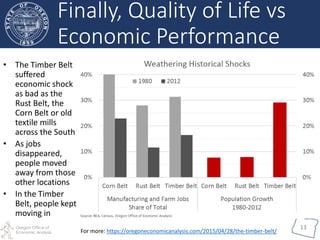
Finally, Quality of Life vs
Economic Performance
• The Timber Belt
suffered
economic shock
as bad as the
Rust Belt, the
Corn Belt or old
textile mills
across the South
• As jobs
disappeared,
people moved
away from those
other locations
• In the Timber
Belt, people kept
moving in
For more: https://oregoneconomicanalysis.com/2015/04/28/the-timber-belt/
Oregon Office of
Economic Analysis
14
joshua.lehner@oregon.gov
(503) 378-4052
www.OregonEconomicAnalysis.com
@OR_EconAnalysis
Questions and Contact

Oregon's Timber History

  • 1.
    Historical Look atOregon’s Wood Products Industry September 2017 Oregon Office of Economic Analysis
  • 2.
    Oregon Office of EconomicAnalysis 2 Historical Employment • SIC to NAICS conversion results in historical data breaks Industry Impacted By: • Early 1980s recession • Federal Land Restrictions • Productivity and efficiency increases • Increased competition (Southeastern states, British Columbia)
  • 3.
    Oregon Office of EconomicAnalysis 3 Oregon Wood Products Employment Data Not Perfectly Compatible: 1978 Lumber and Wood Products (SIC 24), 2015 Wood Products + Logging (NAICS 321, 113) Source: Oregon Employment Department, Oregon Office of Economic Analysis 1978: 81,400 500 - 1,000 > 5,000 3 – 5,000 1 - 3,000 200 - 500 < 200 No Data 2016: 29,000 Number of Jobs County Employment
  • 4.
    Oregon Office of EconomicAnalysis 4 Oregon Wood Products Employment Share of All Private Sector Jobs Data Not Perfectly Compatible: 1978 Lumber and Wood Products (SIC 24), 2015 Wood Products + Logging (NAICS 321, 113) Source: Oregon Employment Department, Oregon Office of Economic Analysis 1978: 10.2% > 33% 20 – 33% 10 – 20% 2 – 10% < 2% No Data 2016: 1.9% Share of County Employment
  • 5.
    Oregon Office of EconomicAnalysis 5 Share of State GDP • Industry output has actually held steady since mid- 1970s • However, other Oregon industries (especially high tech) have grown substantially • Thus, Wood Products’ share of state GDP continues to decline
  • 6.
    Oregon Office of EconomicAnalysis 6 Harvest: Back to the Future • Timber harvest increased substantially beginning during the Great Depression • Harvest levels held steady through the mid-70s • Following federal restrictions, harvest declined dramatically in the 1990s
  • 7.
    Oregon Office of EconomicAnalysis 7 Changes in Harvest • Biggest change in Oregon’s timber harvest has been the decreased logging on federal lands, particularly since the late 1980s • Private land harvests have fallen some over time • Harvests on state and local lands has increased in recent decades, but remain a small portion of the market
  • 8.
    8 Federal Payments toCounties Decline • Since 1908 counties received 25% of sales • Secure Rural Schools and Community Self- Determination Act of 2000 • Continued for 4 years at declining levels, included in ARRA Oregon Office of Economic Analysis $0 $100 $200 $300 $400 $500 1986 1990 1994 1998 2002 2006 2010 Millions Fiscal Year Timber Payments OWL 25% Fund (FS) Secure Rural Schools Mineral BLM PILT Chart not updated
  • 9.
    Oregon Office of EconomicAnalysis 9 Flat Wages, Falling Premium • Timber-related jobs used to be great, paying a 30%+ premium compared to the average industry • Total industry wages accounted for 13% of statewide wages, approx. the same as High-Tech today • Automation and industry decline led to stagnant wages • Industry jobs today are middle-wage, not low-wage, but no wage premium remains relative to statewide average
  • 10.
    Oregon Office of EconomicAnalysis 10 Increased Competition for Scarce Supply of Logs • Chinese demand for NW logs didn’t really used to exist • Following recession and Russian tariffs, Chinese sought out other log sources • Impact raises log prices (good for landowners, bad for mills facing weak domestic housing demand for finished goods) • Chinese demand has ebbed some, but remains • Of course, would love to export finished lumber, not raw logs
  • 11.
    Oregon Office of EconomicAnalysis 11 • In recent years, Pacific Northwest mill margins under pressure from both sides. High log prices due to low harvest levels and increased competition from China for raw logs. Weak domestic demand and increased Canadian exports hold down final prices. • Under either a tariff or another softwood lumber agreement, it should help Pacific Northwest mills with pricing power • Better margins for mills, supporting their operation, but also higher consumer prices • Some of this pricing power will flow to land owners. At higher lumber prices, mills can afford to pay more for logs, thus raising or at least supporting log prices too. • Higher log prices should result in higher private land harvest levels. Unclear how much. Economic impact likely smallish. • The tariff (if it sticks) or a SLA may help Northwest mills some, but it cannot solve their biggest obstacle: raw logs Canadian Tariff
  • 12.
    Oregon Office of EconomicAnalysis 12 •During the 1940s-1970s the industry employed 70,000+ workers and paid 30% above the state average •Events with significant impact: •Early 1980s recession, industry restructuring, Federal Land restrictions, increased competition from Southeastern U.S. and British Columbia, increased productivity and mechanization •Today there are about 30,000 jobs that pay the state average Conclusion
  • 13.
    Oregon Office of EconomicAnalysis 13 Finally, Quality of Life vs Economic Performance • The Timber Belt suffered economic shock as bad as the Rust Belt, the Corn Belt or old textile mills across the South • As jobs disappeared, people moved away from those other locations • In the Timber Belt, people kept moving in For more: https://oregoneconomicanalysis.com/2015/04/28/the-timber-belt/
  • 14.
    Oregon Office of EconomicAnalysis 14 joshua.lehner@oregon.gov (503) 378-4052 www.OregonEconomicAnalysis.com @OR_EconAnalysis Questions and Contact