Orchestrating Legacy Sustainment and Migration with ERP Implementation –   How to Reduce Risks   Presented by Stephen Lahanas
Introduction A Crisis in Capability Each year the USAF falls further behind the technology curve Modernization projects were largely unsuccessful Many USAF IT systems are 10, 20 or more years old In many domains, no new requirements have been addressed in over two years The current strategy for COTS / ERP implementation will further restrict legacy improvements and delay eventual capability roll-outs for many more years This ‘Big Bang’ strategy only exacerbates an existing problem The budget allocated in recent years to address capability should have produced more results; expectations are high, confidence is low, the pressure is on; but does it all have to be on ERP ?
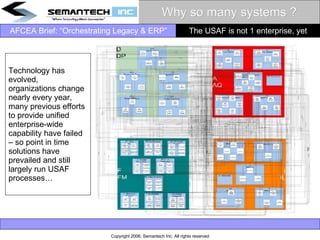
Why so many systems ? The USAF is not 1 enterprise, yet Technology has evolved, organizations change nearly every year, many previous efforts to provide unified enterprise-wide capability have failed – so point in time solutions have prevailed and still largely run USAF processes…
Impact of Capability Gap What are the Risks of ERP Big Bang ? There is no guarantee of success, many ERP projects have failed or suffered serious delays & cost overruns; this is both a commercial and federal phenomenon  Both the USA Navy and Army have suffered severe problems with their ERP implementations  Starving legacy funding means that mitigation of any ERP failure is next to impossible – unless funding and work is coordinated between legacy and ERP system offices Restricting legacy systems will impede the ability of the USAF to build it’s enterprise into a joint Netcentric environment, to use RFID and AIS technology, and to reduce pressures on an overworked personnel force facing near-term reductions… Legacy capability is fighting the global war on terror, the ERP projects have yet to make any major contributions   Legacy Limitations Matter
Musings of a  Chief Engineer The view from the legacy systems office I wondered who was going to interface with customers on day to day issues, not just the “to be,” where does the knowledge go ? I was concerned that there didn’t seem to be a clear mechanism or set of processes connecting the legacy PMOs with the ERP implementations The sheer number of offices and issues involved was even larger than I had imagined it would be (and I had worked within the Single Supply initiative, IL Data Strategy etc.) It seemed as though the assumptions made in the original Stock Control ERP study had been overly simplistic and not taken into consideration the true challenge of process change Whether we wanted to push the USAF to an ERP COTS process view or not, USAF business logic will likely push the COTS beyond its bounds into bolt-on integrations, yet where is all the analysis occurring to make those determinations ?  The devil is in the details
Challenging Assumptions  Assumptions that had once helped to mobilize us to action… All legacy IT development is contrary to modernization goals ERP and legacy funding cannot be orchestrated, it is an either / or proposition All legacy processes will be replaced All legacy systems will be replaced New legacy system development would only encourage system proliferation and retard ERP adoption One might assume then that legacy systems are and have been the main problem facing the USAF enterprise, but in fact the real problem has been the inability to replace them in a consistent and cost-efficient manner. Having to sustain all those systems and finance modernization on a continual basis is where the real pain becomes evident. Perhaps, right now, again we are ignoring a lesson we’ve already learned ? Can we afford to continue to view legacy IT as separate from the ‘to be’ enterprise vision ?  Polar Opposites
Theory of IT Relativity All modernized technology becomes legacy at IOC Often times it also already becoming obsolete  In the past ten years, we’ve seen: Client Server, Corba, J2EE, EAI, ERP, web services, the semantic web and more… What will we see between now and 2012 to 2015, when the ERP initiatives will likely be completed ? The technology lifecycles are becoming shorter  Our deployment cycles are becoming longer This gap results in lost capability Capability is the true focus area, not the technology per se, we must focus on ensuring capability across a continuum of changing / diverse technologies on a constant basis, this will never change – there is no ‘end state’ Capability / Time Continuum
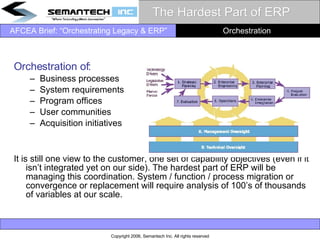
The Hardest Part of ERP Orchestration of: Business processes  System requirements Program offices User communities Acquisition initiatives It is still one view to the customer, one set of capability objectives (even if it isn’t integrated yet on our side). The hardest part of ERP will be managing this coordination. System / function / process migration or convergence or replacement will require analysis of 100’s of thousands of variables at our scale.  Orchestration
Pragmatic Problem Solving There isn’t one simple solution Success does require more adaptability though – viewing this too rigidly will lead to slow going Orchestration can occur through various mechanisms:  Capability tradeoff analysis  Common project automation services (but without the need to conform all participants within the exact same process / culture) Exploitation and reuse of current capabilities / technologies using innovative solutions  Through legacy mitigation of ERP risks (there should be a failsafe – and that should be coordinated lock-step with ERP capability implementation) – the requirements freeze needs to be reevaluated (funding can come from any source, it is not an acquisition strategy but rather a technology examination & response to real time needs)  Success Requires Agility
An Example of Pragmatism Some systems can become Netcentric Now… It still isn’t clear whether their functionality can or will be replaced by ERP (just being in a category such as Supply or Maintenance doesn’t signify that the determination has been made) Migrating some of these unique USAF systems now into the framework will expose services and data to the enterprise on a more efficient basis Migrating them will allow for near term to mid term requirements to be met during this decade, the USAF cannot afford to wait for everything until 2012 or later… New technology makes near-term achievement realistic, sometimes stop gap solutions are the most effective, many of our current systems were at some point ‘quick fixes’ – they’ve been running for decades.  This will make bolting-on, the eventual ERP integration easier Near-term to Mid-term

Orchestrating Legacy ERP Infotech 2006

  • 1.
    Orchestrating Legacy Sustainmentand Migration with ERP Implementation – How to Reduce Risks Presented by Stephen Lahanas
  • 2.
    Introduction A Crisisin Capability Each year the USAF falls further behind the technology curve Modernization projects were largely unsuccessful Many USAF IT systems are 10, 20 or more years old In many domains, no new requirements have been addressed in over two years The current strategy for COTS / ERP implementation will further restrict legacy improvements and delay eventual capability roll-outs for many more years This ‘Big Bang’ strategy only exacerbates an existing problem The budget allocated in recent years to address capability should have produced more results; expectations are high, confidence is low, the pressure is on; but does it all have to be on ERP ?
  • 3.
    Why so manysystems ? The USAF is not 1 enterprise, yet Technology has evolved, organizations change nearly every year, many previous efforts to provide unified enterprise-wide capability have failed – so point in time solutions have prevailed and still largely run USAF processes…
  • 4.
    Impact of CapabilityGap What are the Risks of ERP Big Bang ? There is no guarantee of success, many ERP projects have failed or suffered serious delays & cost overruns; this is both a commercial and federal phenomenon Both the USA Navy and Army have suffered severe problems with their ERP implementations Starving legacy funding means that mitigation of any ERP failure is next to impossible – unless funding and work is coordinated between legacy and ERP system offices Restricting legacy systems will impede the ability of the USAF to build it’s enterprise into a joint Netcentric environment, to use RFID and AIS technology, and to reduce pressures on an overworked personnel force facing near-term reductions… Legacy capability is fighting the global war on terror, the ERP projects have yet to make any major contributions Legacy Limitations Matter
  • 5.
    Musings of a Chief Engineer The view from the legacy systems office I wondered who was going to interface with customers on day to day issues, not just the “to be,” where does the knowledge go ? I was concerned that there didn’t seem to be a clear mechanism or set of processes connecting the legacy PMOs with the ERP implementations The sheer number of offices and issues involved was even larger than I had imagined it would be (and I had worked within the Single Supply initiative, IL Data Strategy etc.) It seemed as though the assumptions made in the original Stock Control ERP study had been overly simplistic and not taken into consideration the true challenge of process change Whether we wanted to push the USAF to an ERP COTS process view or not, USAF business logic will likely push the COTS beyond its bounds into bolt-on integrations, yet where is all the analysis occurring to make those determinations ? The devil is in the details
  • 6.
    Challenging Assumptions Assumptions that had once helped to mobilize us to action… All legacy IT development is contrary to modernization goals ERP and legacy funding cannot be orchestrated, it is an either / or proposition All legacy processes will be replaced All legacy systems will be replaced New legacy system development would only encourage system proliferation and retard ERP adoption One might assume then that legacy systems are and have been the main problem facing the USAF enterprise, but in fact the real problem has been the inability to replace them in a consistent and cost-efficient manner. Having to sustain all those systems and finance modernization on a continual basis is where the real pain becomes evident. Perhaps, right now, again we are ignoring a lesson we’ve already learned ? Can we afford to continue to view legacy IT as separate from the ‘to be’ enterprise vision ? Polar Opposites
  • 7.
    Theory of ITRelativity All modernized technology becomes legacy at IOC Often times it also already becoming obsolete In the past ten years, we’ve seen: Client Server, Corba, J2EE, EAI, ERP, web services, the semantic web and more… What will we see between now and 2012 to 2015, when the ERP initiatives will likely be completed ? The technology lifecycles are becoming shorter Our deployment cycles are becoming longer This gap results in lost capability Capability is the true focus area, not the technology per se, we must focus on ensuring capability across a continuum of changing / diverse technologies on a constant basis, this will never change – there is no ‘end state’ Capability / Time Continuum
  • 8.
    The Hardest Partof ERP Orchestration of: Business processes System requirements Program offices User communities Acquisition initiatives It is still one view to the customer, one set of capability objectives (even if it isn’t integrated yet on our side). The hardest part of ERP will be managing this coordination. System / function / process migration or convergence or replacement will require analysis of 100’s of thousands of variables at our scale. Orchestration
  • 9.
    Pragmatic Problem SolvingThere isn’t one simple solution Success does require more adaptability though – viewing this too rigidly will lead to slow going Orchestration can occur through various mechanisms: Capability tradeoff analysis Common project automation services (but without the need to conform all participants within the exact same process / culture) Exploitation and reuse of current capabilities / technologies using innovative solutions Through legacy mitigation of ERP risks (there should be a failsafe – and that should be coordinated lock-step with ERP capability implementation) – the requirements freeze needs to be reevaluated (funding can come from any source, it is not an acquisition strategy but rather a technology examination & response to real time needs) Success Requires Agility
  • 10.
    An Example ofPragmatism Some systems can become Netcentric Now… It still isn’t clear whether their functionality can or will be replaced by ERP (just being in a category such as Supply or Maintenance doesn’t signify that the determination has been made) Migrating some of these unique USAF systems now into the framework will expose services and data to the enterprise on a more efficient basis Migrating them will allow for near term to mid term requirements to be met during this decade, the USAF cannot afford to wait for everything until 2012 or later… New technology makes near-term achievement realistic, sometimes stop gap solutions are the most effective, many of our current systems were at some point ‘quick fixes’ – they’ve been running for decades. This will make bolting-on, the eventual ERP integration easier Near-term to Mid-term