Presented by: Ms. Carla B. Espiritu
The students should be able to
identify the different levels of
communication.
The students should be able to
show appreciation of
communication within oneself
through writing a letter.
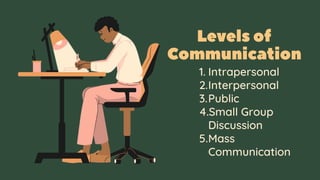
1. Intrapersonal
2.Interpersonal
3.Public
4.Small Group
Discussion
5.Mass
Communication
The prefix “intra”
means within or inside.
Talking to yourself
It involves thinking,
remembering, and
feeling- all the things
you do internally.
The person involved in the
communication process
serves as both the sender
and the receiver of the
message.
Ex. Self-reflection
This type of
communication involves
two persons (dyadic) or a
relatively small number of
people.
Most of our daily
communicative
experiences take place on
this level.
In this type of
communication, people
come to know each other
better.
It is a give-and-take
relationship.
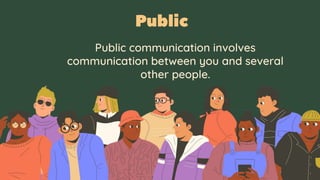
Public communication involves
communication between you and several
other people.
At this level of communication, you
engaged primarily in a monologue
rather than a dialogue.
Internal discourse involves reflection,
analysis, and concentration. Some
activities that are under internal
discourse are daydreaming,
analyzing, praying, and meditating.
Examples: Delivering a Speech, Giving a
Lecture, Reporting in front of the
Audience, Public Announcement
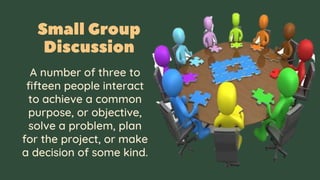
A number of three to
fifteen people interact
to achieve a common
purpose, or objective,
solve a problem, plan
for the project, or make
a decision of some kind.
Examples:
Brainstorming,
Group Discussion
and Planning
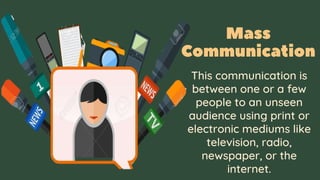
This communication is
between one or a few
people to an unseen
audience using print or
electronic mediums like
television, radio,
newspaper, or the
internet.
Examples: Radio
Broadcasting, and Social
Media Trends and Issues
News
Think about yourself and all your experiences from then
until now, and your experiences in the future. What do
you want to say to your past, present, and future self?
Your performance task for this lesson is to
write a letter addressed to yourself. You have
creative liberty in the tone of your letter and its
parts.
Oral Communication 11
Oral Communication.pptx12345678987654ert

Oral Communication.pptx12345678987654ert