josh.holmes@microsoft.com
http://www.joshholmes.com
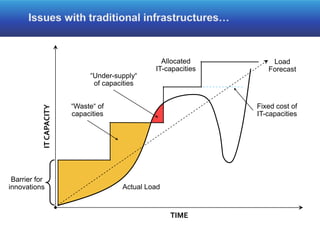
Allocated         Load
                                                IT-capacities      Forecast
                              “Under-supply“
                               of capacities


                         “Waste“ of                             Fixed cost of
           IT CAPACITY


                         capacities                             IT-capacities


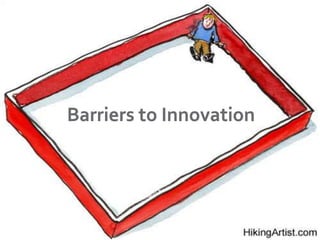
 Barrier for
innovations                            Actual Load


                                                     TIME
Load
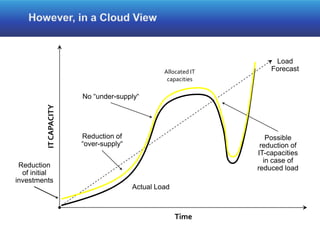
                                                 Allocated IT       Forecast
                                                  capacities

                        No “under-supply“
          IT CAPACITY


                        Reduction of                               Possible
                        “over-supply“                            reduction of
                                                                IT-capacities
                                                                  in case of
 Reduction                                                      reduced load
  of initial
investments
                                        Actual Load


                                                      Time
Compute


                                             Compute
                       Inactivity
                        Period
                                                                     Average Usage
           Average                   Usage


                         Time                                 Time


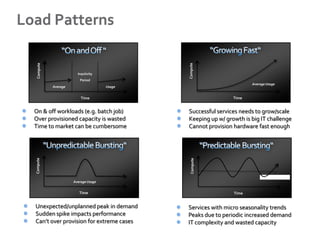
On & off workloads (e.g. batch job)          Successful services needs to grow/scale
Over provisioned capacity is wasted          Keeping up w/ growth is big IT challenge
Time to market can be cumbersome             Cannot provision hardware fast enough
Compute


                                              Compute
                                                                           Average Usage
                     Average Usage


                        Time                                  Time


Unexpected/unplanned peak in demand          Services with micro seasonality trends
Sudden spike impacts performance             Peaks due to periodic increased demand
Can’t over provision for extreme cases       IT complexity and wasted capacity
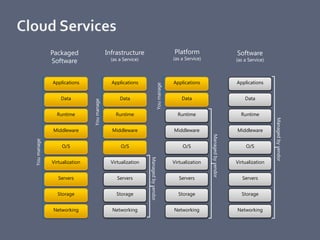
Packaged                      Infrastructure                            Platform                             Software
                                             (as a Service)                          (as a Service)
             Software                                                                                                     (as a Service)


             Applications                    Applications                            Applications                         Applications


                                                                        You manage
                 Data         You manage         Data                                    Data                                 Data


               Runtime                         Runtime                                 Runtime                              Runtime


                                                                                                                                           Managed by vendor
             Middleware                      Middleware                              Middleware                           Middleware


                                                                                                      Managed by vendor
You manage


                 O/S                              O/S                                    O/S                                   O/S
                                                              Managed by vendor

             Virtualization                  Virtualization                          Virtualization                       Virtualization


                Servers                         Servers                                 Servers                              Servers


               Storage                         Storage                                 Storage                              Storage


             Networking                      Networking                              Networking                           Networking
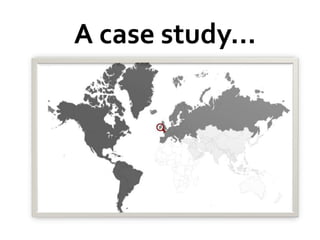
A case study…
Profile


Largest dept of education in southern hemisphere
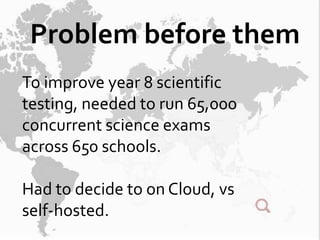
Problem before them
To improve year 8 scientific
testing, needed to run 65,000
concurrent science exams
across 650 schools.

Had to decide to on Cloud, vs
self-hosted.
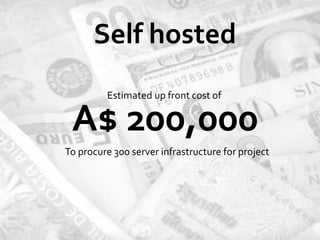
Self hosted
         Estimated up front cost of

 A$ 200,000
To procure 300 server infrastructure for project
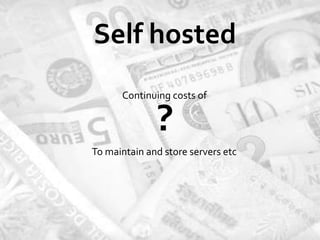
Self hosted
      Continuing costs of

              ?
To maintain and store servers etc
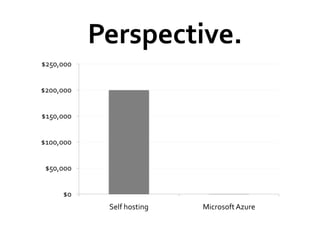
Perspective.
$250,000


$200,000


$150,000


$100,000


 $50,000


     $0
            Self hosting   Microsoft Azure
A case study…
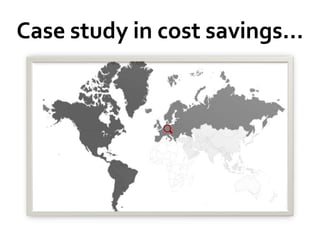
Case study in cost savings…
Profile


Major supplier of data warehousing for hospitals…
Problem they solve

Warehousing data for hospitals is
expensive, time consuming and
fragmented across all the hospitals.
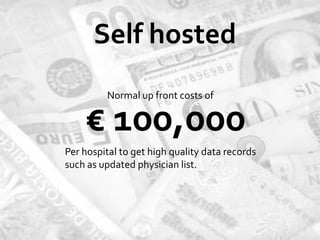
Self hosted
         Normal up front costs of

    € 100,000
Per hospital to get high quality data records
such as updated physician list.
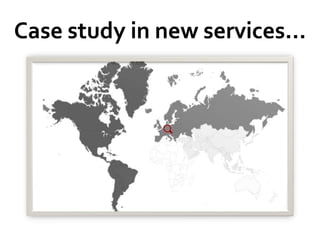
Case study in new services…
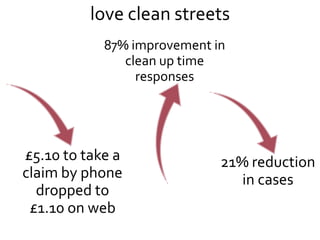
Love Clean Streets


http://www.lewisham.gov.uk/doitonline/Pages/Report-it.aspx
love clean streets
            87% improvement in
               clean up time
                 responses


£5.10 to take a              21% reduction
claim by phone                  in cases
  dropped to
 £1.10 on web
   So what’s the path to the cloud?
http://www.azure.com
Most of the artwork used in this presentation is licensed under
Creative Commons by Frits Ahlefeldt, aka hikingartist
 Support his amazing craft at http://hikingartist.com
josh.holmes@microsoft.com
http://www.joshholmes.com

Cloud becomingreality

  • 1.
  • 9.
    Allocated Load IT-capacities Forecast “Under-supply“ of capacities “Waste“ of Fixed cost of IT CAPACITY capacities IT-capacities Barrier for innovations Actual Load TIME
  • 10.
    Load Allocated IT Forecast capacities No “under-supply“ IT CAPACITY Reduction of Possible “over-supply“ reduction of IT-capacities in case of Reduction reduced load of initial investments Actual Load Time
  • 11.
    Compute Compute Inactivity Period Average Usage Average Usage Time Time On & off workloads (e.g. batch job) Successful services needs to grow/scale Over provisioned capacity is wasted Keeping up w/ growth is big IT challenge Time to market can be cumbersome Cannot provision hardware fast enough Compute Compute Average Usage Average Usage Time Time Unexpected/unplanned peak in demand Services with micro seasonality trends Sudden spike impacts performance Peaks due to periodic increased demand Can’t over provision for extreme cases IT complexity and wasted capacity
  • 13.
    Packaged Infrastructure Platform Software (as a Service) (as a Service) Software (as a Service) Applications Applications Applications Applications You manage Data You manage Data Data Data Runtime Runtime Runtime Runtime Managed by vendor Middleware Middleware Middleware Middleware Managed by vendor You manage O/S O/S O/S O/S Managed by vendor Virtualization Virtualization Virtualization Virtualization Servers Servers Servers Servers Storage Storage Storage Storage Networking Networking Networking Networking
  • 18.
  • 19.
    Profile Largest dept ofeducation in southern hemisphere
  • 20.
    Problem before them Toimprove year 8 scientific testing, needed to run 65,000 concurrent science exams across 650 schools. Had to decide to on Cloud, vs self-hosted.
  • 21.
    Self hosted Estimated up front cost of A$ 200,000 To procure 300 server infrastructure for project
  • 22.
    Self hosted Continuing costs of ? To maintain and store servers etc
  • 28.
  • 30.
  • 37.
    Case study incost savings…
  • 38.
    Profile Major supplier ofdata warehousing for hospitals…
  • 39.
    Problem they solve Warehousingdata for hospitals is expensive, time consuming and fragmented across all the hospitals.
  • 40.
    Self hosted Normal up front costs of € 100,000 Per hospital to get high quality data records such as updated physician list.
  • 46.
    Case study innew services…
  • 47.
  • 48.
    love clean streets 87% improvement in clean up time responses £5.10 to take a 21% reduction claim by phone in cases dropped to £1.10 on web
  • 50.
    So what’s the path to the cloud?
  • 55.
  • 60.
    Most of theartwork used in this presentation is licensed under Creative Commons by Frits Ahlefeldt, aka hikingartist Support his amazing craft at http://hikingartist.com
  • 62.

Editor's Notes

  • #5 http://www.flickr.com/photos/hikingartist/5612418937/sizes/l/in/photostream/
  • #6 I’m here to share my vision with you about the future of IT and really of Ireland itself.
  • #8 http://www.flickr.com/photos/hikingartist/4192572927/sizes/z/in/photostream/There are those that look at the cloud as a lemming type buzz word drinking game.
  • #9 http://www.flickr.com/photos/hikingartist/4192572579/sizes/l/in/photostream/Cloud
  • #10 To build an application or solution in a legacy world, you have to think about network, OS, storage, and scale. But they have little to do with what you really want to build, an application.But what if there were a different way.
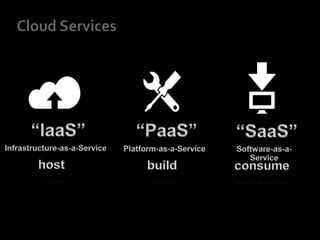
  • #13 Slide Objectives:Explain the three established terms in the industry for cloud servicesSpeaking Points:With this in mind, it’s important to understand how to talk about our Cloud Services offerings.There is a lot of confusion in the industry when it comes to the cloud. It’s important that you understand both what is happening in the industry and how we think about the cloud. This is the most commonly used taxonomy for differentiating between types of cloud services.The industry has defined three categories of services:IaaS – a set of infrastructure level capabilities such as an operating system, network connectivity, etc. that are delivered as pay for use services and can be used to host applications. PaaS – higher level sets of functionality that are delivered as consumable services for developers who are building applications. PaaS is about abstracting developers from the underlying infrastructure to enable applications to quickly be composed. SaaS – applications that are delivered using a service delivery model where organizations can simply consume and use the application. Typically an organization would pay for the use of the application or the application could be monetized through ad revenue. It is important to note that these 3 types of services may exist independently of one another or combined with one another. SaaS offerings needn’t be developed upon PaaS offerings although solutions built on PaaS offerings are often delivered as SaaS. PaaS offerings also needn’t expose IaaS and there’s more to PaaS than just running platforms on IaaS.
  • #14 Slide Objectives:Explain the differences and relationship between IaaS, PaaS, and SaaS in more detail.Speaking Points:Here’s another way to look at the cloud services taxonomy and how this taxonomy maps to the components in an IT infrastructure. Packaged SoftwareWith packaged software a customer would be responsible for managing the entire stack – ranging from the network connectivity to the applications. IaaSWith Infrastructure as a Service, the lower levels of the stack are managed by a vendor. Some of these components can be provided by traditional hosters – in fact most of them have moved to having a virtualized offering. Very few actually provide an OSThe customer is still responsible for managing the OS through the Applications. For the developer, an obvious benefit with IaaS is that it frees the developer from many concerns when provisioning physical or virtual machines. This was one of the earliest and primary use cases for Amazon Web Services Elastic Cloud Compute (EC2). Developers were able to readily provision virtual machines (AMIs) on EC2, develop and test solutions and, often, run the results ‘in production’. The only requirement was a credit card to pay for the services.PaaSWith Platform as a Service, everything from the network connectivity through the runtime is provided and managed by the platform vendor. The Windows Azure Platform best fits in this category today. In fact because we don’t provide access to the underlying virtualization or operating system today, we’re often referred to as not providing IaaS.PaaS offerings further reduce the developer burden by additionally supporting the platform runtime and related application services. With PaaS, the developer can, almost immediately, begin creating the business logic for an application. Potentially, the increases in productivity are considerable and, because the hardware and operational aspects of the cloud platform are also managed by the cloud platform provider, applications can quickly be taken from an idea to reality very quickly.SaaSFinally, with SaaS, a vendor provides the application and abstracts you from all of the underlying components.
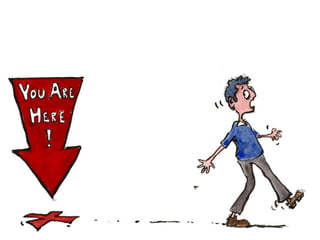
  • #15 http://www.flickr.com/photos/hikingartist/5557164256/sizes/l/in/photostream/Let’s start with a quick discussion about where we’re at right now. Lots to add here…
  • #16 There’s two reasons to move to the cloud – improve ROI on things that you were going to do anyway or improve your strategy and thereby lowering barriers to innovation.
  • #18 http://www.flickr.com/photos/hikingartist/5612418421/sizes/l/in/photostream/The second reason is to improve your strategy.
  • #19 http://www.flickr.com/photos/hikingartist/3010375078/sizes/o/in/photostream/
  • #25 You could probably leave that as a question mark. Everyone knows it’s expensive to leave servers in a room running and shutting them down is waving good by to cash.
  • #26 Depending on your presentation style I’d consider teeing the crowd up here. The last bullet point leaves the crowd in mystery.
  • #27 You could say 80,000 would be a 40% saving on the original cost.
  • #28 A 25% saving on the original cost?
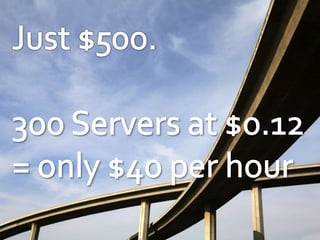
  • #29 1/200th of the original cost? No way.
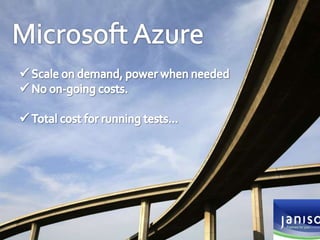
  • #30 This is not a joke. Moving to Microsoft Azure reduced the cost of running the test to practically nothing. (A good quip here would be to say that $500 wouldn’t even cover the power strips needed to keep the servers running)
  • #31 This is a deliberately bad chart, in that Azure can’t be seen. That will help hammer the point home that if you’re not using cloud, you’re basically not at the races.
  • #32 http://www.flickr.com/photos/hikingartist/5612417649/sizes/l/in/photostream/
  • #48 http://www.flickr.com/photos/hikingartist/3554540449/sizes/o/in/photostream/
  • #50 http://www.microsoft.com/casestudies/Windows-Azure/London-Borough-of-Lewisham-LoveCleanStreets/Council-Uses-Cloud-Technology-to-Reduce-Costs-and-Increase-Savings-by-150-000-a-Year/4000011112
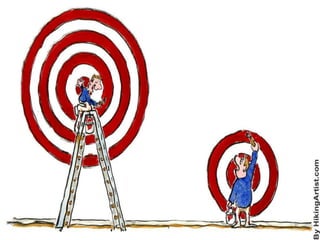
  • #52 http://www.flickr.com/photos/hikingartist/4789352849/sizes/l/in/photostream/There’s a real issue that we are not setting out targets correctly. And we need to be aiming high enough and big enough to make a difference…
  • #53 http://www.flickr.com/photos/hikingartist/4581405185/sizes/z/in/photostream/So what’s the path to the cloud?
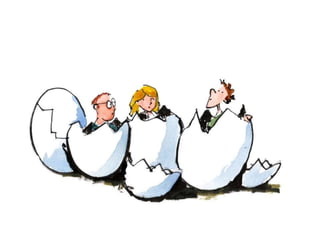
  • #54 http://hikingartist.com/animals_g58-Hatching_type_p117.htmlThere are three things that I want to talk about… Demand SideSupply SideInfrastructure
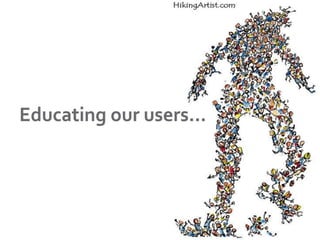
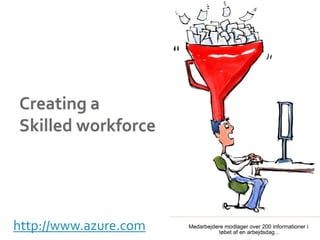
  • #58 http://www.flickr.com/photos/hikingartist/5612999850/sizes/l/in/photostream/Obviously part of it starts with the education system and there is a tremendous amount of knowledge to assume. But we also need to upskill our current workforce.
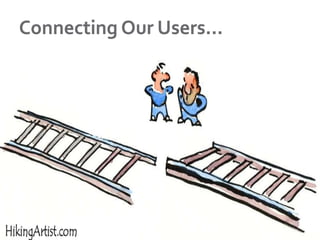
  • #61 http://www.flickr.com/photos/hikingartist/4193331630/sizes/l/in/photostream/If we can’t connect to our users, then the strategy is a non-starter…Ensuring the continued investment in broadband and international internet connectivity to ensure sufficient capacity exists to support the growth of the Cloud industry
  • #62 http://www.flickr.com/photos/hikingartist/5612419607/sizes/l/in/photostream/Now that I’ve shared my vision with you, I want for you to
  • #63 Before I finish, I need to say a quick thank you to Fritz Ahlefeldt. He’s a Danish artist with obvious talent. He publishes a large amount of his work under creative commons. If you like this art, you can see much more at http://www.hikingartist.com and support him and his amazing craft.