Optimizing Sterile Processing Workflow A Roadmap to Success Source:  HealthCare Purchasing News, Nov 2006: A Roadmap to Optimizing Sterile Processing Workflow , Dan Johnson, SterilTek Inc.
Trends Pressuring Sterile Processing Departments Higher surgical volumes Overburdened process capacities Inadequate instrumentation availability Reduced or under-skilled staff Viable sterile process outsourcing alternatives
New View of SPDs as Factories Lean Process Concentrates improvement effort on workflow (value stream) Identifies waste Eliminates waste Eliminates process variability
Processing Circular flow Increasingly efforts are being directed toward improving the circular flow of reprocessing work from the O.R. through the SPD and back, with the goal to: Produce more quality Produce higher quality Improve process efficiency Work with same resources
Workflow Optimization Developing processing to promote rational, logical and efficient workflow In a hospital SPD, you must determine: What is of value to customers How to deliver more value to them How to accomplish more with available resources How to satisfy the supply needs of the O.R.
Why Does Workflow Matter? Eliminates non-productive, repetitive tasks Cultivates an environment that seeks to improve efficiency Strengthens customer relationships Reengineers processes to be leaner and more productive Positions SPDs for growth
The Costs of Inefficiency Ineffective and inefficient workflows often go unexamined, unmeasured and unmanaged. Poor workflow compromises: Effectiveness of the operation Level of customer service Many areas of the healthcare facility SPD staff OR staff Technologies
Efficient SPD Workflow Incorporates reprocessing operation and related systems Automates when possible Eliminates redundancy Eliminates process variability Reduces errors Increases speed Improves quality
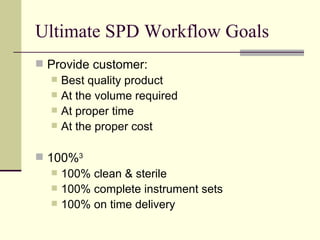
Ultimate SPD Workflow Goals Provide customer:  Best quality product At the volume required At proper time At the proper cost 100% 3 100% clean & sterile 100% complete instrument sets 100% on time delivery
Characteristics of Optimal Workflows Compatible with current systems and they streamline existing methods Applicable across similar functional departments Consistent
What Managers Should Know To ensure process improvement success: Take Action Gather information Analyze it Determine action steps Implement them Then, do it again
“ Now and better is better than perfect and never” –unknown “ Just do it.” –Taiichi Ohno, former vice president of Toyota Motor Corporation
What Managers Should Know Actively involve employees and customers Staff understands pitfalls and makeshift operations Staff is available, valuable, and willing creative resource Customers will be happy to help you improve product and service level Customers can identify potential change impact Customers also creative resource
What Managers Should Know Be prepared for resistance Change is hard work in an organization People have a natural reluctance to change Change challenges comfort zones Proposed change is threatening
“ It must be considered that there is nothing more difficult to carry out, not more doubtful of success, nor more dangerous to handle than to initiate a new order of things.” ---Niccolo Machiavelli
What Managers Should Know Leading Change Show dedication to the improvement process Leading change is not a part-time job Change requires daily attention Don’t get caught up in daily distractions Engage the services of a knowledgeable change agent Facilitate improvement process Plan and lead improvement activities Demonstrate and teach effective techniques
Another Day in CS!
Step 1:  Mapping your Central Sterile    Workflow Optimizing the sterile processing functions first begins with a process flow and map. Visual representation of the reprocessing cycle Focuses initially on the primary process steps Dives deeper into the process to uncover process layers of complexity
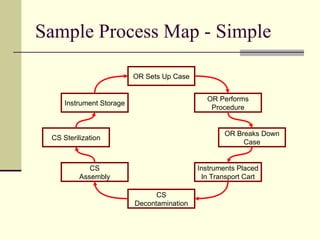
Sample Process Map - Simple OR Sets Up Case Instruments Placed In Transport Cart CS Decontamination CS Assembly Instrument Storage OR Performs Procedure OR Breaks Down Case CS Sterilization
Value Added Activities Process maps help in identifying value-added activities within the process Characteristics of Value Added Activities Customer is willing to pay for Physically improve the fit, form, or function of an item Performed correctly the first time
Non-Value Added Activities Non-value added activities = Waste Characteristics of Non-Value Added Activities Take time, resources, or space but do not add value to the product Rework at any point in the process Searching or waiting for instruments or supplies Waiting on machine cycles Double handling
Constraints / Bottlenecks Process mapping also assists in identifying process constraints or “bottlenecks” Process Constraint = Area where demand is greater than the current ability to supply More on this later!
Step 2: Improving Functions and   Workflow Optimizing Workflow Streamline Identify Waste Work Process Simplification Capacity Line Balancing
Streamline Eliminating and minimizing non-value added steps in the process Quick hits to produce quick results Not all non-value added can or should be eliminated
Identify Waste Labor Waste Quality inspections after the set is complete versus IT solutions and certification to ensure proper set preparation the first time Time spent looking for an item that should be readily available Improperly staffed SPD or other reprocessing areas
Identify Waste Overproduction Excessive stat washes or flash sterilization in the OR when instrument set is not used for an immediate procedure Space Non-linear workflow from requiring storage racks and transportation routes Excessive movements, poor ergonomics Non-reprocessing supplies stored in reprocessing work areas
Identify Waste Defects Sets put up with missing instruments, extra instruments, or wrong instruments Improper Count Sheets or documentation Instruments not returned to decontamination in their original container/tray Sets returned with instruments missing
Identify Waste Time Work schedules that do not align with workload requirements (too many technicians too early in the day as an example) Assembly staff waiting for instruments from decontamination Instruments arriving from the OR with extra items, missing items, or non-instrument items that slow down decontamination process
Work Process Simplification Deep dive into detailed process steps Increase process utilization and capacity Develop smooth flow of materials, work and communication Eliminate Unnecessary work Rework Fatiguing motions Long transports and complicated paperwork
Work Process Simplification Prioritize Select activity that benefits the entire process Select activity that a lot of time is currently spent on - greater benefit than smaller tasks Select activities that currently require a lot of chasing or looking for items, hard work, inspections, or non-desirable work conditions
Work Process Simplification Prioritize – Instrument Assembly example Provide all needed materials within the technician’s reach Eliminate unnecessary materials from instrument sets Remove unneeded instruments from set to reduce the set size and simply the assembly Provide accurate count sheets, IT solutions, or pictures to assist in the assembly process
Work Process Simplification Steps Keep an open mind and no work process can be taken for granted – question everything! 1. Select the job or function to be improved 2. Process chart the job in detail All operational steps Transportations Inspections Storage Delays Time and Distance
Work Process Simplification Steps Sample Instrument Assembly Process Chart
Work Process Simplification Steps 3. Question each detail 4. Develop a new method Reduce the number of steps Arrange the steps in the best order Make the steps as efficient as possible Reduce handling Combine steps Shorten moves Provide the most economical method
Work Process Simplification Steps 5. Implement the new process 6. Review, measure, and repeat
Work Process Simplification Steps Sample Instrument Assembly Are instruments brought to the assembler? Are extra instruments readily available to replace missing? Are all needed materials within reach? Is the walking and transporting minimized? Can sets assembled per hour be increased? Can time to assemble each set be decreased? Are clear procedures available to handle non-conforming situations?
Work Process Simplification Steps Streamlined and Simplified in Assembly
Work Process Simplification Steps Streamlined and Simplified in Decontamination
Capacity Line Balancing Capacity: The amount of work a person, equipment, or process is  capable  or producing during a given amount of time Capacity Requirement: The amount of work a person, equipment, or process is  required  to produce during a given amount of time Capacity Line Balancing:  Matching  the capacity of each operation within a process to the requirements of the next
Capacity Line Balancing Optimize the capacity of the entire process! First, perform a Capacity Analysis Determine customer workload – often considered OR soiled instruments entering decontamination Establish the arrival pattern or timing of workload Utilize cycle times and work standards Determine needed resources to provide the required capacity to handle the workload
Capacity Analysis Instrument Washers Assembly Sterilizers
Capacity Line Balancing Second, balance the capacity Identify the capacity restraint or “bottleneck” Ensure that the bottleneck operation is properly scheduled and staffed to handle the reprocessing workload that is coming into it Ensure that the operation and it’s equipment is functioning at it’s peak performance Acquire additional pieces of equipment or staff to meet demand
Capacity Line Balancing A typical balanced reprocessing cycle A typical non-balanced reprocessing cycle Washers Sterilizers Assembly OR 65 Items 64 Items 60 Items 73 Items 2005 Upgraded Process Items/Hour Washers Sterilizers Assembly OR 65 Items 56 Items 38 Items 73 Items 2005 Upgraded Process Items/Hour
Step 3: Workstation and Operations   Sequence Layout Linear flow for operational efficiencies but also necessary to separate soiled, clean, and sterile items All necessary and frequently used items are available within arm’s reach Properly designed seating, fatigue mats, and ergonomically workstations
Step 4: Standardize Work Practices Determine best practice and standardize to it Involve the people doing the work Document practice in procedures and work instructions Train, train, and train Follow-up to ensure compliance Encourage continuous improvement and change
Step 5: Scheduling Process Ensure the sequence of CS operations are logical and easily understood Schedule people, equipment, and processes to ensure smooth flow without interruptions or delays Schedule to support the capacity line balancing except for the “push” of decontamination
Step 5: Scheduling Process Push: Decontamination should “push” instrumentation as quickly as possible to assembly without regard to capacity balancing “Push” ensures instruments are quickly cleaned and identified as being in CS Pull: Assembly and sterilization can then “pull” the instrumentation through according to capacity restraints and customer requirements
Step 6: Measuring Process   Performance Measure what you value Differentiate between perception and reality Measure based on facts Identifies process issues and bottlenecks Evaluates customer satisfaction level Provide a baseline to monitor improvement
Measuring Process Performance Two purposes for developing consistent metrics and measurements within CS Ensure performance meets expectations while driving accountability To measure the impact of any improvement while driving additional improvement efforts
Measuring Process Performance All measurements require a “goal” Sustainable goals reflect current process performance such as hitting your budget Stretch goals focus people on changing the process rather than tweaking the existing one
Measuring Process Performance “We can’t change what we don’t measure.” “Don’t measure what you won’t change.” Focus your measurements on what you value and what you want to improve.
Measuring Process Performance Track, post, discuss, and take action based on the performance factors being measured Timeliness of measurement and feedback is of utmost importance Employees should have a clear understanding of what the customer and management expects of them for every task they perform – both quality and productivity
Measuring Process Performance Key CS measurements Quality: Defects per total items produced Customer Experience: Positive experiences per total experiences CS Labor Hours per Procedure Productivity Skill mix and competency
Step 7: Active Management /   Supervisory Techniques Communication Continuous cycle Effective assignment giving and follow-up Regular interaction to ensure processes are being followed Leads to problem identification and resolution Nothing in the process or work practices should be taken for granted
Active Management / Supervisory Techniques Problem Resolution and Documentation “If it isn’t written – it isn’t done.” Use an Action Item tool or at least a simple To-Do list.
Summary It Doesn’t Take A Crisis – But It Helps… Change is usually a response to negative circumstances – but this doesn’t have to be the reason Start today by mapping and understanding your process and identifying your first opportunity for improvement

Optimizing Sterile Processing Workflow

  • 1.
    Optimizing Sterile ProcessingWorkflow A Roadmap to Success Source: HealthCare Purchasing News, Nov 2006: A Roadmap to Optimizing Sterile Processing Workflow , Dan Johnson, SterilTek Inc.
  • 2.
    Trends Pressuring SterileProcessing Departments Higher surgical volumes Overburdened process capacities Inadequate instrumentation availability Reduced or under-skilled staff Viable sterile process outsourcing alternatives
  • 3.
    New View ofSPDs as Factories Lean Process Concentrates improvement effort on workflow (value stream) Identifies waste Eliminates waste Eliminates process variability
  • 4.
    Processing Circular flowIncreasingly efforts are being directed toward improving the circular flow of reprocessing work from the O.R. through the SPD and back, with the goal to: Produce more quality Produce higher quality Improve process efficiency Work with same resources
  • 5.
    Workflow Optimization Developingprocessing to promote rational, logical and efficient workflow In a hospital SPD, you must determine: What is of value to customers How to deliver more value to them How to accomplish more with available resources How to satisfy the supply needs of the O.R.
  • 6.
    Why Does WorkflowMatter? Eliminates non-productive, repetitive tasks Cultivates an environment that seeks to improve efficiency Strengthens customer relationships Reengineers processes to be leaner and more productive Positions SPDs for growth
  • 7.
    The Costs ofInefficiency Ineffective and inefficient workflows often go unexamined, unmeasured and unmanaged. Poor workflow compromises: Effectiveness of the operation Level of customer service Many areas of the healthcare facility SPD staff OR staff Technologies
  • 8.
    Efficient SPD WorkflowIncorporates reprocessing operation and related systems Automates when possible Eliminates redundancy Eliminates process variability Reduces errors Increases speed Improves quality
  • 9.
    Ultimate SPD WorkflowGoals Provide customer: Best quality product At the volume required At proper time At the proper cost 100% 3 100% clean & sterile 100% complete instrument sets 100% on time delivery
  • 10.
    Characteristics of OptimalWorkflows Compatible with current systems and they streamline existing methods Applicable across similar functional departments Consistent
  • 11.
    What Managers ShouldKnow To ensure process improvement success: Take Action Gather information Analyze it Determine action steps Implement them Then, do it again
  • 12.
    “ Now andbetter is better than perfect and never” –unknown “ Just do it.” –Taiichi Ohno, former vice president of Toyota Motor Corporation
  • 13.
    What Managers ShouldKnow Actively involve employees and customers Staff understands pitfalls and makeshift operations Staff is available, valuable, and willing creative resource Customers will be happy to help you improve product and service level Customers can identify potential change impact Customers also creative resource
  • 14.
    What Managers ShouldKnow Be prepared for resistance Change is hard work in an organization People have a natural reluctance to change Change challenges comfort zones Proposed change is threatening
  • 15.
    “ It mustbe considered that there is nothing more difficult to carry out, not more doubtful of success, nor more dangerous to handle than to initiate a new order of things.” ---Niccolo Machiavelli
  • 16.
    What Managers ShouldKnow Leading Change Show dedication to the improvement process Leading change is not a part-time job Change requires daily attention Don’t get caught up in daily distractions Engage the services of a knowledgeable change agent Facilitate improvement process Plan and lead improvement activities Demonstrate and teach effective techniques
  • 17.
  • 18.
    Step 1: Mapping your Central Sterile Workflow Optimizing the sterile processing functions first begins with a process flow and map. Visual representation of the reprocessing cycle Focuses initially on the primary process steps Dives deeper into the process to uncover process layers of complexity
  • 19.
    Sample Process Map- Simple OR Sets Up Case Instruments Placed In Transport Cart CS Decontamination CS Assembly Instrument Storage OR Performs Procedure OR Breaks Down Case CS Sterilization
  • 20.
    Value Added ActivitiesProcess maps help in identifying value-added activities within the process Characteristics of Value Added Activities Customer is willing to pay for Physically improve the fit, form, or function of an item Performed correctly the first time
  • 21.
    Non-Value Added ActivitiesNon-value added activities = Waste Characteristics of Non-Value Added Activities Take time, resources, or space but do not add value to the product Rework at any point in the process Searching or waiting for instruments or supplies Waiting on machine cycles Double handling
  • 22.
    Constraints / BottlenecksProcess mapping also assists in identifying process constraints or “bottlenecks” Process Constraint = Area where demand is greater than the current ability to supply More on this later!
  • 23.
    Step 2: ImprovingFunctions and Workflow Optimizing Workflow Streamline Identify Waste Work Process Simplification Capacity Line Balancing
  • 24.
    Streamline Eliminating andminimizing non-value added steps in the process Quick hits to produce quick results Not all non-value added can or should be eliminated
  • 25.
    Identify Waste LaborWaste Quality inspections after the set is complete versus IT solutions and certification to ensure proper set preparation the first time Time spent looking for an item that should be readily available Improperly staffed SPD or other reprocessing areas
  • 26.
    Identify Waste OverproductionExcessive stat washes or flash sterilization in the OR when instrument set is not used for an immediate procedure Space Non-linear workflow from requiring storage racks and transportation routes Excessive movements, poor ergonomics Non-reprocessing supplies stored in reprocessing work areas
  • 27.
    Identify Waste DefectsSets put up with missing instruments, extra instruments, or wrong instruments Improper Count Sheets or documentation Instruments not returned to decontamination in their original container/tray Sets returned with instruments missing
  • 28.
    Identify Waste TimeWork schedules that do not align with workload requirements (too many technicians too early in the day as an example) Assembly staff waiting for instruments from decontamination Instruments arriving from the OR with extra items, missing items, or non-instrument items that slow down decontamination process
  • 29.
    Work Process SimplificationDeep dive into detailed process steps Increase process utilization and capacity Develop smooth flow of materials, work and communication Eliminate Unnecessary work Rework Fatiguing motions Long transports and complicated paperwork
  • 30.
    Work Process SimplificationPrioritize Select activity that benefits the entire process Select activity that a lot of time is currently spent on - greater benefit than smaller tasks Select activities that currently require a lot of chasing or looking for items, hard work, inspections, or non-desirable work conditions
  • 31.
    Work Process SimplificationPrioritize – Instrument Assembly example Provide all needed materials within the technician’s reach Eliminate unnecessary materials from instrument sets Remove unneeded instruments from set to reduce the set size and simply the assembly Provide accurate count sheets, IT solutions, or pictures to assist in the assembly process
  • 32.
    Work Process SimplificationSteps Keep an open mind and no work process can be taken for granted – question everything! 1. Select the job or function to be improved 2. Process chart the job in detail All operational steps Transportations Inspections Storage Delays Time and Distance
  • 33.
    Work Process SimplificationSteps Sample Instrument Assembly Process Chart
  • 34.
    Work Process SimplificationSteps 3. Question each detail 4. Develop a new method Reduce the number of steps Arrange the steps in the best order Make the steps as efficient as possible Reduce handling Combine steps Shorten moves Provide the most economical method
  • 35.
    Work Process SimplificationSteps 5. Implement the new process 6. Review, measure, and repeat
  • 36.
    Work Process SimplificationSteps Sample Instrument Assembly Are instruments brought to the assembler? Are extra instruments readily available to replace missing? Are all needed materials within reach? Is the walking and transporting minimized? Can sets assembled per hour be increased? Can time to assemble each set be decreased? Are clear procedures available to handle non-conforming situations?
  • 37.
    Work Process SimplificationSteps Streamlined and Simplified in Assembly
  • 38.
    Work Process SimplificationSteps Streamlined and Simplified in Decontamination
  • 39.
    Capacity Line BalancingCapacity: The amount of work a person, equipment, or process is capable or producing during a given amount of time Capacity Requirement: The amount of work a person, equipment, or process is required to produce during a given amount of time Capacity Line Balancing: Matching the capacity of each operation within a process to the requirements of the next
  • 40.
    Capacity Line BalancingOptimize the capacity of the entire process! First, perform a Capacity Analysis Determine customer workload – often considered OR soiled instruments entering decontamination Establish the arrival pattern or timing of workload Utilize cycle times and work standards Determine needed resources to provide the required capacity to handle the workload
  • 41.
    Capacity Analysis InstrumentWashers Assembly Sterilizers
  • 42.
    Capacity Line BalancingSecond, balance the capacity Identify the capacity restraint or “bottleneck” Ensure that the bottleneck operation is properly scheduled and staffed to handle the reprocessing workload that is coming into it Ensure that the operation and it’s equipment is functioning at it’s peak performance Acquire additional pieces of equipment or staff to meet demand
  • 43.
    Capacity Line BalancingA typical balanced reprocessing cycle A typical non-balanced reprocessing cycle Washers Sterilizers Assembly OR 65 Items 64 Items 60 Items 73 Items 2005 Upgraded Process Items/Hour Washers Sterilizers Assembly OR 65 Items 56 Items 38 Items 73 Items 2005 Upgraded Process Items/Hour
  • 44.
    Step 3: Workstationand Operations Sequence Layout Linear flow for operational efficiencies but also necessary to separate soiled, clean, and sterile items All necessary and frequently used items are available within arm’s reach Properly designed seating, fatigue mats, and ergonomically workstations
  • 45.
    Step 4: StandardizeWork Practices Determine best practice and standardize to it Involve the people doing the work Document practice in procedures and work instructions Train, train, and train Follow-up to ensure compliance Encourage continuous improvement and change
  • 46.
    Step 5: SchedulingProcess Ensure the sequence of CS operations are logical and easily understood Schedule people, equipment, and processes to ensure smooth flow without interruptions or delays Schedule to support the capacity line balancing except for the “push” of decontamination
  • 47.
    Step 5: SchedulingProcess Push: Decontamination should “push” instrumentation as quickly as possible to assembly without regard to capacity balancing “Push” ensures instruments are quickly cleaned and identified as being in CS Pull: Assembly and sterilization can then “pull” the instrumentation through according to capacity restraints and customer requirements
  • 48.
    Step 6: MeasuringProcess Performance Measure what you value Differentiate between perception and reality Measure based on facts Identifies process issues and bottlenecks Evaluates customer satisfaction level Provide a baseline to monitor improvement
  • 49.
    Measuring Process PerformanceTwo purposes for developing consistent metrics and measurements within CS Ensure performance meets expectations while driving accountability To measure the impact of any improvement while driving additional improvement efforts
  • 50.
    Measuring Process PerformanceAll measurements require a “goal” Sustainable goals reflect current process performance such as hitting your budget Stretch goals focus people on changing the process rather than tweaking the existing one
  • 51.
    Measuring Process Performance“We can’t change what we don’t measure.” “Don’t measure what you won’t change.” Focus your measurements on what you value and what you want to improve.
  • 52.
    Measuring Process PerformanceTrack, post, discuss, and take action based on the performance factors being measured Timeliness of measurement and feedback is of utmost importance Employees should have a clear understanding of what the customer and management expects of them for every task they perform – both quality and productivity
  • 53.
    Measuring Process PerformanceKey CS measurements Quality: Defects per total items produced Customer Experience: Positive experiences per total experiences CS Labor Hours per Procedure Productivity Skill mix and competency
  • 54.
    Step 7: ActiveManagement / Supervisory Techniques Communication Continuous cycle Effective assignment giving and follow-up Regular interaction to ensure processes are being followed Leads to problem identification and resolution Nothing in the process or work practices should be taken for granted
  • 55.
    Active Management /Supervisory Techniques Problem Resolution and Documentation “If it isn’t written – it isn’t done.” Use an Action Item tool or at least a simple To-Do list.
  • 56.
    Summary It Doesn’tTake A Crisis – But It Helps… Change is usually a response to negative circumstances – but this doesn’t have to be the reason Start today by mapping and understanding your process and identifying your first opportunity for improvement