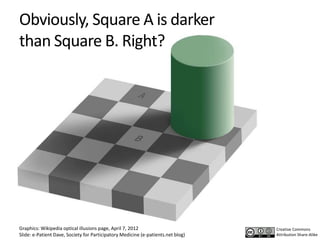
Obviously, Square A is darker
than Square B. Right?


Graphics: Wikipedia optical illusions page, April 7, 2012                         Creative Commons
Slide: e-Patient Dave, Society for Participatory Medicine (e-patients.net blog)   Attribution Share-Alike
Obviously, Square A is darker
than Square B. Right?


Graphics: Wikipedia optical illusions page, April 7, 2012                         Creative Commons
Slide: e-Patient Dave, Society for Participatory Medicine (e-patients.net blog)   Attribution Share-Alike
Obviously, the top circle’s darker,
and it’s in a darker square. Right?


Graphics: Wikipedia optical illusions page, April 7, 2012                         Creative Commons
Slide: e-Patient Dave, Society for Participatory Medicine (e-patients.net blog)   Attribution Share-Alike
Obviously, the top circle’s darker,
and it’s in a darker square. Right?


Graphics: Wikipedia optical illusions page, April 7, 2012                         Creative Commons
Slide: e-Patient Dave, Society for Participatory Medicine (e-patients.net blog)   Attribution Share-Alike
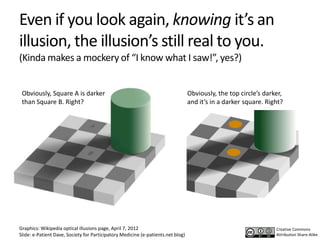
Even if you look again, knowing it’s an
illusion, the illusion’s still real to you.
(Kinda makes a mockery of “I know what I saw!”, yes?)


 Obviously, Square A is darker                                                    Obviously, the top circle’s darker,
 than Square B. Right?                                                            and it’s in a darker square. Right?


Graphics: Wikipedia optical illusions page, April 7, 2012                                                         Creative Commons
Slide: e-Patient Dave, Society for Participatory Medicine (e-patients.net blog)                                   Attribution Share-Alike
Decades of research
           have shown that
       the same thing happens
   with many options we’re shown,
           not just optical.


Graphics: Wikipedia optical illusions page, April 7, 2012                         Creative Commons
Slide: e-Patient Dave, Society for Participatory Medicine (e-patients.net blog)   Attribution Share-Alike
It’s a major challenge for social change,
behavior change, and policy change.

 Obviously, Square A is darker                                                    Obviously, the top circle’s darker,
 than Square B. Right?                                                            and it’s in a darker square. Right?


Graphics: Wikipedia optical illusions page, April 7, 2012                                                         Creative Commons
Slide: e-Patient Dave, Society for Participatory Medicine (e-patients.net blog)                                   Attribution Share-Alike
The books Nudge, Switch,
and Thinking, Fast and Slow
discuss the challenges
of irrational perceptions.

                                                                                                     532 pages, 6”x9.1”


                                                                                  320 pages, 5.5”x8.5”       320 pages, 5.2”x8.5”

Graphics: Wikipedia optical illusions page, April 7, 2012                                                       Creative Commons
Slide: e-Patient Dave, Society for Participatory Medicine (e-patients.net blog)                                 Attribution Share-Alike
The books Nudge, Switch,
and Thinking, Fast and Slow
discuss the challenges
of irrational perceptions.
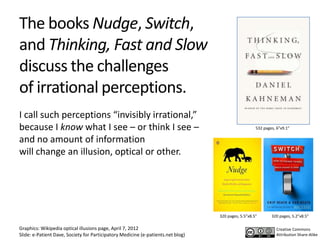
I call such perceptions “invisibly irrational,”
because I know what I see – or think I see –                                                         532 pages, 6”x9.1”

and no amount of information
will change an illusion, optical or other.


                                                                                  320 pages, 5.5”x8.5”       320 pages, 5.2”x8.5”

Graphics: Wikipedia optical illusions page, April 7, 2012                                                       Creative Commons
Slide: e-Patient Dave, Society for Participatory Medicine (e-patients.net blog)                                 Attribution Share-Alike
The books Nudge, Switch,
and Thinking, Fast and Slow
discuss the challenges
of irrational perceptions.
I call such perceptions “invisibly irrational,”
because I know what I see – or think I see –                                                         532 pages, 6”x9.1”

and no amount of information
will change an illusion, optical or other.
We need to understand this about
ourselves and others, realize that certainty
can still be wrong, and help reach good
choices – despite the illusions.
                                                                                  320 pages, 5.5”x8.5”       320 pages, 5.2”x8.5”

Graphics: Wikipedia optical illusions page, April 7, 2012                                                       Creative Commons
Slide: e-Patient Dave, Society for Participatory Medicine (e-patients.net blog)                                 Attribution Share-Alike
Blog of the Society for Participatory Medicine


                                                                                                  ParticipatoryMedicine.org


Graphics: Wikipedia optical illusions page, April 7, 2012                                                      Creative Commons
Slide: e-Patient Dave, Society for Participatory Medicine (e-patients.net blog)                                Attribution Share-Alike

Optical illusion examples

  • 1.
    Obviously, Square Ais darker than Square B. Right? Graphics: Wikipedia optical illusions page, April 7, 2012 Creative Commons Slide: e-Patient Dave, Society for Participatory Medicine (e-patients.net blog) Attribution Share-Alike
  • 2.
    Obviously, Square Ais darker than Square B. Right? Graphics: Wikipedia optical illusions page, April 7, 2012 Creative Commons Slide: e-Patient Dave, Society for Participatory Medicine (e-patients.net blog) Attribution Share-Alike
  • 3.
    Obviously, the topcircle’s darker, and it’s in a darker square. Right? Graphics: Wikipedia optical illusions page, April 7, 2012 Creative Commons Slide: e-Patient Dave, Society for Participatory Medicine (e-patients.net blog) Attribution Share-Alike
  • 4.
    Obviously, the topcircle’s darker, and it’s in a darker square. Right? Graphics: Wikipedia optical illusions page, April 7, 2012 Creative Commons Slide: e-Patient Dave, Society for Participatory Medicine (e-patients.net blog) Attribution Share-Alike
  • 5.
    Even if youlook again, knowing it’s an illusion, the illusion’s still real to you. (Kinda makes a mockery of “I know what I saw!”, yes?) Obviously, Square A is darker Obviously, the top circle’s darker, than Square B. Right? and it’s in a darker square. Right? Graphics: Wikipedia optical illusions page, April 7, 2012 Creative Commons Slide: e-Patient Dave, Society for Participatory Medicine (e-patients.net blog) Attribution Share-Alike
  • 6.
    Decades of research have shown that the same thing happens with many options we’re shown, not just optical. Graphics: Wikipedia optical illusions page, April 7, 2012 Creative Commons Slide: e-Patient Dave, Society for Participatory Medicine (e-patients.net blog) Attribution Share-Alike
  • 7.
    It’s a majorchallenge for social change, behavior change, and policy change. Obviously, Square A is darker Obviously, the top circle’s darker, than Square B. Right? and it’s in a darker square. Right? Graphics: Wikipedia optical illusions page, April 7, 2012 Creative Commons Slide: e-Patient Dave, Society for Participatory Medicine (e-patients.net blog) Attribution Share-Alike
  • 8.
    The books Nudge,Switch, and Thinking, Fast and Slow discuss the challenges of irrational perceptions. 532 pages, 6”x9.1” 320 pages, 5.5”x8.5” 320 pages, 5.2”x8.5” Graphics: Wikipedia optical illusions page, April 7, 2012 Creative Commons Slide: e-Patient Dave, Society for Participatory Medicine (e-patients.net blog) Attribution Share-Alike
  • 9.
    The books Nudge,Switch, and Thinking, Fast and Slow discuss the challenges of irrational perceptions. I call such perceptions “invisibly irrational,” because I know what I see – or think I see – 532 pages, 6”x9.1” and no amount of information will change an illusion, optical or other. 320 pages, 5.5”x8.5” 320 pages, 5.2”x8.5” Graphics: Wikipedia optical illusions page, April 7, 2012 Creative Commons Slide: e-Patient Dave, Society for Participatory Medicine (e-patients.net blog) Attribution Share-Alike
  • 10.
    The books Nudge,Switch, and Thinking, Fast and Slow discuss the challenges of irrational perceptions. I call such perceptions “invisibly irrational,” because I know what I see – or think I see – 532 pages, 6”x9.1” and no amount of information will change an illusion, optical or other. We need to understand this about ourselves and others, realize that certainty can still be wrong, and help reach good choices – despite the illusions. 320 pages, 5.5”x8.5” 320 pages, 5.2”x8.5” Graphics: Wikipedia optical illusions page, April 7, 2012 Creative Commons Slide: e-Patient Dave, Society for Participatory Medicine (e-patients.net blog) Attribution Share-Alike
  • 11.
    Blog of theSociety for Participatory Medicine ParticipatoryMedicine.org Graphics: Wikipedia optical illusions page, April 7, 2012 Creative Commons Slide: e-Patient Dave, Society for Participatory Medicine (e-patients.net blog) Attribution Share-Alike