The New Eye Exam
By: Jane Sun, Shriya Kommaraju, Kaleigh Seitz, and Naomi Ghahrai
What is Visual Acuity?
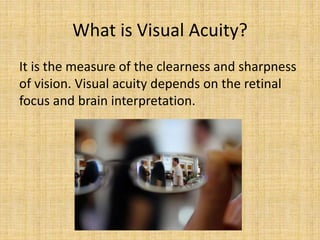
It is the measure of the clearness and sharpness
of vision. Visual acuity depends on the retinal
focus and brain interpretation.
How Visual Acuity is Measured?
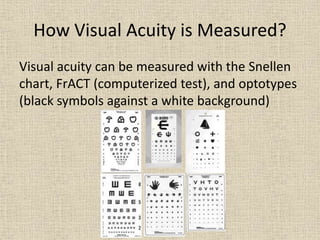
Visual acuity can be measured with the Snellen
chart, FrACT (computerized test), and optotypes
(black symbols against a white background)
Visual Acuity in Real Life
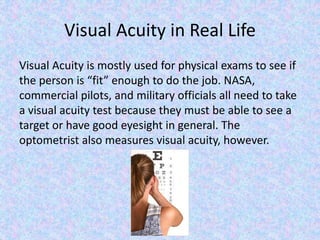
Visual Acuity is mostly used for physical exams to see if
the person is “fit” enough to do the job. NASA,
commercial pilots, and military officials all need to take
a visual acuity test because they must be able to see a
target or have good eyesight in general. The
optometrist also measures visual acuity, however.
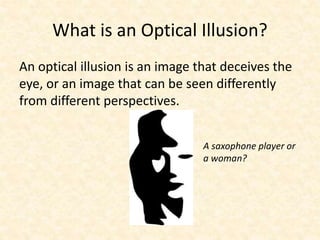
What is an Optical Illusion?
An optical illusion is an image that deceives the
eye, or an image that can be seen differently
from different perspectives.
A saxophone player or
a woman?
Our Optical Illusions
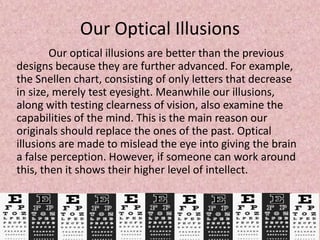
Our optical illusions are better than the previous
designs because they are further advanced. For example,
the Snellen chart, consisting of only letters that decrease
in size, merely test eyesight. Meanwhile our illusions,
along with testing clearness of vision, also examine the
capabilities of the mind. This is the main reason our
originals should replace the ones of the past. Optical
illusions are made to mislead the eye into giving the brain
a false perception. However, if someone can work around
this, then it shows their higher level of intellect.
Benefits to Your Company
Our designs are eligible for visual acuity testing
because they can accurately show whether or not a person
is near-sighted or far-sighted. For instance, when someone
is nearsighted, the person can’t get fooled by the optical
illusion far away, but they can close up. However, if
farsighted, the person doesn’t see the illusion in our designs
close up, but they do see it far away. By calculating the
maximum distance they can see the illusion and the
minimum distance they can’t see the illusion, there will be
more accurate visual acuity test results.
Computerized Designs
Optical Illusion #1 (Computer)
Description
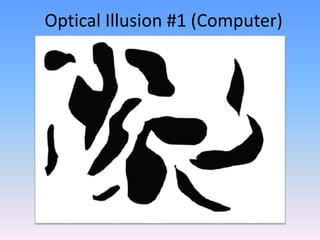
This optical illusion design portrays a
butterfly and, at the same time, falling leaves.
The black and white help emphasize the
highlights and shadows, so that the image will
appear to be a butterfly from a distance.
Because of this, you could use this to tell
farsightedness. However, if nearsighted and
close to the image, the image would appear to
only be of misshapen shapes.
Optical Illusion #2 (Computer)
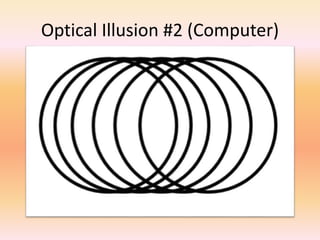
Description
Translation of a circle creates a cylinder of
rings. This creates the illusion of it being three-
dimensional. It appears to be a cylinder to some
people or, to others, it looks almost to be a
pumpkin of sorts.
Optical Illusion #3 (Computer)
Description
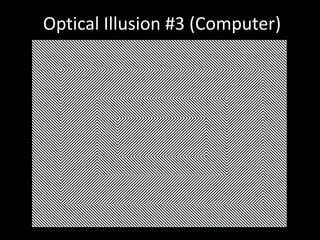
This is of dilation and glide; the rectangles
increase in size, and they also reflect, then slide
into place, as you can tell by the diagonal lines.
This creates a dizzying effect, like the image is
flashing, and all the lines kind of blur together.
From afar, it just looks like a gray screen
but up close, you can clearly see the lines.
Hand-Drawn Designs
Optical Illusion #4 (Drawing)
Description
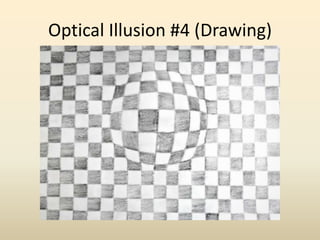
This design uses some translation in the
squares up to the centre. This allows you to see
the change in elevation, making it appear 3-D,
but not obviously drawing out the shape of the
circle. There are two different ways to look at it;
it can appear to either have a depression in the
center, or it can appear to have a bulge.
Optical Illusion #5 (Drawing)
Description
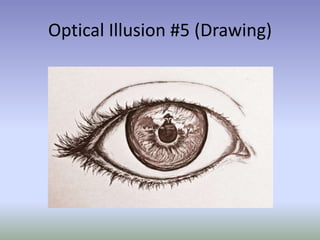
This does not include any tessellations,
symmetry, etc. and the colors do not contribute
to the illusion itself - just to making it seem 3-D.
It is of an eye, and inside that eye, is a scene of
two girls surrounded by forest. If one is far away,
they can only see the eye. But if someone is
close, then they can also see the scene inside
that eye.
Optical Illusion #6 (Drawing)
Description
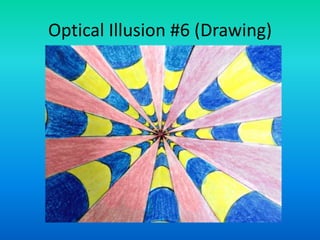
The section of repeated blue and yellow is
rotated around in a circular pattern, but is not
consistent. The repeating colors add to that
sense of it getting smaller and smaller (or bigger
and bigger). When far away, you cannot actually
experience the feeling of it moving
outwards/inwards. But when closer up, you can
get that feeling of being “sucked in”.
As one can conclude, our optical illusions are the best way to
test visual acuity. Our illusions will benefit today’s optometrist. The
designs we created are more complex than the original visual acuity
test; they challenge the eyes, while also testing the limits of the mind.
When someone is tested by our designs, they will get a more accurate
reading of their visual acuity. Our designs should be chosen because it
will advance your company and the people of this world.

The new eye exam (1)

  • 1.
    The New EyeExam By: Jane Sun, Shriya Kommaraju, Kaleigh Seitz, and Naomi Ghahrai
  • 2.
    What is VisualAcuity? It is the measure of the clearness and sharpness of vision. Visual acuity depends on the retinal focus and brain interpretation.
  • 3.
    How Visual Acuityis Measured? Visual acuity can be measured with the Snellen chart, FrACT (computerized test), and optotypes (black symbols against a white background)
  • 4.
    Visual Acuity inReal Life Visual Acuity is mostly used for physical exams to see if the person is “fit” enough to do the job. NASA, commercial pilots, and military officials all need to take a visual acuity test because they must be able to see a target or have good eyesight in general. The optometrist also measures visual acuity, however.
  • 5.
    What is anOptical Illusion? An optical illusion is an image that deceives the eye, or an image that can be seen differently from different perspectives. A saxophone player or a woman?
  • 6.
    Our Optical Illusions Ouroptical illusions are better than the previous designs because they are further advanced. For example, the Snellen chart, consisting of only letters that decrease in size, merely test eyesight. Meanwhile our illusions, along with testing clearness of vision, also examine the capabilities of the mind. This is the main reason our originals should replace the ones of the past. Optical illusions are made to mislead the eye into giving the brain a false perception. However, if someone can work around this, then it shows their higher level of intellect.
  • 7.
    Benefits to YourCompany Our designs are eligible for visual acuity testing because they can accurately show whether or not a person is near-sighted or far-sighted. For instance, when someone is nearsighted, the person can’t get fooled by the optical illusion far away, but they can close up. However, if farsighted, the person doesn’t see the illusion in our designs close up, but they do see it far away. By calculating the maximum distance they can see the illusion and the minimum distance they can’t see the illusion, there will be more accurate visual acuity test results.
  • 8.
  • 9.
  • 10.
    Description This optical illusiondesign portrays a butterfly and, at the same time, falling leaves. The black and white help emphasize the highlights and shadows, so that the image will appear to be a butterfly from a distance. Because of this, you could use this to tell farsightedness. However, if nearsighted and close to the image, the image would appear to only be of misshapen shapes.
  • 11.
  • 12.
    Description Translation of acircle creates a cylinder of rings. This creates the illusion of it being three- dimensional. It appears to be a cylinder to some people or, to others, it looks almost to be a pumpkin of sorts.
  • 13.
  • 14.
    Description This is ofdilation and glide; the rectangles increase in size, and they also reflect, then slide into place, as you can tell by the diagonal lines. This creates a dizzying effect, like the image is flashing, and all the lines kind of blur together. From afar, it just looks like a gray screen but up close, you can clearly see the lines.
  • 15.
  • 16.
  • 17.
    Description This design usessome translation in the squares up to the centre. This allows you to see the change in elevation, making it appear 3-D, but not obviously drawing out the shape of the circle. There are two different ways to look at it; it can appear to either have a depression in the center, or it can appear to have a bulge.
  • 18.
  • 19.
    Description This does notinclude any tessellations, symmetry, etc. and the colors do not contribute to the illusion itself - just to making it seem 3-D. It is of an eye, and inside that eye, is a scene of two girls surrounded by forest. If one is far away, they can only see the eye. But if someone is close, then they can also see the scene inside that eye.
  • 20.
  • 21.
    Description The section ofrepeated blue and yellow is rotated around in a circular pattern, but is not consistent. The repeating colors add to that sense of it getting smaller and smaller (or bigger and bigger). When far away, you cannot actually experience the feeling of it moving outwards/inwards. But when closer up, you can get that feeling of being “sucked in”.
  • 22.
    As one canconclude, our optical illusions are the best way to test visual acuity. Our illusions will benefit today’s optometrist. The designs we created are more complex than the original visual acuity test; they challenge the eyes, while also testing the limits of the mind. When someone is tested by our designs, they will get a more accurate reading of their visual acuity. Our designs should be chosen because it will advance your company and the people of this world.