Topic:
Optical Fibres
Submitted by:
k.sailesh(22P61A6797)
Submitted to:
Mr.M.Pavan kumar
1
Introduction to Optical Fibres
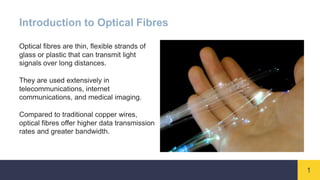
Optical fibres are thin, flexible strands of
glass or plastic that can transmit light
signals over long distances.
They are used extensively in
telecommunications, internet
communications, and medical imaging.
Compared to traditional copper wires,
optical fibres offer higher data transmission
rates and greater bandwidth.
2
Structure of Optical Fibres
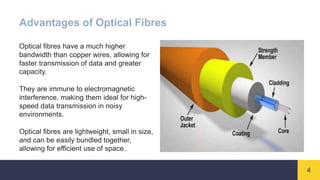
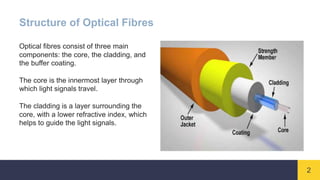
Optical fibres consist of three main
components: the core, the cladding, and
the buffer coating.
The core is the innermost layer through
which light signals travel.
The cladding is a layer surrounding the
core, with a lower refractive index, which
helps to guide the light signals.
3
Principle of Optical Fibre Transmission
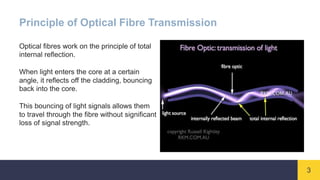
Optical fibres work on the principle of total
internal reflection.
When light enters the core at a certain
angle, it reflects off the cladding, bouncing
back into the core.
This bouncing of light signals allows them
to travel through the fibre without significant
loss of signal strength.
4
Advantages of Optical Fibres
Optical fibres have a much higher
bandwidth than copper wires, allowing for
faster transmission of data and greater
capacity.
They are immune to electromagnetic
interference, making them ideal for high-
speed data transmission in noisy
environments.
Optical fibres are lightweight, small in size,
and can be easily bundled together,
allowing for efficient use of space.
5
Types of Optical Fibres
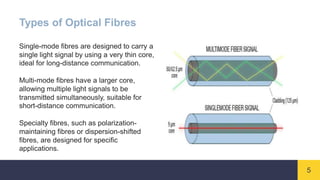
Single-mode fibres are designed to carry a
single light signal by using a very thin core,
ideal for long-distance communication.
Multi-mode fibres have a larger core,
allowing multiple light signals to be
transmitted simultaneously, suitable for
short-distance communication.
Specialty fibres, such as polarization-
maintaining fibres or dispersion-shifted
fibres, are designed for specific
applications.
6
Applications of Optical Fibres in Telecommunications
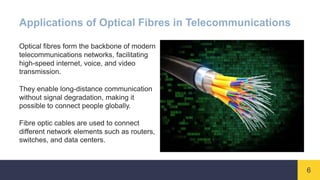
Optical fibres form the backbone of modern
telecommunications networks, facilitating
high-speed internet, voice, and video
transmission.
They enable long-distance communication
without signal degradation, making it
possible to connect people globally.
Fibre optic cables are used to connect
different network elements such as routers,
switches, and data centers.
7
Medical and Scientific Applications of Optical Fibres
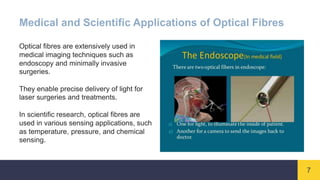
Optical fibres are extensively used in
medical imaging techniques such as
endoscopy and minimally invasive
surgeries.
They enable precise delivery of light for
laser surgeries and treatments.
In scientific research, optical fibres are
used in various sensing applications, such
as temperature, pressure, and chemical
sensing.
8
Future Trends in Optical Fibres
Researchers are continuously improving
the efficiency and performance of optical
fibres.
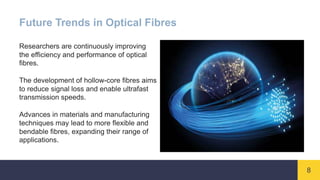
The development of hollow-core fibres aims
to reduce signal loss and enable ultrafast
transmission speeds.
Advances in materials and manufacturing
techniques may lead to more flexible and
bendable fibres, expanding their range of
applications.
9
Challenges and Limitations of Optical Fibres
Despite their numerous advantages, optical
fibres are more expensive to install and
maintain compared to traditional copper
wires.
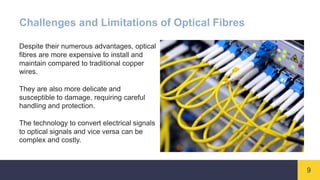
They are also more delicate and
susceptible to damage, requiring careful
handling and protection.
The technology to convert electrical signals
to optical signals and vice versa can be
complex and costly.
10
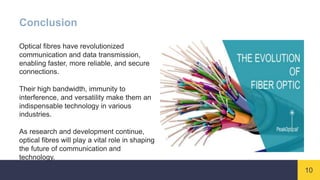
Conclusion
Optical fibres have revolutionized
communication and data transmission,
enabling faster, more reliable, and secure
connections.
Their high bandwidth, immunity to
interference, and versatility make them an
indispensable technology in various
industries.
As research and development continue,
optical fibres will play a vital role in shaping
the future of communication and
technology.
Thank you

Optical Fibres (1).pptx

  • 1.
  • 2.
    1 Introduction to OpticalFibres Optical fibres are thin, flexible strands of glass or plastic that can transmit light signals over long distances. They are used extensively in telecommunications, internet communications, and medical imaging. Compared to traditional copper wires, optical fibres offer higher data transmission rates and greater bandwidth.
  • 3.
    2 Structure of OpticalFibres Optical fibres consist of three main components: the core, the cladding, and the buffer coating. The core is the innermost layer through which light signals travel. The cladding is a layer surrounding the core, with a lower refractive index, which helps to guide the light signals.
  • 4.
    3 Principle of OpticalFibre Transmission Optical fibres work on the principle of total internal reflection. When light enters the core at a certain angle, it reflects off the cladding, bouncing back into the core. This bouncing of light signals allows them to travel through the fibre without significant loss of signal strength.
  • 5.
    4 Advantages of OpticalFibres Optical fibres have a much higher bandwidth than copper wires, allowing for faster transmission of data and greater capacity. They are immune to electromagnetic interference, making them ideal for high- speed data transmission in noisy environments. Optical fibres are lightweight, small in size, and can be easily bundled together, allowing for efficient use of space.
  • 6.
    5 Types of OpticalFibres Single-mode fibres are designed to carry a single light signal by using a very thin core, ideal for long-distance communication. Multi-mode fibres have a larger core, allowing multiple light signals to be transmitted simultaneously, suitable for short-distance communication. Specialty fibres, such as polarization- maintaining fibres or dispersion-shifted fibres, are designed for specific applications.
  • 7.
    6 Applications of OpticalFibres in Telecommunications Optical fibres form the backbone of modern telecommunications networks, facilitating high-speed internet, voice, and video transmission. They enable long-distance communication without signal degradation, making it possible to connect people globally. Fibre optic cables are used to connect different network elements such as routers, switches, and data centers.
  • 8.
    7 Medical and ScientificApplications of Optical Fibres Optical fibres are extensively used in medical imaging techniques such as endoscopy and minimally invasive surgeries. They enable precise delivery of light for laser surgeries and treatments. In scientific research, optical fibres are used in various sensing applications, such as temperature, pressure, and chemical sensing.
  • 9.
    8 Future Trends inOptical Fibres Researchers are continuously improving the efficiency and performance of optical fibres. The development of hollow-core fibres aims to reduce signal loss and enable ultrafast transmission speeds. Advances in materials and manufacturing techniques may lead to more flexible and bendable fibres, expanding their range of applications.
  • 10.
    9 Challenges and Limitationsof Optical Fibres Despite their numerous advantages, optical fibres are more expensive to install and maintain compared to traditional copper wires. They are also more delicate and susceptible to damage, requiring careful handling and protection. The technology to convert electrical signals to optical signals and vice versa can be complex and costly.
  • 11.
    10 Conclusion Optical fibres haverevolutionized communication and data transmission, enabling faster, more reliable, and secure connections. Their high bandwidth, immunity to interference, and versatility make them an indispensable technology in various industries. As research and development continue, optical fibres will play a vital role in shaping the future of communication and technology.
  • 12.

Editor's Notes

  • #3 Image source: https://www.sciencestockphotos.com/free/physics/slides/fibre_optic_light.html
  • #4 Image source: https://engineer-educators.com/topic/basic-structure-of-an-optical-fiber/
  • #5 Image source: https://rkm.com.au/ANIMATIONS/Animation-Fibre-Optic-MOBILE.html
  • #6 Image source: https://community.fs.com/blog/the-advantages-and-disadvantages-of-optical-fibers.html
  • #7 Image source: https://americanfibertek.com/2019/03/06/multimode-vs-singlemode-fiber/
  • #8 Image source: http://cpstelecom.net/2017/05/fttx/
  • #9 Image source: https://www.slideshare.net/RamSinghPatel/ppt-on-optical-fiber
  • #10 Image source: https://www.wiretechworld.com/the-future-of-optical-fibres/
  • #11 Image source: https://www.challenges.fr/economie/internet-perturbe-dans-de-grandes-villes-apres-un-sabotage-de-fibres-optiques_811038
  • #12 Image source: https://www.sigfox.us/2021/04/did-you-know-fiber-optics.html