OPC
POISONING
By Dr. Shoily Datta
Intern Doctor
Medicine Unit – Green
M. Abdur Rahim Medical College &
Hospital, Dinajpur.
4/6/2022
What is OPC?
OPC means organophosphorus
compounds.
A widely used pesticides especially in
developing countries.
4/6/2022
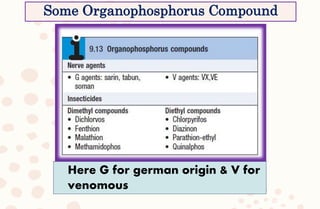
Here G for german origin & V for
venomous
Some Organophosphorus Compound
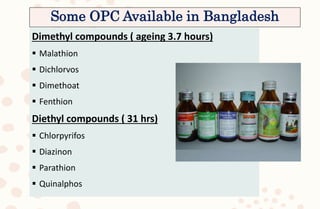
Some OPC Available in Bangladesh
Dimethyl compounds ( ageing 3.7 hours)
 Malathion
 Dichlorvos
 Dimethoat
 Fenthion
Diethyl compounds ( 31 hrs)
 Chlorpyrifos
 Diazinon
 Parathion
 Quinalphos
4/6/2022
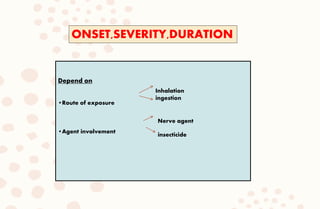
ONSET,SEVERITY,DURATION
Depend on
•Route of exposure
•Agent involvement
Inhalation
ingestion
Nerve agent
insecticide
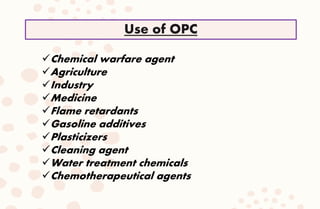
Chemical warfare agent
Agriculture
Industry
Medicine
Flame retardants
Gasoline additives
Plasticizers
Cleaning agent
Water treatment chemicals
Chemotherapeutical agents
Use of OPC
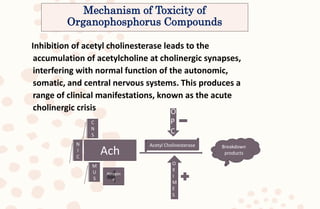
Inhibition of acetyl cholinesterase leads to the
accumulation of acetylcholine at cholinergic synapses,
interfering with normal function of the autonomic,
somatic, and central nervous systems. This produces a
range of clinical manifestations, known as the acute
cholinergic crisis
Ach
Acetyl Cholinesterase Breakdown
products
O
P
C
O
X
I
M
E
S
C
N
S
N
I
C
M
U
S
Atropin
e
Mechanism of Toxicity of
Organophosphorus Compounds
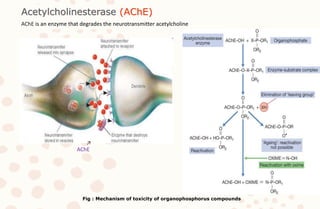
Acetylcholinesterase (AChE)
AChE is an enzyme that degrades the neurotransmitter acetylcholine
↗
AChE
Fig : Mechanism of toxicity of organophosphorus compounds
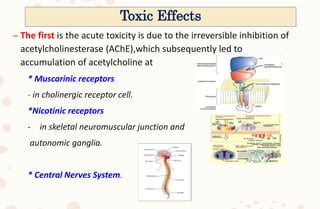
– The first is the acute toxicity is due to the irreversible inhibition of
acetylcholinesterase (AChE),which subsequently led to
accumulation of acetylcholine at
* Muscarinic receptors
- in cholinergic receptor cell.
*Nicotinic receptors
- in skeletal neuromuscular junction and
autonomic ganglia.
* Central Nerves System.
Toxic Effects
 The second effect is arising from single or
repeated exposure to OPC.
 With degeneration of the axon and the myelin both
central and peripheral nervous system, which is
known as oganophosphate-induced delayed
polyneuropathy.
Toxic Effects
4/6/2022
–Three clinical syndromes have been described:
1.Acute cholinergic syndrome (most common)
2.Sub acute proximal weakness (Intermediate syndrome)
3.Organophosphate Induced Delayed Polyneuropathy (OPIDN)
Signs and Symptoms of OPC Poisoning
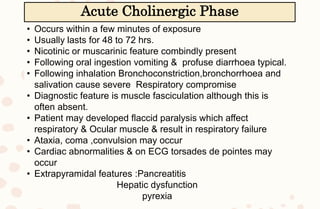
• Occurs within a few minutes of exposure
• Usually lasts for 48 to 72 hrs.
• Nicotinic or muscarinic feature combindly present
• Following oral ingestion vomiting & profuse diarrhoea typical.
• Following inhalation Bronchoconstriction,bronchorrhoea and
salivation cause severe Respiratory compromise
• Diagnostic feature is muscle fasciculation although this is
often absent.
• Patient may developed flaccid paralysis which affect
respiratory & Ocular muscle & result in respiratory failure
• Ataxia, coma ,convulsion may occur
• Cardiac abnormalities & on ECG torsades de pointes may
occur
• Extrapyramidal features :Pancreatitis
Hepatic dysfunction
pyrexia
Acute Cholinergic Phase
4/6/2022
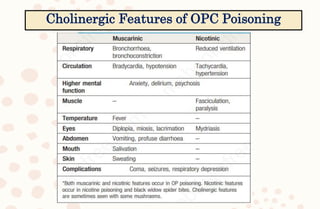
Cholinergic Features of OPC Poisoning
4/6/2022
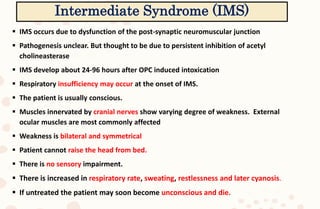
 IMS occurs due to dysfunction of the post-synaptic neuromuscular junction
 Pathogenesis unclear. But thought to be due to persistent inhibition of acetyl
cholineasterase
 IMS develop about 24-96 hours after OPC induced intoxication
 Respiratory insufficiency may occur at the onset of IMS.
 The patient is usually conscious.
 Muscles innervated by cranial nerves show varying degree of weakness. External
ocular muscles are most commonly affected
 Weakness is bilateral and symmetrical
 Patient cannot raise the head from bed.
 There is no sensory impairment.
 There is increased in respiratory rate, sweating, restlessness and later cyanosis.
 If untreated the patient may soon become unconscious and die.
Intermediate Syndrome (IMS)
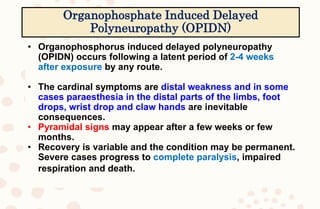
• Organophosphorus induced delayed polyneuropathy
(OPIDN) occurs following a latent period of 2-4 weeks
after exposure by any route.
• The cardinal symptoms are distal weakness and in some
cases paraesthesia in the distal parts of the limbs, foot
drops, wrist drop and claw hands are inevitable
consequences.
• Pyramidal signs may appear after a few weeks or few
months.
• Recovery is variable and the condition may be permanent.
Severe cases progress to complete paralysis, impaired
respiration and death.
Organophosphate Induced Delayed
Polyneuropathy (OPIDN)
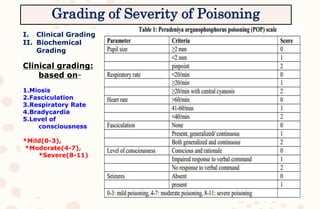
I. Clinical Grading
II. Biochemical
Grading
Clinical grading:
based on-
1.Miosis
2.Fasciculation
3.Respiratory Rate
4.Bradycardia
5.Level of
consciousness
*Mild(0-3),
*Moderate(4-7),
*Severe(8-11)
Grading of Severity of Poisoning
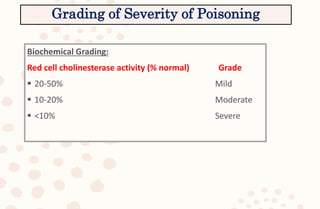
Biochemical Grading:
Red cell cholinesterase activity (% normal) Grade
 20-50% Mild
 10-20% Moderate
 <10% Severe
4/6/2022
Determinant of toxicity
• The rate of ageing is an important
for determinant of toxicity
What is ageing
Ageing duration for
different OPC
• Dimethyl compound:3.7
hrs
• Diethyl compound:31hrs
• Nerve agent: within
minutes
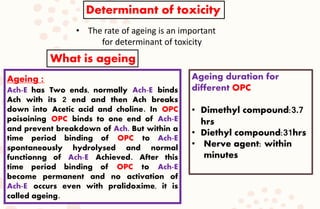
Ageing :
Ach-E has Two ends, normally Ach-E binds
Ach with its 2 end and then Ach breaks
down into Acetic acid and choline. In OPC
poisoining OPC binds to one end of Ach-E
and prevent breakdown of Ach. But within a
time period binding of OPC to Ach-E
spontaneously hydrolysed and normal
functionng of Ach-E Achieved. After this
time period binding of OPC to Ach-E
become permanent and no activation of
Ach-E occurs even with pralidoxime, it is
called ageing.
 Routine inv:
• CBC: leukocytosis
• RBS: hypoglycemia
• LFT: increased PT
• Urine R/E: proteiurea
• S.amylase: raised
• ECG: arrythmia
• torsades de pointes
• Chest X ray: pulmonary
odema
• Oxygen saturation
• Blood gas analysis
 Special inv:
1. Direct measurement of opc
2. Estimation of red cell
cholinesterase
3. Spirometry
4. Histopathology
 All patients and their attendants should be repeatedly
encouraged to bring the sample to the health facility for
diagnosis and management.
Investigations
Hospitalization/ ICU
1. Initial stabilization
2. Reduction of exposure
3. Administration of specific antidote
4. Supportive treatment
• Clear airway and
• Adequate ventilation because the patient with acute
organophosphate poisoning commonly presents with respiratory
distress.
• Oxygen- high flow
• circulation- by iv access
Management of OPC Poisoning
Initial Stabilization of the Patient
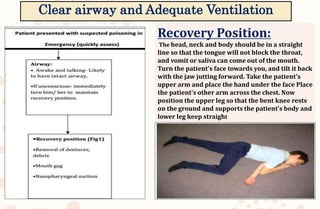
Recovery Position:
The head, neck and body should be in a straight
line so that the tongue will not block the throat,
and vomit or saliva can come out of the mouth.
Turn the patient's face towards you, and tilt it back
with the jaw jutting forward. Take the patient's
upper arm and place the hand under the face Place
the patient's other arm across the chest. Now
position the upper leg so that the bent knee rests
on the ground and supports the patient's body and
lower leg keep straight
Clear airway and Adequate Ventilation
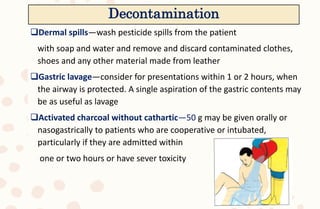
Dermal spills—wash pesticide spills from the patient
with soap and water and remove and discard contaminated clothes,
shoes and any other material made from leather
Gastric lavage—consider for presentations within 1 or 2 hours, when
the airway is protected. A single aspiration of the gastric contents may
be as useful as lavage
Activated charcoal without cathartic—50 g may be given orally or
nasogastrically to patients who are cooperative or intubated,
particularly if they are admitted within
one or two hours or have sever toxicity
Decontamination
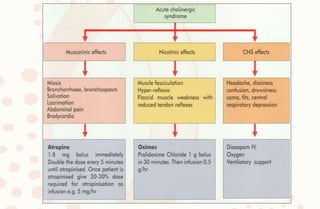
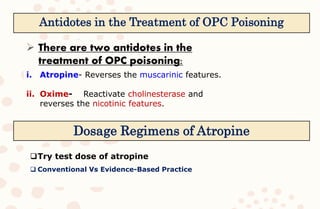
 There are two antidotes in the
treatment of OPC poisoning:
i. Atropine- Reverses the muscarinic features.
ii. Oxime- Reactivate cholinesterase and
reverses the nicotinic features.
Try test dose of atropine
 Conventional Vs Evidence-Based Practice
Antidotes in the Treatment of OPC Poisoning
Dosage Regimens of Atropine
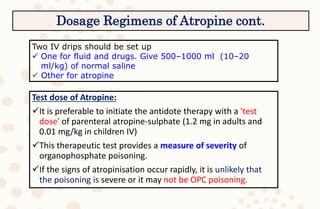
Test dose of Atropine:
It is preferable to initiate the antidote therapy with a 'test
dose' of parenteral atropine-sulphate (1.2 mg in adults and
0.01 mg/kg in children IV)
This therapeutic test provides a measure of severity of
organophosphate poisoning.
If the signs of atropinisation occur rapidly, it is unlikely that
the poisoning is severe or it may not be OPC poisoning.
Two IV drips should be set up
 One for fluid and drugs. Give 500–1000 ml (10–20
ml/kg) of normal saline
 Other for atropine
Dosage Regimens of Atropine cont.
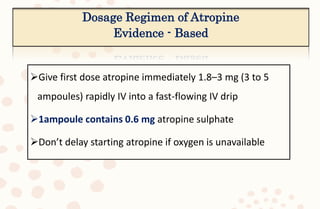
Dosage Regimen of Atropine
Evidence - Based
Give first dose atropine immediately 1.8–3 mg (3 to 5
ampoules) rapidly IV into a fast-flowing IV drip
1ampoule contains 0.6 mg atropine sulphate
Don’t delay starting atropine if oxygen is unavailable
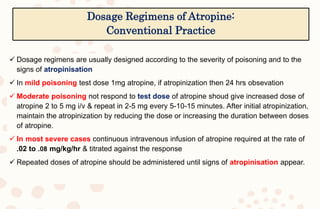
 Dosage regimens are usually designed according to the severity of poisoning and to the
signs of atropinisation
 In mild poisoning test dose 1mg atropine, if atropinization then 24 hrs obsevation
 Moderate poisoning not respond to test dose of atropine shoud give increased dose of
atropine 2 to 5 mg i/v & repeat in 2-5 mg every 5-10-15 minutes. After initial atropinization,
maintain the atropinization by reducing the dose or increasing the duration between doses
of atropine.
 In most severe cases continuous intravenous infusion of atropine required at the rate of
.02 to .08 mg/kg/hr & titrated against the response
 Repeated doses of atropine should be administered until signs of atropinisation appear.
Dosage Regimens of Atropine:
Conventional Practice
After 3-5 minutes of atropine administration
record followings :-
(1) Chest auscultation : Clear with no wheeze
(2) Blood pressure: SBP > 80 mm/Hg
(3) heart rate: > 80 beats/min
(4) Pupil: no longer pinpoint
(5) Dry axilla
These are the Target End points of atropinization
Assess – is the Patient Atropinised?
A uniform improvement in most of the five parameters is required, not
improvements in just one.
Pupil dilatation is sometimes delayed. and the other parameters may improve
more rapidly, it is reasonable to observe air entry on chest auscultation, heart rate,
and blood pressure as the main parameters for adequate atropinisation.
When all the parameters are satisfactory, the patient has received enough
atropine and is “atropinised”
Assess – is the Patient Atropinised?
Continuation of Bolus Atropine Loading to
Reach Atropinisation
 If after 3–5 min a consistent improvement across the five
parameters has not occurred.
 Then
 Continue to double the dose every 3-5 minutes until
atropinisation has been achieved
 Do not simply repeat the initial dose of atropine
 Atropinise the patient as quickly as possible
Atropine treatment after
atropinization
• Once atropinized, set up an infusion using one of the two IV cannulae
• In the infusion, give 10–20% of the total atropine that was required to
load the patient every hour
• If very large dose required then less dose can be used
• Larger dose required if oxime not avaiable
Giving Fluids / IV Channel
• Follow up every 15 min with five parameter
• If recurrence of bronchospasm or bradycardia, give further
boluses of atropine
• Once the patient settled then follow up hourly for the first 6
hours to check that the atropine infusion rate is sufficient and
that there are no signs of atropine toxicity
• As the required dose of atropine falls, observation for
recurrence of cholinergic features can be done less often
(every 2–3 hours)
• However, regular observation is still required to spot patients
at risk of, and going into, respiratory failure
The most important
Observation of the Patient
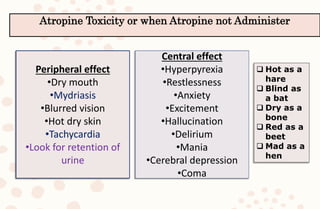
Peripheral effect
•Dry mouth
•Mydriasis
•Blurred vision
•Hot dry skin
•Tachycardia
•Look for retention of
urine
Central effect
•Hyperpyrexia
•Restlessness
•Anxiety
•Excitement
•Hallucination
•Delirium
•Mania
•Cerebral depression
•Coma
 Hot as a
hare
 Blind as
a bat
 Dry as a
bone
 Red as a
beet
 Mad as a
hen
Atropine Toxicity or when Atropine not Administer
Atropine should only be stopped if signs of over
atropinization such as fever,muscle fasciculation &
delerium are present
Treatment of atropine toxicity
Stop the atropine infusion
Diazepam for convulsion
 Benzodiazepines are usually given intravenously as required for agitation or seizures—with doses
starting at:
 Diazepam 5-10 mg (0.05-0.3 mg/kg/dose),
 Lorazepam 2-4 mg (0.05-0.1 mg/kg/dose), or
 Midazolam 5-10 mg (0.15-0.2 mg/kg/dose)
• Physostigmine for peripheral effect
•Pyrexia should be contolled by anti pyretics
Management of Atropine Toxicity
4/6/2022
Check again after 30 min to see whether the features of toxicity have settled
If not, continue to review every 30 min so when they do settle, restart at 70–80% of
the previous rate
The patient should then be seen frequently to ensure that the new infusion rate has
reduced the signs of atropine toxicity without permitting the reappearance of
cholinergic signs
Management of Atropine Toxicity cont.
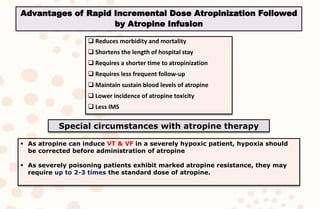
 Reduces morbidity and mortality
 Shortens the length of hospital stay
 Requires a shorter time to atropinization
 Requires less frequent follow-up
 Maintain sustain blood levels of atropine
 Lower incidence of atropine toxicity
 Less IMS
Special circumstances with atropine therapy
 As atropine can induce VT & VF in a severely hypoxic patient, hypoxia should
be corrected before administration of atropine
 As severely poisoning patients exhibit marked atropine resistance, they may
require up to 2-3 times the standard dose of atropine.
Advantages of Rapid Incremental Dose Atropinization Followed
by Atropine Infusion
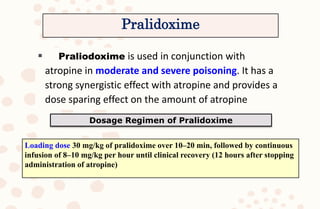
 Praliodoxime is used in conjunction with
atropine in moderate and severe poisoning. It has a
strong synergistic effect with atropine and provides a
dose sparing effect on the amount of atropine
Loading dose 30 mg/kg of pralidoxime over 10–20 min, followed by continuous
infusion of 8–10 mg/kg per hour until clinical recovery (12 hours after stopping
administration of atropine)
Dosage Regimen of Pralidoxime
Pralidoxime
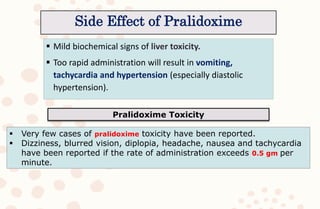
 Mild biochemical signs of liver toxicity.
 Too rapid administration will result in vomiting,
tachycardia and hypertension (especially diastolic
hypertension).
 Very few cases of pralidoxime toxicity have been reported.
 Dizziness, blurred vision, diplopia, headache, nausea and tachycardia
have been reported if the rate of administration exceeds 0.5 gm per
minute.
Side Effect of Pralidoxime
Pralidoxime Toxicity
Currently obidoxime has been introduced. It crosses
blood brain barrier more than pralidoxime
Where obidoxime is available, a loading dose of 250
mg is followed by an infusion giving 750 mg every 24
hours
Obidoxime
 Management of respiratory insufficiency :
 In respiratory failure : Artificial respiration
 Pulmonary odema needs high conc O2 & diuretics
 In aspiration pneumonia high dose antibiotics
 Maintainence of circulation by i/v fluids
 Treatment of convulsion by diazepam & and other
complications
 Fluid & electrolyte balance
 Control of infections
 Maintainence of nutrition
 Control of body temperature by sponging, fanning.
Supportive Treatment
1. Vital signs
2. Signs of Atropinisation
3. Effect of oxime
4. Toxicity of atropine and oxime
5. RBC and plasma AChE level
6. Recurrence of symptoms on withdrawal of antidote
7. Restart the treatment promptly if recurrence
occurs
8. Patient’s general condition
Follow up of the Patient
Consider discharge from ICU to medical ward once
stable for 12 hours after oxime
Stable for 48 hours after discharge from intensive
care unit- consider disposition and psychiatric review
Disposition
Signs of Atropinization/ Target endpoints for
Atropine therapy
™ Clear chest on auscultation with no wheeze
™ Heart rate >80 beats/min
™ Pupils no longer pinpoint
™ Dry axillae
™ Systolic blood pressure >80 mmHg
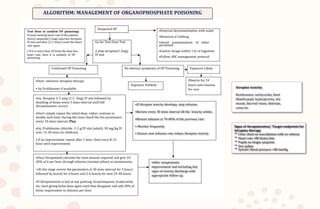
Suspected OP
Test Dose to confirm OP poisoning:
•Count existing heart rate of the patient.
•Give2 ampoule(1.2mg) injection Atropine
IV stat and after (2-3 mins) count the heart Go for Test Dose Test
rate again.
• If it is more than 20 from the base line 2 amp atropine(1.2mg)
heart rate, then it is unlikely of OP IV stat
poisoning.
•External decontamination with water
•Removal of clothing
•Avoid contamination of other
personnel
•Gastric lavage within 1 hr of ingestion
•Follow ABC management protocol.
Confirmed OP Poisoning
•Start intensive Atropine therapy
• Inj Pralidoxime if available
•Inj. Atropine 2-5 amp (1.2 -3mg) IV stat followed by
doubling of doses every 5 mins interval until full
Atropinization* occurs.
•Don’t simply repeat the initial dose; rather continue to
double each time. During this time check the five parameters
every 10 mins interval. Plus
•Inj. Pralidoxime chloride :1-2 g/IV stat (adult); 30 mg/kg IV
over 15-30 mins (in children).
• If no improvement repeat after 1 hour, then every 8-12
hour until improvement.
No obvious symptoms of OP Poisoning Exposure Likely
Observe for 24
Exposure Unlikely hours and reassess
for care
•If Atropine toxicity develops, stop infusion.
•Review every 30 mins interval till the toxicity settles.
•Restart infusion at 70-80% of the previous rate.
• Monitor frequently
• Ensure new infusion rate reduce Atropine toxicity.
•Once Atropinized calculate the total amount required and give 10-
20% of it per hour through infusion (normal saline) as maintenance.
•At this stage review the parameters at 30 mins interval for 3 hours,
followed by hourly for 6 hours and 3-6 hourly for next 24-48 hours.
•If Atropinization is lost at any point,eg; bronchospasm, bradycardia
etc. start giving bolus dose again until they disappear and add 20% of
bolus requirement to infusion per hour.
•After symptomatic
improvement and excluding late
signs of toxicity discharge with
appropriate follow up.
Atropine toxicity:
Restlessness, tachycardia, fixed
dilated pupil, hyperpyrexia, dry
mouth, blurred vision, delirium,
coma etc.
ALGORITHM: MANAGEMENT OF ORGANOPHOSPHATE POISONING
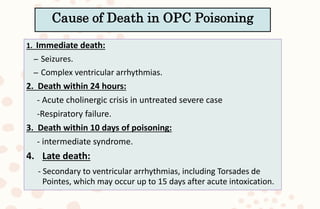
1. Immediate death:
– Seizures.
– Complex ventricular arrhythmias.
2. Death within 24 hours:
- Acute cholinergic crisis in untreated severe case
-Respiratory failure.
3. Death within 10 days of poisoning:
- intermediate syndrome.
4. Late death:
- Secondary to ventricular arrhythmias, including Torsades de
Pointes, which may occur up to 15 days after acute intoxication.
Cause of Death in OPC Poisoning
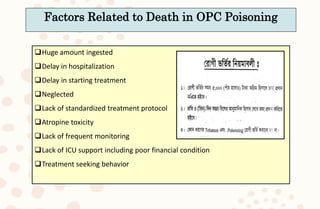
Huge amount ingested
Delay in hospitalization
Delay in starting treatment
Neglected
Lack of standardized treatment protocol
Atropine toxicity
Lack of frequent monitoring
Lack of ICU support including poor financial condition
Treatment seeking behavior
Factors Related to Death in OPC Poisoning
– Deaths usually occur within the first 24 hours in untreated cases
and within 10 days in treatment failure cases.
– If there has been no anoxic brain damage, recovery will usually
occur within 10 days, although there may be residual sequelae.
Prognosis of Organophosphorus Insecticide
Poisoning
Thank You All…

OPC Poisonig Slide ,Treatment and Data analysis.

  • 1.
    OPC POISONING By Dr. ShoilyDatta Intern Doctor Medicine Unit – Green M. Abdur Rahim Medical College & Hospital, Dinajpur.
  • 2.
    4/6/2022 What is OPC? OPCmeans organophosphorus compounds. A widely used pesticides especially in developing countries.
  • 3.
    4/6/2022 Here G forgerman origin & V for venomous Some Organophosphorus Compound
  • 4.
    Some OPC Availablein Bangladesh Dimethyl compounds ( ageing 3.7 hours)  Malathion  Dichlorvos  Dimethoat  Fenthion Diethyl compounds ( 31 hrs)  Chlorpyrifos  Diazinon  Parathion  Quinalphos
  • 5.
    4/6/2022 ONSET,SEVERITY,DURATION Depend on •Route ofexposure •Agent involvement Inhalation ingestion Nerve agent insecticide
  • 6.
    Chemical warfare agent Agriculture Industry Medicine Flameretardants Gasoline additives Plasticizers Cleaning agent Water treatment chemicals Chemotherapeutical agents Use of OPC
  • 7.
    Inhibition of acetylcholinesterase leads to the accumulation of acetylcholine at cholinergic synapses, interfering with normal function of the autonomic, somatic, and central nervous systems. This produces a range of clinical manifestations, known as the acute cholinergic crisis Ach Acetyl Cholinesterase Breakdown products O P C O X I M E S C N S N I C M U S Atropin e Mechanism of Toxicity of Organophosphorus Compounds
  • 8.
    Acetylcholinesterase (AChE) AChE isan enzyme that degrades the neurotransmitter acetylcholine ↗ AChE Fig : Mechanism of toxicity of organophosphorus compounds
  • 9.
    – The firstis the acute toxicity is due to the irreversible inhibition of acetylcholinesterase (AChE),which subsequently led to accumulation of acetylcholine at * Muscarinic receptors - in cholinergic receptor cell. *Nicotinic receptors - in skeletal neuromuscular junction and autonomic ganglia. * Central Nerves System. Toxic Effects
  • 10.
     The secondeffect is arising from single or repeated exposure to OPC.  With degeneration of the axon and the myelin both central and peripheral nervous system, which is known as oganophosphate-induced delayed polyneuropathy. Toxic Effects
  • 11.
    4/6/2022 –Three clinical syndromeshave been described: 1.Acute cholinergic syndrome (most common) 2.Sub acute proximal weakness (Intermediate syndrome) 3.Organophosphate Induced Delayed Polyneuropathy (OPIDN) Signs and Symptoms of OPC Poisoning
  • 12.
    • Occurs withina few minutes of exposure • Usually lasts for 48 to 72 hrs. • Nicotinic or muscarinic feature combindly present • Following oral ingestion vomiting & profuse diarrhoea typical. • Following inhalation Bronchoconstriction,bronchorrhoea and salivation cause severe Respiratory compromise • Diagnostic feature is muscle fasciculation although this is often absent. • Patient may developed flaccid paralysis which affect respiratory & Ocular muscle & result in respiratory failure • Ataxia, coma ,convulsion may occur • Cardiac abnormalities & on ECG torsades de pointes may occur • Extrapyramidal features :Pancreatitis Hepatic dysfunction pyrexia Acute Cholinergic Phase
  • 13.
  • 14.
  • 15.
     IMS occursdue to dysfunction of the post-synaptic neuromuscular junction  Pathogenesis unclear. But thought to be due to persistent inhibition of acetyl cholineasterase  IMS develop about 24-96 hours after OPC induced intoxication  Respiratory insufficiency may occur at the onset of IMS.  The patient is usually conscious.  Muscles innervated by cranial nerves show varying degree of weakness. External ocular muscles are most commonly affected  Weakness is bilateral and symmetrical  Patient cannot raise the head from bed.  There is no sensory impairment.  There is increased in respiratory rate, sweating, restlessness and later cyanosis.  If untreated the patient may soon become unconscious and die. Intermediate Syndrome (IMS)
  • 16.
    • Organophosphorus induceddelayed polyneuropathy (OPIDN) occurs following a latent period of 2-4 weeks after exposure by any route. • The cardinal symptoms are distal weakness and in some cases paraesthesia in the distal parts of the limbs, foot drops, wrist drop and claw hands are inevitable consequences. • Pyramidal signs may appear after a few weeks or few months. • Recovery is variable and the condition may be permanent. Severe cases progress to complete paralysis, impaired respiration and death. Organophosphate Induced Delayed Polyneuropathy (OPIDN)
  • 17.
    I. Clinical Grading II.Biochemical Grading Clinical grading: based on- 1.Miosis 2.Fasciculation 3.Respiratory Rate 4.Bradycardia 5.Level of consciousness *Mild(0-3), *Moderate(4-7), *Severe(8-11) Grading of Severity of Poisoning
  • 18.
    Grading of Severityof Poisoning Biochemical Grading: Red cell cholinesterase activity (% normal) Grade  20-50% Mild  10-20% Moderate  <10% Severe
  • 19.
    4/6/2022 Determinant of toxicity •The rate of ageing is an important for determinant of toxicity What is ageing Ageing duration for different OPC • Dimethyl compound:3.7 hrs • Diethyl compound:31hrs • Nerve agent: within minutes Ageing : Ach-E has Two ends, normally Ach-E binds Ach with its 2 end and then Ach breaks down into Acetic acid and choline. In OPC poisoining OPC binds to one end of Ach-E and prevent breakdown of Ach. But within a time period binding of OPC to Ach-E spontaneously hydrolysed and normal functionng of Ach-E Achieved. After this time period binding of OPC to Ach-E become permanent and no activation of Ach-E occurs even with pralidoxime, it is called ageing.
  • 20.
     Routine inv: •CBC: leukocytosis • RBS: hypoglycemia • LFT: increased PT • Urine R/E: proteiurea • S.amylase: raised • ECG: arrythmia • torsades de pointes • Chest X ray: pulmonary odema • Oxygen saturation • Blood gas analysis  Special inv: 1. Direct measurement of opc 2. Estimation of red cell cholinesterase 3. Spirometry 4. Histopathology  All patients and their attendants should be repeatedly encouraged to bring the sample to the health facility for diagnosis and management. Investigations
  • 21.
    Hospitalization/ ICU 1. Initialstabilization 2. Reduction of exposure 3. Administration of specific antidote 4. Supportive treatment • Clear airway and • Adequate ventilation because the patient with acute organophosphate poisoning commonly presents with respiratory distress. • Oxygen- high flow • circulation- by iv access Management of OPC Poisoning Initial Stabilization of the Patient
  • 22.
    Recovery Position: The head,neck and body should be in a straight line so that the tongue will not block the throat, and vomit or saliva can come out of the mouth. Turn the patient's face towards you, and tilt it back with the jaw jutting forward. Take the patient's upper arm and place the hand under the face Place the patient's other arm across the chest. Now position the upper leg so that the bent knee rests on the ground and supports the patient's body and lower leg keep straight Clear airway and Adequate Ventilation
  • 23.
    Dermal spills—wash pesticidespills from the patient with soap and water and remove and discard contaminated clothes, shoes and any other material made from leather Gastric lavage—consider for presentations within 1 or 2 hours, when the airway is protected. A single aspiration of the gastric contents may be as useful as lavage Activated charcoal without cathartic—50 g may be given orally or nasogastrically to patients who are cooperative or intubated, particularly if they are admitted within one or two hours or have sever toxicity Decontamination
  • 24.
     There aretwo antidotes in the treatment of OPC poisoning: i. Atropine- Reverses the muscarinic features. ii. Oxime- Reactivate cholinesterase and reverses the nicotinic features. Try test dose of atropine  Conventional Vs Evidence-Based Practice Antidotes in the Treatment of OPC Poisoning Dosage Regimens of Atropine
  • 25.
    Test dose ofAtropine: It is preferable to initiate the antidote therapy with a 'test dose' of parenteral atropine-sulphate (1.2 mg in adults and 0.01 mg/kg in children IV) This therapeutic test provides a measure of severity of organophosphate poisoning. If the signs of atropinisation occur rapidly, it is unlikely that the poisoning is severe or it may not be OPC poisoning. Two IV drips should be set up  One for fluid and drugs. Give 500–1000 ml (10–20 ml/kg) of normal saline  Other for atropine Dosage Regimens of Atropine cont.
  • 26.
    Dosage Regimen ofAtropine Evidence - Based Give first dose atropine immediately 1.8–3 mg (3 to 5 ampoules) rapidly IV into a fast-flowing IV drip 1ampoule contains 0.6 mg atropine sulphate Don’t delay starting atropine if oxygen is unavailable
  • 27.
     Dosage regimensare usually designed according to the severity of poisoning and to the signs of atropinisation  In mild poisoning test dose 1mg atropine, if atropinization then 24 hrs obsevation  Moderate poisoning not respond to test dose of atropine shoud give increased dose of atropine 2 to 5 mg i/v & repeat in 2-5 mg every 5-10-15 minutes. After initial atropinization, maintain the atropinization by reducing the dose or increasing the duration between doses of atropine.  In most severe cases continuous intravenous infusion of atropine required at the rate of .02 to .08 mg/kg/hr & titrated against the response  Repeated doses of atropine should be administered until signs of atropinisation appear. Dosage Regimens of Atropine: Conventional Practice
  • 28.
    After 3-5 minutesof atropine administration record followings :- (1) Chest auscultation : Clear with no wheeze (2) Blood pressure: SBP > 80 mm/Hg (3) heart rate: > 80 beats/min (4) Pupil: no longer pinpoint (5) Dry axilla These are the Target End points of atropinization Assess – is the Patient Atropinised?
  • 29.
    A uniform improvementin most of the five parameters is required, not improvements in just one. Pupil dilatation is sometimes delayed. and the other parameters may improve more rapidly, it is reasonable to observe air entry on chest auscultation, heart rate, and blood pressure as the main parameters for adequate atropinisation. When all the parameters are satisfactory, the patient has received enough atropine and is “atropinised” Assess – is the Patient Atropinised?
  • 30.
    Continuation of BolusAtropine Loading to Reach Atropinisation  If after 3–5 min a consistent improvement across the five parameters has not occurred.  Then  Continue to double the dose every 3-5 minutes until atropinisation has been achieved  Do not simply repeat the initial dose of atropine  Atropinise the patient as quickly as possible
  • 31.
    Atropine treatment after atropinization •Once atropinized, set up an infusion using one of the two IV cannulae • In the infusion, give 10–20% of the total atropine that was required to load the patient every hour • If very large dose required then less dose can be used • Larger dose required if oxime not avaiable Giving Fluids / IV Channel
  • 32.
    • Follow upevery 15 min with five parameter • If recurrence of bronchospasm or bradycardia, give further boluses of atropine • Once the patient settled then follow up hourly for the first 6 hours to check that the atropine infusion rate is sufficient and that there are no signs of atropine toxicity • As the required dose of atropine falls, observation for recurrence of cholinergic features can be done less often (every 2–3 hours) • However, regular observation is still required to spot patients at risk of, and going into, respiratory failure The most important Observation of the Patient
  • 33.
    Peripheral effect •Dry mouth •Mydriasis •Blurredvision •Hot dry skin •Tachycardia •Look for retention of urine Central effect •Hyperpyrexia •Restlessness •Anxiety •Excitement •Hallucination •Delirium •Mania •Cerebral depression •Coma  Hot as a hare  Blind as a bat  Dry as a bone  Red as a beet  Mad as a hen Atropine Toxicity or when Atropine not Administer
  • 34.
    Atropine should onlybe stopped if signs of over atropinization such as fever,muscle fasciculation & delerium are present Treatment of atropine toxicity Stop the atropine infusion Diazepam for convulsion  Benzodiazepines are usually given intravenously as required for agitation or seizures—with doses starting at:  Diazepam 5-10 mg (0.05-0.3 mg/kg/dose),  Lorazepam 2-4 mg (0.05-0.1 mg/kg/dose), or  Midazolam 5-10 mg (0.15-0.2 mg/kg/dose) • Physostigmine for peripheral effect •Pyrexia should be contolled by anti pyretics Management of Atropine Toxicity
  • 35.
    4/6/2022 Check again after30 min to see whether the features of toxicity have settled If not, continue to review every 30 min so when they do settle, restart at 70–80% of the previous rate The patient should then be seen frequently to ensure that the new infusion rate has reduced the signs of atropine toxicity without permitting the reappearance of cholinergic signs Management of Atropine Toxicity cont.
  • 36.
     Reduces morbidityand mortality  Shortens the length of hospital stay  Requires a shorter time to atropinization  Requires less frequent follow-up  Maintain sustain blood levels of atropine  Lower incidence of atropine toxicity  Less IMS Special circumstances with atropine therapy  As atropine can induce VT & VF in a severely hypoxic patient, hypoxia should be corrected before administration of atropine  As severely poisoning patients exhibit marked atropine resistance, they may require up to 2-3 times the standard dose of atropine. Advantages of Rapid Incremental Dose Atropinization Followed by Atropine Infusion
  • 37.
     Praliodoxime isused in conjunction with atropine in moderate and severe poisoning. It has a strong synergistic effect with atropine and provides a dose sparing effect on the amount of atropine Loading dose 30 mg/kg of pralidoxime over 10–20 min, followed by continuous infusion of 8–10 mg/kg per hour until clinical recovery (12 hours after stopping administration of atropine) Dosage Regimen of Pralidoxime Pralidoxime
  • 38.
     Mild biochemicalsigns of liver toxicity.  Too rapid administration will result in vomiting, tachycardia and hypertension (especially diastolic hypertension).  Very few cases of pralidoxime toxicity have been reported.  Dizziness, blurred vision, diplopia, headache, nausea and tachycardia have been reported if the rate of administration exceeds 0.5 gm per minute. Side Effect of Pralidoxime Pralidoxime Toxicity
  • 39.
    Currently obidoxime hasbeen introduced. It crosses blood brain barrier more than pralidoxime Where obidoxime is available, a loading dose of 250 mg is followed by an infusion giving 750 mg every 24 hours Obidoxime
  • 40.
     Management ofrespiratory insufficiency :  In respiratory failure : Artificial respiration  Pulmonary odema needs high conc O2 & diuretics  In aspiration pneumonia high dose antibiotics  Maintainence of circulation by i/v fluids  Treatment of convulsion by diazepam & and other complications  Fluid & electrolyte balance  Control of infections  Maintainence of nutrition  Control of body temperature by sponging, fanning. Supportive Treatment
  • 41.
    1. Vital signs 2.Signs of Atropinisation 3. Effect of oxime 4. Toxicity of atropine and oxime 5. RBC and plasma AChE level 6. Recurrence of symptoms on withdrawal of antidote 7. Restart the treatment promptly if recurrence occurs 8. Patient’s general condition Follow up of the Patient
  • 42.
    Consider discharge fromICU to medical ward once stable for 12 hours after oxime Stable for 48 hours after discharge from intensive care unit- consider disposition and psychiatric review Disposition
  • 43.
    Signs of Atropinization/Target endpoints for Atropine therapy ™ Clear chest on auscultation with no wheeze ™ Heart rate >80 beats/min ™ Pupils no longer pinpoint ™ Dry axillae ™ Systolic blood pressure >80 mmHg Suspected OP Test Dose to confirm OP poisoning: •Count existing heart rate of the patient. •Give2 ampoule(1.2mg) injection Atropine IV stat and after (2-3 mins) count the heart Go for Test Dose Test rate again. • If it is more than 20 from the base line 2 amp atropine(1.2mg) heart rate, then it is unlikely of OP IV stat poisoning. •External decontamination with water •Removal of clothing •Avoid contamination of other personnel •Gastric lavage within 1 hr of ingestion •Follow ABC management protocol. Confirmed OP Poisoning •Start intensive Atropine therapy • Inj Pralidoxime if available •Inj. Atropine 2-5 amp (1.2 -3mg) IV stat followed by doubling of doses every 5 mins interval until full Atropinization* occurs. •Don’t simply repeat the initial dose; rather continue to double each time. During this time check the five parameters every 10 mins interval. Plus •Inj. Pralidoxime chloride :1-2 g/IV stat (adult); 30 mg/kg IV over 15-30 mins (in children). • If no improvement repeat after 1 hour, then every 8-12 hour until improvement. No obvious symptoms of OP Poisoning Exposure Likely Observe for 24 Exposure Unlikely hours and reassess for care •If Atropine toxicity develops, stop infusion. •Review every 30 mins interval till the toxicity settles. •Restart infusion at 70-80% of the previous rate. • Monitor frequently • Ensure new infusion rate reduce Atropine toxicity. •Once Atropinized calculate the total amount required and give 10- 20% of it per hour through infusion (normal saline) as maintenance. •At this stage review the parameters at 30 mins interval for 3 hours, followed by hourly for 6 hours and 3-6 hourly for next 24-48 hours. •If Atropinization is lost at any point,eg; bronchospasm, bradycardia etc. start giving bolus dose again until they disappear and add 20% of bolus requirement to infusion per hour. •After symptomatic improvement and excluding late signs of toxicity discharge with appropriate follow up. Atropine toxicity: Restlessness, tachycardia, fixed dilated pupil, hyperpyrexia, dry mouth, blurred vision, delirium, coma etc. ALGORITHM: MANAGEMENT OF ORGANOPHOSPHATE POISONING
  • 44.
    1. Immediate death: –Seizures. – Complex ventricular arrhythmias. 2. Death within 24 hours: - Acute cholinergic crisis in untreated severe case -Respiratory failure. 3. Death within 10 days of poisoning: - intermediate syndrome. 4. Late death: - Secondary to ventricular arrhythmias, including Torsades de Pointes, which may occur up to 15 days after acute intoxication. Cause of Death in OPC Poisoning
  • 45.
    Huge amount ingested Delayin hospitalization Delay in starting treatment Neglected Lack of standardized treatment protocol Atropine toxicity Lack of frequent monitoring Lack of ICU support including poor financial condition Treatment seeking behavior Factors Related to Death in OPC Poisoning
  • 46.
    – Deaths usuallyoccur within the first 24 hours in untreated cases and within 10 days in treatment failure cases. – If there has been no anoxic brain damage, recovery will usually occur within 10 days, although there may be residual sequelae. Prognosis of Organophosphorus Insecticide Poisoning
  • 47.