GONIOSCOPY Presented by
Karan kumar Satapathy (40)
Srikanta kumar Panda (85)
Guided by
Prof. Dr. Sujata Priyambada
Madam
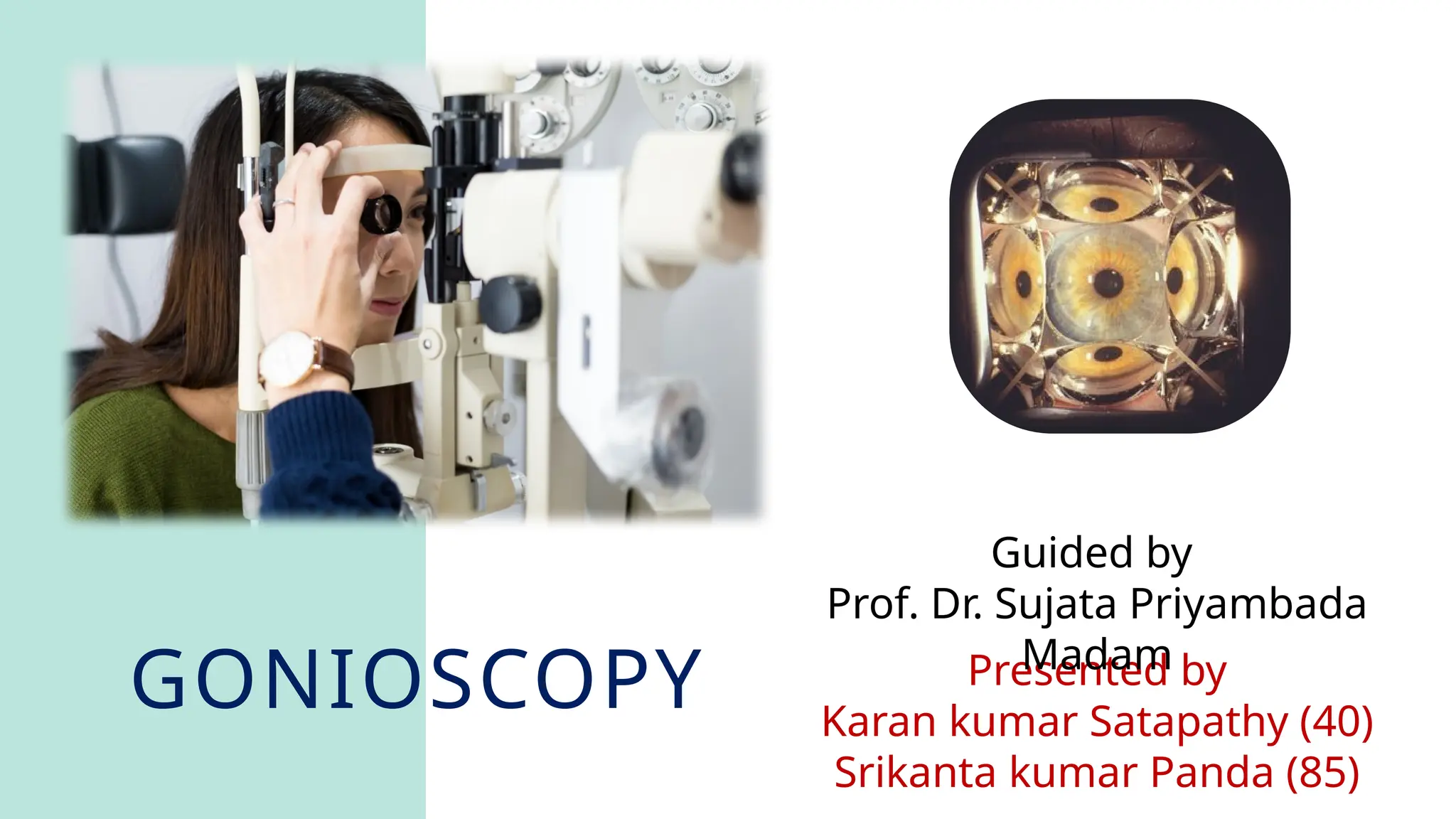
WHAT IS GONIOSCOPY?
 It is a biomicroscopic examination of angle of anterior chamber (irido-
corneal angle) by using a device goniolens/ gonioscope/ gonioprism
WHY THE ANGLE OF ANTERIOR CHAMBER
CANNOT BE VISUALISE DIRECTLY?
 Lack of transparency of corneoscleral junction.
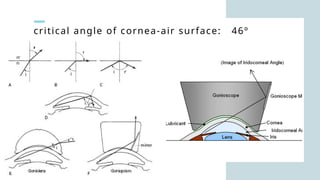
 Emergent light from angle structures undergo Total Internal Reflection at
Corneal surface
critical angle of cornea-air surface: 46º
TYPES:
Direct gonioscopy:
 Done in supine position
 Provides a direct view of the
angle
 Useful in bedridden patient,
anaesthetized patient, children
 E.g., Koeppe goniolens, Barkan
goniolens
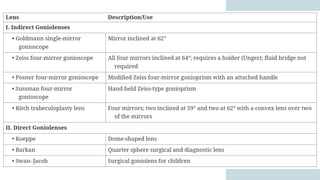
Indirect gonioscopy:
 Done in sitting position on slit
lamp
 Provides a mirror image of the
opposite angle
 E.g. Zeiss 4 mirror gonioscope,
Posner 4 mirror gonioscope,
Goldmann single mirror
gonioscope
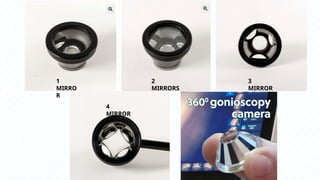
1
MIRRO
R
2
MIRRORS
3
MIRROR
S
4
MIRROR
S
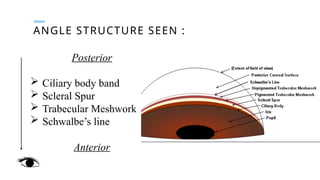
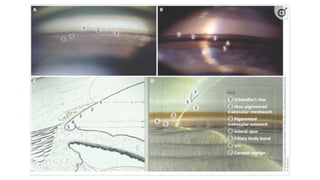
ANGLE STRUCTURE SEEN :
Posterior
 Ciliary body band
 Scleral Spur
 Trabecular Meshwork
 Schwalbe’s line
Anterior
GRADING
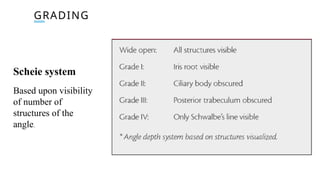
Scheie system
Based upon visibility
of number of
structures of the
angle.
GRADING
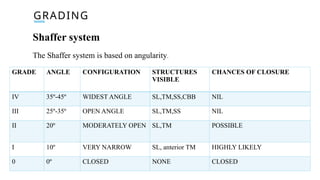
Shaffer system
The Shaffer system is based on angularity.
GRADE ANGLE CONFIGURATION STRUCTURES
VISIBLE
CHANCES OF CLOSURE
IV 35º-45º WIDEST ANGLE SL,TM,SS,CBB NIL
III 25º-35º OPEN ANGLE SL,TM,SS NIL
II 20º MODERATELY OPEN SL,TM POSSIBLE
I 10º VERY NARROW SL, anterior TM HIGHLY LIKELY
0 0º CLOSED NONE CLOSED
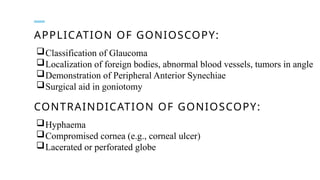
APPLICATION OF GONIOSCOPY:
Classification of Glaucoma
Localization of foreign bodies, abnormal blood vessels, tumors in angle
Demonstration of Peripheral Anterior Synechiae
Surgical aid in goniotomy
CONTRAINDICATION OF GONIOSCOPY:
Hyphaema
Compromised cornea (e.g., corneal ulcer)
Lacerated or perforated globe
Thank you

Ophthalmic presentation on Gonioscopy - A Simple overview

  • 1.
    GONIOSCOPY Presented by Karankumar Satapathy (40) Srikanta kumar Panda (85) Guided by Prof. Dr. Sujata Priyambada Madam
  • 2.
    WHAT IS GONIOSCOPY? It is a biomicroscopic examination of angle of anterior chamber (irido- corneal angle) by using a device goniolens/ gonioscope/ gonioprism WHY THE ANGLE OF ANTERIOR CHAMBER CANNOT BE VISUALISE DIRECTLY?  Lack of transparency of corneoscleral junction.  Emergent light from angle structures undergo Total Internal Reflection at Corneal surface
  • 3.
    critical angle ofcornea-air surface: 46º
  • 4.
    TYPES: Direct gonioscopy:  Donein supine position  Provides a direct view of the angle  Useful in bedridden patient, anaesthetized patient, children  E.g., Koeppe goniolens, Barkan goniolens Indirect gonioscopy:  Done in sitting position on slit lamp  Provides a mirror image of the opposite angle  E.g. Zeiss 4 mirror gonioscope, Posner 4 mirror gonioscope, Goldmann single mirror gonioscope
  • 6.
  • 7.
    ANGLE STRUCTURE SEEN: Posterior  Ciliary body band  Scleral Spur  Trabecular Meshwork  Schwalbe’s line Anterior
  • 9.
    GRADING Scheie system Based uponvisibility of number of structures of the angle.
  • 10.
    GRADING Shaffer system The Shaffersystem is based on angularity. GRADE ANGLE CONFIGURATION STRUCTURES VISIBLE CHANCES OF CLOSURE IV 35º-45º WIDEST ANGLE SL,TM,SS,CBB NIL III 25º-35º OPEN ANGLE SL,TM,SS NIL II 20º MODERATELY OPEN SL,TM POSSIBLE I 10º VERY NARROW SL, anterior TM HIGHLY LIKELY 0 0º CLOSED NONE CLOSED
  • 11.
    APPLICATION OF GONIOSCOPY: Classificationof Glaucoma Localization of foreign bodies, abnormal blood vessels, tumors in angle Demonstration of Peripheral Anterior Synechiae Surgical aid in goniotomy CONTRAINDICATION OF GONIOSCOPY: Hyphaema Compromised cornea (e.g., corneal ulcer) Lacerated or perforated globe
  • 12.