IMPLANTS FOR SHORT EYES
V2018-01/BAR
background of the bil
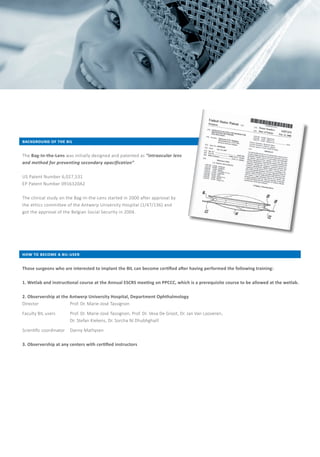
The Bag-In-the-Lens was initially designed and patented as “intraocular lens
and method for preventing secondary opacification”.
US Patent Number 6,027,531
EP Patent Number 0916320A2
The clinical study on the Bag-In-the-Lens started in 2000 after approval by
the ethics committee of the Antwerp University Hospital (1/47/136) and
got the approval of the Belgian Social Security in 2004.
how to become a bil-user
Those surgeons who are interested to implant the BIL can become certified after having performed the following training:
1. Wetlab and instructional course at the Annual ESCRS meeting on PPCCC, which is a prerequisite course to be allowed at the wetlab.
2. Observership at the Antwerp University Hospital, Department Ophthalmology
Director 	 Prof. Dr. Marie-José Tassignon
Faculty BIL users 	 Prof. Dr. Marie-José Tassignon, Prof. Dr. Veva De Groot, Dr. Jan Van Looveren,
		 Dr. Stefan Kiekens, Dr. Sorcha Ní Dhubhghaill
Scientific coordinator 	 Danny Mathysen
3. Observership at any centers with certified instructors
OPHTHALMIC IMPLANTS
FOR SHORT EYES
MORCHER® GmbH
Kapuzinerweg 12	
70374 Stuttgart
GERMANY	
Phone 	 +49 (0) 711 / 95 320 - 0	 E-Mail 	 info@morcher.com
Fax 	 +49 (0) 711 / 95 320 - 80	 Web	 www.morcher.com
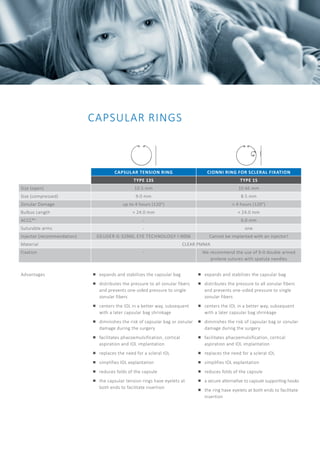
FOLDABLE HYDROPHILIC IOLS CAPSULAR RINGSSPECIAL PMMA IOL
CAPSULAR TENSION RING CIONNI RING FOR SCLERAL FIXATION
TYPE 13S TYPE 1S
Size (open) 10.5 mm 10.66 mm
Size (compressed) 9.0 mm 8.5 mm
Zonular Damage up to 4 hours (120°) > 4 hours (120°)
Bulbus Length < 24.0 mm < 24.0 mm
ACCC*2
- 6.0 mm
Suturable arms - one
Injector (recommendation) GEUDER G-32960, EYE TECHNOLOGY I-9006 Cannot be implanted with an injector!
Material CLEAR PMMA
Fixation - We recommend the use of 9-0 double armed
prolene sutures with spatula needles
Advantages ■	 expands and stabilizes the capsular bag
■	 distributes the pressure to all zonular fibers 	
	 and prevents one-sided pressure to single 		
	 zonular fibers
■	 centers the IOL in a better way, subsequent 		
	 with a later capsular bag shrinkage
■	 diminishes the risk of capsular bag or zonular 	
	 damage during the surgery
■	 facilitates phacoemulsification, cortical
	 aspiration and IOL implantation
■	 replaces the need for a scleral IOL
■	 simplifies IOL explantation
■	 reduces folds of the capsule
■	 the capsular tension rings have eyelets at 		
	 both ends to facilitate insertion
■	 expands and stabilizes the capsular bag
■	 distributes the pressure to all zonular fibers 	
	 and prevents one-sided pressure to single 		
	 zonular fibers
■	 centers the IOL in a better way, subsequent 		
	 with a later capsular bag shrinkage
■	 diminishes the risk of capsular bag or zonular 	
	 damage during the surgery
■	 facilitates phacoemulsification, cortical
	 aspiration and IOL implantation
■	 replaces the need for a scleral IOL
■	 simplifies IOL explantation
■	 reduces folds of the capsule
■	 a secure alternative to capsule supporting hooks
■	 the ring have eyelets at both ends to facilitate 	
	insertion
*1
Other D on request │ *2
Anterior Continuous Curvolinear Capsulorhexis │ *3
Gauge for Capsulorhexis
No PCO in
visual field!
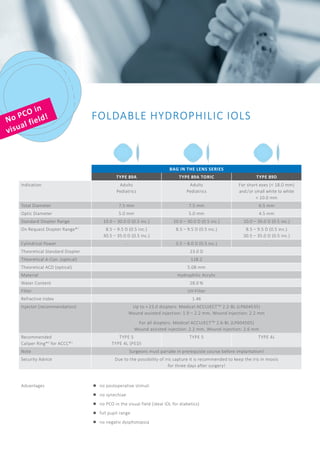
BAG IN THE LENS SERIES
TYPE 89A TYPE 89A TORIC TYPE 89D
Indication Adults
Pediatrics
Adults
Pediatrics
For short eyes (< 18.0 mm)
and/or small white to white
< 10.0 mm
Total Diameter 7.5 mm 7.5 mm 6.5 mm
Optic Diameter 5.0 mm 5.0 mm 4.5 mm
Standard Diopter Range 10.0 – 30.0 D (0.5 inc.) 10.0 – 30.0 D (0.5 inc.) 10.0 – 30.0 D (0.5 inc.)
On Request Diopter Range*1
8.5 – 9.5 D (0.5 inc.)
30.5 – 35.0 D (0.5 inc.)
8.5 – 9.5 D (0.5 inc.) 8.5 – 9.5 D (0.5 inc.)
30.5 – 35.0 D (0.5 inc.)
Cylindrical Power - 0.5 – 8.0 D (0.5 inc.) -
Theoretical Standard Diopter 23.0 D
Theoretical A-Con. (optical) 118.2
Theoretical ACD (optical) 5.08 mm
Material Hydrophilic Acrylic
Water Content 28.0 %
Filter UV-Filter
Refractive Index 1.46
Injector (recommendation) Up to + 23.0 diopters: Medicel ACCUJECTTM
2.2-BL (LP604535)
Wound assisted injection: 1.9 – 2.2 mm, Wound injection: 2.2 mm
For all diopters: Medicel ACCUJECTTM
2.6-BL (LP604505)
Wound assisted injection: 2.2 mm, Wound injection: 2.6 mm
Recommended
Caliper Ring*3
for ACCC*2
TYPE 5
TYPE 4L (PED)
TYPE 5 TYPE 4L
Note Surgeons must partake in prerequiste course before implantation!
Security Advice Due to the possibility of iris capture it is recommended to keep the iris in miosis
for three days after surgery!
Advantages ■	 no postoperative stimuli
■	 no synechiae
■	 no PCO in the visual field (ideal IOL for diabetics)
■	 full pupil range
■	 no negativ dysphotopsia
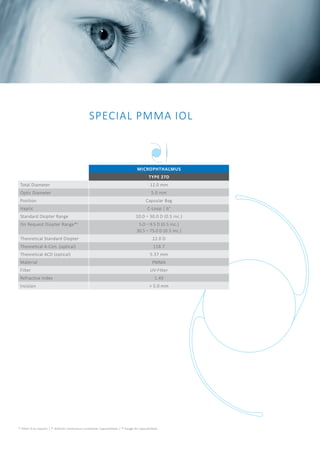
MICROPHTHALMUS
TYPE 27D
Total Diameter 12.0 mm
Optic Diameter 5.0 mm
Position Capsular Bag
Haptic C-Loop | 6°
Standard Diopter Range 10.0 – 30.0 D (0.5 inc.)
On Request Diopter Range*1
5.0 – 9.5 D (0.5 inc.)
30.5 – 75.0 D (0.5 inc.)
Theoretical Standard Diopter 22.0 D
Theoretical A-Con. (optical) 118.7
Theoretical ACD (optical) 5.37 mm
Material PMMA
Filter UV-Filter
Refractive Index 1.49
Incision > 5.0 mm
IMPLANTS FOR SHORT EYES
V2018-01/BAR
background of the bil
The Bag-In-the-Lens was initially designed and patented as “intraocular lens
and method for preventing secondary opacification”.
US Patent Number 6,027,531
EP Patent Number 0916320A2
The clinical study on the Bag-In-the-Lens started in 2000 after approval by
the ethics committee of the Antwerp University Hospital (1/47/136) and
got the approval of the Belgian Social Security in 2004.
how to become a bil-user
Those surgeons who are interested to implant the BIL can become certified after having performed the following training:
1. Wetlab and instructional course at the Annual ESCRS meeting on PPCCC, which is a prerequisite course to be allowed at the wetlab.
2. Observership at the Antwerp University Hospital, Department Ophthalmology
Director 	 Prof. Dr. Marie-José Tassignon
Faculty BIL users 	 Prof. Dr. Marie-José Tassignon, Prof. Dr. Veva De Groot, Dr. Jan Van Looveren,
		 Dr. Stefan Kiekens, Dr. Sorcha Ní Dhubhghaill
Scientific coordinator 	 Danny Mathysen
3. Observership at any centers with certified instructors
OPHTHALMIC IMPLANTS
FOR SHORT EYES
MORCHER® GmbH
Kapuzinerweg 12	
70374 Stuttgart
GERMANY	
Phone 	 +49 (0) 711 / 95 320 - 0	 E-Mail 	 info@morcher.com
Fax 	 +49 (0) 711 / 95 320 - 80	 Web	 www.morcher.com
FOLDABLE HYDROPHILIC IOLS CAPSULAR RINGSSPECIAL PMMA IOL
CAPSULAR TENSION RING CIONNI RING FOR SCLERAL FIXATION
TYPE 13S TYPE 1S
Size (open) 10.5 mm 10.66 mm
Size (compressed) 9.0 mm 8.5 mm
Zonular Damage up to 4 hours (120°) > 4 hours (120°)
Bulbus Length < 24.0 mm < 24.0 mm
ACCC*2
- 6.0 mm
Suturable arms - one
Injector (recommendation) GEUDER G-32960, EYE TECHNOLOGY I-9006 Cannot be implanted with an injector!
Material CLEAR PMMA
Fixation - We recommend the use of 9-0 double armed
prolene sutures with spatula needles
Advantages ■	 expands and stabilizes the capsular bag
■	 distributes the pressure to all zonular fibers 	
	 and prevents one-sided pressure to single 		
	 zonular fibers
■	 centers the IOL in a better way, subsequent 		
	 with a later capsular bag shrinkage
■	 diminishes the risk of capsular bag or zonular 	
	 damage during the surgery
■	 facilitates phacoemulsification, cortical
	 aspiration and IOL implantation
■	 replaces the need for a scleral IOL
■	 simplifies IOL explantation
■	 reduces folds of the capsule
■	 the capsular tension rings have eyelets at 		
	 both ends to facilitate insertion
■	 expands and stabilizes the capsular bag
■	 distributes the pressure to all zonular fibers 	
	 and prevents one-sided pressure to single 		
	 zonular fibers
■	 centers the IOL in a better way, subsequent 		
	 with a later capsular bag shrinkage
■	 diminishes the risk of capsular bag or zonular 	
	 damage during the surgery
■	 facilitates phacoemulsification, cortical
	 aspiration and IOL implantation
■	 replaces the need for a scleral IOL
■	 simplifies IOL explantation
■	 reduces folds of the capsule
■	 a secure alternative to capsule supporting hooks
■	 the ring have eyelets at both ends to facilitate 	
	insertion
*1
Other D on request │ *2
Anterior Continuous Curvolinear Capsulorhexis │ *3
Gauge for Capsulorhexis
No PCO in
visual field!
BAG IN THE LENS SERIES
TYPE 89A TYPE 89A TORIC TYPE 89D
Indication Adults
Pediatrics
Adults
Pediatrics
For short eyes (< 18.0 mm)
and/or small white to white
< 10.0 mm
Total Diameter 7.5 mm 7.5 mm 6.5 mm
Optic Diameter 5.0 mm 5.0 mm 4.5 mm
Standard Diopter Range 10.0 – 30.0 D (0.5 inc.) 10.0 – 30.0 D (0.5 inc.) 10.0 – 30.0 D (0.5 inc.)
On Request Diopter Range*1
8.5 – 9.5 D (0.5 inc.)
30.5 – 35.0 D (0.5 inc.)
8.5 – 9.5 D (0.5 inc.) 8.5 – 9.5 D (0.5 inc.)
30.5 – 35.0 D (0.5 inc.)
Cylindrical Power - 0.5 – 8.0 D (0.5 inc.) -
Theoretical Standard Diopter 23.0 D
Theoretical A-Con. (optical) 118.2
Theoretical ACD (optical) 5.08 mm
Material Hydrophilic Acrylic
Water Content 28.0 %
Filter UV-Filter
Refractive Index 1.46
Injector (recommendation) Up to + 23.0 diopters: Medicel ACCUJECTTM
2.2-BL (LP604535)
Wound assisted injection: 1.9 – 2.2 mm, Wound injection: 2.2 mm
For all diopters: Medicel ACCUJECTTM
2.6-BL (LP604505)
Wound assisted injection: 2.2 mm, Wound injection: 2.6 mm
Recommended
Caliper Ring*3
for ACCC*2
TYPE 5
TYPE 4L (PED)
TYPE 5 TYPE 4L
Note Surgeons must partake in prerequiste course before implantation!
Security Advice Due to the possibility of iris capture it is recommended to keep the iris in miosis
for three days after surgery!
Advantages ■	 no postoperative stimuli
■	 no synechiae
■	 no PCO in the visual field (ideal IOL for diabetics)
■	 full pupil range
■	 no negativ dysphotopsia
MICROPHTHALMUS
TYPE 27D
Total Diameter 12.0 mm
Optic Diameter 5.0 mm
Position Capsular Bag
Haptic C-Loop | 6°
Standard Diopter Range 10.0 – 30.0 D (0.5 inc.)
On Request Diopter Range*1
5.0 – 9.5 D (0.5 inc.)
30.5 – 75.0 D (0.5 inc.)
Theoretical Standard Diopter 22.0 D
Theoretical A-Con. (optical) 118.7
Theoretical ACD (optical) 5.37 mm
Material PMMA
Filter UV-Filter
Refractive Index 1.49
Incision > 5.0 mm
FOLDABLE HYDROPHILIC IOLS CAPSULAR RINGSSPECIAL PMMA IOL
CAPSULAR TENSION RING CIONNI RING FOR SCLERAL FIXATION
TYPE 13S TYPE 1S
Size (open) 10.5 mm 10.66 mm
Size (compressed) 9.0 mm 8.5 mm
Zonular Damage up to 4 hours (120°) > 4 hours (120°)
Bulbus Length < 24.0 mm < 24.0 mm
ACCC*2
- 6.0 mm
Suturable arms - one
Injector (recommendation) GEUDER G-32960, EYE TECHNOLOGY I-9006 Cannot be implanted with an injector!
Material CLEAR PMMA
Fixation - We recommend the use of 9-0 double armed
prolene sutures with spatula needles
Advantages ■	 expands and stabilizes the capsular bag
■	 distributes the pressure to all zonular fibers 	
	 and prevents one-sided pressure to single 		
	 zonular fibers
■	 centers the IOL in a better way, subsequent 		
	 with a later capsular bag shrinkage
■	 diminishes the risk of capsular bag or zonular 	
	 damage during the surgery
■	 facilitates phacoemulsification, cortical
	 aspiration and IOL implantation
■	 replaces the need for a scleral IOL
■	 simplifies IOL explantation
■	 reduces folds of the capsule
■	 the capsular tension rings have eyelets at 		
	 both ends to facilitate insertion
■	 expands and stabilizes the capsular bag
■	 distributes the pressure to all zonular fibers 	
	 and prevents one-sided pressure to single 		
	 zonular fibers
■	 centers the IOL in a better way, subsequent 		
	 with a later capsular bag shrinkage
■	 diminishes the risk of capsular bag or zonular 	
	 damage during the surgery
■	 facilitates phacoemulsification, cortical
	 aspiration and IOL implantation
■	 replaces the need for a scleral IOL
■	 simplifies IOL explantation
■	 reduces folds of the capsule
■	 a secure alternative to capsule supporting hooks
■	 the ring have eyelets at both ends to facilitate 	
	insertion
*1
Other D on request │ *2
Anterior Continuous Curvolinear Capsulorhexis │ *3
Gauge for Capsulorhexis
No PCO in
visual field!
BAG IN THE LENS SERIES
TYPE 89A TYPE 89A TORIC TYPE 89D
Indication Adults
Pediatrics
Adults
Pediatrics
For short eyes (< 18.0 mm)
and/or small white to white
< 10.0 mm
Total Diameter 7.5 mm 7.5 mm 6.5 mm
Optic Diameter 5.0 mm 5.0 mm 4.5 mm
Standard Diopter Range 10.0 – 30.0 D (0.5 inc.) 10.0 – 30.0 D (0.5 inc.) 10.0 – 30.0 D (0.5 inc.)
On Request Diopter Range*1
8.5 – 9.5 D (0.5 inc.)
30.5 – 35.0 D (0.5 inc.)
8.5 – 9.5 D (0.5 inc.) 8.5 – 9.5 D (0.5 inc.)
30.5 – 35.0 D (0.5 inc.)
Cylindrical Power - 0.5 – 8.0 D (0.5 inc.) -
Theoretical Standard Diopter 23.0 D
Theoretical A-Con. (optical) 118.2
Theoretical ACD (optical) 5.08 mm
Material Hydrophilic Acrylic
Water Content 28.0 %
Filter UV-Filter
Refractive Index 1.46
Injector (recommendation) Up to + 23.0 diopters: Medicel ACCUJECTTM
2.2-BL (LP604535)
Wound assisted injection: 1.9 – 2.2 mm, Wound injection: 2.2 mm
For all diopters: Medicel ACCUJECTTM
2.6-BL (LP604505)
Wound assisted injection: 2.2 mm, Wound injection: 2.6 mm
Recommended
Caliper Ring*3
for ACCC*2
TYPE 5
TYPE 4L (PED)
TYPE 5 TYPE 4L
Note Surgeons must partake in prerequiste course before implantation!
Security Advice Due to the possibility of iris capture it is recommended to keep the iris in miosis
for three days after surgery!
Advantages ■	 no postoperative stimuli
■	 no synechiae
■	 no PCO in the visual field (ideal IOL for diabetics)
■	 full pupil range
■	 no negativ dysphotopsia
MICROPHTHALMUS
TYPE 27D
Total Diameter 12.0 mm
Optic Diameter 5.0 mm
Position Capsular Bag
Haptic C-Loop | 6°
Standard Diopter Range 10.0 – 30.0 D (0.5 inc.)
On Request Diopter Range*1
5.0 – 9.5 D (0.5 inc.)
30.5 – 75.0 D (0.5 inc.)
Theoretical Standard Diopter 22.0 D
Theoretical A-Con. (optical) 118.7
Theoretical ACD (optical) 5.37 mm
Material PMMA
Filter UV-Filter
Refractive Index 1.49
Incision > 5.0 mm
IMPLANTS FOR SHORT EYES
V2018-01/BAR
background of the bil
The Bag-In-the-Lens was initially designed and patented as “intraocular lens
and method for preventing secondary opacification”.
US Patent Number 6,027,531
EP Patent Number 0916320A2
The clinical study on the Bag-In-the-Lens started in 2000 after approval by
the ethics committee of the Antwerp University Hospital (1/47/136) and
got the approval of the Belgian Social Security in 2004.
how to become a bil-user
Those surgeons who are interested to implant the BIL can become certified after having performed the following training:
1. Wetlab and instructional course at the Annual ESCRS meeting on PPCCC, which is a prerequisite course to be allowed at the wetlab.
2. Observership at the Antwerp University Hospital, Department Ophthalmology
Director 	 Prof. Dr. Marie-José Tassignon
Faculty BIL users 	 Prof. Dr. Marie-José Tassignon, Prof. Dr. Veva De Groot, Dr. Jan Van Looveren,
		 Dr. Stefan Kiekens, Dr. Sorcha Ní Dhubhghaill
Scientific coordinator 	 Danny Mathysen
3. Observership at any centers with certified instructors
OPHTHALMIC IMPLANTS
FOR SHORT EYES
MORCHER® GmbH
Kapuzinerweg 12	
70374 Stuttgart
GERMANY	
Phone 	 +49 (0) 711 / 95 320 - 0	 E-Mail 	 info@morcher.com
Fax 	 +49 (0) 711 / 95 320 - 80	 Web	 www.morcher.com

Ophthalmic implants for short eyes

  • 1.
    IMPLANTS FOR SHORTEYES V2018-01/BAR background of the bil The Bag-In-the-Lens was initially designed and patented as “intraocular lens and method for preventing secondary opacification”. US Patent Number 6,027,531 EP Patent Number 0916320A2 The clinical study on the Bag-In-the-Lens started in 2000 after approval by the ethics committee of the Antwerp University Hospital (1/47/136) and got the approval of the Belgian Social Security in 2004. how to become a bil-user Those surgeons who are interested to implant the BIL can become certified after having performed the following training: 1. Wetlab and instructional course at the Annual ESCRS meeting on PPCCC, which is a prerequisite course to be allowed at the wetlab. 2. Observership at the Antwerp University Hospital, Department Ophthalmology Director Prof. Dr. Marie-José Tassignon Faculty BIL users Prof. Dr. Marie-José Tassignon, Prof. Dr. Veva De Groot, Dr. Jan Van Looveren, Dr. Stefan Kiekens, Dr. Sorcha Ní Dhubhghaill Scientific coordinator Danny Mathysen 3. Observership at any centers with certified instructors OPHTHALMIC IMPLANTS FOR SHORT EYES MORCHER® GmbH Kapuzinerweg 12 70374 Stuttgart GERMANY Phone +49 (0) 711 / 95 320 - 0 E-Mail info@morcher.com Fax +49 (0) 711 / 95 320 - 80 Web www.morcher.com
  • 2.
    FOLDABLE HYDROPHILIC IOLSCAPSULAR RINGSSPECIAL PMMA IOL CAPSULAR TENSION RING CIONNI RING FOR SCLERAL FIXATION TYPE 13S TYPE 1S Size (open) 10.5 mm 10.66 mm Size (compressed) 9.0 mm 8.5 mm Zonular Damage up to 4 hours (120°) > 4 hours (120°) Bulbus Length < 24.0 mm < 24.0 mm ACCC*2 - 6.0 mm Suturable arms - one Injector (recommendation) GEUDER G-32960, EYE TECHNOLOGY I-9006 Cannot be implanted with an injector! Material CLEAR PMMA Fixation - We recommend the use of 9-0 double armed prolene sutures with spatula needles Advantages ■ expands and stabilizes the capsular bag ■ distributes the pressure to all zonular fibers and prevents one-sided pressure to single zonular fibers ■ centers the IOL in a better way, subsequent with a later capsular bag shrinkage ■ diminishes the risk of capsular bag or zonular damage during the surgery ■ facilitates phacoemulsification, cortical aspiration and IOL implantation ■ replaces the need for a scleral IOL ■ simplifies IOL explantation ■ reduces folds of the capsule ■ the capsular tension rings have eyelets at both ends to facilitate insertion ■ expands and stabilizes the capsular bag ■ distributes the pressure to all zonular fibers and prevents one-sided pressure to single zonular fibers ■ centers the IOL in a better way, subsequent with a later capsular bag shrinkage ■ diminishes the risk of capsular bag or zonular damage during the surgery ■ facilitates phacoemulsification, cortical aspiration and IOL implantation ■ replaces the need for a scleral IOL ■ simplifies IOL explantation ■ reduces folds of the capsule ■ a secure alternative to capsule supporting hooks ■ the ring have eyelets at both ends to facilitate insertion *1 Other D on request │ *2 Anterior Continuous Curvolinear Capsulorhexis │ *3 Gauge for Capsulorhexis No PCO in visual field! BAG IN THE LENS SERIES TYPE 89A TYPE 89A TORIC TYPE 89D Indication Adults Pediatrics Adults Pediatrics For short eyes (< 18.0 mm) and/or small white to white < 10.0 mm Total Diameter 7.5 mm 7.5 mm 6.5 mm Optic Diameter 5.0 mm 5.0 mm 4.5 mm Standard Diopter Range 10.0 – 30.0 D (0.5 inc.) 10.0 – 30.0 D (0.5 inc.) 10.0 – 30.0 D (0.5 inc.) On Request Diopter Range*1 8.5 – 9.5 D (0.5 inc.) 30.5 – 35.0 D (0.5 inc.) 8.5 – 9.5 D (0.5 inc.) 8.5 – 9.5 D (0.5 inc.) 30.5 – 35.0 D (0.5 inc.) Cylindrical Power - 0.5 – 8.0 D (0.5 inc.) - Theoretical Standard Diopter 23.0 D Theoretical A-Con. (optical) 118.2 Theoretical ACD (optical) 5.08 mm Material Hydrophilic Acrylic Water Content 28.0 % Filter UV-Filter Refractive Index 1.46 Injector (recommendation) Up to + 23.0 diopters: Medicel ACCUJECTTM 2.2-BL (LP604535) Wound assisted injection: 1.9 – 2.2 mm, Wound injection: 2.2 mm For all diopters: Medicel ACCUJECTTM 2.6-BL (LP604505) Wound assisted injection: 2.2 mm, Wound injection: 2.6 mm Recommended Caliper Ring*3 for ACCC*2 TYPE 5 TYPE 4L (PED) TYPE 5 TYPE 4L Note Surgeons must partake in prerequiste course before implantation! Security Advice Due to the possibility of iris capture it is recommended to keep the iris in miosis for three days after surgery! Advantages ■ no postoperative stimuli ■ no synechiae ■ no PCO in the visual field (ideal IOL for diabetics) ■ full pupil range ■ no negativ dysphotopsia MICROPHTHALMUS TYPE 27D Total Diameter 12.0 mm Optic Diameter 5.0 mm Position Capsular Bag Haptic C-Loop | 6° Standard Diopter Range 10.0 – 30.0 D (0.5 inc.) On Request Diopter Range*1 5.0 – 9.5 D (0.5 inc.) 30.5 – 75.0 D (0.5 inc.) Theoretical Standard Diopter 22.0 D Theoretical A-Con. (optical) 118.7 Theoretical ACD (optical) 5.37 mm Material PMMA Filter UV-Filter Refractive Index 1.49 Incision > 5.0 mm
  • 3.
    IMPLANTS FOR SHORTEYES V2018-01/BAR background of the bil The Bag-In-the-Lens was initially designed and patented as “intraocular lens and method for preventing secondary opacification”. US Patent Number 6,027,531 EP Patent Number 0916320A2 The clinical study on the Bag-In-the-Lens started in 2000 after approval by the ethics committee of the Antwerp University Hospital (1/47/136) and got the approval of the Belgian Social Security in 2004. how to become a bil-user Those surgeons who are interested to implant the BIL can become certified after having performed the following training: 1. Wetlab and instructional course at the Annual ESCRS meeting on PPCCC, which is a prerequisite course to be allowed at the wetlab. 2. Observership at the Antwerp University Hospital, Department Ophthalmology Director Prof. Dr. Marie-José Tassignon Faculty BIL users Prof. Dr. Marie-José Tassignon, Prof. Dr. Veva De Groot, Dr. Jan Van Looveren, Dr. Stefan Kiekens, Dr. Sorcha Ní Dhubhghaill Scientific coordinator Danny Mathysen 3. Observership at any centers with certified instructors OPHTHALMIC IMPLANTS FOR SHORT EYES MORCHER® GmbH Kapuzinerweg 12 70374 Stuttgart GERMANY Phone +49 (0) 711 / 95 320 - 0 E-Mail info@morcher.com Fax +49 (0) 711 / 95 320 - 80 Web www.morcher.com
  • 4.
    FOLDABLE HYDROPHILIC IOLSCAPSULAR RINGSSPECIAL PMMA IOL CAPSULAR TENSION RING CIONNI RING FOR SCLERAL FIXATION TYPE 13S TYPE 1S Size (open) 10.5 mm 10.66 mm Size (compressed) 9.0 mm 8.5 mm Zonular Damage up to 4 hours (120°) > 4 hours (120°) Bulbus Length < 24.0 mm < 24.0 mm ACCC*2 - 6.0 mm Suturable arms - one Injector (recommendation) GEUDER G-32960, EYE TECHNOLOGY I-9006 Cannot be implanted with an injector! Material CLEAR PMMA Fixation - We recommend the use of 9-0 double armed prolene sutures with spatula needles Advantages ■ expands and stabilizes the capsular bag ■ distributes the pressure to all zonular fibers and prevents one-sided pressure to single zonular fibers ■ centers the IOL in a better way, subsequent with a later capsular bag shrinkage ■ diminishes the risk of capsular bag or zonular damage during the surgery ■ facilitates phacoemulsification, cortical aspiration and IOL implantation ■ replaces the need for a scleral IOL ■ simplifies IOL explantation ■ reduces folds of the capsule ■ the capsular tension rings have eyelets at both ends to facilitate insertion ■ expands and stabilizes the capsular bag ■ distributes the pressure to all zonular fibers and prevents one-sided pressure to single zonular fibers ■ centers the IOL in a better way, subsequent with a later capsular bag shrinkage ■ diminishes the risk of capsular bag or zonular damage during the surgery ■ facilitates phacoemulsification, cortical aspiration and IOL implantation ■ replaces the need for a scleral IOL ■ simplifies IOL explantation ■ reduces folds of the capsule ■ a secure alternative to capsule supporting hooks ■ the ring have eyelets at both ends to facilitate insertion *1 Other D on request │ *2 Anterior Continuous Curvolinear Capsulorhexis │ *3 Gauge for Capsulorhexis No PCO in visual field! BAG IN THE LENS SERIES TYPE 89A TYPE 89A TORIC TYPE 89D Indication Adults Pediatrics Adults Pediatrics For short eyes (< 18.0 mm) and/or small white to white < 10.0 mm Total Diameter 7.5 mm 7.5 mm 6.5 mm Optic Diameter 5.0 mm 5.0 mm 4.5 mm Standard Diopter Range 10.0 – 30.0 D (0.5 inc.) 10.0 – 30.0 D (0.5 inc.) 10.0 – 30.0 D (0.5 inc.) On Request Diopter Range*1 8.5 – 9.5 D (0.5 inc.) 30.5 – 35.0 D (0.5 inc.) 8.5 – 9.5 D (0.5 inc.) 8.5 – 9.5 D (0.5 inc.) 30.5 – 35.0 D (0.5 inc.) Cylindrical Power - 0.5 – 8.0 D (0.5 inc.) - Theoretical Standard Diopter 23.0 D Theoretical A-Con. (optical) 118.2 Theoretical ACD (optical) 5.08 mm Material Hydrophilic Acrylic Water Content 28.0 % Filter UV-Filter Refractive Index 1.46 Injector (recommendation) Up to + 23.0 diopters: Medicel ACCUJECTTM 2.2-BL (LP604535) Wound assisted injection: 1.9 – 2.2 mm, Wound injection: 2.2 mm For all diopters: Medicel ACCUJECTTM 2.6-BL (LP604505) Wound assisted injection: 2.2 mm, Wound injection: 2.6 mm Recommended Caliper Ring*3 for ACCC*2 TYPE 5 TYPE 4L (PED) TYPE 5 TYPE 4L Note Surgeons must partake in prerequiste course before implantation! Security Advice Due to the possibility of iris capture it is recommended to keep the iris in miosis for three days after surgery! Advantages ■ no postoperative stimuli ■ no synechiae ■ no PCO in the visual field (ideal IOL for diabetics) ■ full pupil range ■ no negativ dysphotopsia MICROPHTHALMUS TYPE 27D Total Diameter 12.0 mm Optic Diameter 5.0 mm Position Capsular Bag Haptic C-Loop | 6° Standard Diopter Range 10.0 – 30.0 D (0.5 inc.) On Request Diopter Range*1 5.0 – 9.5 D (0.5 inc.) 30.5 – 75.0 D (0.5 inc.) Theoretical Standard Diopter 22.0 D Theoretical A-Con. (optical) 118.7 Theoretical ACD (optical) 5.37 mm Material PMMA Filter UV-Filter Refractive Index 1.49 Incision > 5.0 mm
  • 5.
    FOLDABLE HYDROPHILIC IOLSCAPSULAR RINGSSPECIAL PMMA IOL CAPSULAR TENSION RING CIONNI RING FOR SCLERAL FIXATION TYPE 13S TYPE 1S Size (open) 10.5 mm 10.66 mm Size (compressed) 9.0 mm 8.5 mm Zonular Damage up to 4 hours (120°) > 4 hours (120°) Bulbus Length < 24.0 mm < 24.0 mm ACCC*2 - 6.0 mm Suturable arms - one Injector (recommendation) GEUDER G-32960, EYE TECHNOLOGY I-9006 Cannot be implanted with an injector! Material CLEAR PMMA Fixation - We recommend the use of 9-0 double armed prolene sutures with spatula needles Advantages ■ expands and stabilizes the capsular bag ■ distributes the pressure to all zonular fibers and prevents one-sided pressure to single zonular fibers ■ centers the IOL in a better way, subsequent with a later capsular bag shrinkage ■ diminishes the risk of capsular bag or zonular damage during the surgery ■ facilitates phacoemulsification, cortical aspiration and IOL implantation ■ replaces the need for a scleral IOL ■ simplifies IOL explantation ■ reduces folds of the capsule ■ the capsular tension rings have eyelets at both ends to facilitate insertion ■ expands and stabilizes the capsular bag ■ distributes the pressure to all zonular fibers and prevents one-sided pressure to single zonular fibers ■ centers the IOL in a better way, subsequent with a later capsular bag shrinkage ■ diminishes the risk of capsular bag or zonular damage during the surgery ■ facilitates phacoemulsification, cortical aspiration and IOL implantation ■ replaces the need for a scleral IOL ■ simplifies IOL explantation ■ reduces folds of the capsule ■ a secure alternative to capsule supporting hooks ■ the ring have eyelets at both ends to facilitate insertion *1 Other D on request │ *2 Anterior Continuous Curvolinear Capsulorhexis │ *3 Gauge for Capsulorhexis No PCO in visual field! BAG IN THE LENS SERIES TYPE 89A TYPE 89A TORIC TYPE 89D Indication Adults Pediatrics Adults Pediatrics For short eyes (< 18.0 mm) and/or small white to white < 10.0 mm Total Diameter 7.5 mm 7.5 mm 6.5 mm Optic Diameter 5.0 mm 5.0 mm 4.5 mm Standard Diopter Range 10.0 – 30.0 D (0.5 inc.) 10.0 – 30.0 D (0.5 inc.) 10.0 – 30.0 D (0.5 inc.) On Request Diopter Range*1 8.5 – 9.5 D (0.5 inc.) 30.5 – 35.0 D (0.5 inc.) 8.5 – 9.5 D (0.5 inc.) 8.5 – 9.5 D (0.5 inc.) 30.5 – 35.0 D (0.5 inc.) Cylindrical Power - 0.5 – 8.0 D (0.5 inc.) - Theoretical Standard Diopter 23.0 D Theoretical A-Con. (optical) 118.2 Theoretical ACD (optical) 5.08 mm Material Hydrophilic Acrylic Water Content 28.0 % Filter UV-Filter Refractive Index 1.46 Injector (recommendation) Up to + 23.0 diopters: Medicel ACCUJECTTM 2.2-BL (LP604535) Wound assisted injection: 1.9 – 2.2 mm, Wound injection: 2.2 mm For all diopters: Medicel ACCUJECTTM 2.6-BL (LP604505) Wound assisted injection: 2.2 mm, Wound injection: 2.6 mm Recommended Caliper Ring*3 for ACCC*2 TYPE 5 TYPE 4L (PED) TYPE 5 TYPE 4L Note Surgeons must partake in prerequiste course before implantation! Security Advice Due to the possibility of iris capture it is recommended to keep the iris in miosis for three days after surgery! Advantages ■ no postoperative stimuli ■ no synechiae ■ no PCO in the visual field (ideal IOL for diabetics) ■ full pupil range ■ no negativ dysphotopsia MICROPHTHALMUS TYPE 27D Total Diameter 12.0 mm Optic Diameter 5.0 mm Position Capsular Bag Haptic C-Loop | 6° Standard Diopter Range 10.0 – 30.0 D (0.5 inc.) On Request Diopter Range*1 5.0 – 9.5 D (0.5 inc.) 30.5 – 75.0 D (0.5 inc.) Theoretical Standard Diopter 22.0 D Theoretical A-Con. (optical) 118.7 Theoretical ACD (optical) 5.37 mm Material PMMA Filter UV-Filter Refractive Index 1.49 Incision > 5.0 mm
  • 6.
    IMPLANTS FOR SHORTEYES V2018-01/BAR background of the bil The Bag-In-the-Lens was initially designed and patented as “intraocular lens and method for preventing secondary opacification”. US Patent Number 6,027,531 EP Patent Number 0916320A2 The clinical study on the Bag-In-the-Lens started in 2000 after approval by the ethics committee of the Antwerp University Hospital (1/47/136) and got the approval of the Belgian Social Security in 2004. how to become a bil-user Those surgeons who are interested to implant the BIL can become certified after having performed the following training: 1. Wetlab and instructional course at the Annual ESCRS meeting on PPCCC, which is a prerequisite course to be allowed at the wetlab. 2. Observership at the Antwerp University Hospital, Department Ophthalmology Director Prof. Dr. Marie-José Tassignon Faculty BIL users Prof. Dr. Marie-José Tassignon, Prof. Dr. Veva De Groot, Dr. Jan Van Looveren, Dr. Stefan Kiekens, Dr. Sorcha Ní Dhubhghaill Scientific coordinator Danny Mathysen 3. Observership at any centers with certified instructors OPHTHALMIC IMPLANTS FOR SHORT EYES MORCHER® GmbH Kapuzinerweg 12 70374 Stuttgart GERMANY Phone +49 (0) 711 / 95 320 - 0 E-Mail info@morcher.com Fax +49 (0) 711 / 95 320 - 80 Web www.morcher.com