OPERATIONS
ON REAL NUMBERS
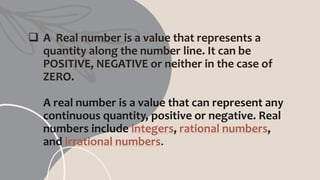
 A Real number is a value that represents a
quantity along the number line. It can be
POSITIVE, NEGATIVE or neither in the case of
ZERO.
A real number is a value that can represent any
continuous quantity, positive or negative. Real
numbers include integers, rational numbers,
and irrational numbers.
3
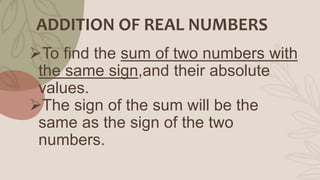
ADDITION OF REAL NUMBERS
To find the sum of two numbers with
the same sign,and their absolute
values.
The sign of the sum will be the
same as the sign of the two
numbers.
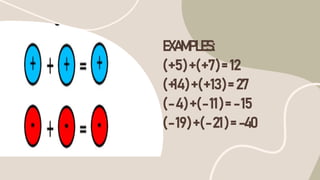
EXAMPLES:
(+5)+(+7)= 12
(+14)+(+13)= 27
(-4)+( -11)= -15
(-19)+( -21)= -40
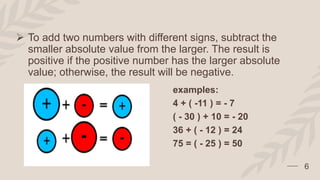
 To add two numbers with different signs, subtract the
smaller absolute value from the larger. The result is
positive if the positive number has the larger absolute
value; otherwise, the result will be negative.
examples:
4 + ( -11 ) = - 7
( - 30 ) + 10 = - 20
36 + ( - 12 ) = 24
75 = ( - 25 ) = 50
6
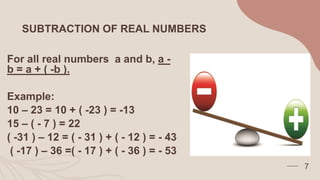
SUBTRACTION OF REAL NUMBERS
For all real numbers a and b, a -
b = a + ( -b ).
Example:
10 – 23 = 10 + ( -23 ) = -13
15 – ( - 7 ) = 22
( -31 ) – 12 = ( - 31 ) + ( - 12 ) = - 43
( -17 ) – 36 =( - 17 ) + ( - 36 ) = - 53
7
MULTIPLICATION OF REAL NUMBERS
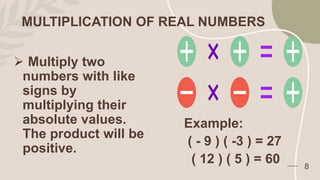
 Multiply two
numbers with like
signs by
multiplying their
absolute values.
The product will be
positive.
8
Example:
( - 9 ) ( -3 ) = 27
( 12 ) ( 5 ) = 60
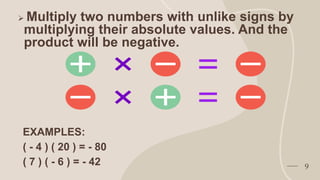
 Multiply two numbers with unlike signs by
multiplying their absolute values. And the
product will be negative.
9
EXAMPLES:
( - 4 ) ( 20 ) = - 80
( 7 ) ( - 6 ) = - 42
DIVISION OF REAL NUMBERS
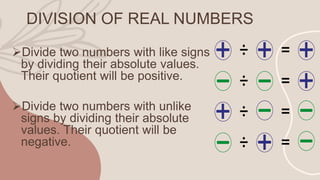
Divide two numbers with like signs
by dividing their absolute values.
Their quotient will be positive.
Divide two numbers with unlike
signs by dividing their absolute
values. Their quotient will be
negative.
THANK YOU!

Operation on real number mathematics.pptx

  • 1.
  • 2.
     A Realnumber is a value that represents a quantity along the number line. It can be POSITIVE, NEGATIVE or neither in the case of ZERO. A real number is a value that can represent any continuous quantity, positive or negative. Real numbers include integers, rational numbers, and irrational numbers.
  • 3.
  • 4.
    ADDITION OF REALNUMBERS To find the sum of two numbers with the same sign,and their absolute values. The sign of the sum will be the same as the sign of the two numbers.
  • 5.
  • 6.
     To addtwo numbers with different signs, subtract the smaller absolute value from the larger. The result is positive if the positive number has the larger absolute value; otherwise, the result will be negative. examples: 4 + ( -11 ) = - 7 ( - 30 ) + 10 = - 20 36 + ( - 12 ) = 24 75 = ( - 25 ) = 50 6
  • 7.
    SUBTRACTION OF REALNUMBERS For all real numbers a and b, a - b = a + ( -b ). Example: 10 – 23 = 10 + ( -23 ) = -13 15 – ( - 7 ) = 22 ( -31 ) – 12 = ( - 31 ) + ( - 12 ) = - 43 ( -17 ) – 36 =( - 17 ) + ( - 36 ) = - 53 7
  • 8.
    MULTIPLICATION OF REALNUMBERS  Multiply two numbers with like signs by multiplying their absolute values. The product will be positive. 8 Example: ( - 9 ) ( -3 ) = 27 ( 12 ) ( 5 ) = 60
  • 9.
     Multiply twonumbers with unlike signs by multiplying their absolute values. And the product will be negative. 9 EXAMPLES: ( - 4 ) ( 20 ) = - 80 ( 7 ) ( - 6 ) = - 42
  • 10.
    DIVISION OF REALNUMBERS Divide two numbers with like signs by dividing their absolute values. Their quotient will be positive. Divide two numbers with unlike signs by dividing their absolute values. Their quotient will be negative.
  • 11.