QUESTION:
On what basis did you sort these objects
into 2 groups?
Which of these are the same?
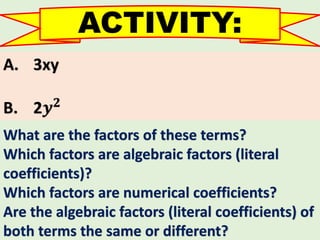
ACTIVITY:
A. 3xy
B. 2𝒚 𝟐
What are the factors of these terms?
Which factors are algebraic factors (literal
coefficients)?
Which factors are numerical coefficients?
Are the algebraic factors (literal coefficients) of
both terms the same or different?
AIM:
Today we will learn about like
terms and unlike terms.
TASK:
A. 6xy
B. 4𝒙 𝟐
C. 2yx
D. 𝒚 𝟐
x
E. 𝒙 𝟐
F. 7x𝒚 𝟐
Identify the factors of the terms. Then, group
the terms according to their algebraic factor.
LIKE TERMS
These are terms that have exactly the
same algebraic (variable) factors.
Terms that have different algebraic factors
are known as unlike terms.
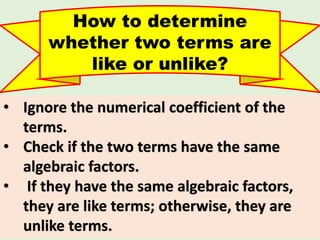
How to determine
whether two terms are
like or unlike?
• Ignore the numerical coefficient of the
terms.
• Check if the two terms have the same
algebraic factors.
• If they have the same algebraic factors,
they are like terms; otherwise, they are
unlike terms.
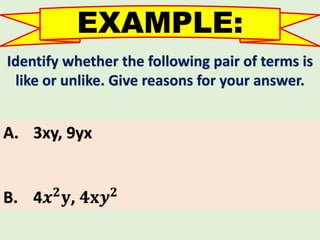
EXAMPLE:
A. 3xy, 9yx
B. 4𝒙 𝟐
𝐲, 𝟒𝐱𝒚 𝟐
Identify whether the following pair of terms is
like or unlike. Give reasons for your answer.
EXAMPLE:
John has 3 set of tiles.
Set 1 Set 2 Set 3
𝒙 𝟐
𝒙 𝟐
𝒙 𝟐 xx xx
What is the number of tiles of each type
in Set 1? Set 2? Set 3?
What do we learn from these?
REMEMBER:
To add like terms, we add the numerical
coefficients and keep the algebraic factors
(variables) the same.
CLASSWORK:
FINISH S1, page 22 from your
XSEED Workbook
HOMEWORK:
Complete Practice Questions 1 – 3,
page 107

Like & unlike terms

  • 1.
    QUESTION: On what basisdid you sort these objects into 2 groups? Which of these are the same?
  • 2.
    ACTIVITY: A. 3xy B. 2𝒚𝟐 What are the factors of these terms? Which factors are algebraic factors (literal coefficients)? Which factors are numerical coefficients? Are the algebraic factors (literal coefficients) of both terms the same or different?
  • 3.
    AIM: Today we willlearn about like terms and unlike terms.
  • 4.
    TASK: A. 6xy B. 4𝒙𝟐 C. 2yx D. 𝒚 𝟐 x E. 𝒙 𝟐 F. 7x𝒚 𝟐 Identify the factors of the terms. Then, group the terms according to their algebraic factor.
  • 5.
    LIKE TERMS These areterms that have exactly the same algebraic (variable) factors. Terms that have different algebraic factors are known as unlike terms.
  • 6.
    How to determine whethertwo terms are like or unlike? • Ignore the numerical coefficient of the terms. • Check if the two terms have the same algebraic factors. • If they have the same algebraic factors, they are like terms; otherwise, they are unlike terms.
  • 7.
    EXAMPLE: A. 3xy, 9yx B.4𝒙 𝟐 𝐲, 𝟒𝐱𝒚 𝟐 Identify whether the following pair of terms is like or unlike. Give reasons for your answer.
  • 8.
    EXAMPLE: John has 3set of tiles. Set 1 Set 2 Set 3 𝒙 𝟐 𝒙 𝟐 𝒙 𝟐 xx xx What is the number of tiles of each type in Set 1? Set 2? Set 3? What do we learn from these?
  • 9.
    REMEMBER: To add liketerms, we add the numerical coefficients and keep the algebraic factors (variables) the same.
  • 10.
    CLASSWORK: FINISH S1, page22 from your XSEED Workbook
  • 11.