Lesson for Week 1
Perfect square and perfect cube
Square root and cuberoot
Irrational Numbers
The learners determine the square roots of perfect
squares and the cube roots of perfect cubes.
1.The learners define perfect square and perfect cube.
2.The learners identify perfect squares and perfect cubes.
3.The learners define square root and cube root.
4.The learners determine the square roots of perfect
squares.
5.The learners determine the cube roots of perfect cubes.
Lesson Competencies
and Objectives
The learners identify irrational numbers involving
square roots and cube roots, and their locations on the
number line.
1. The learners define irrational numbers.
2. The learners identify irrational numbers involving
square roots and cube roots.
3. The learners determine the location of irrational
numbers involving square roots and cube roots by
plotting them on a number line.
Lesson Competencies
and Objectives
DAY 1
Short Review
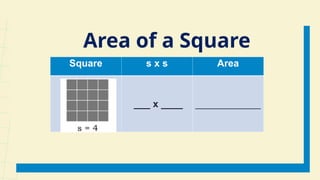
Direction: Compute the area
of each square.
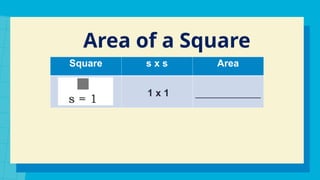
Square s x s Area
1 x 1 ____________
Area of a Square
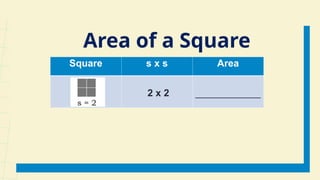
Square s x s Area
2 x 2 ____________
Area of a Square
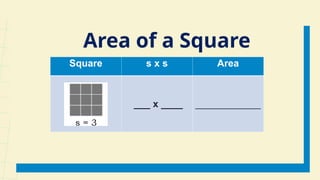
Square s x s Area
___ x ____ ____________
Area of a Square
Square s x s Area
___ x ____ ____________
Area of a Square
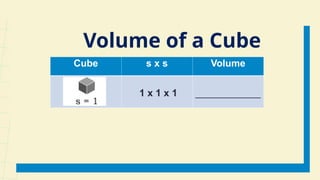
Cube s x s Volume
1 x 1 x 1 ____________
Volume of a Cube
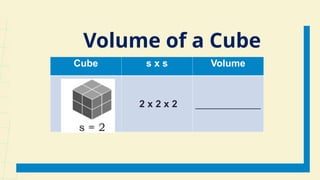
Cube s x s Volume
2 x 2 x 2 ____________
Volume of a Cube
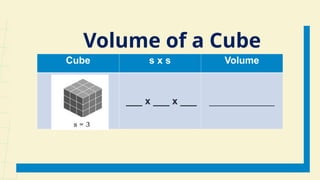
Cube s x s Volume
___ x ___ x ___ ____________
Volume of a Cube
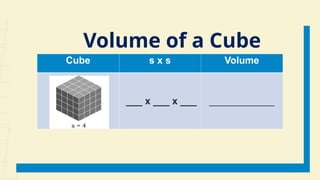
Cube s x s Volume
___ x ___ x ___ ____________
Volume of a Cube
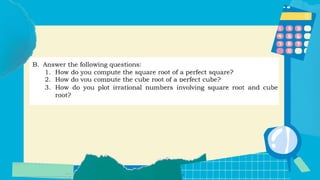
3. How can you find the length of the sides of a
square if its area is given?
4. How can you find the length of the sides of a
cube if its volume is given?
Unlocking
Vocabulary
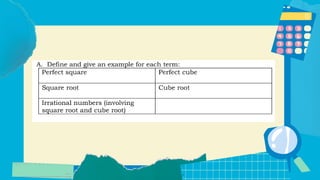
• The number of square units that can form a square is
called a perfect square.
• The number of cube units that can form a cube is called a
perfect cube.
• The square root of the area of the square (perfect
square) is the length of the side of the square.
• The cube root of the volume of a cube (perfect
cube) is the length of each side of the cube.
Sub-Topic 1
Perfect Square and Square Root
When a number n is multiplied by itself, such as
when we compute the area of a square, we write
and read it “n squared”. The result is called the
square of n. That is, if = , then m is a square of
𝑚
n and m is a perfect square.
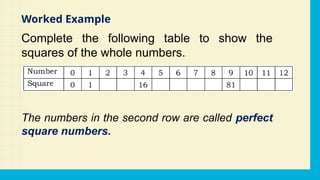
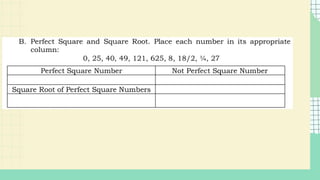
Complete the following table to show the
squares of the whole numbers.
Worked Example
The numbers in the second row are called perfect
square numbers.
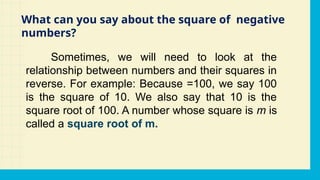
Sometimes, we will need to look at the
relationship between numbers and their squares in
reverse. For example: Because =100, we say 100
is the square of 10. We also say that 10 is the
square root of 100. A number whose square is m is
called a square root of m.
What can you say about the square of negative
numbers?
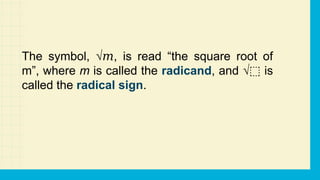
The symbol, √ , is read “the square root of
𝑚
m”, where m is called the radicand, and √ is
⬚
called the radical sign.
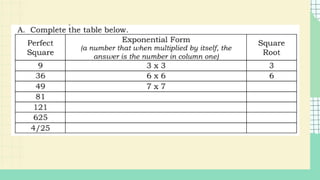
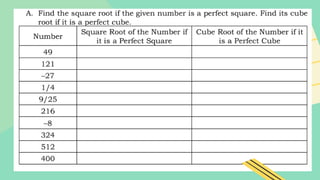
Lesson Activity
Direction: Complete the table.
DAY 2
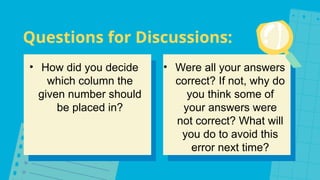
Questions for Discussions:
• How did you decide
which column the
given number should
be placed in?
• Were all your answers
correct? If not, why do
you think some of
your answers were
not correct? What will
you do to avoid this
error next time?
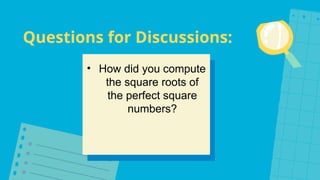
Questions for Discussions:
• How did you compute
the square roots of
the perfect square
numbers?
Sub-Topic 2
Perfect Cube and Cube Root
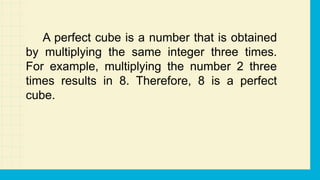
A perfect cube is a number that is obtained
by multiplying the same integer three times.
For example, multiplying the number 2 three
times results in 8. Therefore, 8 is a perfect
cube.
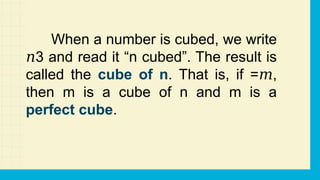
When a number is cubed, we write
3 and read it “n cubed”. The result is
𝑛
called the cube of n. That is, if = ,
𝑚
then m is a cube of n and m is a
perfect cube.
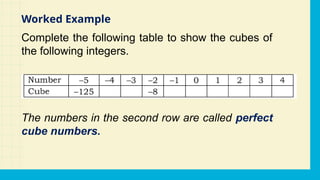
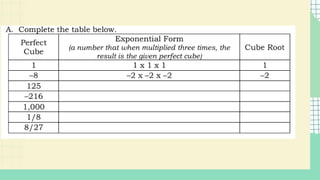
Complete the following table to show the cubes of
the following integers.
Worked Example
The numbers in the second row are called perfect
cube numbers.
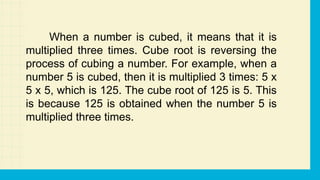
When a number is cubed, it means that it is
multiplied three times. Cube root is reversing the
process of cubing a number. For example, when a
number 5 is cubed, then it is multiplied 3 times: 5 x
5 x 5, which is 125. The cube root of 125 is 5. This
is because 125 is obtained when the number 5 is
multiplied three times.
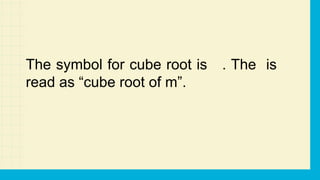
The symbol for cube root is . The is
read as “cube root of m”.
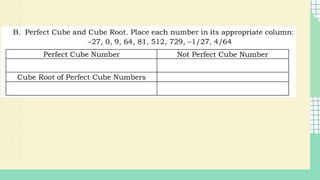
Lesson Activity
Direction: Complete the table.
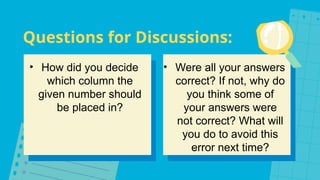
Questions for Discussions:
• How did you decide
which column the
given number should
be placed in?
• Were all your answers
correct? If not, why do
you think some of
your answers were
not correct? What will
you do to avoid this
error next time?
Questions for Discussions:
• How did you compute
the cube roots of the
perfect cube
numbers?
DAY 3
Sub-Topic 3
Irrational Numbers
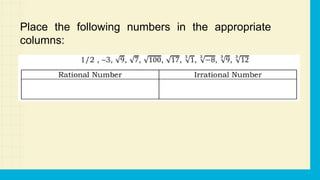
Place the following numbers in the appropriate
columns:
Questions for Discussions:
• Observe the numbers in
the first column. What do
you observe about the
rational numbers?
• Observe the numbers in
the second column.
What do you observe
about the irrational
numbers? (What can
you say about the
number inside the
radical sign?)
If the radicand of a square root is not a
perfect square, then it is considered an irrational
number. Likewise, if the radicand of a cube root is
not a perfect cube, then it is an irrational number.
These numbers cannot be written as a fraction
because the decimal does not end (or non-
terminating) and does not repeat a pattern (or non-
repeating).
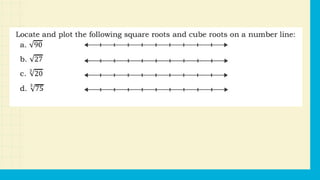
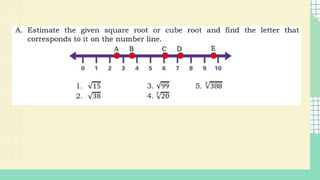
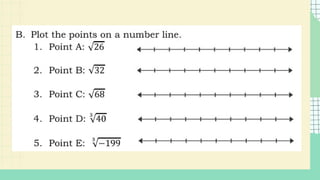
In plotting an irrational number involving square
root or cube root on a number line, estimate first
the square root or cube root of the given irrational
number and to which two consecutive integers it
lies in between.
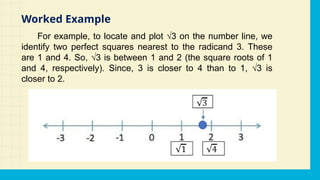
For example, to locate and plot √3 on the number line, we
identify two perfect squares nearest to the radicand 3. These
are 1 and 4. So, √3 is between 1 and 2 (the square roots of 1
and 4, respectively). Since, 3 is closer to 4 than to 1, √3 is
closer to 2.
Worked Example
Lesson Activity
Irrational Numbers
Let student view the video on how to plot
irrational numbers involving square roots using this
link: www.youtube.com/watch?v=ES GkaZnrwrI.
Learner’s
Takeaways
Reflection
on Learning
DAY 4
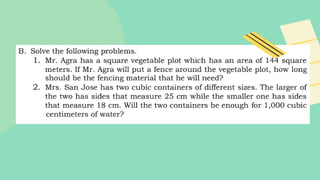
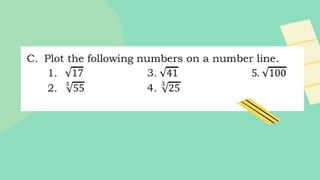
Assessment
Department of Education. (2020). Alternative Delivery Mode. Quarter 1-
Module 7: Principal Roots and Irrational Numbers.
Department of Education. (2020). Alternative Delivery Mode. Quarter 1-
Module 8: Estimating Square Roots of Whole Numbers and Plotting
Irrational Numbers
Sipnayan. (2020, October 10). How to Plot Irrational Numbers on the
Number Line Part 1 [with English subtitles] [Video]. YouTube.
https://www.youtube.com/watch?v=ESGkaZnrwrI
References

Q2_PPT_Mathematics 7_Lesson 1_Week 1.pptx

  • 1.
    Lesson for Week1 Perfect square and perfect cube Square root and cuberoot Irrational Numbers
  • 2.
    The learners determinethe square roots of perfect squares and the cube roots of perfect cubes. 1.The learners define perfect square and perfect cube. 2.The learners identify perfect squares and perfect cubes. 3.The learners define square root and cube root. 4.The learners determine the square roots of perfect squares. 5.The learners determine the cube roots of perfect cubes. Lesson Competencies and Objectives
  • 3.
    The learners identifyirrational numbers involving square roots and cube roots, and their locations on the number line. 1. The learners define irrational numbers. 2. The learners identify irrational numbers involving square roots and cube roots. 3. The learners determine the location of irrational numbers involving square roots and cube roots by plotting them on a number line. Lesson Competencies and Objectives
  • 4.
  • 5.
    Short Review Direction: Computethe area of each square.
  • 6.
    Square s xs Area 1 x 1 ____________ Area of a Square
  • 7.
    Square s xs Area 2 x 2 ____________ Area of a Square
  • 8.
    Square s xs Area ___ x ____ ____________ Area of a Square
  • 9.
    Square s xs Area ___ x ____ ____________ Area of a Square
  • 10.
    Cube s xs Volume 1 x 1 x 1 ____________ Volume of a Cube
  • 11.
    Cube s xs Volume 2 x 2 x 2 ____________ Volume of a Cube
  • 12.
    Cube s xs Volume ___ x ___ x ___ ____________ Volume of a Cube
  • 13.
    Cube s xs Volume ___ x ___ x ___ ____________ Volume of a Cube
  • 14.
    3. How canyou find the length of the sides of a square if its area is given? 4. How can you find the length of the sides of a cube if its volume is given?
  • 15.
  • 16.
    • The numberof square units that can form a square is called a perfect square. • The number of cube units that can form a cube is called a perfect cube. • The square root of the area of the square (perfect square) is the length of the side of the square. • The cube root of the volume of a cube (perfect cube) is the length of each side of the cube.
  • 17.
  • 18.
    When a numbern is multiplied by itself, such as when we compute the area of a square, we write and read it “n squared”. The result is called the square of n. That is, if = , then m is a square of 𝑚 n and m is a perfect square.
  • 19.
    Complete the followingtable to show the squares of the whole numbers. Worked Example The numbers in the second row are called perfect square numbers.
  • 20.
    Sometimes, we willneed to look at the relationship between numbers and their squares in reverse. For example: Because =100, we say 100 is the square of 10. We also say that 10 is the square root of 100. A number whose square is m is called a square root of m. What can you say about the square of negative numbers?
  • 21.
    The symbol, √, is read “the square root of 𝑚 m”, where m is called the radicand, and √ is ⬚ called the radical sign.
  • 22.
  • 24.
  • 26.
    Questions for Discussions: •How did you decide which column the given number should be placed in? • Were all your answers correct? If not, why do you think some of your answers were not correct? What will you do to avoid this error next time?
  • 27.
    Questions for Discussions: •How did you compute the square roots of the perfect square numbers?
  • 28.
  • 29.
    A perfect cubeis a number that is obtained by multiplying the same integer three times. For example, multiplying the number 2 three times results in 8. Therefore, 8 is a perfect cube.
  • 30.
    When a numberis cubed, we write 3 and read it “n cubed”. The result is 𝑛 called the cube of n. That is, if = , 𝑚 then m is a cube of n and m is a perfect cube.
  • 31.
    Complete the followingtable to show the cubes of the following integers. Worked Example The numbers in the second row are called perfect cube numbers.
  • 32.
    When a numberis cubed, it means that it is multiplied three times. Cube root is reversing the process of cubing a number. For example, when a number 5 is cubed, then it is multiplied 3 times: 5 x 5 x 5, which is 125. The cube root of 125 is 5. This is because 125 is obtained when the number 5 is multiplied three times.
  • 33.
    The symbol forcube root is . The is read as “cube root of m”.
  • 34.
  • 37.
    Questions for Discussions: •How did you decide which column the given number should be placed in? • Were all your answers correct? If not, why do you think some of your answers were not correct? What will you do to avoid this error next time?
  • 38.
    Questions for Discussions: •How did you compute the cube roots of the perfect cube numbers?
  • 39.
  • 40.
  • 41.
    Place the followingnumbers in the appropriate columns:
  • 42.
    Questions for Discussions: •Observe the numbers in the first column. What do you observe about the rational numbers? • Observe the numbers in the second column. What do you observe about the irrational numbers? (What can you say about the number inside the radical sign?)
  • 43.
    If the radicandof a square root is not a perfect square, then it is considered an irrational number. Likewise, if the radicand of a cube root is not a perfect cube, then it is an irrational number. These numbers cannot be written as a fraction because the decimal does not end (or non- terminating) and does not repeat a pattern (or non- repeating).
  • 44.
    In plotting anirrational number involving square root or cube root on a number line, estimate first the square root or cube root of the given irrational number and to which two consecutive integers it lies in between.
  • 45.
    For example, tolocate and plot √3 on the number line, we identify two perfect squares nearest to the radicand 3. These are 1 and 4. So, √3 is between 1 and 2 (the square roots of 1 and 4, respectively). Since, 3 is closer to 4 than to 1, √3 is closer to 2. Worked Example
  • 47.
  • 49.
    Let student viewthe video on how to plot irrational numbers involving square roots using this link: www.youtube.com/watch?v=ES GkaZnrwrI.
  • 51.
  • 54.
  • 56.
  • 57.
  • 61.
    Department of Education.(2020). Alternative Delivery Mode. Quarter 1- Module 7: Principal Roots and Irrational Numbers. Department of Education. (2020). Alternative Delivery Mode. Quarter 1- Module 8: Estimating Square Roots of Whole Numbers and Plotting Irrational Numbers Sipnayan. (2020, October 10). How to Plot Irrational Numbers on the Number Line Part 1 [with English subtitles] [Video]. YouTube. https://www.youtube.com/watch?v=ESGkaZnrwrI References