Operating System Support
for Ubiquitous Computing
V.P.I.S.Abeywardana 12/AS/CI/001
W.V.D.Madusanka 12 /AS/CI/027
B.V.D.L.Y.N.Jayawardana 12/AS/CI/020
In this slide
• What is Ubiquitous Computing
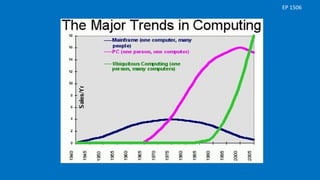
• Trends of computing
• Goals of Ubiquitous Computing
• Ubicomp’s devices characteristics
• Removing Complexity Using Operating Systems
• Examples ubicomp’s devices
• Advantages of Ubiquitous Computing
• Challenges for Ubiquitous Computing
EP 1506
What is Ubiquitous Computing
ubiquitous computing (also called Pervasive computing) is the
growing trend towards embedding microprocessors in everyday
objects so they can communicate information. The words
ubiquitous mean "existing everywhere." Pervasive computing
devices are completely connected and constantly available.
EP 1506
EP 1506
Goals of Ubiquitous Computing
•Invisible Technology
•Simplifying works
•Enabling Computing In class rooms and Home and Mobile and
everywhere.
EP 1506
Ubicomp’s devices characteristics
• In every where
• Very tiny – even invisible-small
• inexpensive
• Light & strong technologies
• robust networked processing devices either mobile or
embedded in almost any type of object such as cars, tools,
appliances, clothing and various consumer good – all
communicating through increasingly interconnected networks.
EP 1531
Removing Complexity Using Operating
Systems
• Manage & control easy
• User friendly
• Easy to use by interfaces
• Application software
EP 1531
Examples ubicomp’s devices
• Digital audio players,
• radio-frequency identification tags,
• PDAs,
• Smartphones GPS, and
• interactive whiteboards, etc…
EP 1531
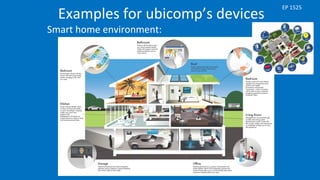
Examples for ubicomp’s devices
Smart home environment:
EP 1525
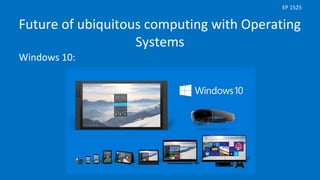
Future of ubiquitous computing with Operating
Systems
Windows 10:
EP 1525
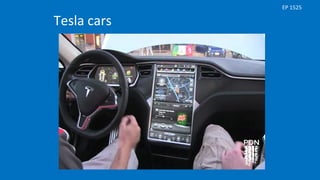
Tesla cars
EP 1525
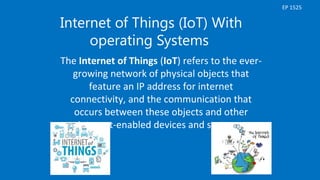
Internet of Things (IoT) With
operating Systems
The Internet of Things (IoT) refers to the ever-
growing network of physical objects that
feature an IP address for internet
connectivity, and the communication that
occurs between these objects and other
Internet-enabled devices and systems.
EP 1525
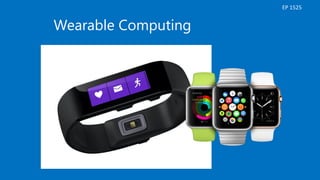
Wearable Computing
EP 1525
Advantages of Ubiquitous
Computing
• Quick, efficient and effortless.
• It supports a new class of intelligent and portable
appliances or “smart devices”.
• It gives people convenient access to relevant
information.
• It removers the complexity of new Technologies
EP 1525
Challenges for Ubiquitous
Computing
• The “Accidentally” Smart Environment
• Impromptu Interoperability
• No Systems Administrator
• Social Implications of aware technologies
EP 1525
Thank You

Operating System Support for Ubiquitous Computing

  • 1.
    Operating System Support forUbiquitous Computing V.P.I.S.Abeywardana 12/AS/CI/001 W.V.D.Madusanka 12 /AS/CI/027 B.V.D.L.Y.N.Jayawardana 12/AS/CI/020
  • 2.
    In this slide •What is Ubiquitous Computing • Trends of computing • Goals of Ubiquitous Computing • Ubicomp’s devices characteristics • Removing Complexity Using Operating Systems • Examples ubicomp’s devices • Advantages of Ubiquitous Computing • Challenges for Ubiquitous Computing EP 1506
  • 3.
    What is UbiquitousComputing ubiquitous computing (also called Pervasive computing) is the growing trend towards embedding microprocessors in everyday objects so they can communicate information. The words ubiquitous mean "existing everywhere." Pervasive computing devices are completely connected and constantly available. EP 1506
  • 4.
  • 5.
    Goals of UbiquitousComputing •Invisible Technology •Simplifying works •Enabling Computing In class rooms and Home and Mobile and everywhere. EP 1506
  • 6.
    Ubicomp’s devices characteristics •In every where • Very tiny – even invisible-small • inexpensive • Light & strong technologies • robust networked processing devices either mobile or embedded in almost any type of object such as cars, tools, appliances, clothing and various consumer good – all communicating through increasingly interconnected networks. EP 1531
  • 7.
    Removing Complexity UsingOperating Systems • Manage & control easy • User friendly • Easy to use by interfaces • Application software EP 1531
  • 8.
    Examples ubicomp’s devices •Digital audio players, • radio-frequency identification tags, • PDAs, • Smartphones GPS, and • interactive whiteboards, etc… EP 1531
  • 9.
    Examples for ubicomp’sdevices Smart home environment: EP 1525
  • 10.
    Future of ubiquitouscomputing with Operating Systems Windows 10: EP 1525
  • 11.
  • 12.
    Internet of Things(IoT) With operating Systems The Internet of Things (IoT) refers to the ever- growing network of physical objects that feature an IP address for internet connectivity, and the communication that occurs between these objects and other Internet-enabled devices and systems. EP 1525
  • 13.
  • 14.
    Advantages of Ubiquitous Computing •Quick, efficient and effortless. • It supports a new class of intelligent and portable appliances or “smart devices”. • It gives people convenient access to relevant information. • It removers the complexity of new Technologies EP 1525
  • 15.
    Challenges for Ubiquitous Computing •The “Accidentally” Smart Environment • Impromptu Interoperability • No Systems Administrator • Social Implications of aware technologies EP 1525
  • 16.

Editor's Notes

  • #4 Virtual Reality and Ubiquitous Computing are different .
  • #6 Goal of ubiquitous ubiquitous computing is invisble technology and enabling computing in everywhere and stay connected all the time. Some organizations are working on building universal operating systems.