Critical evaluation of the
film opening sequence
Ada Dzamic
AS Media Studies
Voice commentary
“‘Music Lessons from Hell’… an epic struggle
between calm and headbanging!”
The brief
1. The brief was to create an opening sequence of a film, introducing the audience to the genre,
establishing the setting, indicating the mood and visual aspects of the film, plus other elements.
We wanted to set up the scene, as well as the main conflict between the characters, coming
from their strongly different personalities. The objective was to draw the viewer into the story as
quickly as possible, as well as to use the lesson preparation scenes as a characterization tool.
2. We have decided to name our film ‘Music Lessons from Hell’, as it tells a story about a mild
music teacher and a wild girl, who is forced to have classical music lessons that she despises.
3. The sub-genre of the film (and our opening sequence) could be creatively described as a
‘personal war’, using the character’s personalities to create comedy. The opening sequence
itself could be ‘the comedy of situations’ with elements of farce, music comedy and even
‘buddy movies.’ We feel that the main genre of the film would be ‘light comedy’.
Intended audience
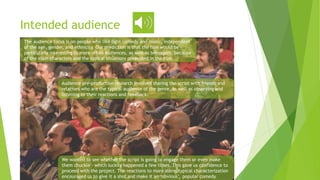
The audience focus is on people who like light comedy and music, independent
of the age, gender, and ethnicity. Our prediction is that the film would be
particularly interesting to more urban audiences, as well as teenagers, because
of the main characters and the typical situations presented in the film.
Audience pre-production research involved sharing the script with friends and
relatives who are the typical audience of the genre, as well as observing and
listening to their reactions and feedback.
We wanted to see whether the script is going to engage them or even make
them chuckle - which luckily happened a few times. This gave us confidence to
proceed with the project. The reactions to more stereotypical characterization
encouraged us to give it a shot and make it an ‘obvious’, popular comedy.
Distribution
1. We were aiming for one TV station deal, followed by the film’s availability on YouTube/Vimeo.
Given the competitiveness of the modern film industry and the very low budget nature of our
film, we didn’t think it credible to count on proper professional distribution.
2. We think that the music institution might be willing to distribute it, given the topic.
3. We are also hoping that Sony Pictures Classics might want to consider distributing our film, as it
includes a conflict between a music student and a music teacher, similar to their film ‘Whiplash’.
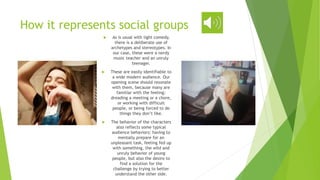
How it represents social groups
 As is usual with light comedy,
there is a deliberate use of
archetypes and stereotypes. In
our case, these were a nerdy
music teacher and an unruly
teenager.
 These are easily identifiable to
a wide modern audience. Our
opening scene should resonate
with them, because many are
familiar with the feeling:
dreading a meeting or a chore,
or working with difficult
people, or being forced to do
things they don’t like.
 The behavior of the characters
also reflects some typical
audience behaviors: having to
mentally prepare for an
unpleasant task, feeling fed up
with something, the wild and
unruly behavior of young
people, but also the desire to
find a solution for the
challenge by trying to better
understand the other side.
Myth and Ideology
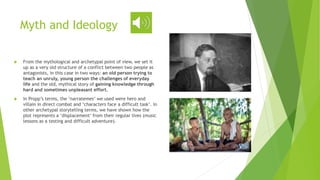
 From the mythological and archetypal point of view, we set it
up as a very old structure of a conflict between two people as
antagonists, in this case in two ways: an old person trying to
teach an unruly, young person the challenges of everyday
life and the old, mythical story of gaining knowledge through
hard and sometimes unpleasant effort.
 In Propp’s terms, the ‘narratemes’ we used were hero and
villain in direct combat and ‘characters face a difficult task’. In
other archetypal storytelling terms, we have shown how the
plot represents a ‘displacement’ from their regular lives (music
lessons as a testing and difficult adventure).
Text analysis
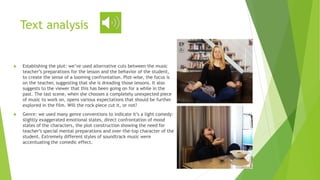
 Establishing the plot: we’ve used alternative cuts between the music
teacher’s preparations for the lesson and the behavior of the student,
to create the sense of a looming confrontation. Plot-wise, the focus is
on the teacher, suggesting that she is dreading those lessons. It also
suggests to the viewer that this has been going on for a while in the
past. The last scene, when she chooses a completely unexpected piece
of music to work on, opens various expectations that should be further
explored in the film. Will the rock piece cut it, or not?
 Genre: we used many genre conventions to indicate it’s a light comedy:
slightly exaggerated emotional states, direct confrontation of mood
states of the characters, the plot construction showing the need for
teacher’s special mental preparations and over-the-top character of the
student. Extremely different styles of soundtrack music were
accentuating the comedic effect.
 In order to further convey the personalities of the two characters,
and to provide a good quality viewing experience for the audience,
we have decided to use several compositional, as well as technical
elements.
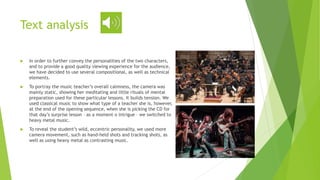
 To portray the music teacher’s overall calmness, the camera was
mainly static, showing her meditating and little rituals of mental
preparation used for these particular lessons. It builds tension. We
used classical music to show what type of a teacher she is, however,
at the end of the opening sequence, when she is picking the CD for
that day’s surprise lesson – as a moment o intrigue – we switched to
heavy metal music.
 To reveal the student’s wild, eccentric personality, we used more
camera movement, such as hand-held shots and tracking shots, as
well as using heavy metal as contrasting music.
Text analysis
Did we reach the target audience?
1. Based on pre-production reactions, we believe that we managed to reach our target audiences
as far as interest is concerned. The distribution would decide how many of them we would be
able to physically reach.
2. During the pre-production, and because of Covid-19, we had to move the production into one
of our family apartments, instead of the school. We believe that a more natural everyday
environment and behaviors of both characters in their homes, may increase the sense of conflict
and comedic effect.
3. According to the audience feedback (see separate presentation), we have successfully made
the camera work, style and editing suitable for the film genre. “The comedy effect was quite
pronounced through the opposites of the two characters. They are nicely shaded, and the music
really supports the contrast”.
4. After analyzing the audience's reaction, we have concluded that we could have made the
meaning of the opening sequence a bit clearer, especially by bringing the wild girl’s character
even more to the fore, using some of her statements. The acting in the last scene could also have
been more expressive
Technologies used
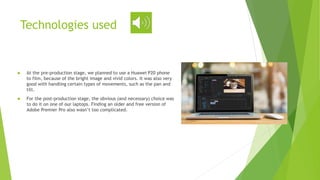
 At the pre-production stage, we planned to use a Huawei P20 phone
to film, because of the bright image and vivid colors. It was also very
good with handling certain types of movements, such as the pan and
tilt.
 For the post-production stage, the obvious (and necessary) choice was
to do it on one of our laptops. Finding an older and free version of
Adobe Premier Pro also wasn’t too complicated.
Editing
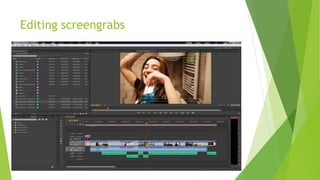
 The editing software we used was an older version of Adobe Premier Pro,
since we had an older laptop.
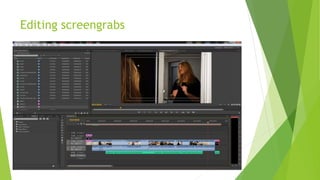
 The first step we did was import the files into the project window. The music
files were downloaded using Y2mate.com, a YouTube downloader that
converts the YT videos into audio-only files. We positioned all the files on a
video 1 timeline in the order of appearance, as well as the music files below
that, also in order of appearance. The video 2 timeline was used to create
the opening and closing credits, using the File > New title. The background
for the title is the first frame from the first scene of the opening sequence.
 From the title font options, we picked the font to use for the opening and
closing credits and decided to use the fade in/fade out fonts. To end on a
strong dramatic effect, we have used the abrupt music stop at the end of the
opening sequence. We used a similar effect at 0:59 during the cut between
the bathroom scene and the teacher’s living room scene. Finally, we went to
File > Export to render the film as a single file that could be shared and
shown on various devices. We have decided to use the mp4 format at 720p
the same one as the raw files.
Editing screengrabs
Editing screengrabs
Preliminary task
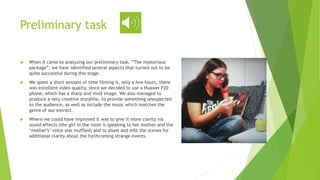
 When it came to analyzing our preliminary task, ”The mysterious
package”, we have identified several aspects that turned out to be
quite successful during this stage.
 We spent a short amount of time filming it, only a few hours, there
was excellent video quality, since we decided to use a Huawei P20
phone, which has a sharp and vivid image. We also managed to
produce a very creative storyline, to provide something unexpected
to the audience, as well as include the music which matches the
genre of our extract.
 Where we could have improved it was to give it more clarity via
sound effects (the girl in the room is speaking to her mother and the
‘mother’s’ voice was muffled) and to shoot and edit the scenes for
additional clarity about the forthcoming strange events.

Opening film sequence evaluation 20.28.12.pptx

  • 1.
    Critical evaluation ofthe film opening sequence Ada Dzamic AS Media Studies Voice commentary “‘Music Lessons from Hell’… an epic struggle between calm and headbanging!”
  • 2.
    The brief 1. Thebrief was to create an opening sequence of a film, introducing the audience to the genre, establishing the setting, indicating the mood and visual aspects of the film, plus other elements. We wanted to set up the scene, as well as the main conflict between the characters, coming from their strongly different personalities. The objective was to draw the viewer into the story as quickly as possible, as well as to use the lesson preparation scenes as a characterization tool. 2. We have decided to name our film ‘Music Lessons from Hell’, as it tells a story about a mild music teacher and a wild girl, who is forced to have classical music lessons that she despises. 3. The sub-genre of the film (and our opening sequence) could be creatively described as a ‘personal war’, using the character’s personalities to create comedy. The opening sequence itself could be ‘the comedy of situations’ with elements of farce, music comedy and even ‘buddy movies.’ We feel that the main genre of the film would be ‘light comedy’.
  • 3.
    Intended audience The audiencefocus is on people who like light comedy and music, independent of the age, gender, and ethnicity. Our prediction is that the film would be particularly interesting to more urban audiences, as well as teenagers, because of the main characters and the typical situations presented in the film. Audience pre-production research involved sharing the script with friends and relatives who are the typical audience of the genre, as well as observing and listening to their reactions and feedback. We wanted to see whether the script is going to engage them or even make them chuckle - which luckily happened a few times. This gave us confidence to proceed with the project. The reactions to more stereotypical characterization encouraged us to give it a shot and make it an ‘obvious’, popular comedy.
  • 4.
    Distribution 1. We wereaiming for one TV station deal, followed by the film’s availability on YouTube/Vimeo. Given the competitiveness of the modern film industry and the very low budget nature of our film, we didn’t think it credible to count on proper professional distribution. 2. We think that the music institution might be willing to distribute it, given the topic. 3. We are also hoping that Sony Pictures Classics might want to consider distributing our film, as it includes a conflict between a music student and a music teacher, similar to their film ‘Whiplash’.
  • 5.
    How it representssocial groups  As is usual with light comedy, there is a deliberate use of archetypes and stereotypes. In our case, these were a nerdy music teacher and an unruly teenager.  These are easily identifiable to a wide modern audience. Our opening scene should resonate with them, because many are familiar with the feeling: dreading a meeting or a chore, or working with difficult people, or being forced to do things they don’t like.  The behavior of the characters also reflects some typical audience behaviors: having to mentally prepare for an unpleasant task, feeling fed up with something, the wild and unruly behavior of young people, but also the desire to find a solution for the challenge by trying to better understand the other side.
  • 6.
    Myth and Ideology From the mythological and archetypal point of view, we set it up as a very old structure of a conflict between two people as antagonists, in this case in two ways: an old person trying to teach an unruly, young person the challenges of everyday life and the old, mythical story of gaining knowledge through hard and sometimes unpleasant effort.  In Propp’s terms, the ‘narratemes’ we used were hero and villain in direct combat and ‘characters face a difficult task’. In other archetypal storytelling terms, we have shown how the plot represents a ‘displacement’ from their regular lives (music lessons as a testing and difficult adventure).
  • 7.
    Text analysis  Establishingthe plot: we’ve used alternative cuts between the music teacher’s preparations for the lesson and the behavior of the student, to create the sense of a looming confrontation. Plot-wise, the focus is on the teacher, suggesting that she is dreading those lessons. It also suggests to the viewer that this has been going on for a while in the past. The last scene, when she chooses a completely unexpected piece of music to work on, opens various expectations that should be further explored in the film. Will the rock piece cut it, or not?  Genre: we used many genre conventions to indicate it’s a light comedy: slightly exaggerated emotional states, direct confrontation of mood states of the characters, the plot construction showing the need for teacher’s special mental preparations and over-the-top character of the student. Extremely different styles of soundtrack music were accentuating the comedic effect.
  • 8.
     In orderto further convey the personalities of the two characters, and to provide a good quality viewing experience for the audience, we have decided to use several compositional, as well as technical elements.  To portray the music teacher’s overall calmness, the camera was mainly static, showing her meditating and little rituals of mental preparation used for these particular lessons. It builds tension. We used classical music to show what type of a teacher she is, however, at the end of the opening sequence, when she is picking the CD for that day’s surprise lesson – as a moment o intrigue – we switched to heavy metal music.  To reveal the student’s wild, eccentric personality, we used more camera movement, such as hand-held shots and tracking shots, as well as using heavy metal as contrasting music. Text analysis
  • 9.
    Did we reachthe target audience? 1. Based on pre-production reactions, we believe that we managed to reach our target audiences as far as interest is concerned. The distribution would decide how many of them we would be able to physically reach. 2. During the pre-production, and because of Covid-19, we had to move the production into one of our family apartments, instead of the school. We believe that a more natural everyday environment and behaviors of both characters in their homes, may increase the sense of conflict and comedic effect. 3. According to the audience feedback (see separate presentation), we have successfully made the camera work, style and editing suitable for the film genre. “The comedy effect was quite pronounced through the opposites of the two characters. They are nicely shaded, and the music really supports the contrast”. 4. After analyzing the audience's reaction, we have concluded that we could have made the meaning of the opening sequence a bit clearer, especially by bringing the wild girl’s character even more to the fore, using some of her statements. The acting in the last scene could also have been more expressive
  • 10.
    Technologies used  Atthe pre-production stage, we planned to use a Huawei P20 phone to film, because of the bright image and vivid colors. It was also very good with handling certain types of movements, such as the pan and tilt.  For the post-production stage, the obvious (and necessary) choice was to do it on one of our laptops. Finding an older and free version of Adobe Premier Pro also wasn’t too complicated.
  • 11.
    Editing  The editingsoftware we used was an older version of Adobe Premier Pro, since we had an older laptop.  The first step we did was import the files into the project window. The music files were downloaded using Y2mate.com, a YouTube downloader that converts the YT videos into audio-only files. We positioned all the files on a video 1 timeline in the order of appearance, as well as the music files below that, also in order of appearance. The video 2 timeline was used to create the opening and closing credits, using the File > New title. The background for the title is the first frame from the first scene of the opening sequence.  From the title font options, we picked the font to use for the opening and closing credits and decided to use the fade in/fade out fonts. To end on a strong dramatic effect, we have used the abrupt music stop at the end of the opening sequence. We used a similar effect at 0:59 during the cut between the bathroom scene and the teacher’s living room scene. Finally, we went to File > Export to render the film as a single file that could be shared and shown on various devices. We have decided to use the mp4 format at 720p the same one as the raw files.
  • 12.
  • 13.
  • 14.
    Preliminary task  Whenit came to analyzing our preliminary task, ”The mysterious package”, we have identified several aspects that turned out to be quite successful during this stage.  We spent a short amount of time filming it, only a few hours, there was excellent video quality, since we decided to use a Huawei P20 phone, which has a sharp and vivid image. We also managed to produce a very creative storyline, to provide something unexpected to the audience, as well as include the music which matches the genre of our extract.  Where we could have improved it was to give it more clarity via sound effects (the girl in the room is speaking to her mother and the ‘mother’s’ voice was muffled) and to shoot and edit the scenes for additional clarity about the forthcoming strange events.