7th Capitalization Meeting
EU Land Governance Programme
Open Tenure & STDM
FAO
Rome, Italy
26 – 29 June, 2018
Maria Paola Rizzo - FAO
Key relevant messages in the VGGT
• Centrality of legitimate tenure rights
• Encourage States to recognize, respect and protect all tenure
rights holders and their rights, including Indigenous and
customary tenure.
• Have a human rights based approach Different sets of tenure
rights and different natural resources.
Voluntary Guidelines on Responsible Governance
of Tenure of Land, Fisheries and Forests (VGGT)
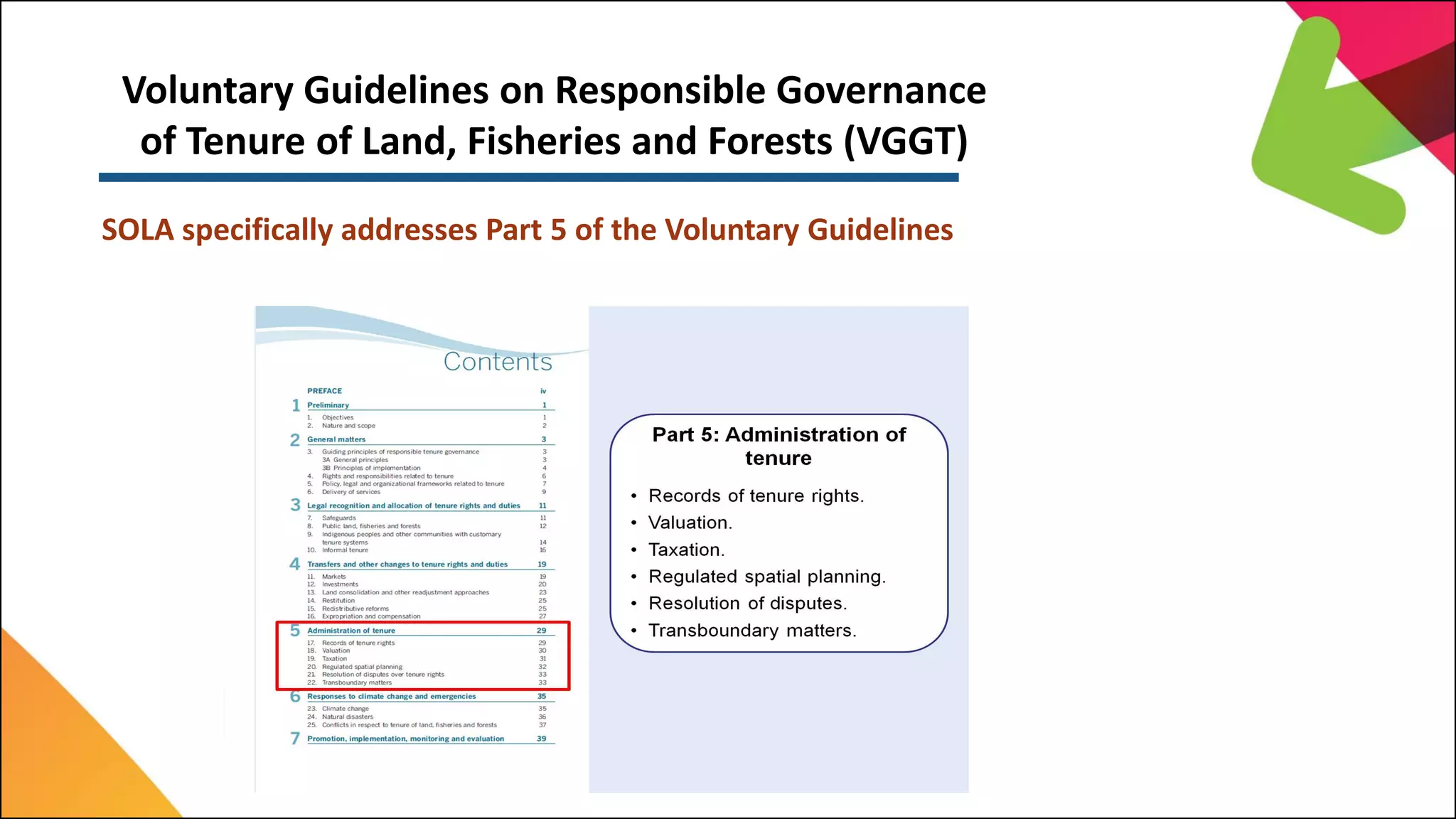
SOLA specifically addresses Part 5 of the Voluntary Guidelines
Voluntary Guidelines on Responsible Governance
of Tenure of Land, Fisheries and Forests (VGGT)
Open Source software (including SOLA) is seen as an Enabling
Technology for the implementation of the VGGT
• It directly provides transparency to tenure rights records by
making them accessible and easily searchable
• It improves service delivery in government agencies responsible
for tenure rights and allows the monitoring of service requests
• It reduces discretionary decision making and controls
registration and cadastral operations
• It records all changes to key records facilitating audits of
changes to tenure records
Voluntary Guidelines on Responsible Governance
of Tenure of Land, Fisheries and Forests (VGGT)
For Communities, Open Tenure is an Enabling Technology for the
implementation of the VGGT in that it:
• Identifies and safeguards tenure rights not recorded by formal
land administration
• Engages with all tenure right holders in tenure governance
processes
• Exercises self-governance for communities with customary
tenure systems
• Protects against unauthorized use of land, fisheries and forest
resources
• Ensures citizen and community involvement
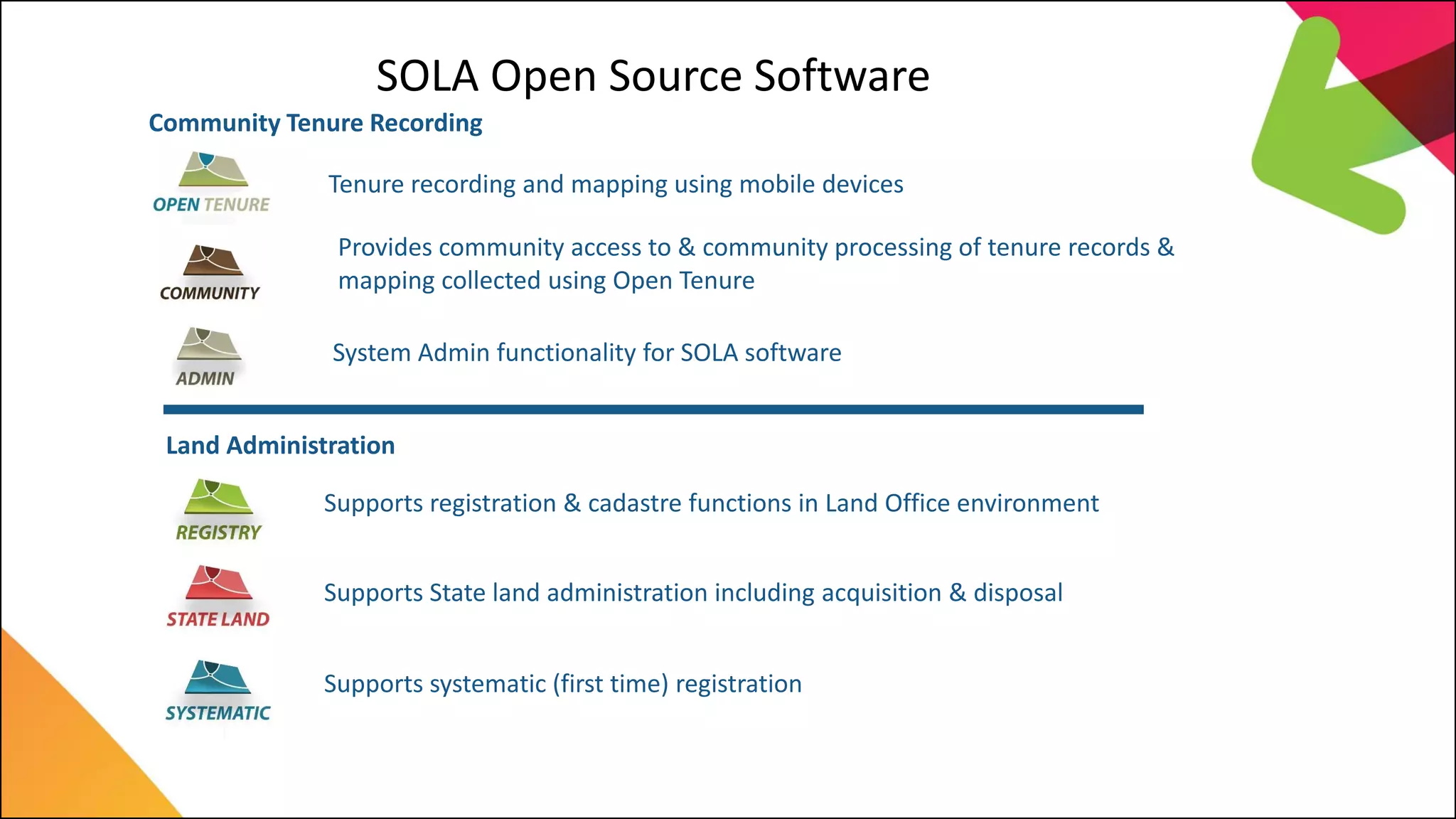
SOLA Open Source Software
Tenure recording and mapping using mobile devices
Provides community access to & community processing of tenure records &
mapping collected using Open Tenure
System Admin functionality for SOLA software
Supports registration & cadastre functions in Land Office environment
Supports State land administration including acquisition & disposal
Supports systematic (first time) registration
Land Administration
Community Tenure Recording
Open Tenure
• Mobile application for Android and iOS devices
• Allows citizen and community recording of tenure rights (crowd
sourcing)
• Record claimant details, capture boundary information and
collect scanned documents and photos to support claim
• Supports fit for purpose mapping
• Claims uploaded to the Community Server for moderation
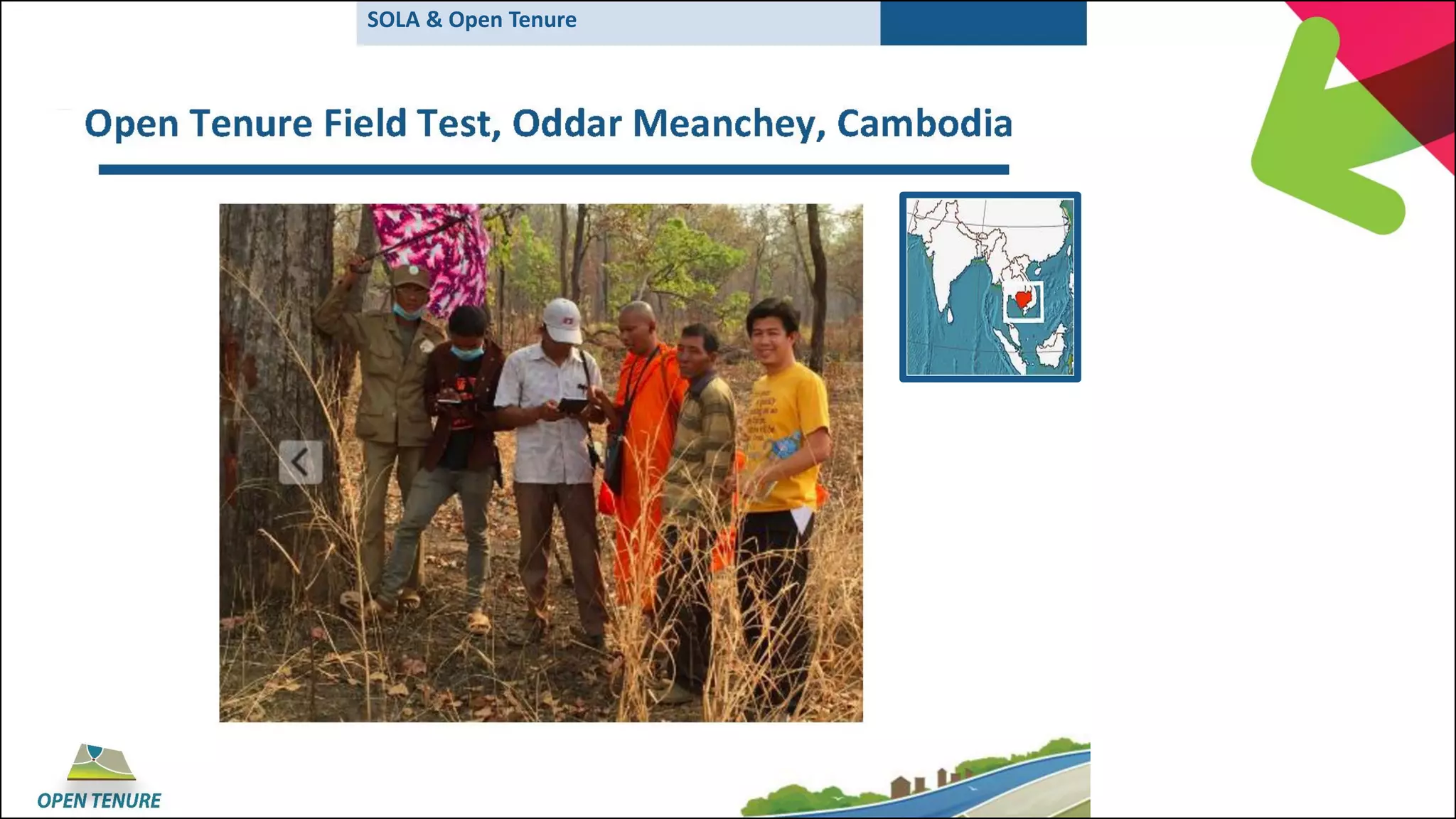
• Field testing completed in 2015 (Cambodia & Guatemala)
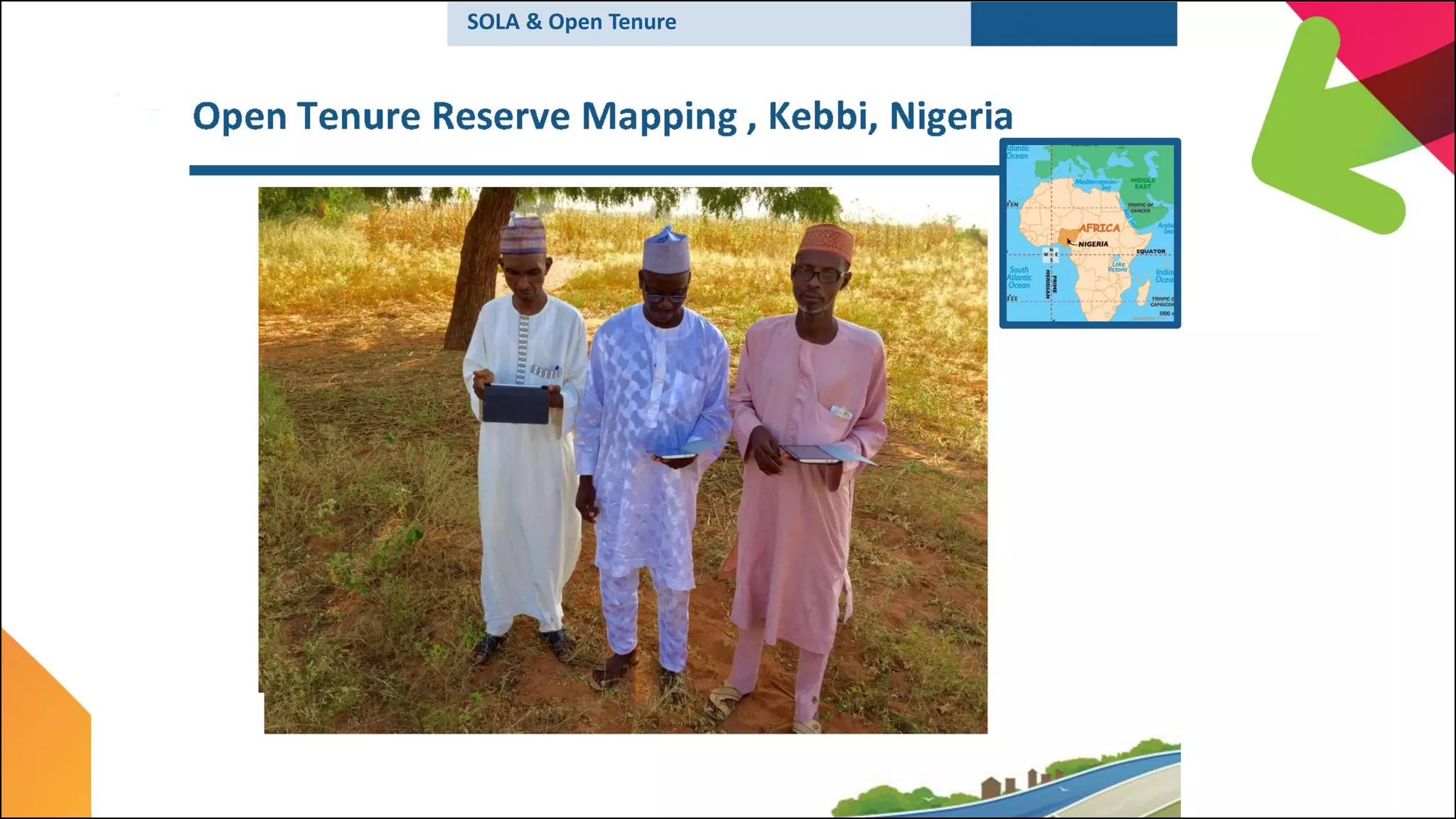
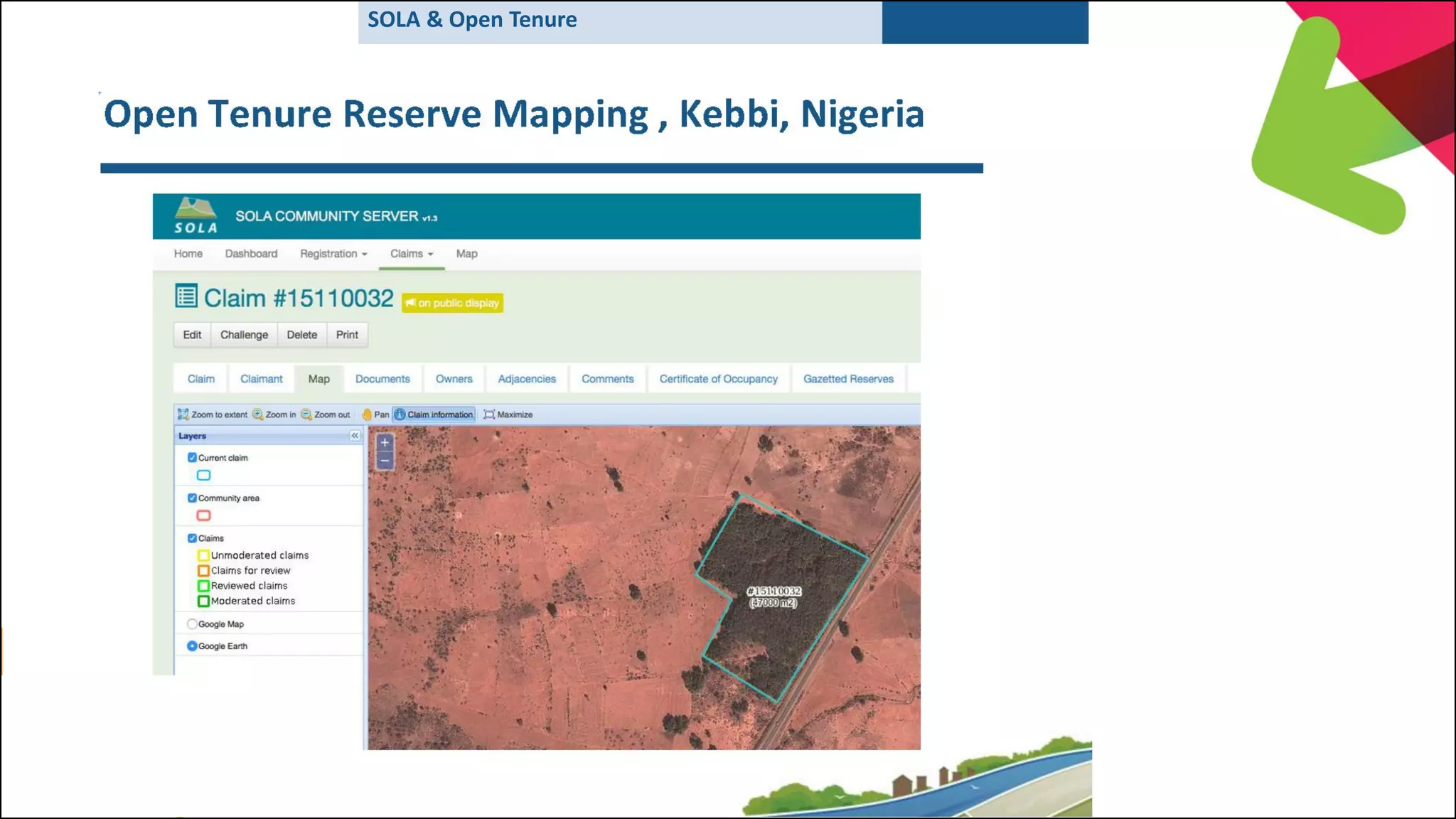
• Also implemented in Nigeria (Reserve Mapping, Certificate
Capture & Systematic Registration) & Uganda (Customary
Registration)
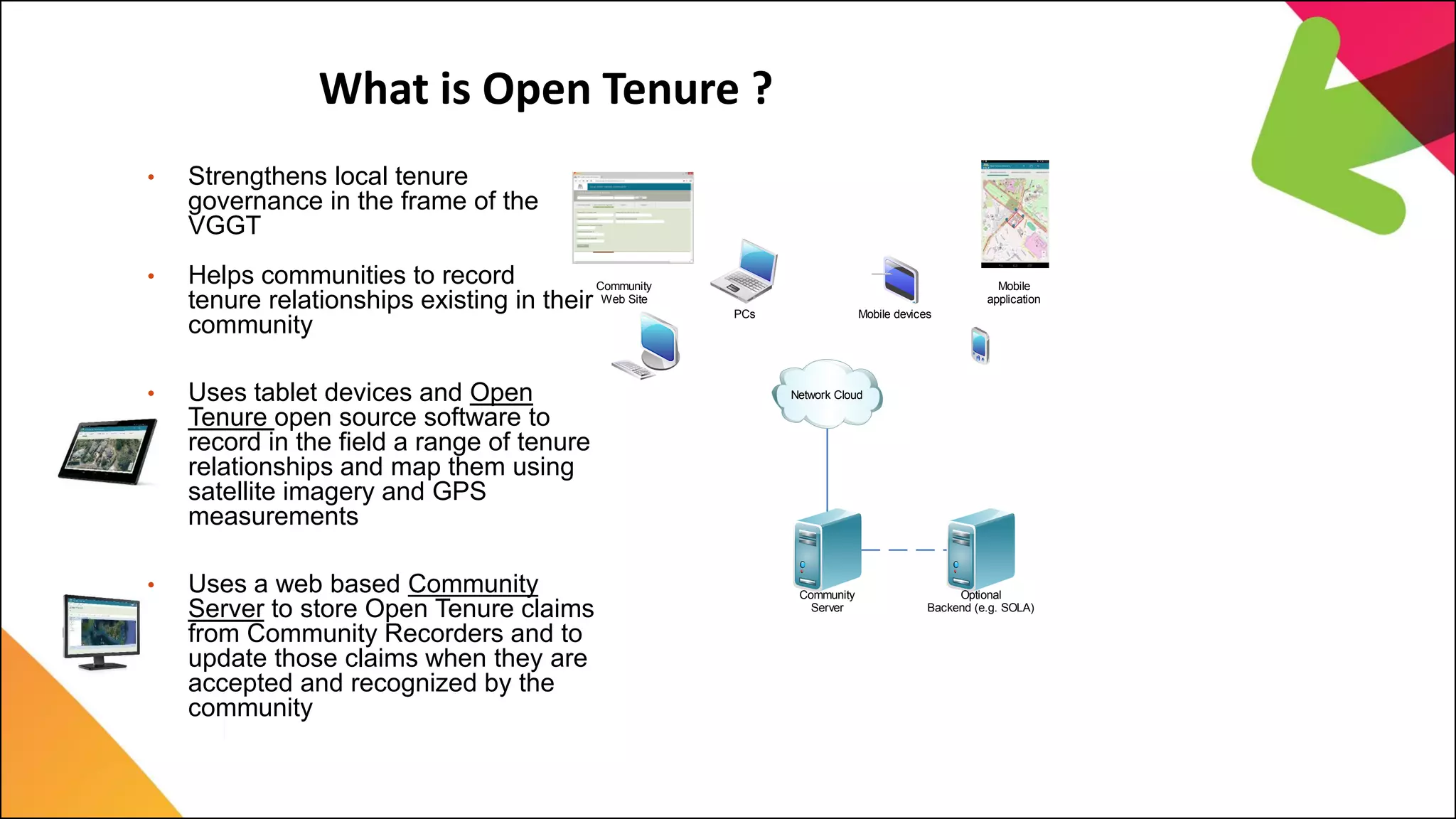
What is Open Tenure ?
• Strengthens local tenure
governance in the frame of the
VGGT
• Helps communities to record
tenure relationships existing in their
community
• Uses tablet devices and Open
Tenure open source software to
record in the field a range of tenure
relationships and map them using
satellite imagery and GPS
measurements
• Uses a web based Community
Server to store Open Tenure claims
from Community Recorders and to
update those claims when they are
accepted and recognized by the
community
Community
Server
Optional
Backend (e.g. SOLA)
PCs Mobile devices
Network Cloud
Mobile
application
Community
Web Site
Field Recording
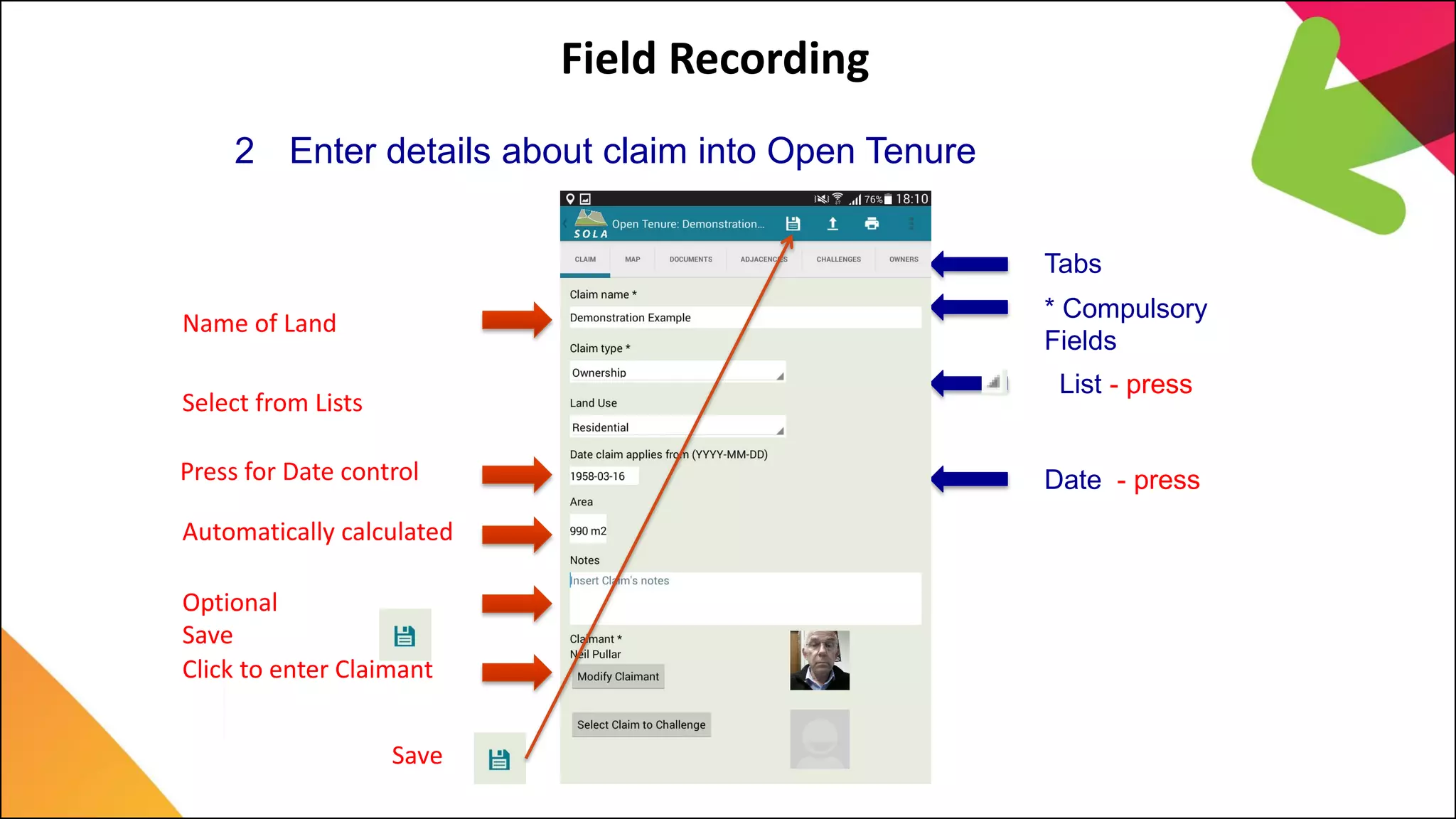
2 Enter details about claim into Open Tenure
Name of Land
Select from Lists
Press for Date control
Automatically calculated
Optional
Click to enter Claimant
Save
Save
Tabs
* Compulsory
Fields
List - press
Date - press
Field Recording
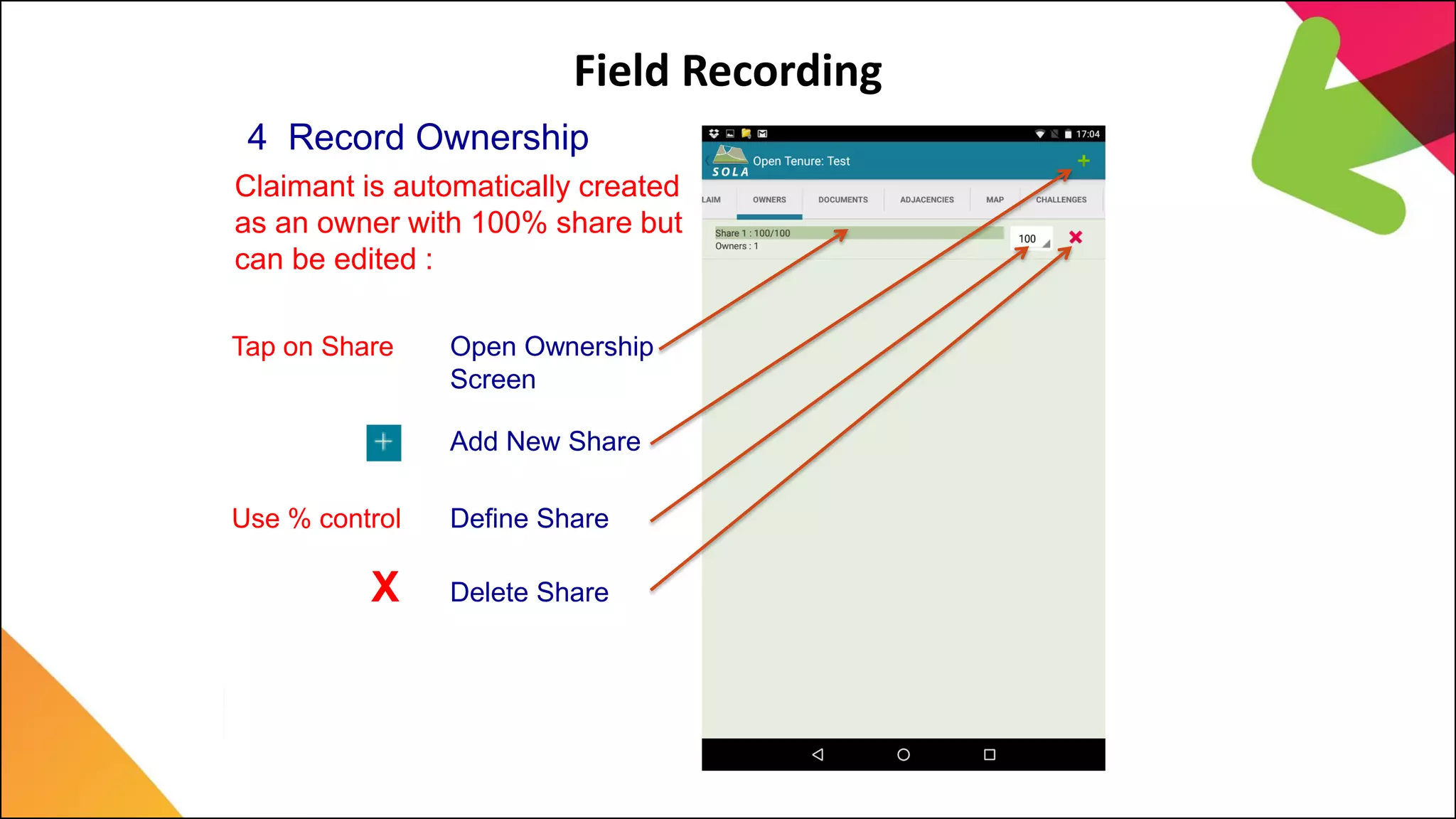
4 Record Ownership
Claimant is automatically created
as an owner with 100% share but
can be edited :
Add New Share
Tap on Share Open Ownership
Screen
Use % control Define Share
X Delete Share
Field Recording
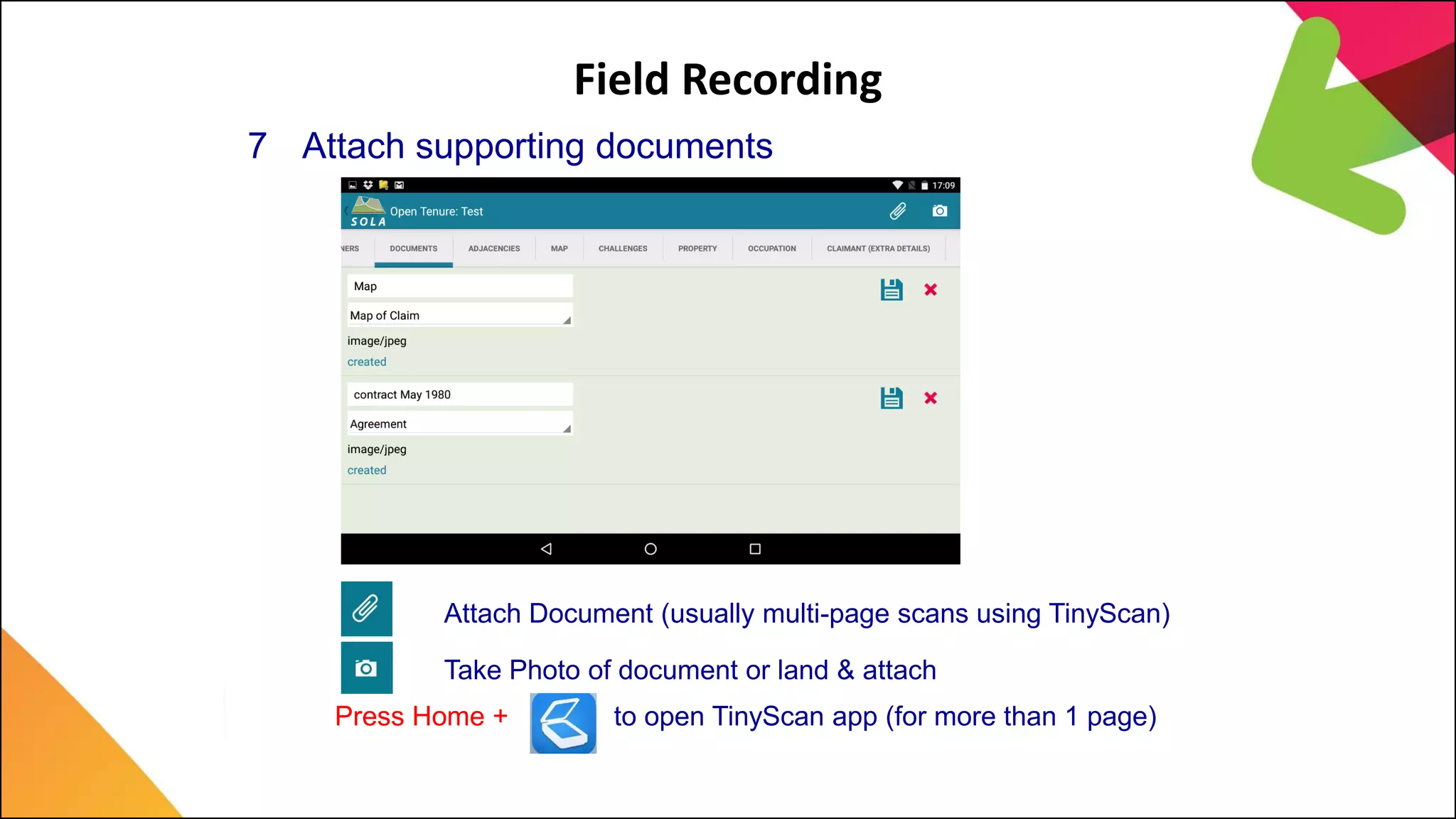
7 Attach supporting documents
Attach Document (usually multi-page scans using TinyScan)
Take Photo of document or land & attach
Press Home + to open TinyScan app (for more than 1 page)
Field Recording
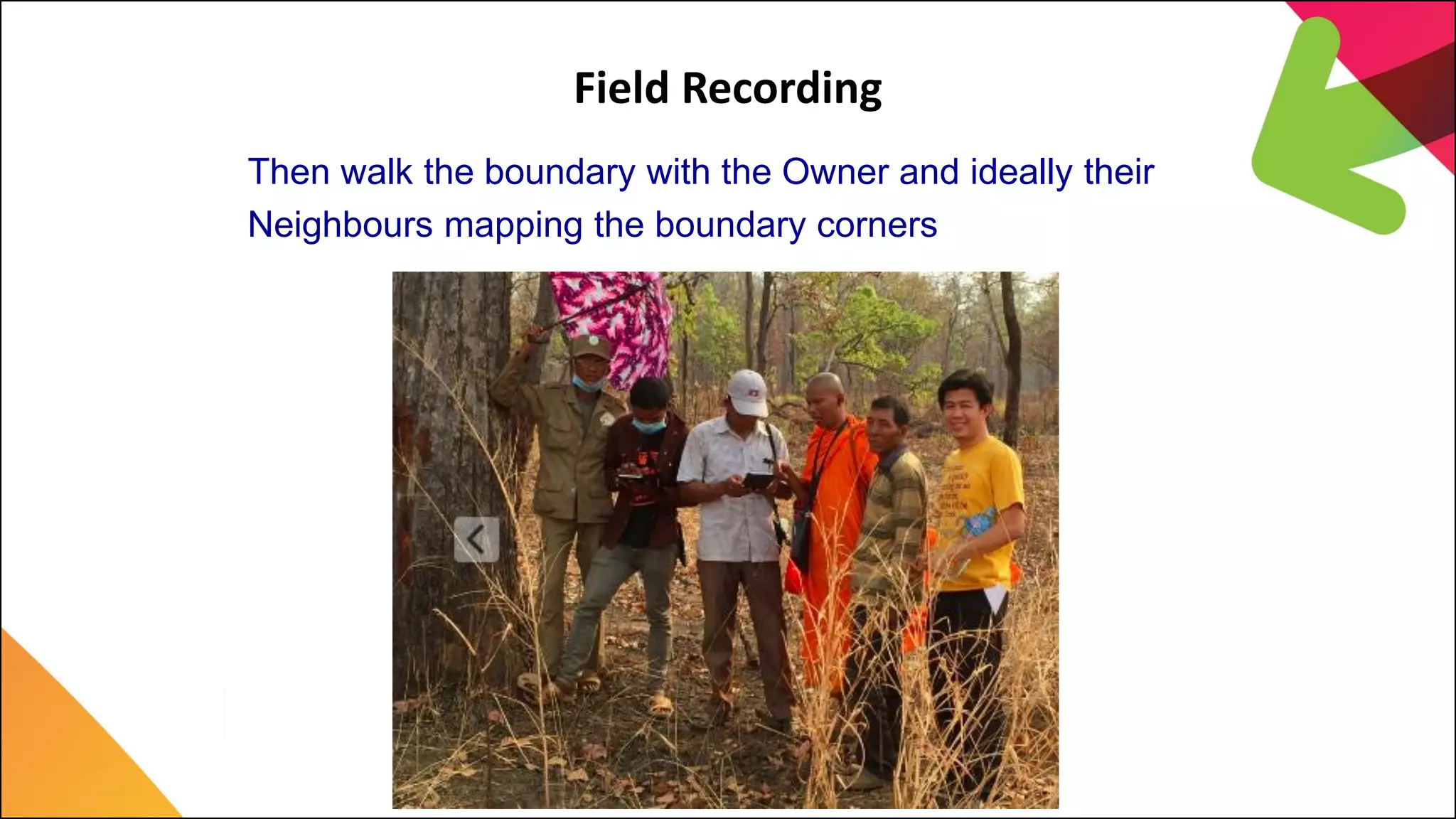
Then walk the boundary with the Owner and ideally their
Neighbours mapping the boundary corners
Field Recording
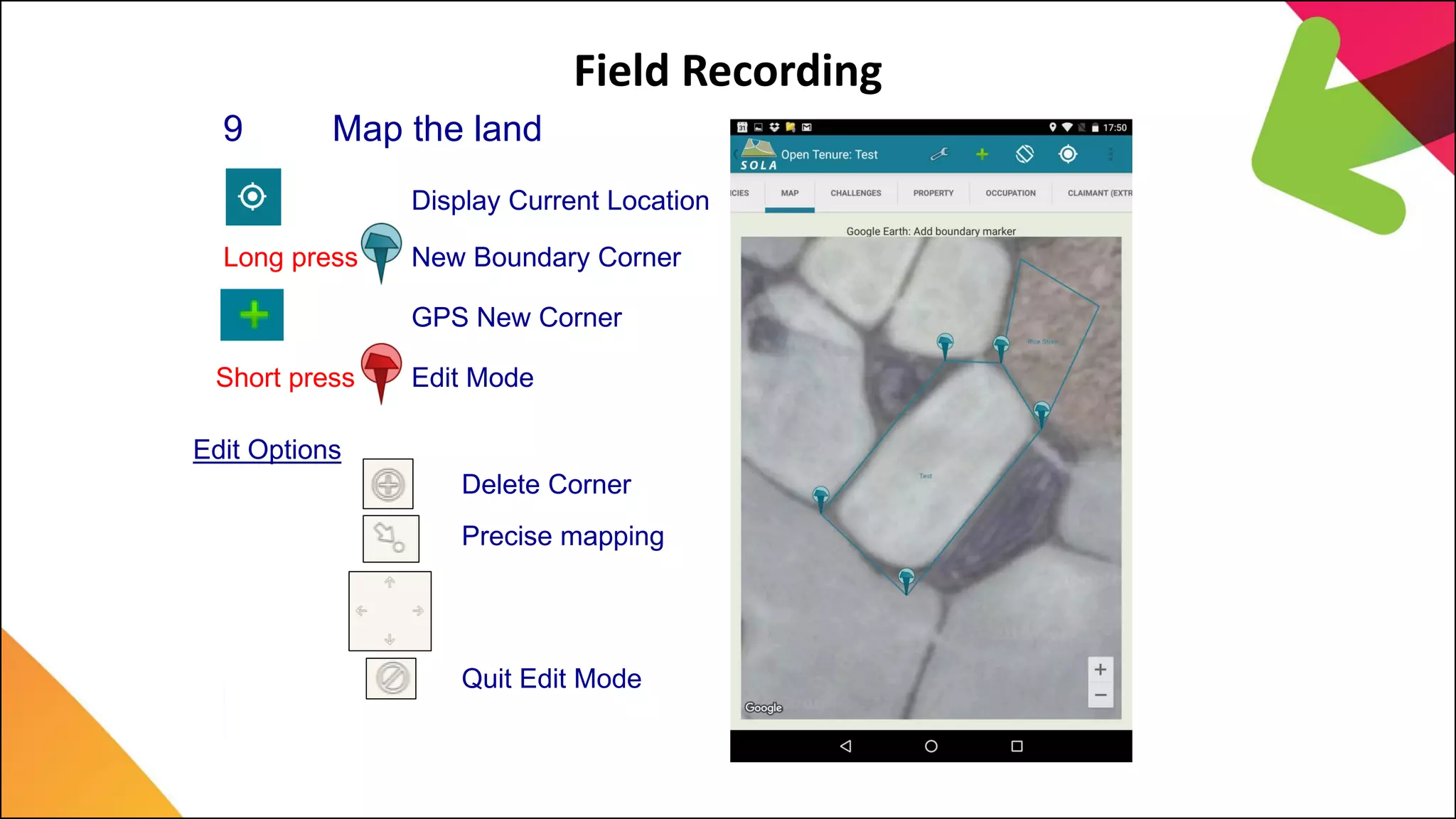
9 Map the land
Long press New Boundary Corner
GPS New Corner
Delete Corner
Edit Options
Precise mapping
Quit Edit Mode
Short press Edit Mode
Display Current Location
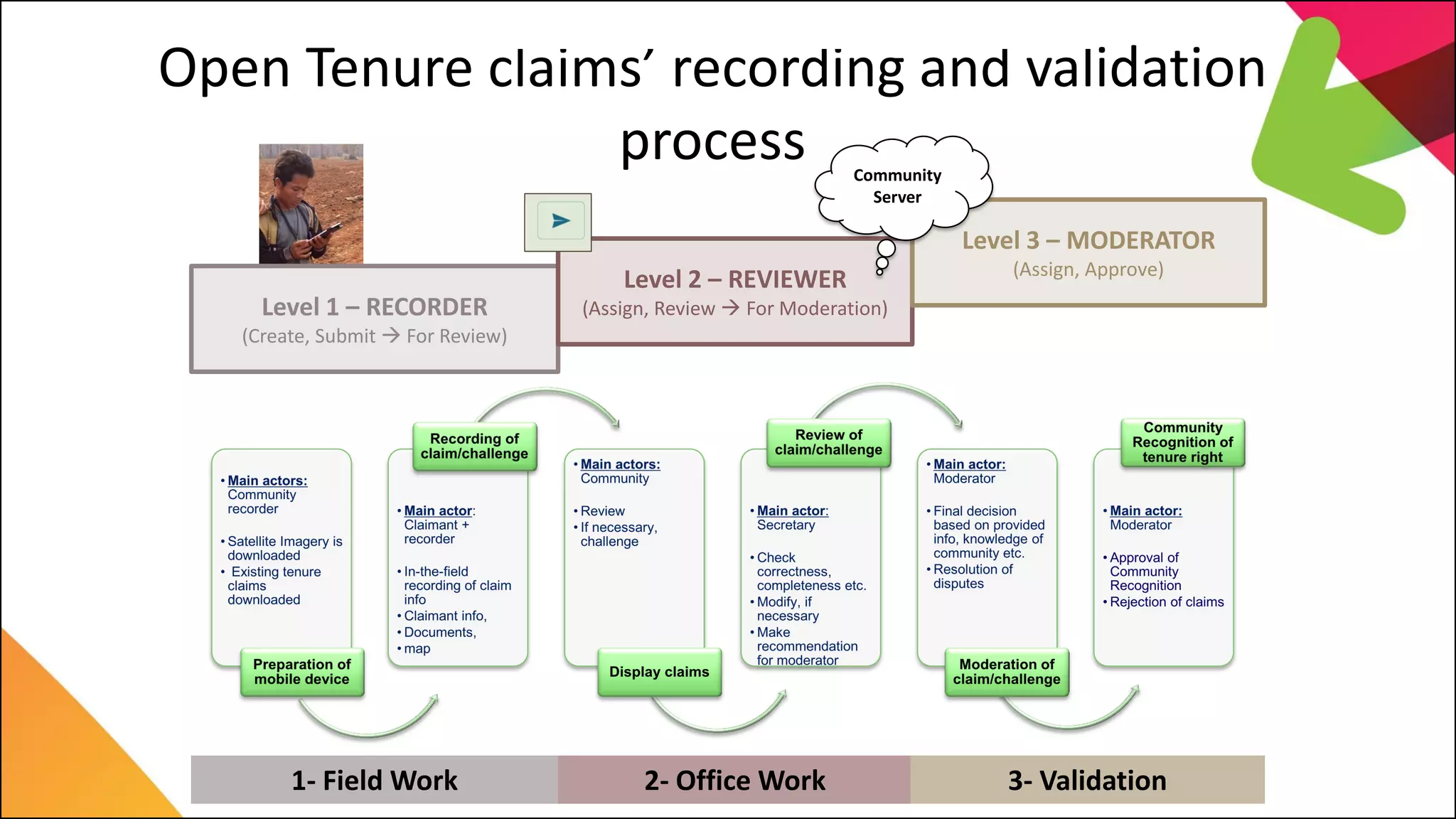
Open Tenure claims’ recording and validation
process
Level 1 – RECORDER
(Create, Submit  For Review)
Level 2 – REVIEWER
(Assign, Review  For Moderation)
Level 3 – MODERATOR
(Assign, Approve)
Community
Server
1- Field Work 2- Office Work 3- Validation
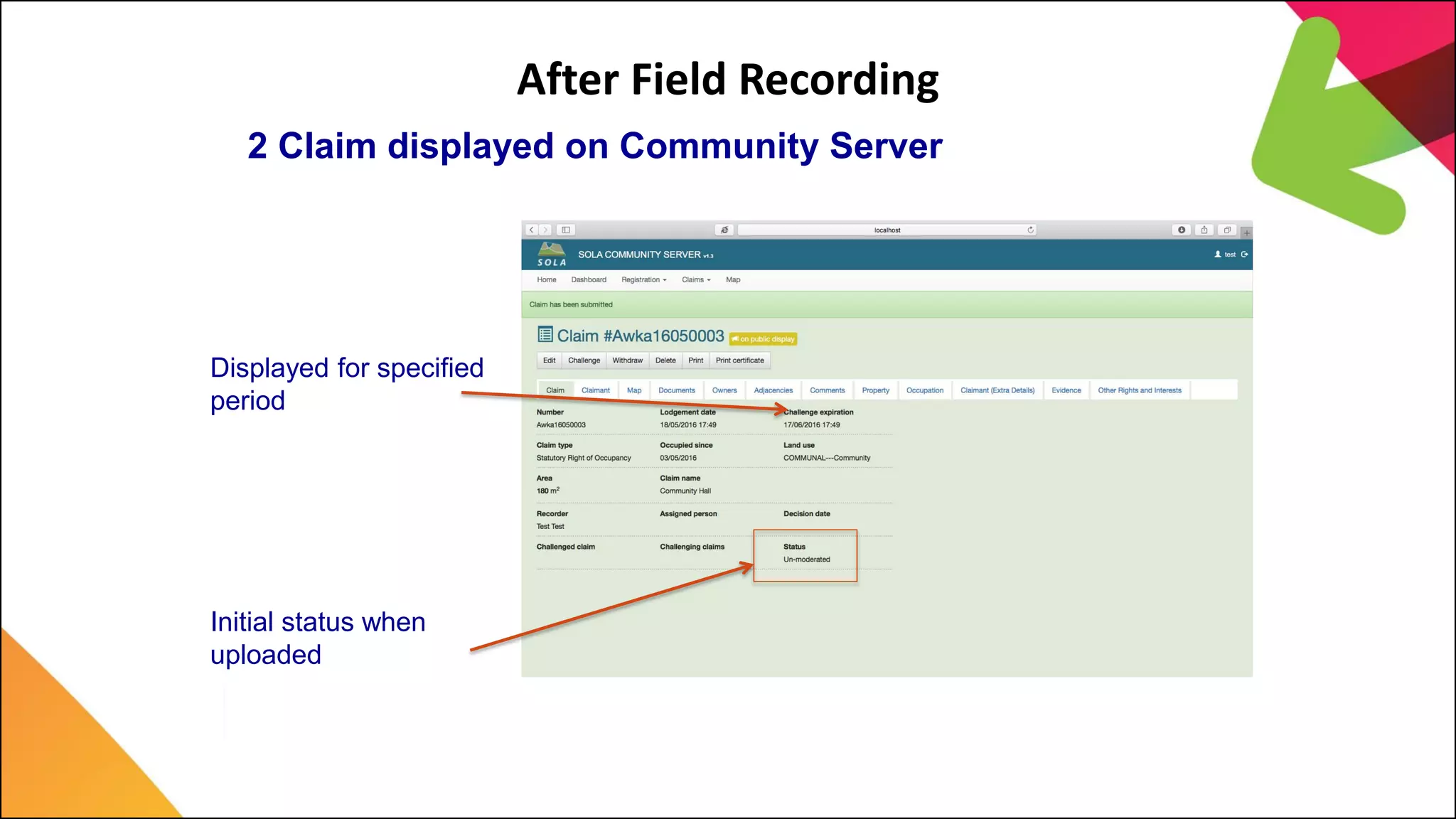
Displayed for specified
period
After Field Recording
2 Claim displayed on Community Server
Initial status when
uploaded
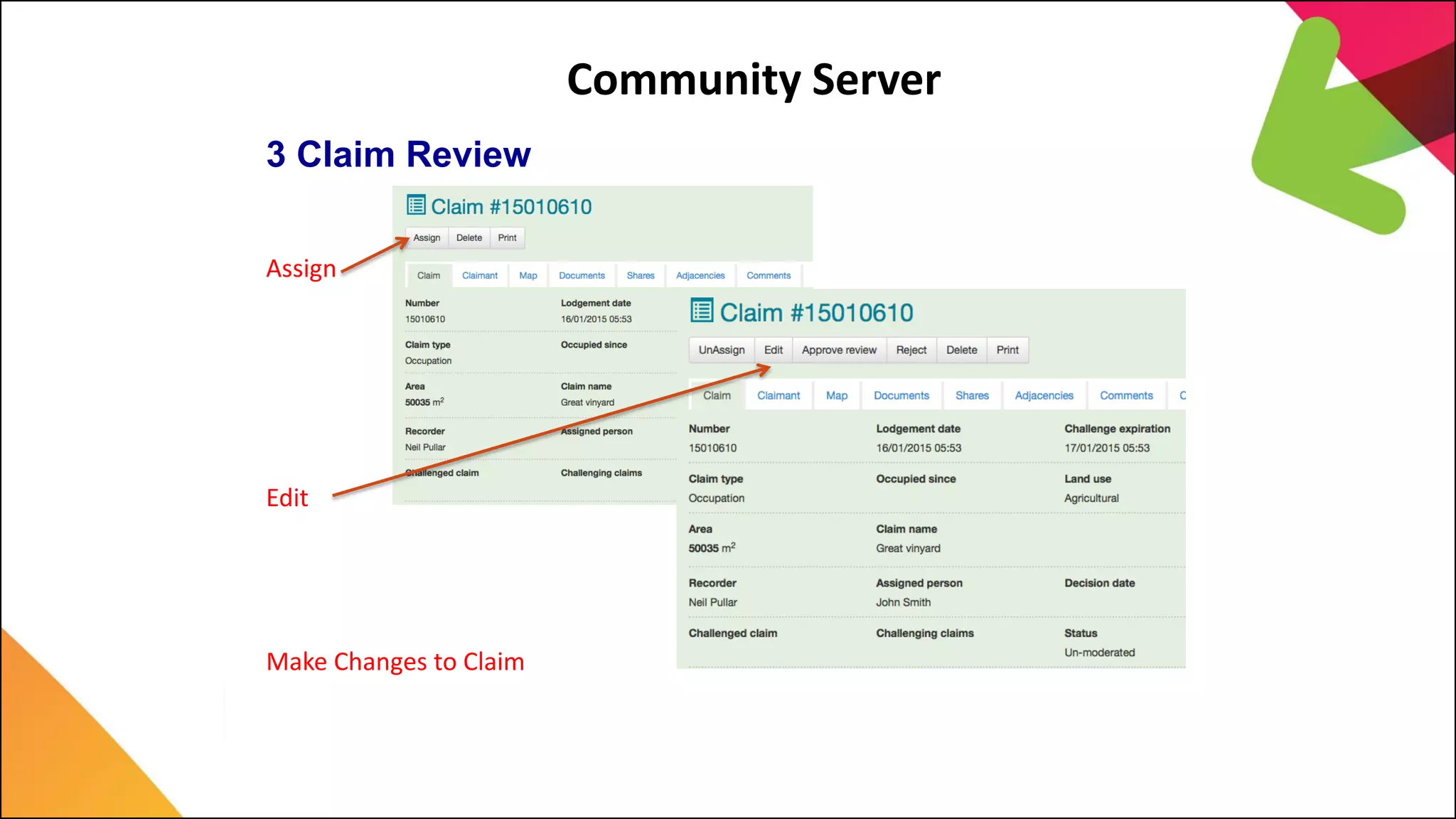
Community Server
3 Claim Review
Assign
Edit
Make Changes to Claim
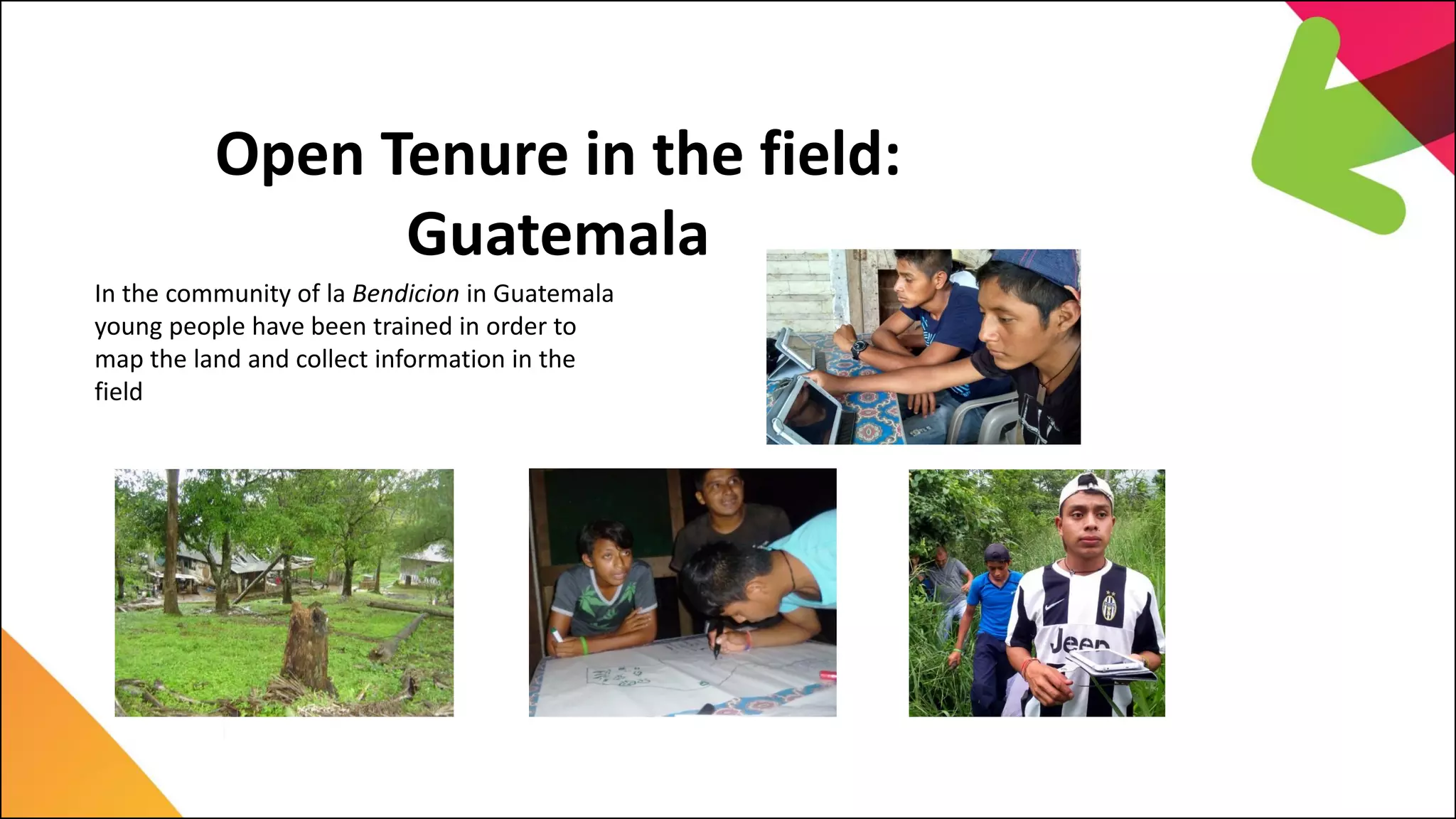
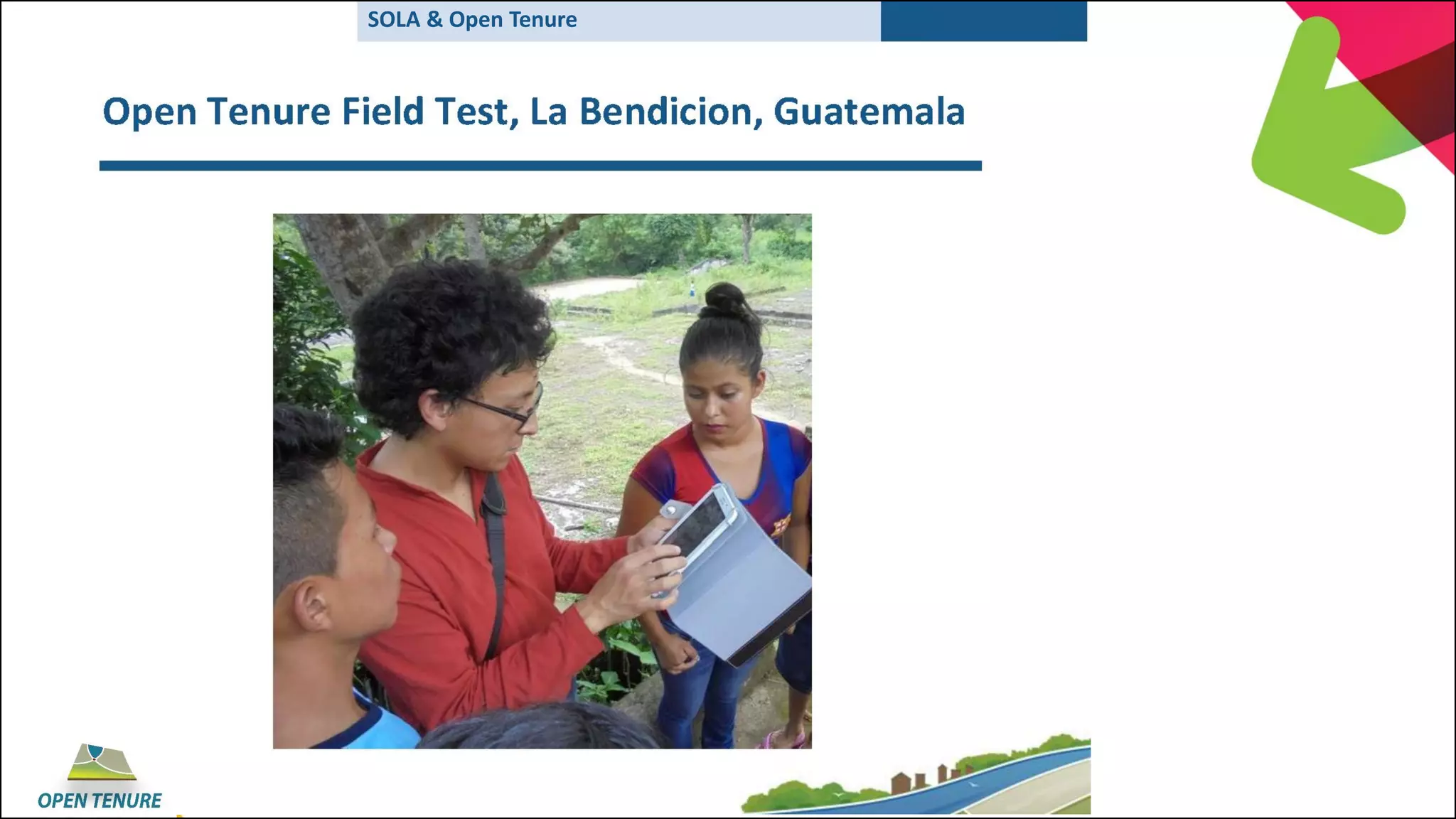
In the community of la Bendicion in Guatemala
young people have been trained in order to
map the land and collect information in the
field
Open Tenure in the field:
Guatemala
SOLA & Open Tenure
SOLA & Open Tenure
SOLA & Open Tenure
SOLA & Open Tenure
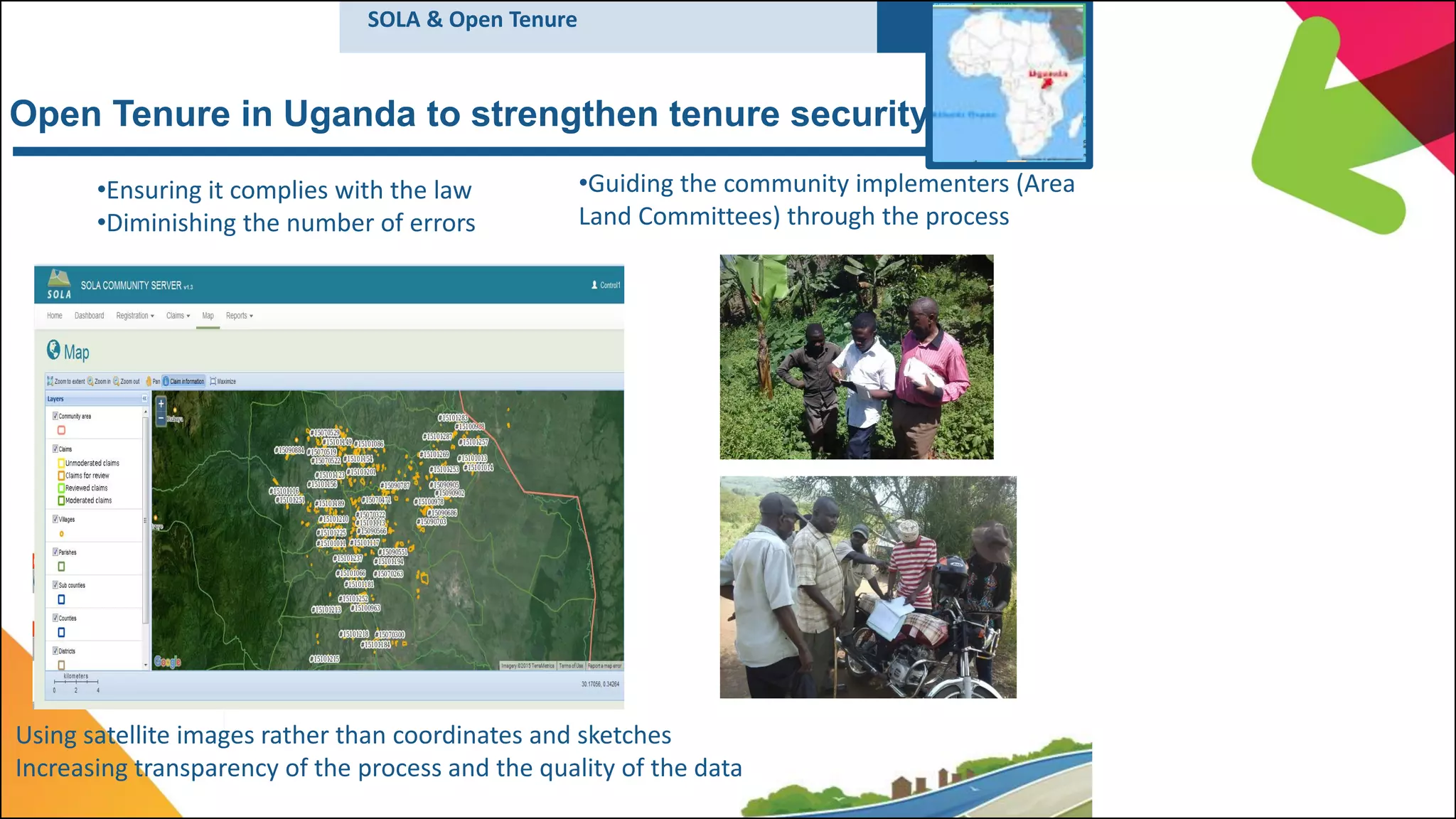
Open Tenure in Uganda to strengthen tenure security
•Guiding the community implementers (Area
Land Committees) through the process
Using satellite images rather than coordinates and sketches
Increasing transparency of the process and the quality of the data
•Ensuring it complies with the law
•Diminishing the number of errors
SOLA & Open Tenure
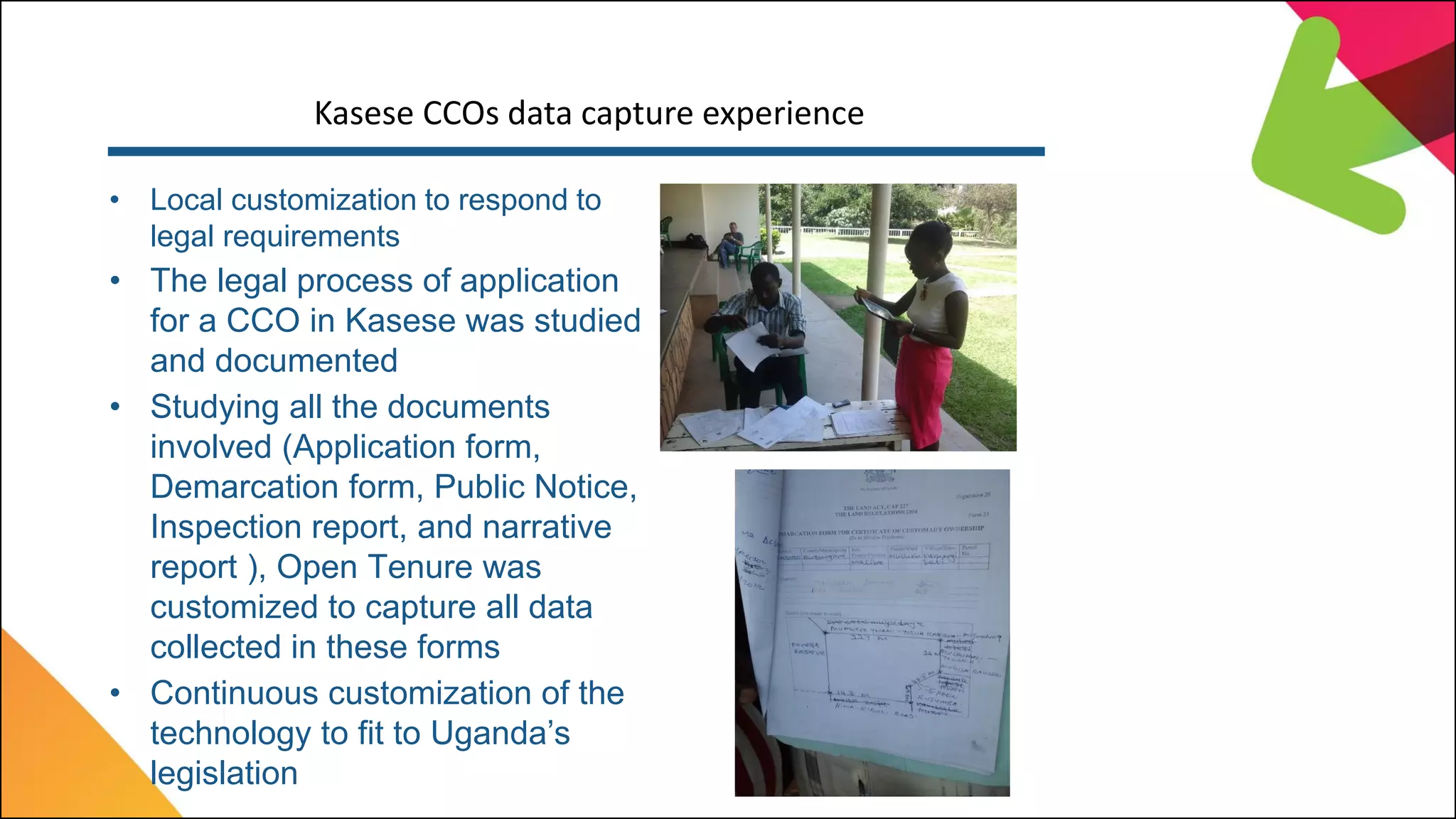
Kasese CCOs data capture experience
• Local customization to respond to
legal requirements
• The legal process of application
for a CCO in Kasese was studied
and documented
• Studying all the documents
involved (Application form,
Demarcation form, Public Notice,
Inspection report, and narrative
report ), Open Tenure was
customized to capture all data
collected in these forms
• Continuous customization of the
technology to fit to Uganda’s
legislation
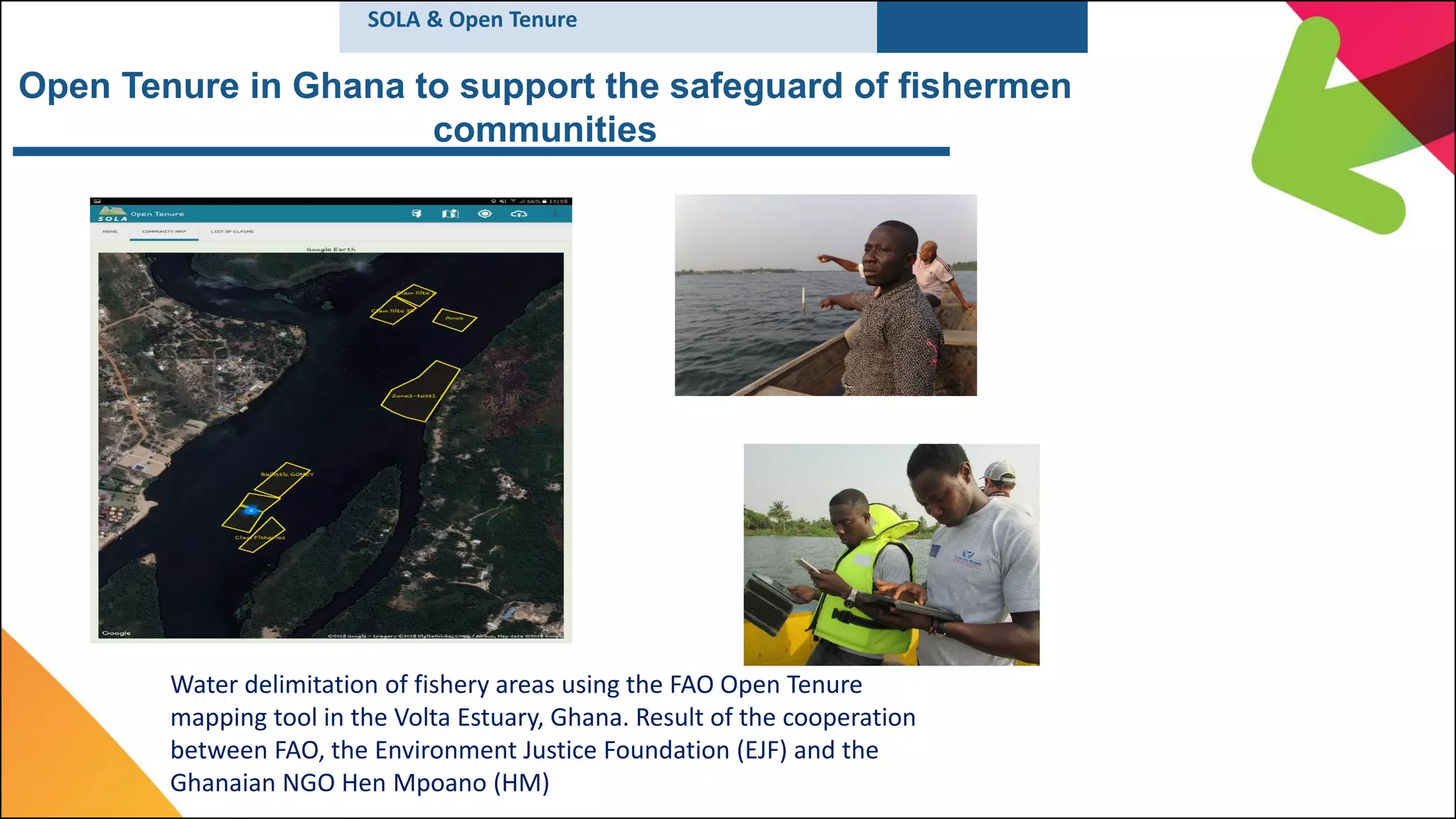
Open Tenure in Ghana to support the safeguard of fishermen
communities
Water delimitation of fishery areas using the FAO Open Tenure
mapping tool in the Volta Estuary, Ghana. Result of the cooperation
between FAO, the Environment Justice Foundation (EJF) and the
Ghanaian NGO Hen Mpoano (HM)
SOLA & Open Tenure
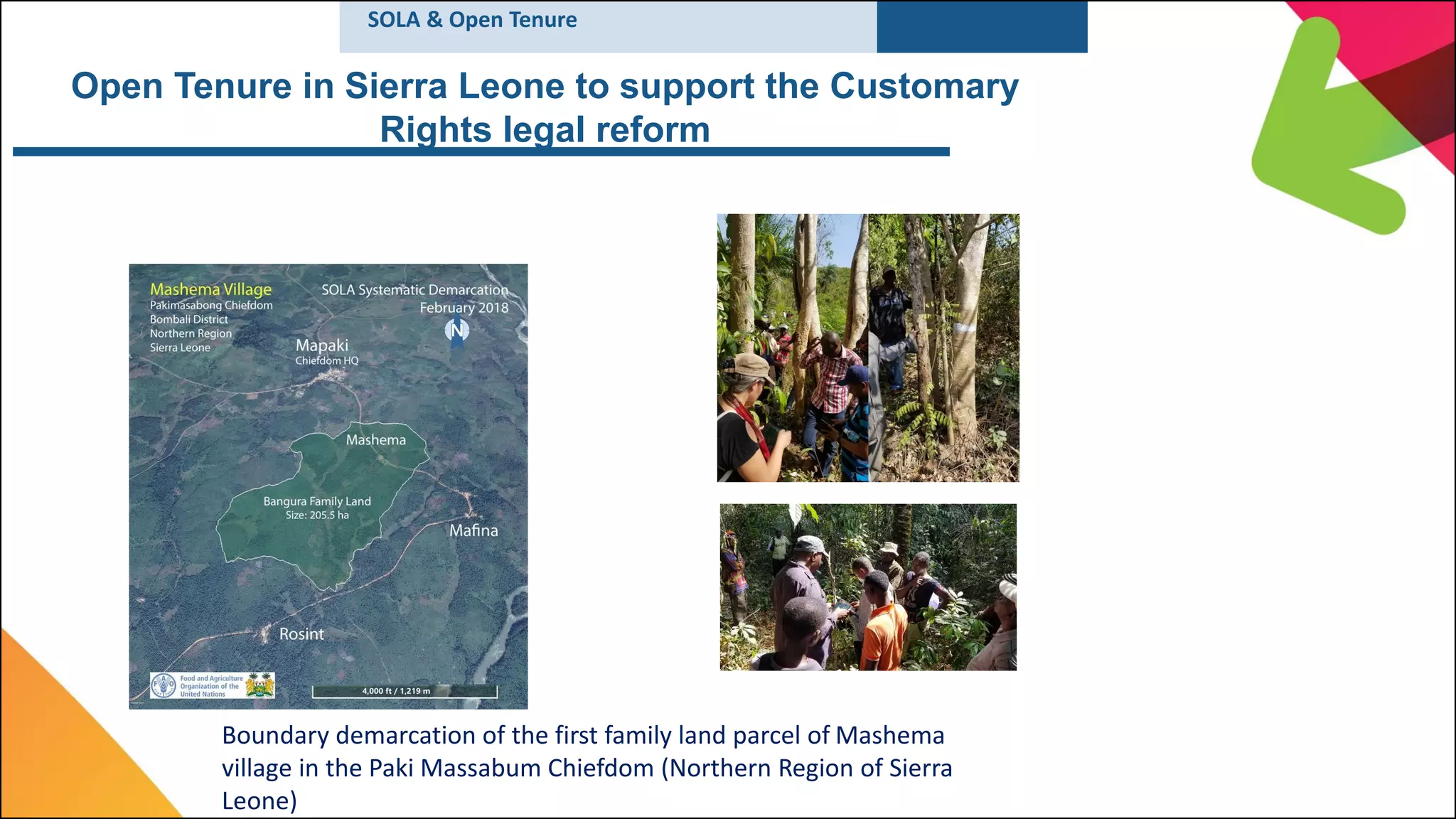
Open Tenure in Sierra Leone to support the Customary
Rights legal reform
Boundary demarcation of the first family land parcel of Mashema
village in the Paki Massabum Chiefdom (Northern Region of Sierra
Leone)
SOLA & Open Tenure
B. Benefits
1. Introduction
• STDM is a QGIS plugin that enables users benefit
from all the features of QGIS and adds several
features on top of it.
• STDM uses PostgreSQL with PostGIS as a geospatial
database.
• Customizations and new features are added for
based on request.
• STDM is extensible and customizable system.
B. Benefits
• The system simplifies work and reduces work load by:
– Removing the need for manual editing on Microsoft Word and AutoCAD
– Quick generation of certificates, survey cover letter and parcel maps
– Creating a parcel polygon from points automatically
– Generating parcel code automatically
– Calculating area of a parcel automatically
– Automatic detection of parcel boundary such as
• overlapping
• duplicate entry
• Containment – for example a parcel being inside a bigger parcel such as public
parcel
– Searching and getting information on parcel, person, institution and any
data in the system with few clicks.
• Increases efficiency and a quick processing of tasks
C. LIMS Major Features
• ADMINISTRATIVE UNIT MANAGER
• Define a hierarchy of administrative entities, where each
consists of one or more parcels that are subject to
registration by social tenure relationship. The hierarchy is
used to automatically generate unique parcel codes.
• IMPORTATION OF VARIOUS DATA TYPES
• Importation of textual and spatial data from CSV and
shapefile file formats respectively into the database. One
unique capability of this tool is that it provides an option to
choose the source- and destination-column to import data.
LIMS Major Features
• ATTIRBUTE DATA ENTRY, EDIT AND DELETE
• Users can add, edit and delete records on spatial and non-spatial
data using the forms created for each database tables.
• SPATIAL DATA ENTRY, EDIT AND DELETE (New)
• Users can register parcel record with attribute data and polygon by
just entering attribute data, typing coordinates or uploading dxf file.
• CUSTOMIZABLE AND COMPREHENSIVE DATABASE
• The database captures data starting from payments on services,
spatial and non-spatial data on parcels, person and institution that
occupy parcels, survey details such as survey date, surveyors and
planners details and relationships of these tables.
LIMS Major Features
• VARIOUS WAYS OF QUERYING DATA
• View Social Tenure Relationship enables users search for parcels,
persons and institutions and see the parcels they are related with the
type of social tenure relationship. In addition, visualize the parcel on a
separate map canvas with google and open street map base layers
embedded.
• Parcel Details enables users see details by clicking on parcel polygons
on the map canvas and pull information such as the parcel details,
survey details, the social tenure relationships, occupants of the parcel -
the persons and institution and all payments they have done for the
same parcel (New).
• Records manager by searching using filters or manual searching.
LIMS Major Features
• REPORTS & CHART GENERATION
• Generic chart generation facility for generating
plots and graphs.
• Generation of document of occupancy.
• ROLE BASED ACCESS CONTROL
• Controlled permissions to each features of LIMS
based on the role that an authorized system user
belongs to.
LIMS Major Features
• DESIGN CUSTOM DATA MANAGEMENT
FORMS
• Design columns for database tables or
extend from an existing template using an
intuitive wizard that generates data
management forms dynamically.
Thank you!
7th Capitalization Meeting
EU Land Governance Programme
FAO
Rome, Italy
26 – 29 June, 2018

Open Tenure and STDM

  • 1.
    7th Capitalization Meeting EULand Governance Programme Open Tenure & STDM FAO Rome, Italy 26 – 29 June, 2018 Maria Paola Rizzo - FAO
  • 2.
    Key relevant messagesin the VGGT • Centrality of legitimate tenure rights • Encourage States to recognize, respect and protect all tenure rights holders and their rights, including Indigenous and customary tenure. • Have a human rights based approach Different sets of tenure rights and different natural resources.
  • 3.
    Voluntary Guidelines onResponsible Governance of Tenure of Land, Fisheries and Forests (VGGT) SOLA specifically addresses Part 5 of the Voluntary Guidelines
  • 4.
    Voluntary Guidelines onResponsible Governance of Tenure of Land, Fisheries and Forests (VGGT) Open Source software (including SOLA) is seen as an Enabling Technology for the implementation of the VGGT • It directly provides transparency to tenure rights records by making them accessible and easily searchable • It improves service delivery in government agencies responsible for tenure rights and allows the monitoring of service requests • It reduces discretionary decision making and controls registration and cadastral operations • It records all changes to key records facilitating audits of changes to tenure records
  • 5.
    Voluntary Guidelines onResponsible Governance of Tenure of Land, Fisheries and Forests (VGGT) For Communities, Open Tenure is an Enabling Technology for the implementation of the VGGT in that it: • Identifies and safeguards tenure rights not recorded by formal land administration • Engages with all tenure right holders in tenure governance processes • Exercises self-governance for communities with customary tenure systems • Protects against unauthorized use of land, fisheries and forest resources • Ensures citizen and community involvement
  • 6.
    SOLA Open SourceSoftware Tenure recording and mapping using mobile devices Provides community access to & community processing of tenure records & mapping collected using Open Tenure System Admin functionality for SOLA software Supports registration & cadastre functions in Land Office environment Supports State land administration including acquisition & disposal Supports systematic (first time) registration Land Administration Community Tenure Recording
  • 7.
    Open Tenure • Mobileapplication for Android and iOS devices • Allows citizen and community recording of tenure rights (crowd sourcing) • Record claimant details, capture boundary information and collect scanned documents and photos to support claim • Supports fit for purpose mapping • Claims uploaded to the Community Server for moderation • Field testing completed in 2015 (Cambodia & Guatemala) • Also implemented in Nigeria (Reserve Mapping, Certificate Capture & Systematic Registration) & Uganda (Customary Registration)
  • 8.
    What is OpenTenure ? • Strengthens local tenure governance in the frame of the VGGT • Helps communities to record tenure relationships existing in their community • Uses tablet devices and Open Tenure open source software to record in the field a range of tenure relationships and map them using satellite imagery and GPS measurements • Uses a web based Community Server to store Open Tenure claims from Community Recorders and to update those claims when they are accepted and recognized by the community Community Server Optional Backend (e.g. SOLA) PCs Mobile devices Network Cloud Mobile application Community Web Site
  • 9.
    Field Recording 2 Enterdetails about claim into Open Tenure Name of Land Select from Lists Press for Date control Automatically calculated Optional Click to enter Claimant Save Save Tabs * Compulsory Fields List - press Date - press
  • 10.
    Field Recording 4 RecordOwnership Claimant is automatically created as an owner with 100% share but can be edited : Add New Share Tap on Share Open Ownership Screen Use % control Define Share X Delete Share
  • 11.
    Field Recording 7 Attachsupporting documents Attach Document (usually multi-page scans using TinyScan) Take Photo of document or land & attach Press Home + to open TinyScan app (for more than 1 page)
  • 12.
    Field Recording Then walkthe boundary with the Owner and ideally their Neighbours mapping the boundary corners
  • 13.
    Field Recording 9 Mapthe land Long press New Boundary Corner GPS New Corner Delete Corner Edit Options Precise mapping Quit Edit Mode Short press Edit Mode Display Current Location
  • 14.
    Open Tenure claims’recording and validation process Level 1 – RECORDER (Create, Submit  For Review) Level 2 – REVIEWER (Assign, Review  For Moderation) Level 3 – MODERATOR (Assign, Approve) Community Server 1- Field Work 2- Office Work 3- Validation
  • 15.
    Displayed for specified period AfterField Recording 2 Claim displayed on Community Server Initial status when uploaded
  • 16.
    Community Server 3 ClaimReview Assign Edit Make Changes to Claim
  • 17.
    In the communityof la Bendicion in Guatemala young people have been trained in order to map the land and collect information in the field Open Tenure in the field: Guatemala
  • 18.
  • 19.
  • 20.
  • 21.
  • 22.
    Open Tenure inUganda to strengthen tenure security •Guiding the community implementers (Area Land Committees) through the process Using satellite images rather than coordinates and sketches Increasing transparency of the process and the quality of the data •Ensuring it complies with the law •Diminishing the number of errors SOLA & Open Tenure
  • 23.
    Kasese CCOs datacapture experience • Local customization to respond to legal requirements • The legal process of application for a CCO in Kasese was studied and documented • Studying all the documents involved (Application form, Demarcation form, Public Notice, Inspection report, and narrative report ), Open Tenure was customized to capture all data collected in these forms • Continuous customization of the technology to fit to Uganda’s legislation
  • 24.
    Open Tenure inGhana to support the safeguard of fishermen communities Water delimitation of fishery areas using the FAO Open Tenure mapping tool in the Volta Estuary, Ghana. Result of the cooperation between FAO, the Environment Justice Foundation (EJF) and the Ghanaian NGO Hen Mpoano (HM) SOLA & Open Tenure
  • 25.
    Open Tenure inSierra Leone to support the Customary Rights legal reform Boundary demarcation of the first family land parcel of Mashema village in the Paki Massabum Chiefdom (Northern Region of Sierra Leone) SOLA & Open Tenure
  • 26.
  • 27.
    1. Introduction • STDMis a QGIS plugin that enables users benefit from all the features of QGIS and adds several features on top of it. • STDM uses PostgreSQL with PostGIS as a geospatial database. • Customizations and new features are added for based on request. • STDM is extensible and customizable system.
  • 29.
    B. Benefits • Thesystem simplifies work and reduces work load by: – Removing the need for manual editing on Microsoft Word and AutoCAD – Quick generation of certificates, survey cover letter and parcel maps – Creating a parcel polygon from points automatically – Generating parcel code automatically – Calculating area of a parcel automatically – Automatic detection of parcel boundary such as • overlapping • duplicate entry • Containment – for example a parcel being inside a bigger parcel such as public parcel – Searching and getting information on parcel, person, institution and any data in the system with few clicks. • Increases efficiency and a quick processing of tasks
  • 30.
    C. LIMS MajorFeatures • ADMINISTRATIVE UNIT MANAGER • Define a hierarchy of administrative entities, where each consists of one or more parcels that are subject to registration by social tenure relationship. The hierarchy is used to automatically generate unique parcel codes. • IMPORTATION OF VARIOUS DATA TYPES • Importation of textual and spatial data from CSV and shapefile file formats respectively into the database. One unique capability of this tool is that it provides an option to choose the source- and destination-column to import data.
  • 31.
    LIMS Major Features •ATTIRBUTE DATA ENTRY, EDIT AND DELETE • Users can add, edit and delete records on spatial and non-spatial data using the forms created for each database tables. • SPATIAL DATA ENTRY, EDIT AND DELETE (New) • Users can register parcel record with attribute data and polygon by just entering attribute data, typing coordinates or uploading dxf file. • CUSTOMIZABLE AND COMPREHENSIVE DATABASE • The database captures data starting from payments on services, spatial and non-spatial data on parcels, person and institution that occupy parcels, survey details such as survey date, surveyors and planners details and relationships of these tables.
  • 32.
    LIMS Major Features •VARIOUS WAYS OF QUERYING DATA • View Social Tenure Relationship enables users search for parcels, persons and institutions and see the parcels they are related with the type of social tenure relationship. In addition, visualize the parcel on a separate map canvas with google and open street map base layers embedded. • Parcel Details enables users see details by clicking on parcel polygons on the map canvas and pull information such as the parcel details, survey details, the social tenure relationships, occupants of the parcel - the persons and institution and all payments they have done for the same parcel (New). • Records manager by searching using filters or manual searching.
  • 33.
    LIMS Major Features •REPORTS & CHART GENERATION • Generic chart generation facility for generating plots and graphs. • Generation of document of occupancy. • ROLE BASED ACCESS CONTROL • Controlled permissions to each features of LIMS based on the role that an authorized system user belongs to.
  • 34.
    LIMS Major Features •DESIGN CUSTOM DATA MANAGEMENT FORMS • Design columns for database tables or extend from an existing template using an intuitive wizard that generates data management forms dynamically.
  • 35.
    Thank you! 7th CapitalizationMeeting EU Land Governance Programme FAO Rome, Italy 26 – 29 June, 2018