OPEN SOURCE
Professor: Dr.
VazifehDoost
Student: Yaser Emami
2018
WHAT IS OPEN SOURCE?
In production and development, open source is a philosophy or a
methodology that promotes free distribution and access to product's
design or ideas and implemention details:
Open as in free
Open as in access
Open as in overtime
Open as in not closed
Open as in reuse and change
Open as in any place and for anyone
OPEN SOURCE VS. CLOSED SOURCE
View/modify The Source Code of an application or software
Open Source software is released to the development community and
undergoes a secondary phase of evolution, but closed Source
software is developed in isolation with a small team of developers
Developers support and large community to help
Open source is more secure and bugs and vulnerabilities are fixed
often
CRITERIA FOR OPEN SOURCE
Source code
Derived works
Free redistribution
Distribution of licence
Integrity of the Arthur's source code
Licence must not restrict other software
No discrimination against person's or groups
No discrimination against fields endeavor
HISTORY OF OPEN SOURCE
The concept of free sharing of technological information existed long
before computers
Similar to open standards, researchers with access to advanced
research projects agency network used a process called request for
comments to develop telecommunication network protocol which led
to the birth of the internet in 1969
The term open source was adopted by a group of people held at Palo
Alto California. Open source summit organised in April 1998 by
technology publisher Tim O'Reily.
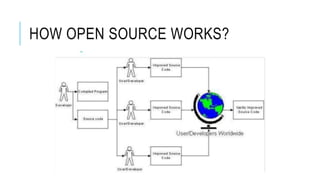
HOW OPEN SOURCE WORKS?
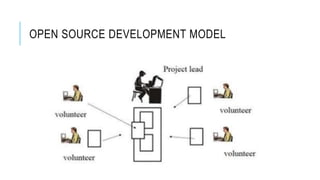
OPEN SOURCE DEVELOPMENT MODEL
ADVANTAGES OF OPEN SOURCE
Availability of source code
 Source code to understand and learn from
 Do not have to reinvent the wheel
 Free as in freedom
Does not depend on vendor
 Can choose additional support
 Can fix work and adapt change in requirements as well as technology
Quality and customizabilty in open source is better
Costs much less than propreitary counterparts
SOME DISADVANTAGES OF OPEN SOURCE
Not generally straightforward to use and require certain learning
curve to use and get accustomed
Incompatibility issue with software and hardware
Bad code, and some unqualified people who uses it
Software quality assurance process is widely not transparent
No financial incentive
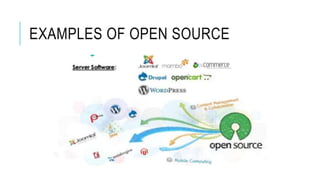
EXAMPLES OF OPEN SOURCE
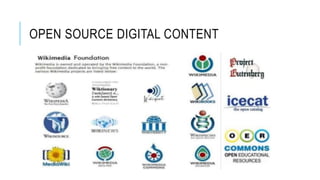
OPEN SOURCE DIGITAL CONTENT
MORE EXAPMLES-ANDROID
Linux based operating system designed primarily for touchscreen
mobile devices such as smartphones and tablet computers
Android is open source and Google releases the code under the
Apache licence after acquiring it from Android
Most widely used mobile platform with over 700000 apps in Google
Play Store, over 25 billion app downloads with 750 million devices
running on Android
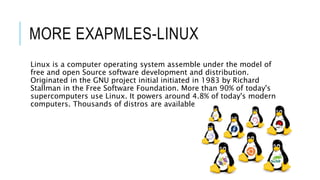
MORE EXAPMLES-LINUX
Linux is a computer operating system assemble under the model of
free and open Source software development and distribution.
Originated in the GNU project initial initiated in 1983 by Richard
Stallman in the Free Software Foundation. More than 90% of today's
supercomputers use Linux. It powers around 4.8% of today's modern
computers. Thousands of distros are available
LICENCE AND COPYRIGHT
There are hundreds of different license
Author chooses to licence under a licence granting open source
freedom. Some are easy to comply with like:
You can do anything you like as long as you buy me a drink sometime if we meet
Some licences are more difficult to comply with:
GNU GPL says that you can only use GPL code if modified/distributed code is also
released under the GPL
Copyleft
MYTHS ABOUT OPEN SOURCE
FOSS= Free and Open Source Software
FOSS is free
FOSS isn't reliable or supported
Making a software open source, anyone can change it
The open source licences to liberal
If you make yourself the open source, well on to your code there's
will fix all of your problems for free
CONCLUSION
Common platform for sharing ideas and putting them into action by
developers or other people who wishes to improve a product
We are in the open source Revolution where people collaborate to
create, produce software or technology
Based upon the key advantages of open source technology, we can
finally conclude that open source deserves the increasing popularity
Thank you

open source

  • 1.
  • 2.
    WHAT IS OPENSOURCE? In production and development, open source is a philosophy or a methodology that promotes free distribution and access to product's design or ideas and implemention details: Open as in free Open as in access Open as in overtime Open as in not closed Open as in reuse and change Open as in any place and for anyone
  • 3.
    OPEN SOURCE VS.CLOSED SOURCE View/modify The Source Code of an application or software Open Source software is released to the development community and undergoes a secondary phase of evolution, but closed Source software is developed in isolation with a small team of developers Developers support and large community to help Open source is more secure and bugs and vulnerabilities are fixed often
  • 4.
    CRITERIA FOR OPENSOURCE Source code Derived works Free redistribution Distribution of licence Integrity of the Arthur's source code Licence must not restrict other software No discrimination against person's or groups No discrimination against fields endeavor
  • 5.
    HISTORY OF OPENSOURCE The concept of free sharing of technological information existed long before computers Similar to open standards, researchers with access to advanced research projects agency network used a process called request for comments to develop telecommunication network protocol which led to the birth of the internet in 1969 The term open source was adopted by a group of people held at Palo Alto California. Open source summit organised in April 1998 by technology publisher Tim O'Reily.
  • 6.
  • 7.
  • 8.
    ADVANTAGES OF OPENSOURCE Availability of source code  Source code to understand and learn from  Do not have to reinvent the wheel  Free as in freedom Does not depend on vendor  Can choose additional support  Can fix work and adapt change in requirements as well as technology Quality and customizabilty in open source is better Costs much less than propreitary counterparts
  • 9.
    SOME DISADVANTAGES OFOPEN SOURCE Not generally straightforward to use and require certain learning curve to use and get accustomed Incompatibility issue with software and hardware Bad code, and some unqualified people who uses it Software quality assurance process is widely not transparent No financial incentive
  • 10.
  • 11.
  • 12.
    MORE EXAPMLES-ANDROID Linux basedoperating system designed primarily for touchscreen mobile devices such as smartphones and tablet computers Android is open source and Google releases the code under the Apache licence after acquiring it from Android Most widely used mobile platform with over 700000 apps in Google Play Store, over 25 billion app downloads with 750 million devices running on Android
  • 13.
    MORE EXAPMLES-LINUX Linux isa computer operating system assemble under the model of free and open Source software development and distribution. Originated in the GNU project initial initiated in 1983 by Richard Stallman in the Free Software Foundation. More than 90% of today's supercomputers use Linux. It powers around 4.8% of today's modern computers. Thousands of distros are available
  • 14.
    LICENCE AND COPYRIGHT Thereare hundreds of different license Author chooses to licence under a licence granting open source freedom. Some are easy to comply with like: You can do anything you like as long as you buy me a drink sometime if we meet Some licences are more difficult to comply with: GNU GPL says that you can only use GPL code if modified/distributed code is also released under the GPL Copyleft
  • 15.
    MYTHS ABOUT OPENSOURCE FOSS= Free and Open Source Software FOSS is free FOSS isn't reliable or supported Making a software open source, anyone can change it The open source licences to liberal If you make yourself the open source, well on to your code there's will fix all of your problems for free
  • 16.
    CONCLUSION Common platform forsharing ideas and putting them into action by developers or other people who wishes to improve a product We are in the open source Revolution where people collaborate to create, produce software or technology Based upon the key advantages of open source technology, we can finally conclude that open source deserves the increasing popularity
  • 17.