Open practice across sectors 
Anna Gruszczynska, Suzanne Hardy, Helen Richardson, 
facilitated by Terry McAndrew
Facilitator 
Terry McAndrewis an advisor at JISC TechDis(since 2010) and the C&IT manager at the UK Centre for Bioscience Subject Centre (since 2000). 
Presenters 
Anna Gruszczynskais Project Officer at C-SAP (Higher Education Academy Subject Centre for Sociology, Anthropology and Politics) where for the past two years she has provided research and project management support to projects taking place within the JISC/HEA supported UK Open Educational Resources [UKOER] programme. 
Suzanne Hardy joined the Subject Centre for Medicine, Dentistry and Veterinary Medicinein July 2000 and is responsible for overseeing the development and management of the website and its associated databases. Her primary brief is to support the information dissemination and publication activities of the Centre facilitated by the appropriate use of new technologies, and to encourage the novel use of new technologies in learning and teaching in the centre's three subject areas. 
Helen Richardson is Business Manager at FusedWorks, Doncaster College's 3D visualisation studio (www.fusedworks.com). The College is a general further education college based in South Yorkshire. Through University Centre Doncaster it is one of the largest providers of Higher Education in the FE sector and currently has over 1000 FTEs on HE programmes..
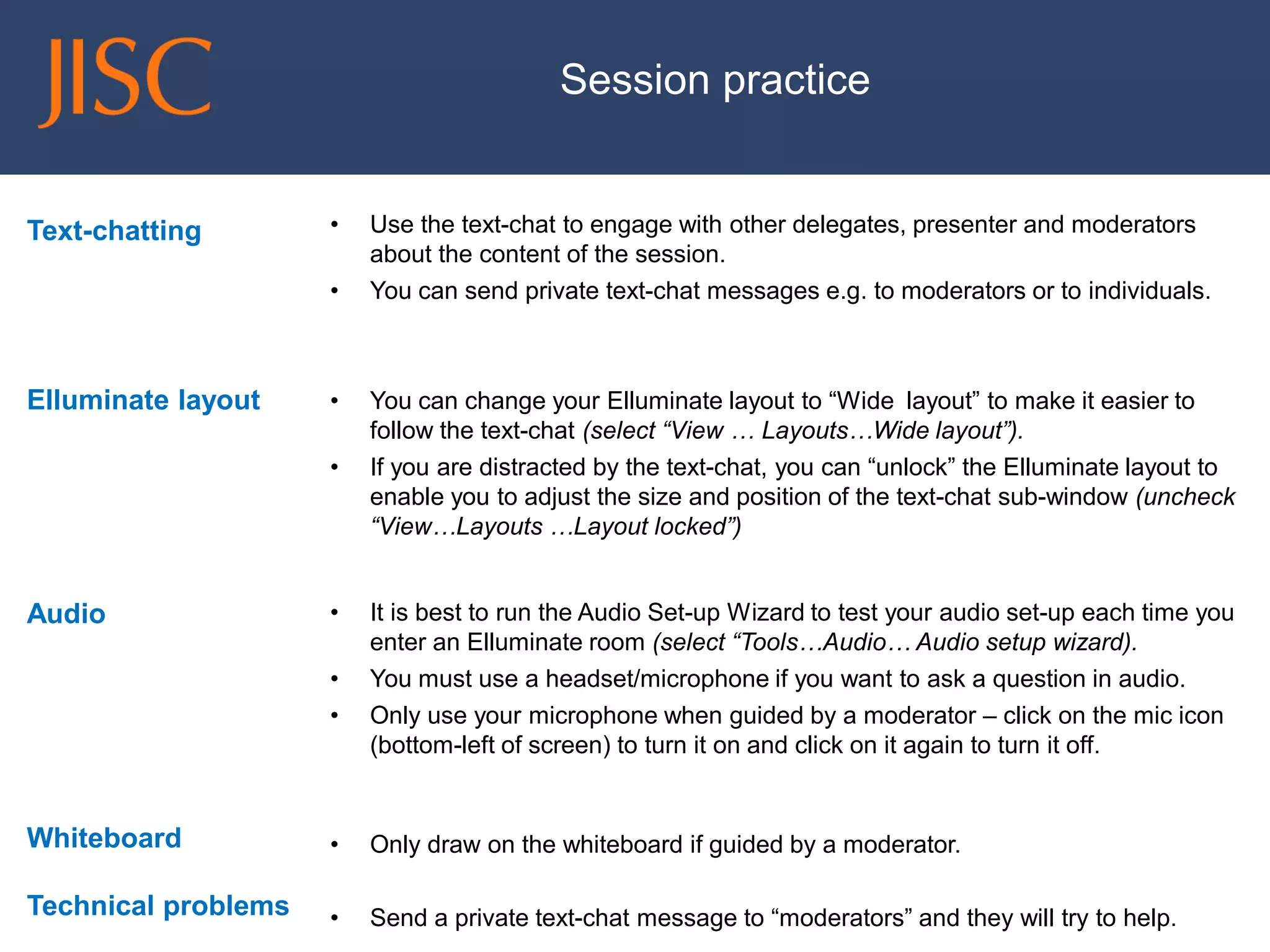
Text-chatting 
Elluminate layout 
Audio 
Whiteboard 
Technical problems 
•Use the text-chat to engage with other delegates, presenter and moderators about the content of the session. 
•You can send private text-chat messages e.g. to moderators or to individuals. 
•You can change your Elluminate layout to “Wide layout” to make it easier to follow the text-chat (select “View … Layouts…Wide layout”). 
•If you are distracted by the text-chat, you can “unlock” the Elluminate layout to enable you to adjust the size and position of the text-chat sub-window (uncheck “View…Layouts …Layout locked”) 
•It is best to run the Audio Set-up Wizard to test your audio set-up each time you enter an Elluminate room (select “Tools…Audio… Audio setup wizard). 
•You must use a headset/microphone if you want to ask a question in audio. 
•Only use your microphone when guided by a moderator –click on the mic icon (bottom-left of screen) to turn it on and click on it again to turn it off. 
•Only draw on the whiteboard if guided by a moderator. 
•Send a private text-chat message to “moderators” and they will try to help. 
Session practice
JISCEL11 
Open Practice Across Sectors
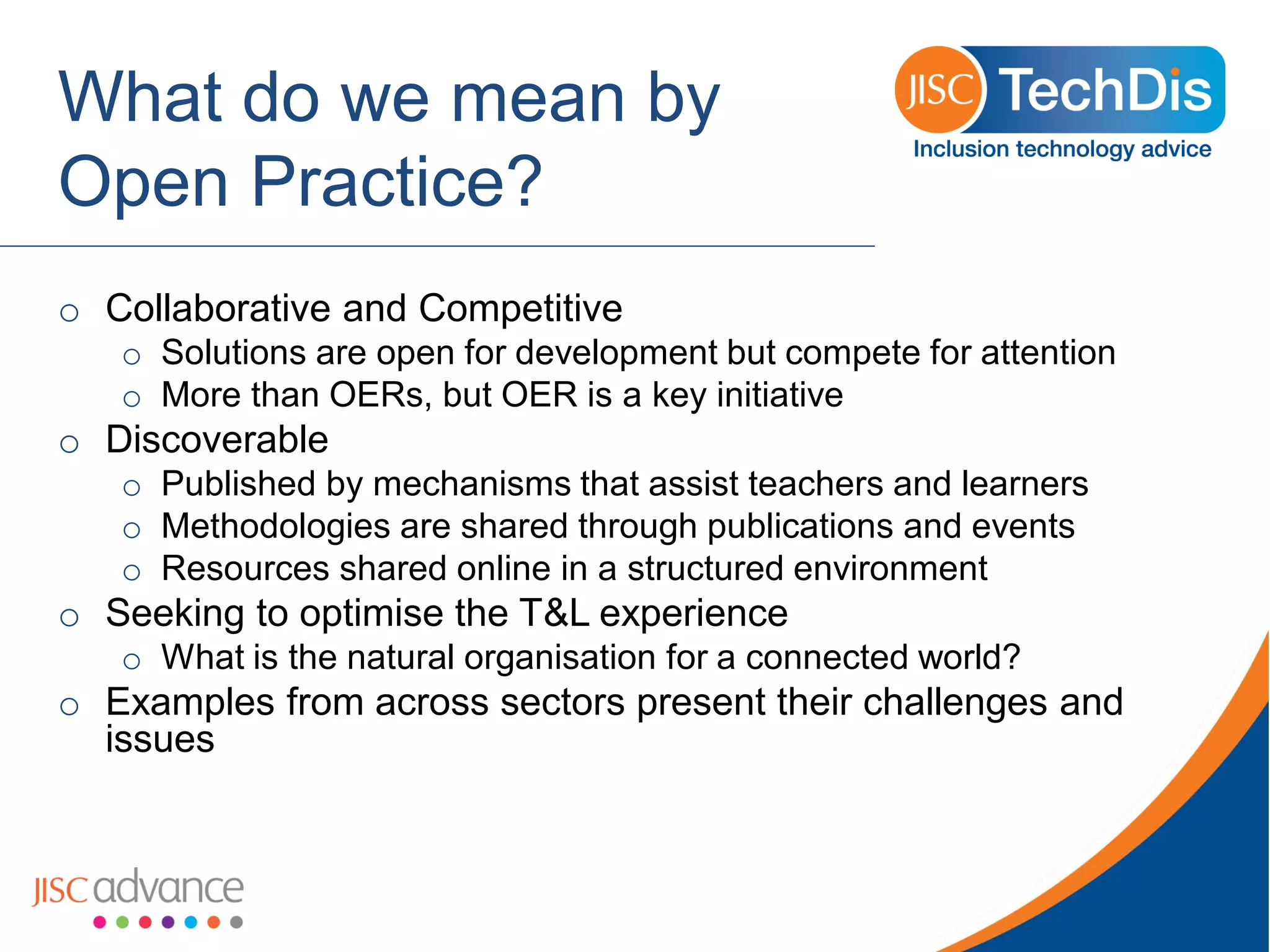
What do we mean by Open Practice? 
oCollaborative and Competitive 
oSolutions are open for development but compete for attention 
oMore than OERs, but OER is a key initiative 
oDiscoverable 
oPublished by mechanisms that assist teachers and learners 
oMethodologies are shared through publications and events 
oResources shared online in a structured environment 
oSeeking to optimise the T&L experience 
oWhat is the natural organisation for a connected world? 
oExamples from across sectors present their challenges and issues
Open Practice Across SectorsFE & HE
Existing Culture -General 
•Limited open practice across the sector 
•Open practise more likely within departments 
•FE less hierarchical and more practical based which can lend itself more to open resources 
•FE resources can also be used within HE 
•Institutional structure that supports open practice
Existing Culture –Working Practice 
•Collaborative approach to way of working within curriculum –learner and employer involvement. 
•OER that works for a wider range of college curriculums (FE & HE) as tutors tailor resources to a students level. 
•Early steps taken to share knowledge of open practice through internal task groups and training days.
Challenges of Culture 
•Limited staff time to re-purpose open resources 
•Limited skill set to re-purpose open resources 
•Lack of infrastructure/policy to support open practice 
•Lack of confidence/knowledge with regards to licensing issues 
•Uncertainty around where to upload and find open resources 
•Limited sharing of resources between departments 
•Lack of awareness that creation of open resource is recognised as form of scholarship
Moving Forward... 
•Increase awareness! 
•Start with encouraging a culture of re-use 
–Where can resources be found. 
–How do you re-use (clear institutional policy). 
•CPD sessions for staff covering open resource availability, searching, re-purposing, licensing and curriculum planning. 
•Include market research phase to ensure open resources are appropriate, aligned to curriculum and employer needs. 
•Involve key stakeholders i.e. students and lecturers wherever possible to encourage wider use once released.
Open practice across sectors: HE in FE issues 
Anna Gruszczynska, 
C-SAP/ Sheffield Hallam University 
(HEA Subject Centre for Sociology, Anthropology and Politics) 
Image source FreeFoto 
(CC BY-NC-ND 3.0)
C-SAP cascade project: creating spaces for open practice 
•Cascade framework: Model of release, discovery and reuse of OERs 
•Emphasis on the broader context (cultural/institutional) in which OERs are created and (re)used and any resulting issues and/or tensions 
•Focus on the “why” rather than the “how” of Open Educational Resources [OERs]
Opening up pedagogical practice: Creativity for edupunks(C4E) 
•A wiki-based resource and space to develop OER literacyand consider the potential impact of theOERs on approaches to teaching and learning 
•11 three-hour long sessions to fit within the 33- hour allocation for research activity (“selling point” for senior management) 
•Inspiration for C4E: connections with Blackburn’s past history of engagement with punk/DIY culture 
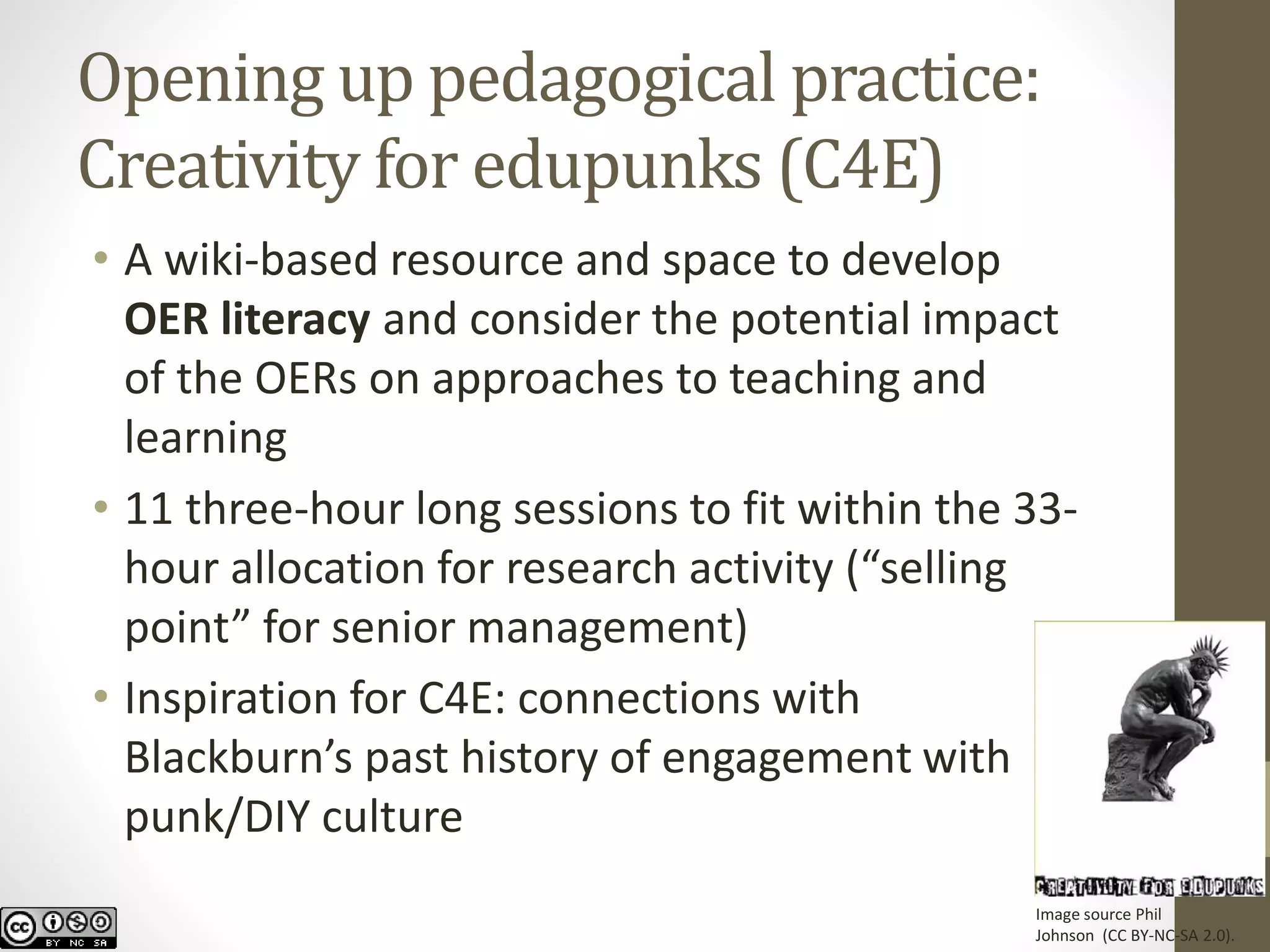
Image source Phil Johnson (CC BY-NC-SA 2.0).
Ideas for going forward: Need for a paradigm shift? 
Edupunkis an approach to teaching and learning practices that result from ado it yourself(DIY) attitude (Downes, 2008). 
Anarchogogy: the idea and the possibility of an approach to democratically disseminating, and openly creating “new” knowledge, where facilitators and learners collaborate, and the emerging ‘learning events’ serve to “lead without ruling” (from C4E wiki). 
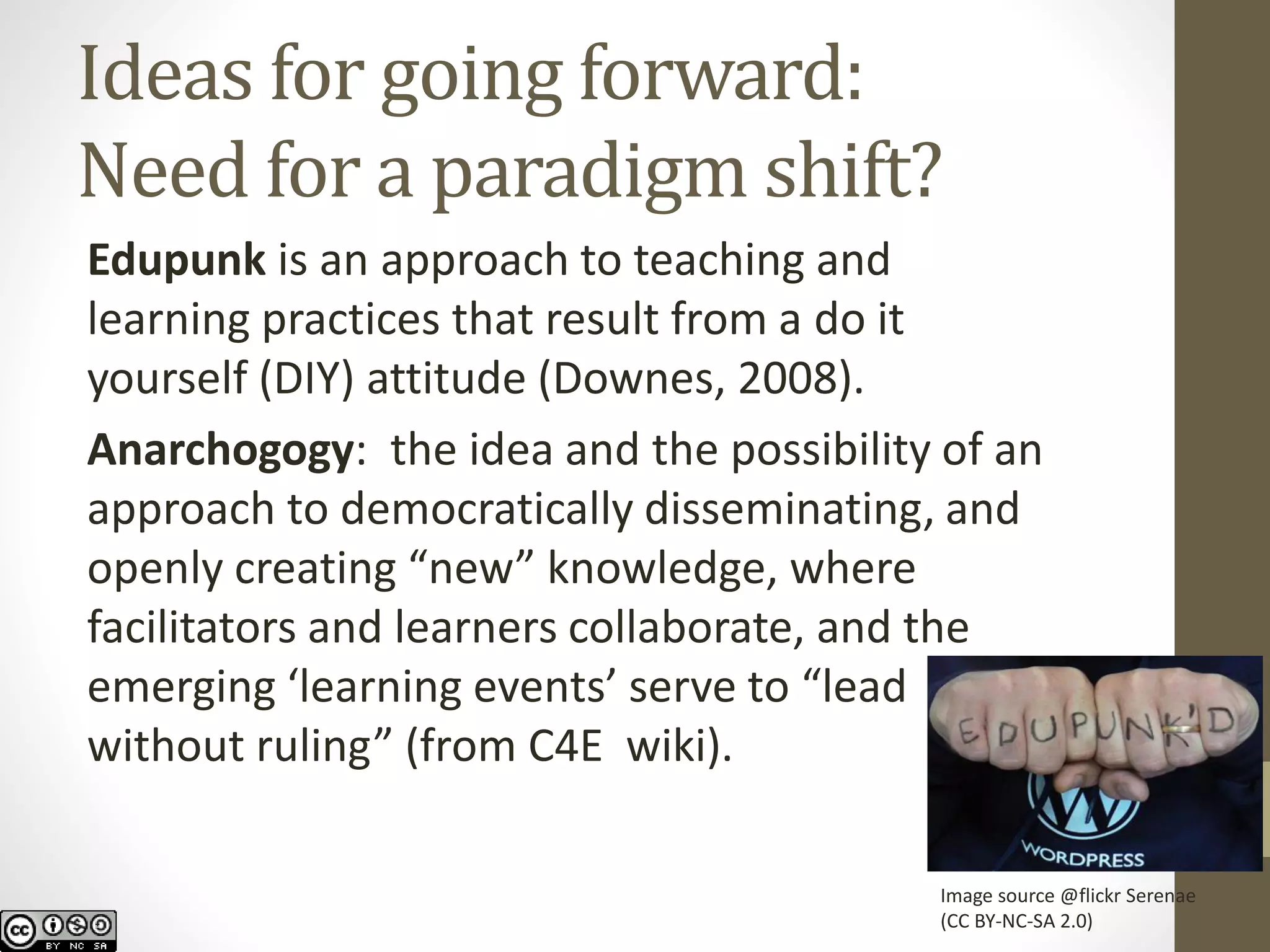
Image source @flickrSerenae 
(CC BY-NC-SA 2.0)
What could open practice mean? (1) 
For me learning has to be memorable, experiential and collaborative. For me open educational resources are a great addition and an extension to the learning that's taking place in the classroom amongst learners who are connected to the subject, the teacher and their peers. Participating in (Creativity for) Edupunk confirms it too: I have watched videos, browsed websites and posted on this wiki but there's no response, no sense of connection, until Phil wandered into my office the other day and for ten minutes we had a really good discussion about this stuff. (from Creativity for Edupunkswiki)
What could open practice mean? (2) 
Thisis exactly what Phil and I have encountered on our "adventures" with this stuff; it is amazing in itself, but, explorations of the 'potential' for this stuff only becomes meaningful when it is discussed and deliberated ... in conversation and debate with real/empassioned[sic!] collaborators. (from Creativity for Edupunkswiki) 
Our best hope is to get better at empowering individuals to find answers for themselves. (…) forget about giving the guy a fish, or teaching him how to fish, either. Teach him how to teach himself, and he’ll always be able to acquire the skills he needs to find food, skills you haven’t even thought of yet for things you didn’t know you could eat (from Kamenetz, 2010 –DIY U).
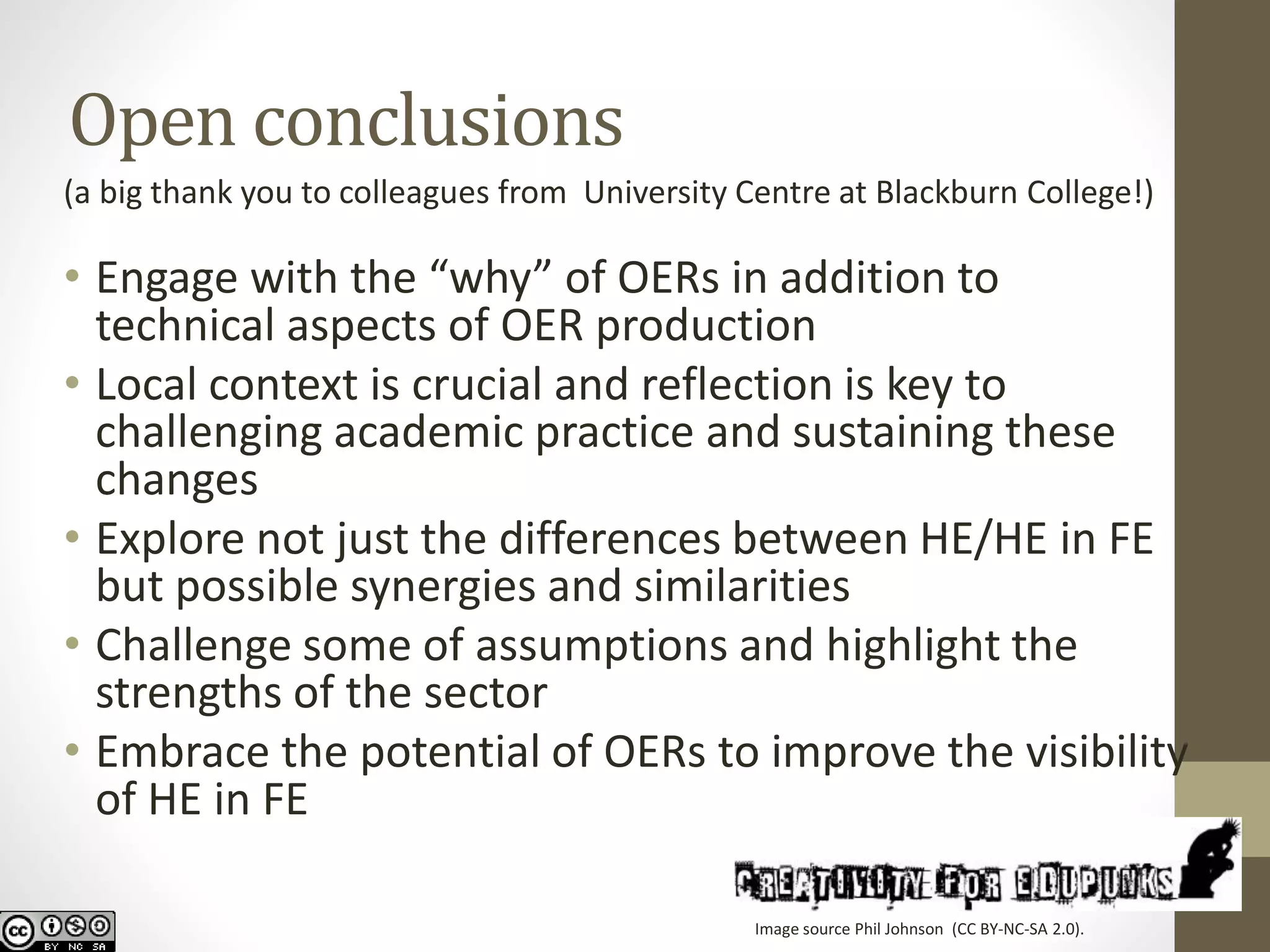
Open conclusions 
(a big thank you to colleagues from University Centre at Blackburn College!) 
•Engage with the “why” of OERs in addition to technical aspects of OER production 
•Local context is crucial and reflection is key to challenging academic practice and sustaining these changes 
•Explore not just the differences between HE/HE in FE but possible synergies and similarities 
•Challenge some of assumptions and highlight the strengths of the sector 
•Embrace the potential of OERs to improve the visibility of HE in FE 
Image source Phil Johnson (CC BY-NC-SA 2.0).
Open practice across sectors: human and animal healthcare. Lessons from ACTOR and PORSCHE 
Suzanne Hardy 
School of Medical Sciences Education Development, Newcastle University
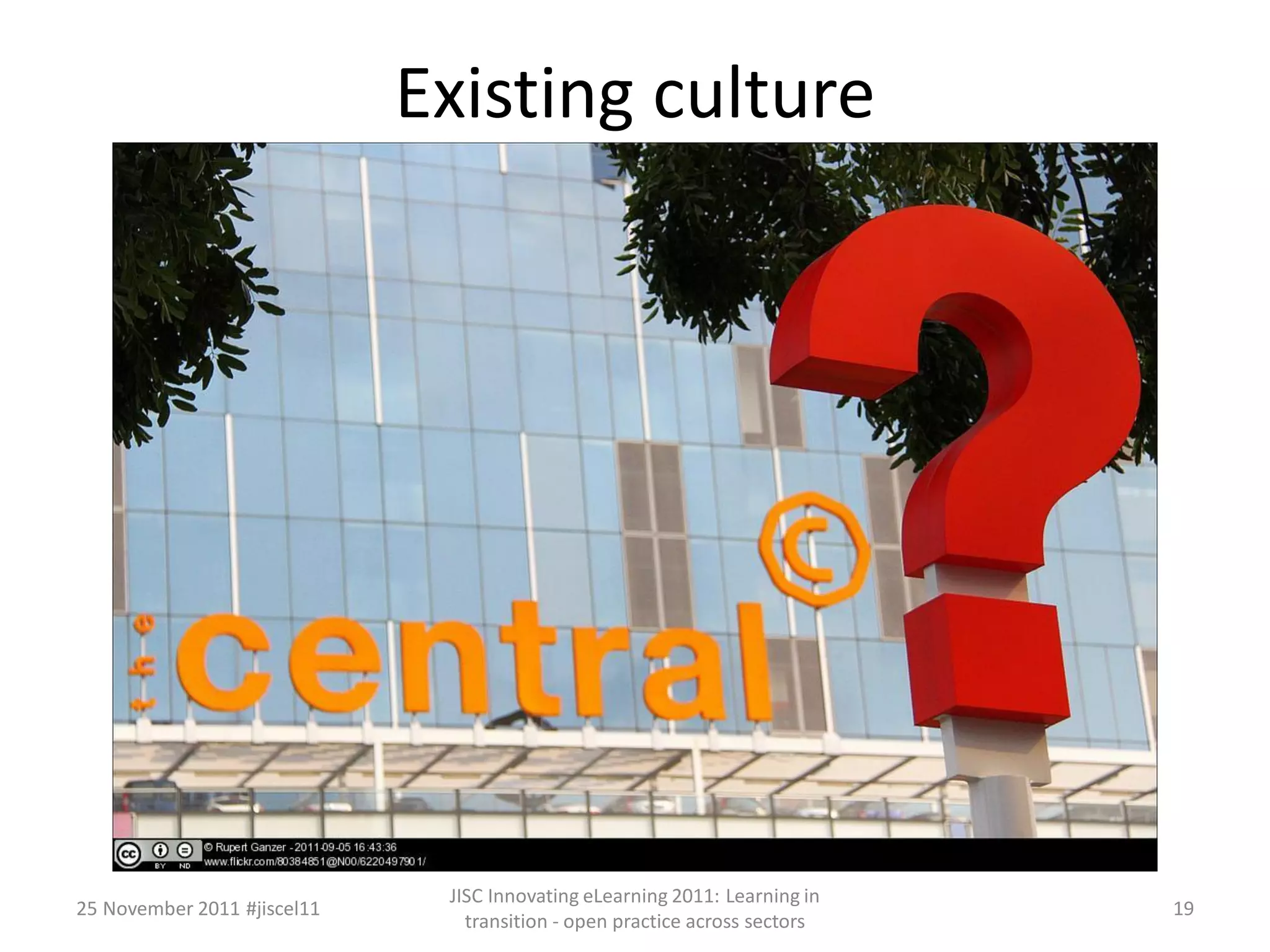
Existing culture 
25 November 2011 #jiscel11 
JISC Innovating eLearning 2011: Learning in 
transition - open practice across sectors 
19
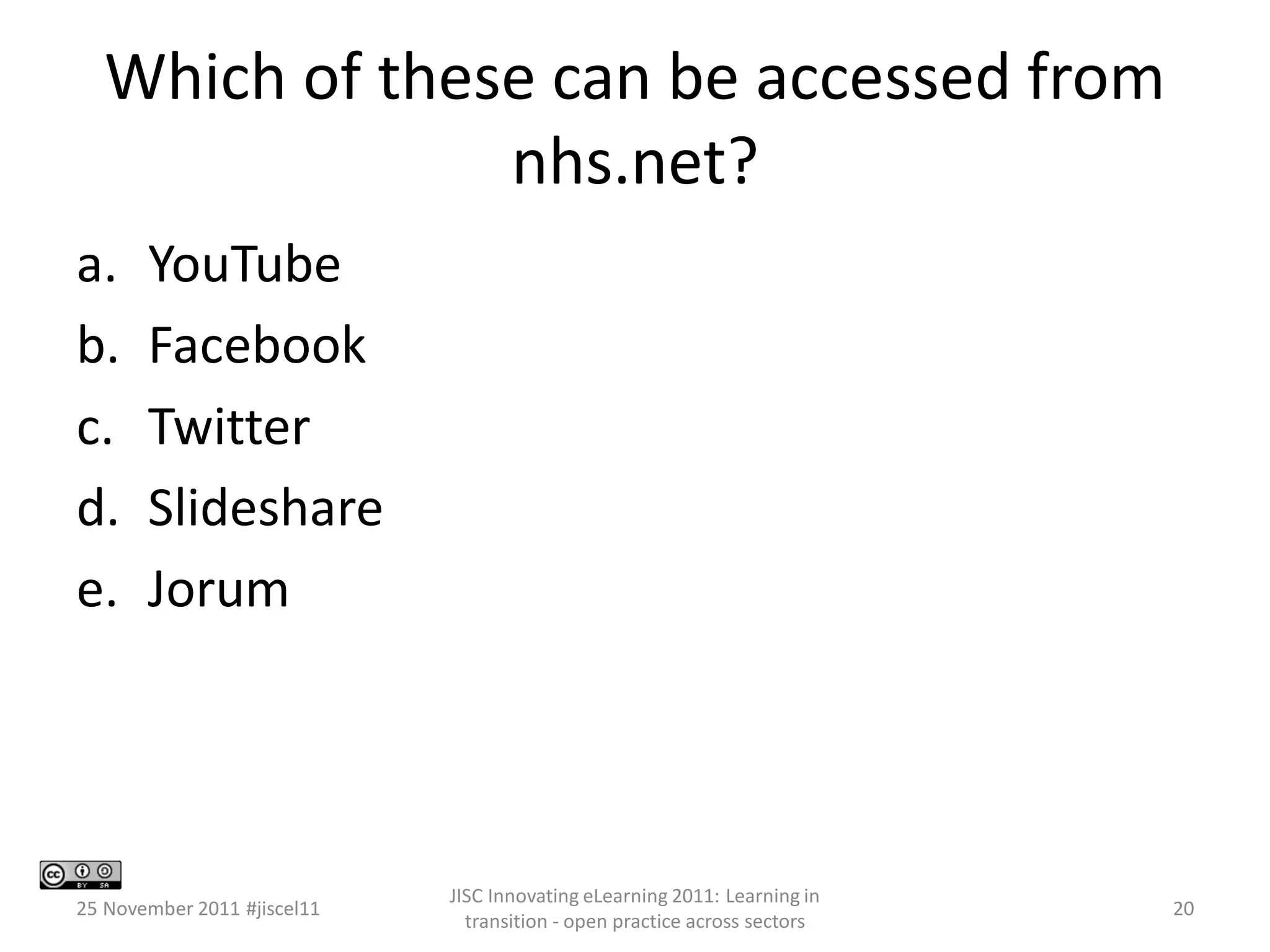
Which of these can be accessed from nhs.net? 
a.YouTube 
b.Facebook 
c.Twitter 
d.Slideshare 
e.Jorum 
25 November 2011 #jiscel11 
JISC Innovating eLearning 2011: Learning in 
transition - open practice across sectors 
20
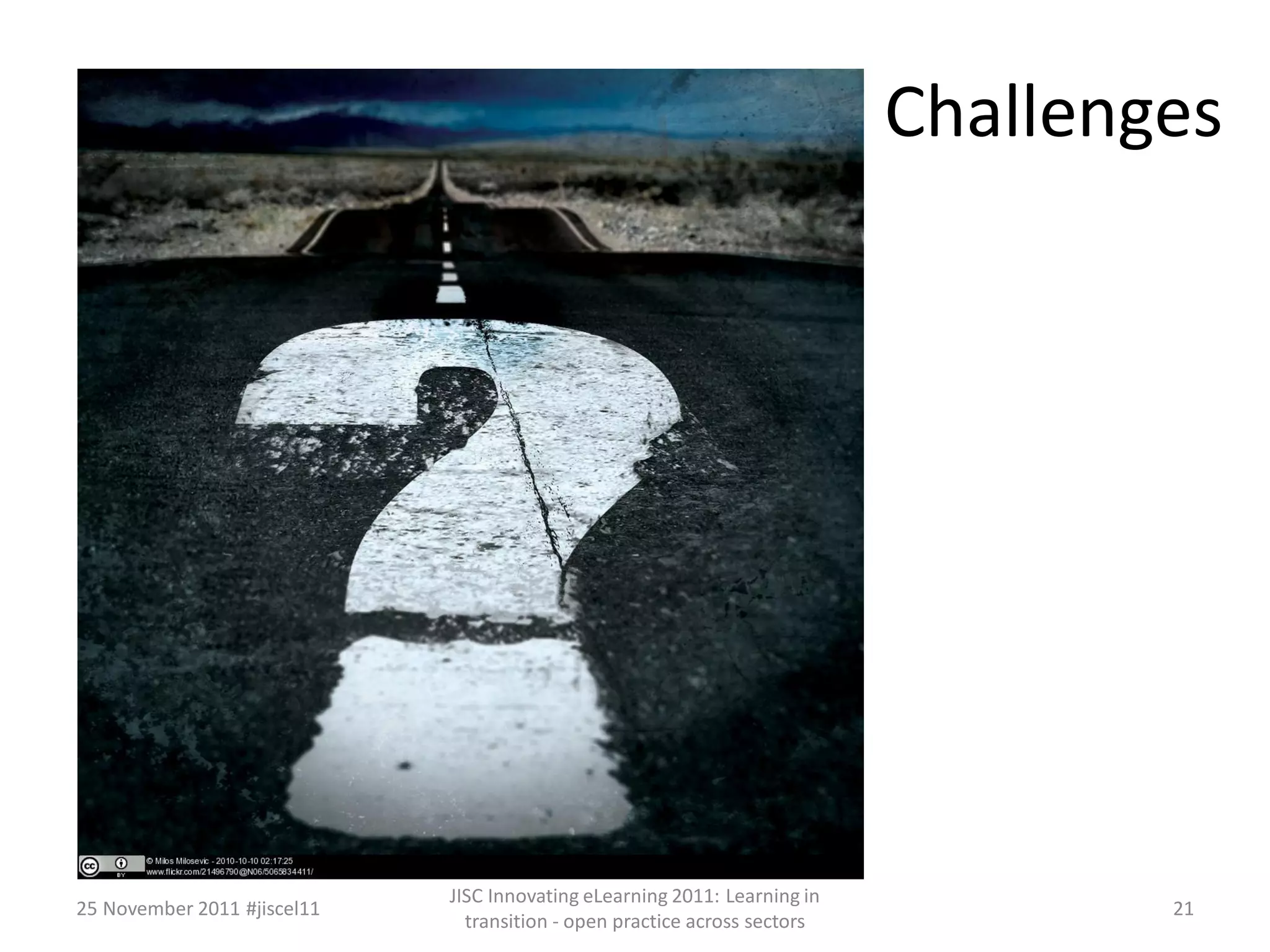
Challenges 
25 November 2011 #jiscel11 
JISC Innovating eLearning 2011: Learning in 
transition - open practice across sectors 
21
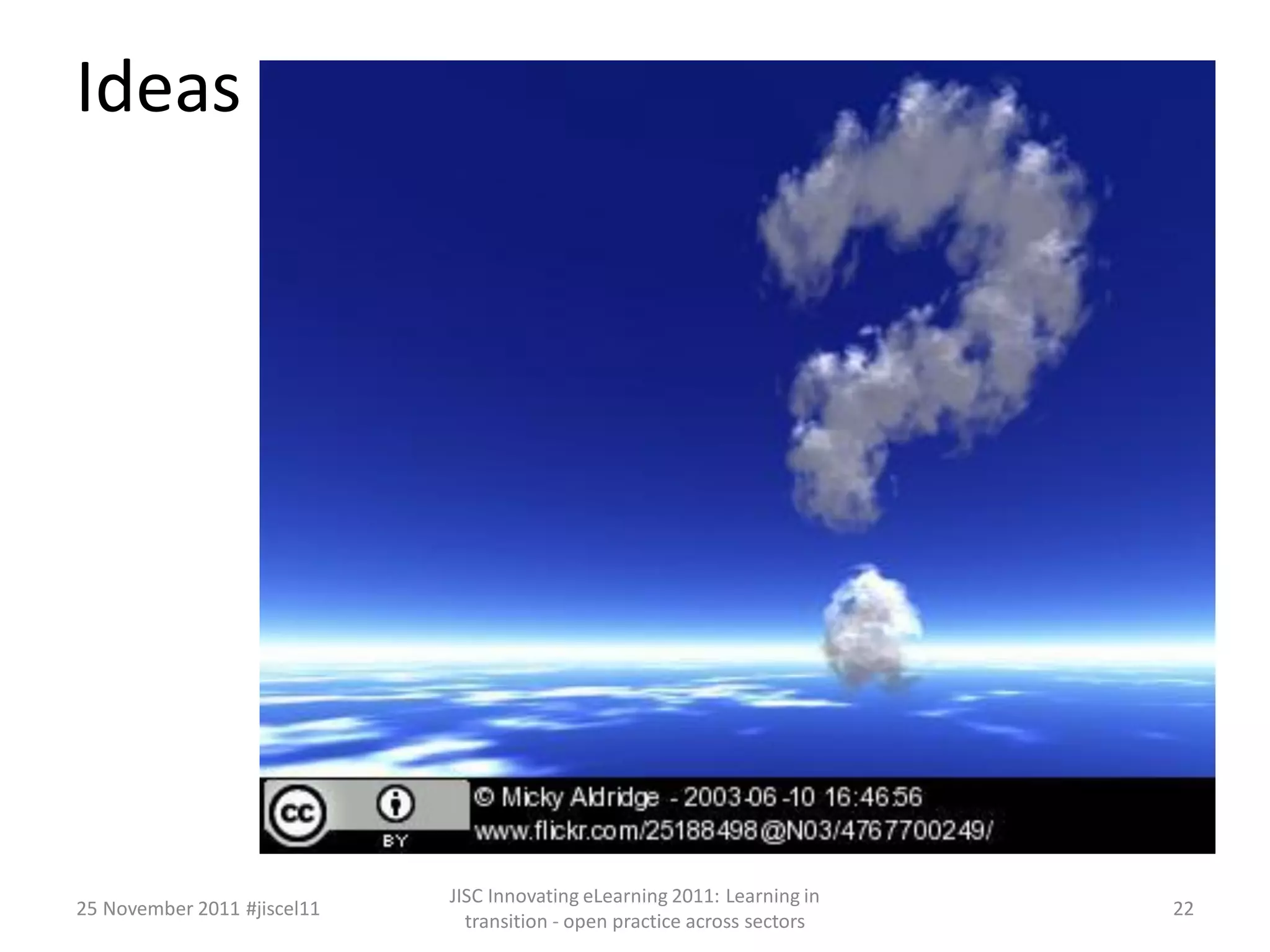
Ideas 
25 November 2011 #jiscel11 
JISC Innovating eLearning 2011: Learning in 
transition - open practice across sectors 
22
www.medev.ac.uk/ourwork/oer/ 
suzanne@medev.ac.uk 
twitter.com/hea_medev 
twitter.com/glittrgirl 
skype: glitt3rgirl 
25 November 2011 #jiscel11 
JISC Innovating eLearning 2011: Learning in 
transition - open practice across sectors 
23
Discussion 
oWe have approximately 25 minsto discuss the key issues 
oHow is Open Practice more than social tactics and trading? 
oThe importance of accessible Open Practice 
oKeynote: 
oCourage for transformative change? 
oThinking globally 
oIncentives and gains to inform stakeholders and management –“Political wisdom” 
oDangers of non-engagement
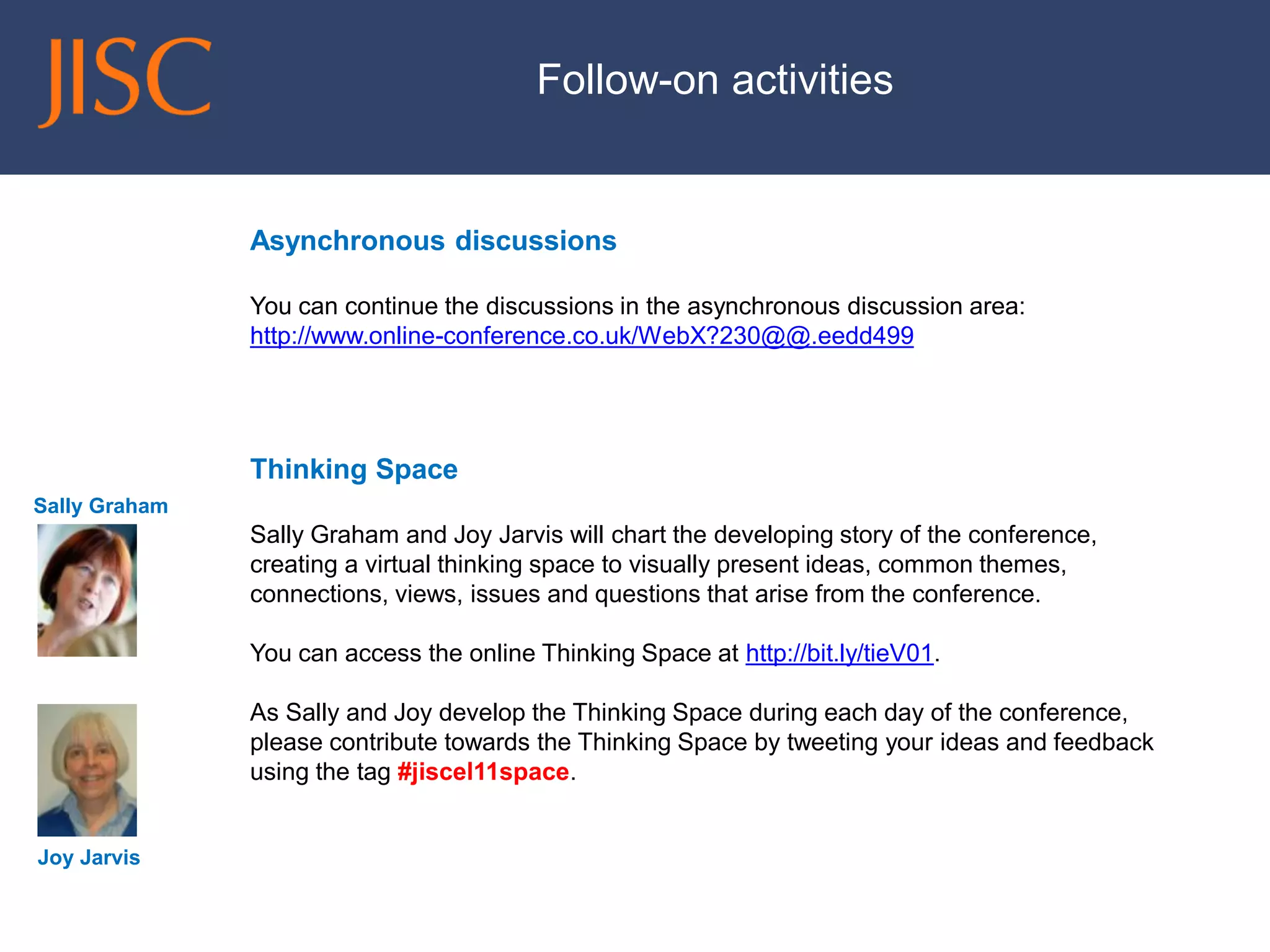
Follow-on activities 
Asynchronous discussions 
You can continue the discussions in the asynchronous discussion area: http://www.online-conference.co.uk/WebX?230@@.eedd499 
Thinking Space 
Sally Graham and Joy Jarvis will chart the developing story of the conference, creating a virtual thinking space to visually present ideas, common themes, connections, views, issues and questions that arise from the conference. 
You can access the online Thinking Space at http://bit.ly/tieV01. 
As Sally and Joy develop the Thinking Space during each day of the conference, please contribute towards the Thinking Space by tweeting your ideas and feedback using the tag #jiscel11space. 
Sally Graham 
Joy Jarvis

Open practice across sectors

  • 1.
    Open practice acrosssectors Anna Gruszczynska, Suzanne Hardy, Helen Richardson, facilitated by Terry McAndrew
  • 2.
    Facilitator Terry McAndrewisan advisor at JISC TechDis(since 2010) and the C&IT manager at the UK Centre for Bioscience Subject Centre (since 2000). Presenters Anna Gruszczynskais Project Officer at C-SAP (Higher Education Academy Subject Centre for Sociology, Anthropology and Politics) where for the past two years she has provided research and project management support to projects taking place within the JISC/HEA supported UK Open Educational Resources [UKOER] programme. Suzanne Hardy joined the Subject Centre for Medicine, Dentistry and Veterinary Medicinein July 2000 and is responsible for overseeing the development and management of the website and its associated databases. Her primary brief is to support the information dissemination and publication activities of the Centre facilitated by the appropriate use of new technologies, and to encourage the novel use of new technologies in learning and teaching in the centre's three subject areas. Helen Richardson is Business Manager at FusedWorks, Doncaster College's 3D visualisation studio (www.fusedworks.com). The College is a general further education college based in South Yorkshire. Through University Centre Doncaster it is one of the largest providers of Higher Education in the FE sector and currently has over 1000 FTEs on HE programmes..
  • 3.
    Text-chatting Elluminate layout Audio Whiteboard Technical problems •Use the text-chat to engage with other delegates, presenter and moderators about the content of the session. •You can send private text-chat messages e.g. to moderators or to individuals. •You can change your Elluminate layout to “Wide layout” to make it easier to follow the text-chat (select “View … Layouts…Wide layout”). •If you are distracted by the text-chat, you can “unlock” the Elluminate layout to enable you to adjust the size and position of the text-chat sub-window (uncheck “View…Layouts …Layout locked”) •It is best to run the Audio Set-up Wizard to test your audio set-up each time you enter an Elluminate room (select “Tools…Audio… Audio setup wizard). •You must use a headset/microphone if you want to ask a question in audio. •Only use your microphone when guided by a moderator –click on the mic icon (bottom-left of screen) to turn it on and click on it again to turn it off. •Only draw on the whiteboard if guided by a moderator. •Send a private text-chat message to “moderators” and they will try to help. Session practice
  • 4.
    JISCEL11 Open PracticeAcross Sectors
  • 5.
    What do wemean by Open Practice? oCollaborative and Competitive oSolutions are open for development but compete for attention oMore than OERs, but OER is a key initiative oDiscoverable oPublished by mechanisms that assist teachers and learners oMethodologies are shared through publications and events oResources shared online in a structured environment oSeeking to optimise the T&L experience oWhat is the natural organisation for a connected world? oExamples from across sectors present their challenges and issues
  • 6.
    Open Practice AcrossSectorsFE & HE
  • 7.
    Existing Culture -General •Limited open practice across the sector •Open practise more likely within departments •FE less hierarchical and more practical based which can lend itself more to open resources •FE resources can also be used within HE •Institutional structure that supports open practice
  • 8.
    Existing Culture –WorkingPractice •Collaborative approach to way of working within curriculum –learner and employer involvement. •OER that works for a wider range of college curriculums (FE & HE) as tutors tailor resources to a students level. •Early steps taken to share knowledge of open practice through internal task groups and training days.
  • 9.
    Challenges of Culture •Limited staff time to re-purpose open resources •Limited skill set to re-purpose open resources •Lack of infrastructure/policy to support open practice •Lack of confidence/knowledge with regards to licensing issues •Uncertainty around where to upload and find open resources •Limited sharing of resources between departments •Lack of awareness that creation of open resource is recognised as form of scholarship
  • 10.
    Moving Forward... •Increaseawareness! •Start with encouraging a culture of re-use –Where can resources be found. –How do you re-use (clear institutional policy). •CPD sessions for staff covering open resource availability, searching, re-purposing, licensing and curriculum planning. •Include market research phase to ensure open resources are appropriate, aligned to curriculum and employer needs. •Involve key stakeholders i.e. students and lecturers wherever possible to encourage wider use once released.
  • 11.
    Open practice acrosssectors: HE in FE issues Anna Gruszczynska, C-SAP/ Sheffield Hallam University (HEA Subject Centre for Sociology, Anthropology and Politics) Image source FreeFoto (CC BY-NC-ND 3.0)
  • 12.
    C-SAP cascade project:creating spaces for open practice •Cascade framework: Model of release, discovery and reuse of OERs •Emphasis on the broader context (cultural/institutional) in which OERs are created and (re)used and any resulting issues and/or tensions •Focus on the “why” rather than the “how” of Open Educational Resources [OERs]
  • 13.
    Opening up pedagogicalpractice: Creativity for edupunks(C4E) •A wiki-based resource and space to develop OER literacyand consider the potential impact of theOERs on approaches to teaching and learning •11 three-hour long sessions to fit within the 33- hour allocation for research activity (“selling point” for senior management) •Inspiration for C4E: connections with Blackburn’s past history of engagement with punk/DIY culture Image source Phil Johnson (CC BY-NC-SA 2.0).
  • 14.
    Ideas for goingforward: Need for a paradigm shift? Edupunkis an approach to teaching and learning practices that result from ado it yourself(DIY) attitude (Downes, 2008). Anarchogogy: the idea and the possibility of an approach to democratically disseminating, and openly creating “new” knowledge, where facilitators and learners collaborate, and the emerging ‘learning events’ serve to “lead without ruling” (from C4E wiki). Image source @flickrSerenae (CC BY-NC-SA 2.0)
  • 15.
    What could openpractice mean? (1) For me learning has to be memorable, experiential and collaborative. For me open educational resources are a great addition and an extension to the learning that's taking place in the classroom amongst learners who are connected to the subject, the teacher and their peers. Participating in (Creativity for) Edupunk confirms it too: I have watched videos, browsed websites and posted on this wiki but there's no response, no sense of connection, until Phil wandered into my office the other day and for ten minutes we had a really good discussion about this stuff. (from Creativity for Edupunkswiki)
  • 16.
    What could openpractice mean? (2) Thisis exactly what Phil and I have encountered on our "adventures" with this stuff; it is amazing in itself, but, explorations of the 'potential' for this stuff only becomes meaningful when it is discussed and deliberated ... in conversation and debate with real/empassioned[sic!] collaborators. (from Creativity for Edupunkswiki) Our best hope is to get better at empowering individuals to find answers for themselves. (…) forget about giving the guy a fish, or teaching him how to fish, either. Teach him how to teach himself, and he’ll always be able to acquire the skills he needs to find food, skills you haven’t even thought of yet for things you didn’t know you could eat (from Kamenetz, 2010 –DIY U).
  • 17.
    Open conclusions (abig thank you to colleagues from University Centre at Blackburn College!) •Engage with the “why” of OERs in addition to technical aspects of OER production •Local context is crucial and reflection is key to challenging academic practice and sustaining these changes •Explore not just the differences between HE/HE in FE but possible synergies and similarities •Challenge some of assumptions and highlight the strengths of the sector •Embrace the potential of OERs to improve the visibility of HE in FE Image source Phil Johnson (CC BY-NC-SA 2.0).
  • 18.
    Open practice acrosssectors: human and animal healthcare. Lessons from ACTOR and PORSCHE Suzanne Hardy School of Medical Sciences Education Development, Newcastle University
  • 19.
    Existing culture 25November 2011 #jiscel11 JISC Innovating eLearning 2011: Learning in transition - open practice across sectors 19
  • 20.
    Which of thesecan be accessed from nhs.net? a.YouTube b.Facebook c.Twitter d.Slideshare e.Jorum 25 November 2011 #jiscel11 JISC Innovating eLearning 2011: Learning in transition - open practice across sectors 20
  • 21.
    Challenges 25 November2011 #jiscel11 JISC Innovating eLearning 2011: Learning in transition - open practice across sectors 21
  • 22.
    Ideas 25 November2011 #jiscel11 JISC Innovating eLearning 2011: Learning in transition - open practice across sectors 22
  • 23.
    www.medev.ac.uk/ourwork/oer/ suzanne@medev.ac.uk twitter.com/hea_medev twitter.com/glittrgirl skype: glitt3rgirl 25 November 2011 #jiscel11 JISC Innovating eLearning 2011: Learning in transition - open practice across sectors 23
  • 24.
    Discussion oWe haveapproximately 25 minsto discuss the key issues oHow is Open Practice more than social tactics and trading? oThe importance of accessible Open Practice oKeynote: oCourage for transformative change? oThinking globally oIncentives and gains to inform stakeholders and management –“Political wisdom” oDangers of non-engagement
  • 25.
    Follow-on activities Asynchronousdiscussions You can continue the discussions in the asynchronous discussion area: http://www.online-conference.co.uk/WebX?230@@.eedd499 Thinking Space Sally Graham and Joy Jarvis will chart the developing story of the conference, creating a virtual thinking space to visually present ideas, common themes, connections, views, issues and questions that arise from the conference. You can access the online Thinking Space at http://bit.ly/tieV01. As Sally and Joy develop the Thinking Space during each day of the conference, please contribute towards the Thinking Space by tweeting your ideas and feedback using the tag #jiscel11space. Sally Graham Joy Jarvis