Open Interest
(Derivatives Classroom- Series II)


   Description

          “Volume & Open Interest are the most important parameters for judging the Futures & Option markets. Volume
         can simply be defined as the number of contracts traded on a particular day. Open Interest is slightly more complex
         data.”


         The Open Interest figure for a given futures/option is the number of contracts outstanding at any given point of time.
         The Open Interest increases when trader “A” opens a new position by buying a futures/option contract from trader
         “B” who did not previously hold any position in that futures/option contract (“B” will said to be holding a "Short
         Position" in the futures/option contract). When trader “A” closes out the position by selling the futures/option
         contract, the Open Interest would either remain the same or go down. In brief the Open Interest is the total numbers
         of futures/option contracts that are not closed or delivered on a particular day.


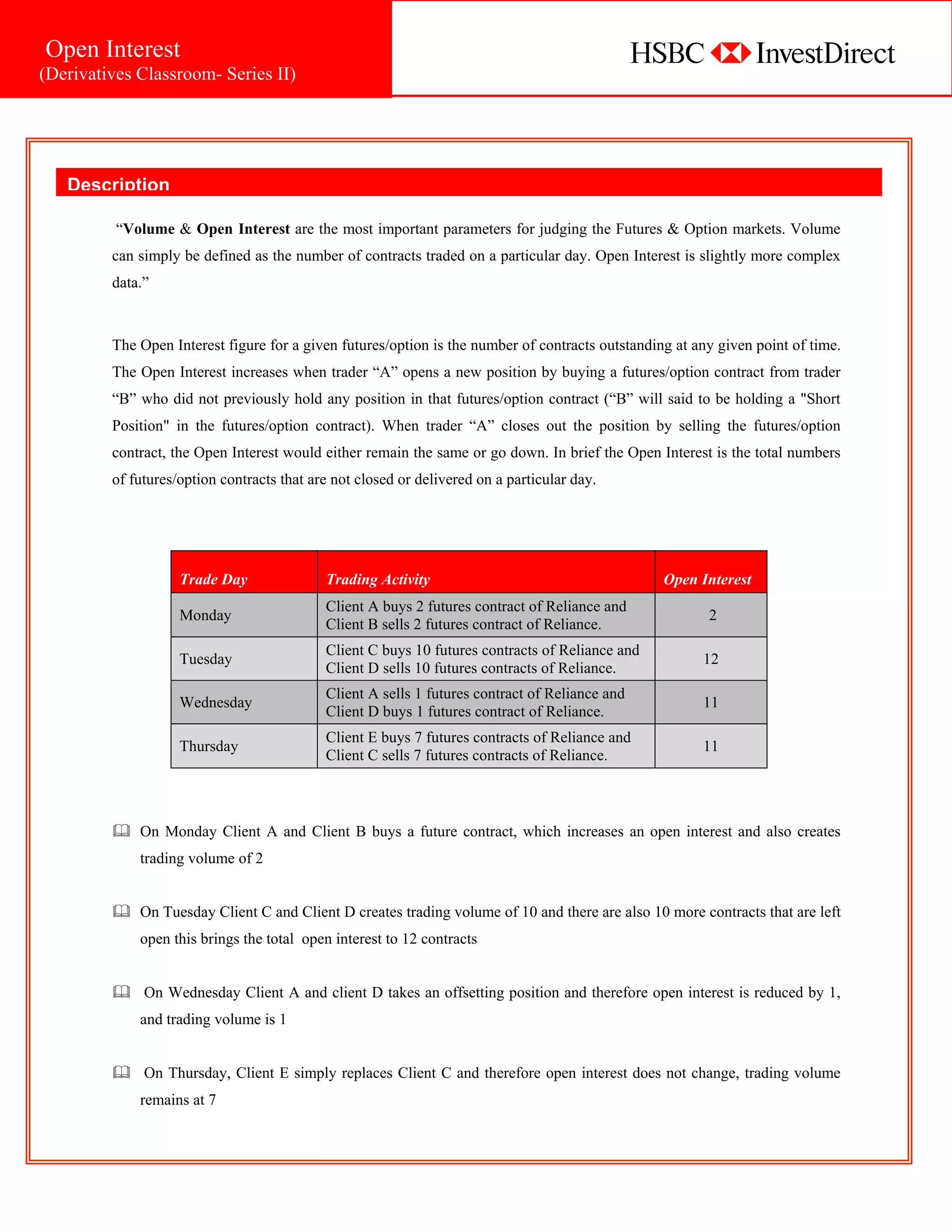
                    Trade Day               Trading Activity                                      Open Interest
                                            Client A buys 2 futures contract of Reliance and
                    Monday                                                                               2
                                            Client B sells 2 futures contract of Reliance.
                                            Client C buys 10 futures contracts of Reliance and
                    Tuesday                                                                             12
                                            Client D sells 10 futures contracts of Reliance.
                                            Client A sells 1 futures contract of Reliance and
                    Wednesday                                                                           11
                                            Client D buys 1 futures contract of Reliance.
                                            Client E buys 7 futures contracts of Reliance and
                    Thursday                                                                            11
                                            Client C sells 7 futures contracts of Reliance.


             On Monday Client A and Client B buys a future contract, which increases an open interest and also creates
             trading volume of 2


             On Tuesday Client C and Client D creates trading volume of 10 and there are also 10 more contracts that are left
             open this brings the total open interest to 12 contracts


              On Wednesday Client A and client D takes an offsetting position and therefore open interest is reduced by 1,
             and trading volume is 1


              On Thursday, Client E simply replaces Client C and therefore open interest does not change, trading volume
             remains at 7
Option Interest
 (Derivatives Classroom- Series II)


 Inferences

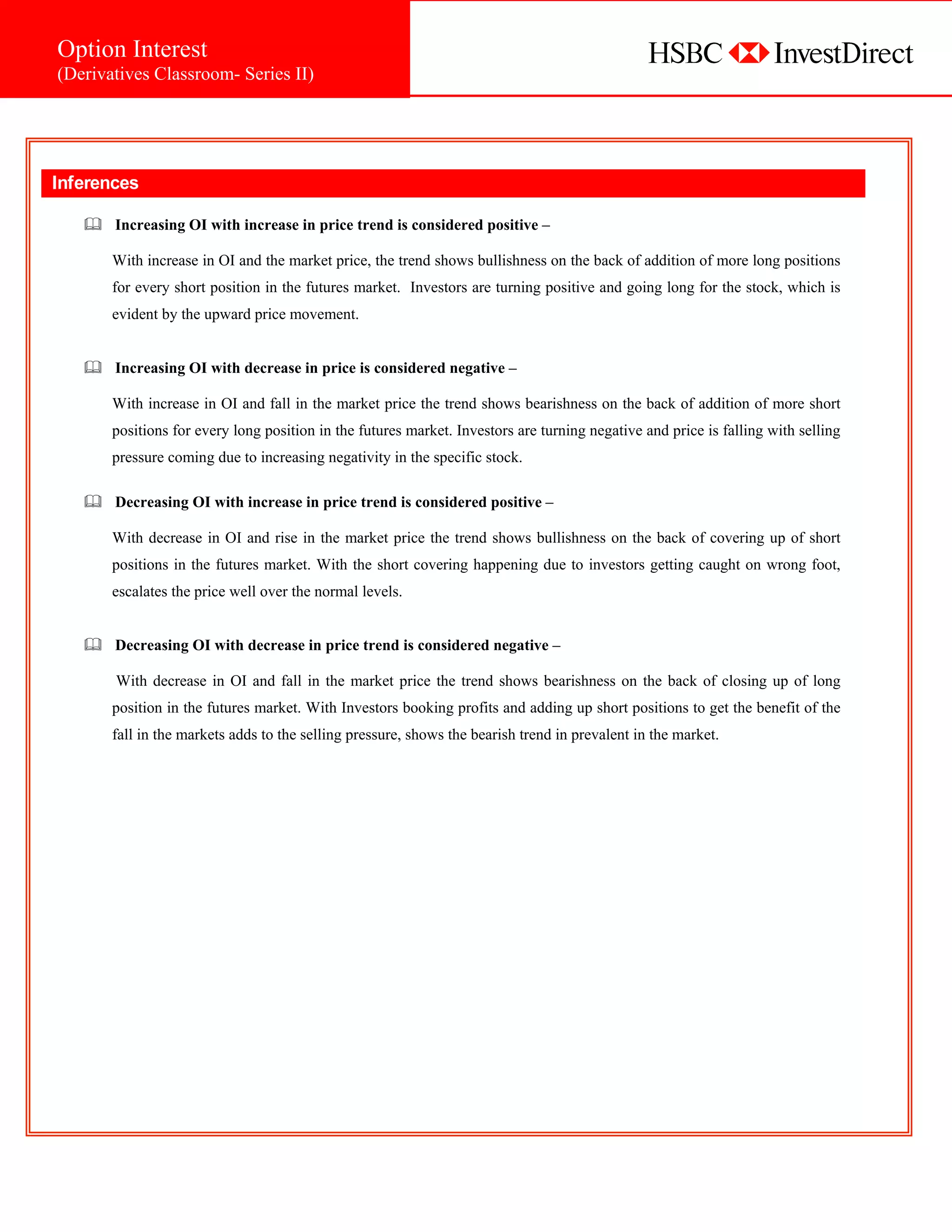
         Increasing OI with increase in price trend is considered positive –

         With increase in OI and the market price, the trend shows bullishness on the back of addition of more long positions
         for every short position in the futures market. Investors are turning positive and going long for the stock, which is
         evident by the upward price movement.


         Increasing OI with decrease in price is considered negative –

         With increase in OI and fall in the market price the trend shows bearishness on the back of addition of more short
         positions for every long position in the futures market. Investors are turning negative and price is falling with selling
         pressure coming due to increasing negativity in the specific stock.

         Decreasing OI with increase in price trend is considered positive –

         With decrease in OI and rise in the market price the trend shows bullishness on the back of covering up of short
         positions in the futures market. With the short covering happening due to investors getting caught on wrong foot,
         escalates the price well over the normal levels.


         Decreasing OI with decrease in price trend is considered negative –

         With decrease in OI and fall in the market price the trend shows bearishness on the back of closing up of long
         position in the futures market. With Investors booking profits and adding up short positions to get the benefit of the
         fall in the markets adds to the selling pressure, shows the bearish trend in prevalent in the market.


                                                            Comprises of


Option Basics
(Derivatives Classroom- Series I)

                                                              Comprises of
Disclaimer:
Issuer of the Document:- HSBC InvestDirect Securities (India) Limited*
Registered Office:-
Dhana Singh Processor Premises
J B Nagar, Andheri - Kurla Road
Andheri (East)
Mumbai – 400 059
Telephone: +91 22 6789 7830
Fax: +91 22 6789 7700
Website: www.hsbcinvestdirect.co.in

Disclosure
HSBC InvestDirect Securities (India) Limited (“HISL”), its associate and group companies, its directors, associates and employees may
have various positions in any of the stocks, securities and financial.
Instruments dealt in this document or may make sale or purchase or other deals in the securities from time to time or may deal in other
securities of the companies / organizations described in this document.

Certification
The views and opinions expressed by the author in the document are his own and do not reflect the views of HSBC InvestDirect
Securities (India) Limited or any of its associate and group companies.

Disclaimer Clause
The above is for customer information only and does not constitute investment advice or an offer to purchase or subscribe for any
investment. This document is not directed to or intended for display, downloading, printing, reproducing or for distribution to or use by
any person or entity who is a citizen or resident or located in any locality, state, country or other jurisdiction where such distribution,
publication, reproduction, availability or use would be contrary to law or regulation or would subject HSBC InvestDirect Securities (India)
Limited (HISL) or its associates or group companies to any registration or licensing requirement within such jurisdiction. If this document
is inadvertently sent or has reached any individual in such country, the same may be ignored and brought to the attention of the sender.
This document may not be reproduced, distributed or published for any purpose without prior written approval of HISL.

This document is not intended to provide legal, accounting or tax advice and should not be relied upon in that regard. Persons accessing
this document are advised to obtain appropriate legal, accounting or tax advice where necessary. Financial advice provided has not been
prepared taking into account the particular investment objectives, financial situation and needs of any particular investor. As a result,
investors using the advice should assess whether it is appropriate in the light of their own individual circumstances before acting on it.

* Formerly known as IL&FS Investsmart Securities Limited

Open Interest

  • 1.
    Open Interest (Derivatives Classroom-Series II) Description “Volume & Open Interest are the most important parameters for judging the Futures & Option markets. Volume can simply be defined as the number of contracts traded on a particular day. Open Interest is slightly more complex data.” The Open Interest figure for a given futures/option is the number of contracts outstanding at any given point of time. The Open Interest increases when trader “A” opens a new position by buying a futures/option contract from trader “B” who did not previously hold any position in that futures/option contract (“B” will said to be holding a "Short Position" in the futures/option contract). When trader “A” closes out the position by selling the futures/option contract, the Open Interest would either remain the same or go down. In brief the Open Interest is the total numbers of futures/option contracts that are not closed or delivered on a particular day. Trade Day Trading Activity Open Interest Client A buys 2 futures contract of Reliance and Monday 2 Client B sells 2 futures contract of Reliance. Client C buys 10 futures contracts of Reliance and Tuesday 12 Client D sells 10 futures contracts of Reliance. Client A sells 1 futures contract of Reliance and Wednesday 11 Client D buys 1 futures contract of Reliance. Client E buys 7 futures contracts of Reliance and Thursday 11 Client C sells 7 futures contracts of Reliance. On Monday Client A and Client B buys a future contract, which increases an open interest and also creates trading volume of 2 On Tuesday Client C and Client D creates trading volume of 10 and there are also 10 more contracts that are left open this brings the total open interest to 12 contracts On Wednesday Client A and client D takes an offsetting position and therefore open interest is reduced by 1, and trading volume is 1 On Thursday, Client E simply replaces Client C and therefore open interest does not change, trading volume remains at 7
  • 2.
    Option Interest (DerivativesClassroom- Series II) Inferences Increasing OI with increase in price trend is considered positive – With increase in OI and the market price, the trend shows bullishness on the back of addition of more long positions for every short position in the futures market. Investors are turning positive and going long for the stock, which is evident by the upward price movement. Increasing OI with decrease in price is considered negative – With increase in OI and fall in the market price the trend shows bearishness on the back of addition of more short positions for every long position in the futures market. Investors are turning negative and price is falling with selling pressure coming due to increasing negativity in the specific stock. Decreasing OI with increase in price trend is considered positive – With decrease in OI and rise in the market price the trend shows bullishness on the back of covering up of short positions in the futures market. With the short covering happening due to investors getting caught on wrong foot, escalates the price well over the normal levels. Decreasing OI with decrease in price trend is considered negative – With decrease in OI and fall in the market price the trend shows bearishness on the back of closing up of long position in the futures market. With Investors booking profits and adding up short positions to get the benefit of the fall in the markets adds to the selling pressure, shows the bearish trend in prevalent in the market. Comprises of Option Basics (Derivatives Classroom- Series I) Comprises of
  • 3.
    Disclaimer: Issuer of theDocument:- HSBC InvestDirect Securities (India) Limited* Registered Office:- Dhana Singh Processor Premises J B Nagar, Andheri - Kurla Road Andheri (East) Mumbai – 400 059 Telephone: +91 22 6789 7830 Fax: +91 22 6789 7700 Website: www.hsbcinvestdirect.co.in Disclosure HSBC InvestDirect Securities (India) Limited (“HISL”), its associate and group companies, its directors, associates and employees may have various positions in any of the stocks, securities and financial. Instruments dealt in this document or may make sale or purchase or other deals in the securities from time to time or may deal in other securities of the companies / organizations described in this document. Certification The views and opinions expressed by the author in the document are his own and do not reflect the views of HSBC InvestDirect Securities (India) Limited or any of its associate and group companies. Disclaimer Clause The above is for customer information only and does not constitute investment advice or an offer to purchase or subscribe for any investment. This document is not directed to or intended for display, downloading, printing, reproducing or for distribution to or use by any person or entity who is a citizen or resident or located in any locality, state, country or other jurisdiction where such distribution, publication, reproduction, availability or use would be contrary to law or regulation or would subject HSBC InvestDirect Securities (India) Limited (HISL) or its associates or group companies to any registration or licensing requirement within such jurisdiction. If this document is inadvertently sent or has reached any individual in such country, the same may be ignored and brought to the attention of the sender. This document may not be reproduced, distributed or published for any purpose without prior written approval of HISL. This document is not intended to provide legal, accounting or tax advice and should not be relied upon in that regard. Persons accessing this document are advised to obtain appropriate legal, accounting or tax advice where necessary. Financial advice provided has not been prepared taking into account the particular investment objectives, financial situation and needs of any particular investor. As a result, investors using the advice should assess whether it is appropriate in the light of their own individual circumstances before acting on it. * Formerly known as IL&FS Investsmart Securities Limited