Open Innovation Platform in
(South) Africa
August 2016
by Amatka (Pty) Ltd
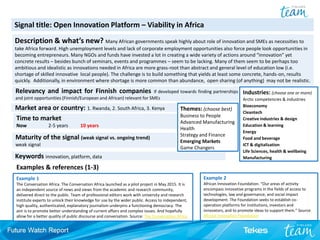
Example 1
The Conversation Africa. The Conversation Africa launched as a pilot project in May 2015. It is
an independent source of news and views from the academic and research community,
delivered direct to the public. Team of professional editors work with university and research
institute experts to unlock their knowledge for use by the wider public. Access to independent,
high quality, authenticated, explanatory journalism underpins a functioning democracy. The
aim is to promote better understanding of current affairs and complex issues. And hopefully
allow for a better quality of public discourse and conversation. Source: The Conversation Africa
Signal title: Open Innovation Platform – Viability in Africa
Description & what’s new? Many African governments speak highly about role of innovation and SMEs as necessities to
take Africa forward. High unemployment levels and lack of corporate employment opportunities also force people look opportunities in
becoming entrepreneurs. Many NGOs and funds have invested a lot in creating a wide variety of actions around “innovation” yet
concrete results – besides bunch of seminars, events and programmes – seem to be lacking. Many of them seem to be perhaps too
ambitious and idealistic as innovations needed in Africa are more grass-root than abstract and general level of education low (i.e.
shortage of skilled innovative local people). The challenge is to build something that yields at least some concrete, hands-on, results
quickly. Additionally, in environment where shortage is more common than abundance, open sharing (of anything) may not be realistic.
Examples & references (1-3)
Industries: (choose one or more)
Arctic competencies & industries
Bioeconomy
Cleantech
Creative industries & design
Education & learning
Energy
Food and beverage
ICT & digitalization
Life Sciences, health & wellbeing
Manufacturing
Themes: (choose best)
Business to People
Advanced Manufacturing
Health
Strategy and Finance
Emerging Markets
Game Changers
Time to market
Now 2-5 years 10 years
Maturity of the signal (weak signal vs. ongoing trend)
weak signal
Market area or country: 1. Rwanda, 2. South Africa, 3. Kenya
Keywords innovation, platform, data
Example 2
African Innovation Foundation. “Our areas of activity
encompass innovative programs in the fields of access to
technologies, law and governance, and social impact
development. The Foundation seeks to establish co-
operation platforms for institutions, investors and
innovators, and to promote ideas to support them.” Source:
African Innovation Foundation
Relevancy and impact for Finnish companies If developed towards finding partnerships
and joint opportunities (Finnish/European and African) relevant for SMEs
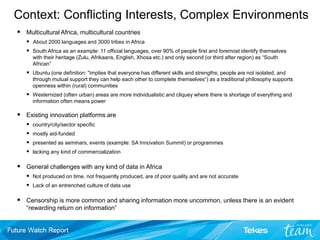
Context: Conflicting Interests, Complex Environments
 Multicultural Africa, multicultural countries
 About 2000 languages and 3000 tribes in Africa
 South Africa as an example: 11 official languages, over 90% of people first and foremost identify themselves
with their heritage (Zulu, Afrikaans, English, Xhosa etc.) and only second (or third after region) as “South
African”
 Ubuntu (one definition: "implies that everyone has different skills and strengths; people are not isolated, and
through mutual support they can help each other to complete themselves“) as a traditional philosophy supports
openness within (rural) communities
 Westernized (often urban) areas are more individualistic and cliquey where there is shortage of everything and
information often means power
 Existing innovation platforms are
 country/city/sector specific
 mostly aid-funded
 presented as seminars, events (example: SA Innovation Summit) or programmes
 lacking any kind of commercialization
 General challenges with any kind of data in Africa
 Not produced on time, not frequently produced, are of poor quality and are not accurate
 Lack of an entrenched culture of data use
 Censorship is more common and sharing information more uncommon, unless there is an evident
“rewarding return on information”
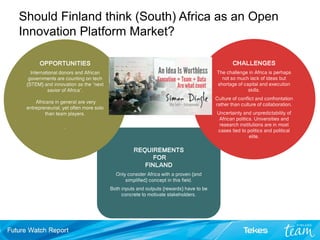
REQUIREMENTS
FOR
FINLAND
Only consider Africa with a proven (and
simplified) concept in this field.
Both inputs and outputs (rewards) have to be
concrete to motivate stakeholders.
CHALLENGES
The challenge in Africa is perhaps
not so much lack of ideas but
shortage of capital and execution
skills.
Culture of conflict and confrontation
rather than culture of collaboration.
Uncertainty and unpredictability of
African politics. Universities and
research institutions are in most
cases tied to politics and political
elite.
OPPORTUNITIES
International donors and African
governments are counting on tech
(STEM) and innovation as the “next
savior of Africa”.
Africans in general are very
entrepreneurial, yet often more solo
than team players.
.
Should Finland think (South) Africa as an Open
Innovation Platform Market?

Open innovation platform - Africa analysis

  • 1.
    Open Innovation Platformin (South) Africa August 2016 by Amatka (Pty) Ltd
  • 2.
    Example 1 The ConversationAfrica. The Conversation Africa launched as a pilot project in May 2015. It is an independent source of news and views from the academic and research community, delivered direct to the public. Team of professional editors work with university and research institute experts to unlock their knowledge for use by the wider public. Access to independent, high quality, authenticated, explanatory journalism underpins a functioning democracy. The aim is to promote better understanding of current affairs and complex issues. And hopefully allow for a better quality of public discourse and conversation. Source: The Conversation Africa Signal title: Open Innovation Platform – Viability in Africa Description & what’s new? Many African governments speak highly about role of innovation and SMEs as necessities to take Africa forward. High unemployment levels and lack of corporate employment opportunities also force people look opportunities in becoming entrepreneurs. Many NGOs and funds have invested a lot in creating a wide variety of actions around “innovation” yet concrete results – besides bunch of seminars, events and programmes – seem to be lacking. Many of them seem to be perhaps too ambitious and idealistic as innovations needed in Africa are more grass-root than abstract and general level of education low (i.e. shortage of skilled innovative local people). The challenge is to build something that yields at least some concrete, hands-on, results quickly. Additionally, in environment where shortage is more common than abundance, open sharing (of anything) may not be realistic. Examples & references (1-3) Industries: (choose one or more) Arctic competencies & industries Bioeconomy Cleantech Creative industries & design Education & learning Energy Food and beverage ICT & digitalization Life Sciences, health & wellbeing Manufacturing Themes: (choose best) Business to People Advanced Manufacturing Health Strategy and Finance Emerging Markets Game Changers Time to market Now 2-5 years 10 years Maturity of the signal (weak signal vs. ongoing trend) weak signal Market area or country: 1. Rwanda, 2. South Africa, 3. Kenya Keywords innovation, platform, data Example 2 African Innovation Foundation. “Our areas of activity encompass innovative programs in the fields of access to technologies, law and governance, and social impact development. The Foundation seeks to establish co- operation platforms for institutions, investors and innovators, and to promote ideas to support them.” Source: African Innovation Foundation Relevancy and impact for Finnish companies If developed towards finding partnerships and joint opportunities (Finnish/European and African) relevant for SMEs
  • 3.
    Context: Conflicting Interests,Complex Environments  Multicultural Africa, multicultural countries  About 2000 languages and 3000 tribes in Africa  South Africa as an example: 11 official languages, over 90% of people first and foremost identify themselves with their heritage (Zulu, Afrikaans, English, Xhosa etc.) and only second (or third after region) as “South African”  Ubuntu (one definition: "implies that everyone has different skills and strengths; people are not isolated, and through mutual support they can help each other to complete themselves“) as a traditional philosophy supports openness within (rural) communities  Westernized (often urban) areas are more individualistic and cliquey where there is shortage of everything and information often means power  Existing innovation platforms are  country/city/sector specific  mostly aid-funded  presented as seminars, events (example: SA Innovation Summit) or programmes  lacking any kind of commercialization  General challenges with any kind of data in Africa  Not produced on time, not frequently produced, are of poor quality and are not accurate  Lack of an entrenched culture of data use  Censorship is more common and sharing information more uncommon, unless there is an evident “rewarding return on information”
  • 4.
    REQUIREMENTS FOR FINLAND Only consider Africawith a proven (and simplified) concept in this field. Both inputs and outputs (rewards) have to be concrete to motivate stakeholders. CHALLENGES The challenge in Africa is perhaps not so much lack of ideas but shortage of capital and execution skills. Culture of conflict and confrontation rather than culture of collaboration. Uncertainty and unpredictability of African politics. Universities and research institutions are in most cases tied to politics and political elite. OPPORTUNITIES International donors and African governments are counting on tech (STEM) and innovation as the “next savior of Africa”. Africans in general are very entrepreneurial, yet often more solo than team players. . Should Finland think (South) Africa as an Open Innovation Platform Market?