Experiment no 16
Object:
To simulate a cyclone separator in Aspen HYSYS using methane, carbon, and hydrogen as
components, and analyze the separation efficiency.
Required software:
Aspen hysys V10.
Theory:
A cyclone separator is a device used for separating particulates from a gas or liquid stream without
the use of filters, through vortex separation. When a fluid containing solid particles is introduced into
the cyclone, a rotating flow is created, causing the heavier solid particles to move outward due to
centrifugal force. The particles then collide with the cyclone wall and fall to the bottom, while the
lighter gas exits from the top.
In this simulation, we use Aspen HYSYS to model a cyclone separator and analyze its performance
with a mixture of methane, carbon, and hydrogen. The Peng-Robinson equation of state is selected
as the fluid package due to its capability to accurately represent the thermodynamic behavior of
hydrocarbon gases and mixtures. By setting the feed conditions and composition, and configuring the
cyclone parameters such as particle efficiency, we aim to observe how well the cyclone separates the
solid carbon from the gas components (methane and hydrogen).
Cyclone separators are commonly used in industries such as chemical processing, oil and gas, and
pollution control for tasks like dust collection, product recovery, and pollution abatement. In this lab,
the effectiveness of the cyclone will be evaluated by its ability to separate solid particles from the gas
stream, quantified by the particle efficiency and the composition of the output streams.
Procedure:
Step 1: Start Aspen HYSYS and Add Components
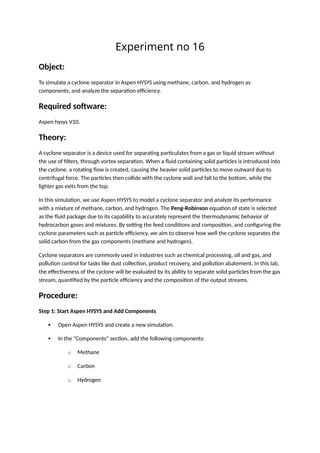
 Open Aspen HYSYS and create a new simulation.
 In the "Components" section, add the following components:
o Methane
o Carbon
o Hydrogen
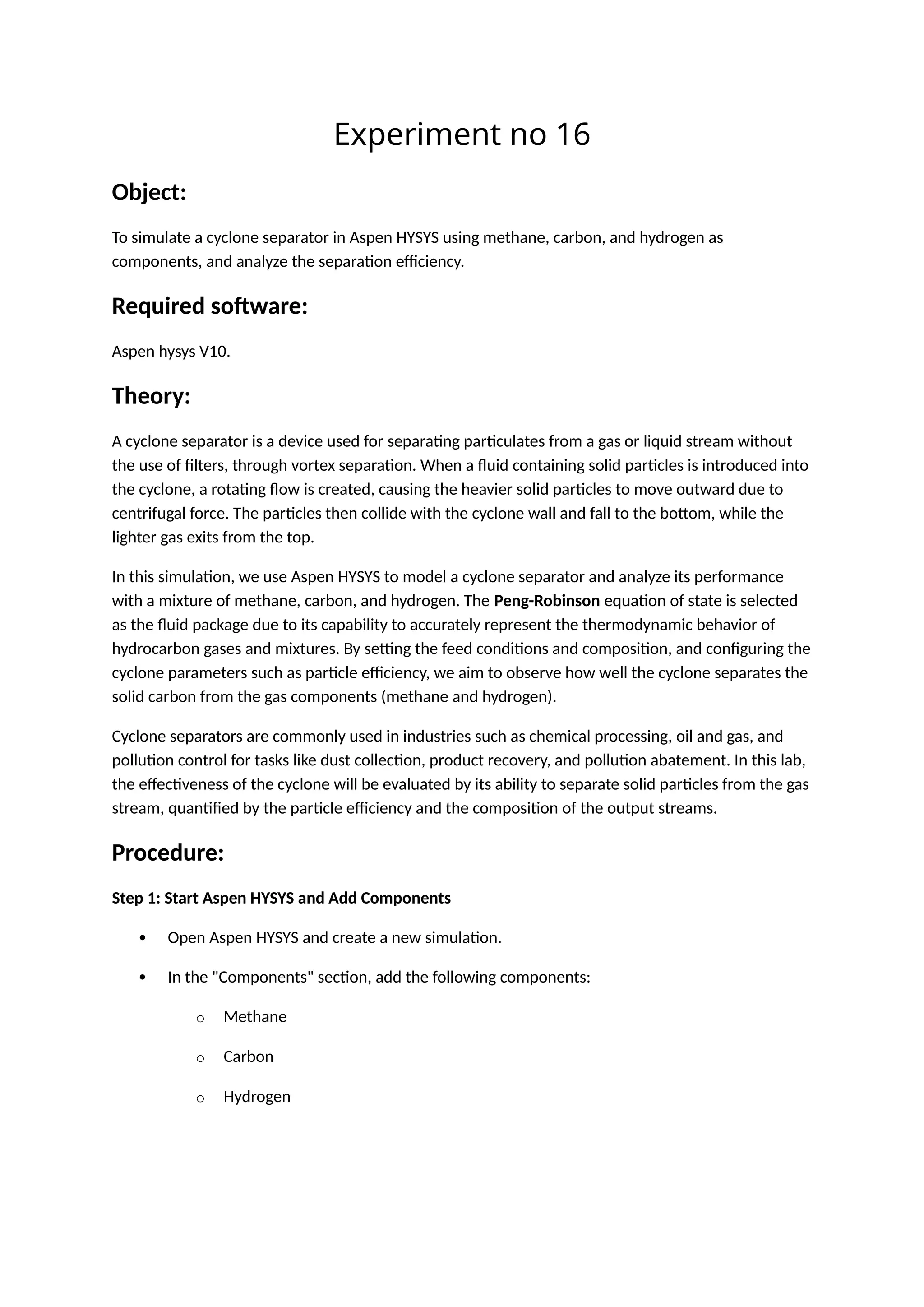
Step 2: Select the Fluid Package
 Go to the "Fluid Packages" section.
 Choose the Peng-Robinson equation of state as the fluid package, suitable for handling non-
ideal gas behavior.
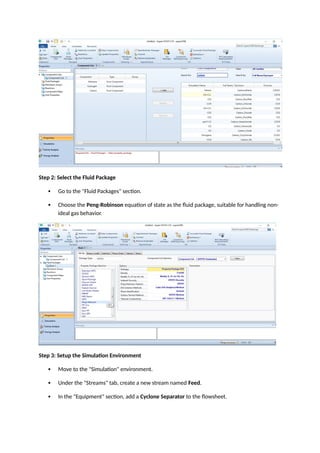
Step 3: Setup the Simulation Environment
 Move to the "Simulation" environment.
 Under the "Streams" tab, create a new stream named Feed.
 In the "Equipment" section, add a Cyclone Separator to the flowsheet.
Step 4: Define Feed Conditions
 Double-click on the Feed stream and go to the "Worksheet" tab.
 Enter the following conditions for the feed:
o Temperature: 25°C
o Pressure: 101.3 kPa
o Mass Flow Rate: 1000 kg/hr
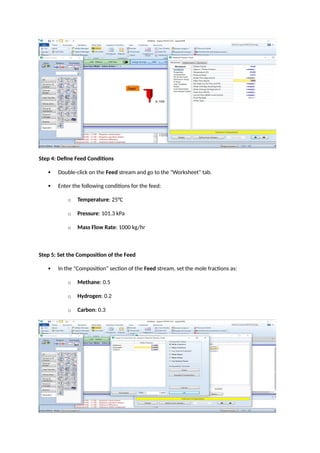
Step 5: Set the Composition of the Feed
 In the "Composition" section of the Feed stream, set the mole fractions as:
o Methane: 0.5
o Hydrogen: 0.2
o Carbon: 0.3
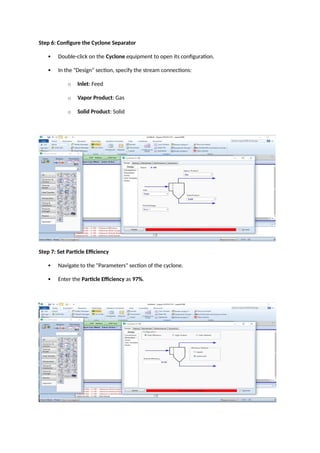
Step 6: Configure the Cyclone Separator
 Double-click on the Cyclone equipment to open its configuration.
 In the "Design" section, specify the stream connections:
o Inlet: Feed
o Vapor Product: Gas
o Solid Product: Solid
Step 7: Set Particle Efficiency
 Navigate to the "Parameters" section of the cyclone.
 Enter the Particle Efficiency as 97%.
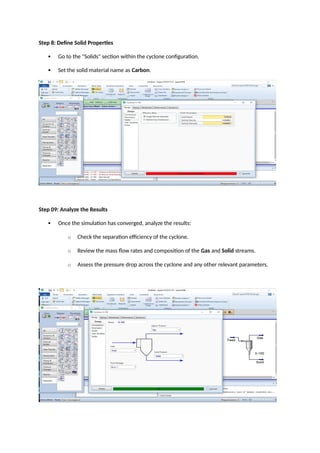
Step 8: Define Solid Properties
 Go to the "Solids" section within the cyclone configuration.
 Set the solid material name as Carbon.
Step 09: Analyze the Results
 Once the simulation has converged, analyze the results:
o Check the separation efficiency of the cyclone.
o Review the mass flow rates and composition of the Gas and Solid streams.
o Assess the pressure drop across the cyclone and any other relevant parameters.
Conclusion:
The simulation successfully demonstrated the use of a cyclone separator to separate solid carbon
particles from a mixture of methane, hydrogen, and carbon. The cyclone's particle efficiency was set
at 97%, indicating that it was highly effective in capturing the solid particles. The results showed that
most of the solid carbon was directed to the solid output stream, while the gas output primarily
contained methane and hydrogen.
Key findings include:
 The simulation converged, indicating that the cyclone separator model was properly
configured, and the specified conditions were realistic.
 The mass flow rates and compositions of the output streams matched expectations based on
the cyclone's efficiency and the feed composition.
 This simulation illustrates the practical application of cyclone separators in industrial
processes for solid-gas separation.
Overall, the lab demonstrated how Aspen HYSYS can be used to model and analyze the performance
of cyclone separators, providing insights into equipment design and process optimization in real-
world scenarios.

open ended lab Muhammad Faheem 21CH057.docx

  • 1.
    Experiment no 16 Object: Tosimulate a cyclone separator in Aspen HYSYS using methane, carbon, and hydrogen as components, and analyze the separation efficiency. Required software: Aspen hysys V10. Theory: A cyclone separator is a device used for separating particulates from a gas or liquid stream without the use of filters, through vortex separation. When a fluid containing solid particles is introduced into the cyclone, a rotating flow is created, causing the heavier solid particles to move outward due to centrifugal force. The particles then collide with the cyclone wall and fall to the bottom, while the lighter gas exits from the top. In this simulation, we use Aspen HYSYS to model a cyclone separator and analyze its performance with a mixture of methane, carbon, and hydrogen. The Peng-Robinson equation of state is selected as the fluid package due to its capability to accurately represent the thermodynamic behavior of hydrocarbon gases and mixtures. By setting the feed conditions and composition, and configuring the cyclone parameters such as particle efficiency, we aim to observe how well the cyclone separates the solid carbon from the gas components (methane and hydrogen). Cyclone separators are commonly used in industries such as chemical processing, oil and gas, and pollution control for tasks like dust collection, product recovery, and pollution abatement. In this lab, the effectiveness of the cyclone will be evaluated by its ability to separate solid particles from the gas stream, quantified by the particle efficiency and the composition of the output streams. Procedure: Step 1: Start Aspen HYSYS and Add Components  Open Aspen HYSYS and create a new simulation.  In the "Components" section, add the following components: o Methane o Carbon o Hydrogen
  • 2.
    Step 2: Selectthe Fluid Package  Go to the "Fluid Packages" section.  Choose the Peng-Robinson equation of state as the fluid package, suitable for handling non- ideal gas behavior. Step 3: Setup the Simulation Environment  Move to the "Simulation" environment.  Under the "Streams" tab, create a new stream named Feed.  In the "Equipment" section, add a Cyclone Separator to the flowsheet.
  • 3.
    Step 4: DefineFeed Conditions  Double-click on the Feed stream and go to the "Worksheet" tab.  Enter the following conditions for the feed: o Temperature: 25°C o Pressure: 101.3 kPa o Mass Flow Rate: 1000 kg/hr Step 5: Set the Composition of the Feed  In the "Composition" section of the Feed stream, set the mole fractions as: o Methane: 0.5 o Hydrogen: 0.2 o Carbon: 0.3
  • 4.
    Step 6: Configurethe Cyclone Separator  Double-click on the Cyclone equipment to open its configuration.  In the "Design" section, specify the stream connections: o Inlet: Feed o Vapor Product: Gas o Solid Product: Solid Step 7: Set Particle Efficiency  Navigate to the "Parameters" section of the cyclone.  Enter the Particle Efficiency as 97%.
  • 5.
    Step 8: DefineSolid Properties  Go to the "Solids" section within the cyclone configuration.  Set the solid material name as Carbon. Step 09: Analyze the Results  Once the simulation has converged, analyze the results: o Check the separation efficiency of the cyclone. o Review the mass flow rates and composition of the Gas and Solid streams. o Assess the pressure drop across the cyclone and any other relevant parameters.
  • 6.
    Conclusion: The simulation successfullydemonstrated the use of a cyclone separator to separate solid carbon particles from a mixture of methane, hydrogen, and carbon. The cyclone's particle efficiency was set at 97%, indicating that it was highly effective in capturing the solid particles. The results showed that most of the solid carbon was directed to the solid output stream, while the gas output primarily contained methane and hydrogen. Key findings include:  The simulation converged, indicating that the cyclone separator model was properly configured, and the specified conditions were realistic.  The mass flow rates and compositions of the output streams matched expectations based on the cyclone's efficiency and the feed composition.  This simulation illustrates the practical application of cyclone separators in industrial processes for solid-gas separation. Overall, the lab demonstrated how Aspen HYSYS can be used to model and analyze the performance of cyclone separators, providing insights into equipment design and process optimization in real- world scenarios.