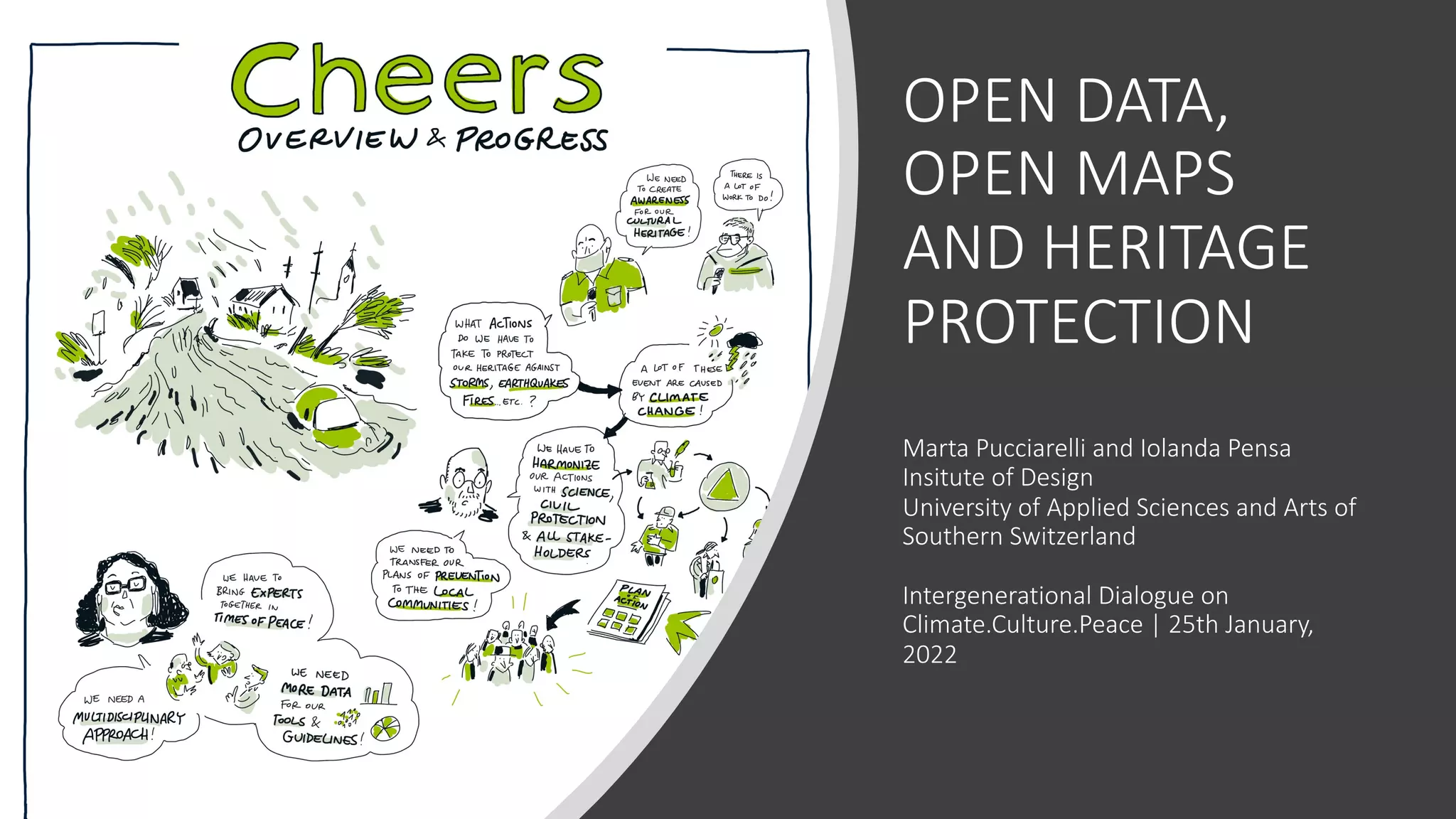
OPEN DATA,
OPEN MAPS
AND HERITAGE
PROTECTION
Marta Pucciarelli and Iolanda Pensa
Insitute of Design
University of Applied Sciences and Arts of
Southern Switzerland
Intergenerational Dialogue on
Climate.Culture.Peace | 25th January,
2022
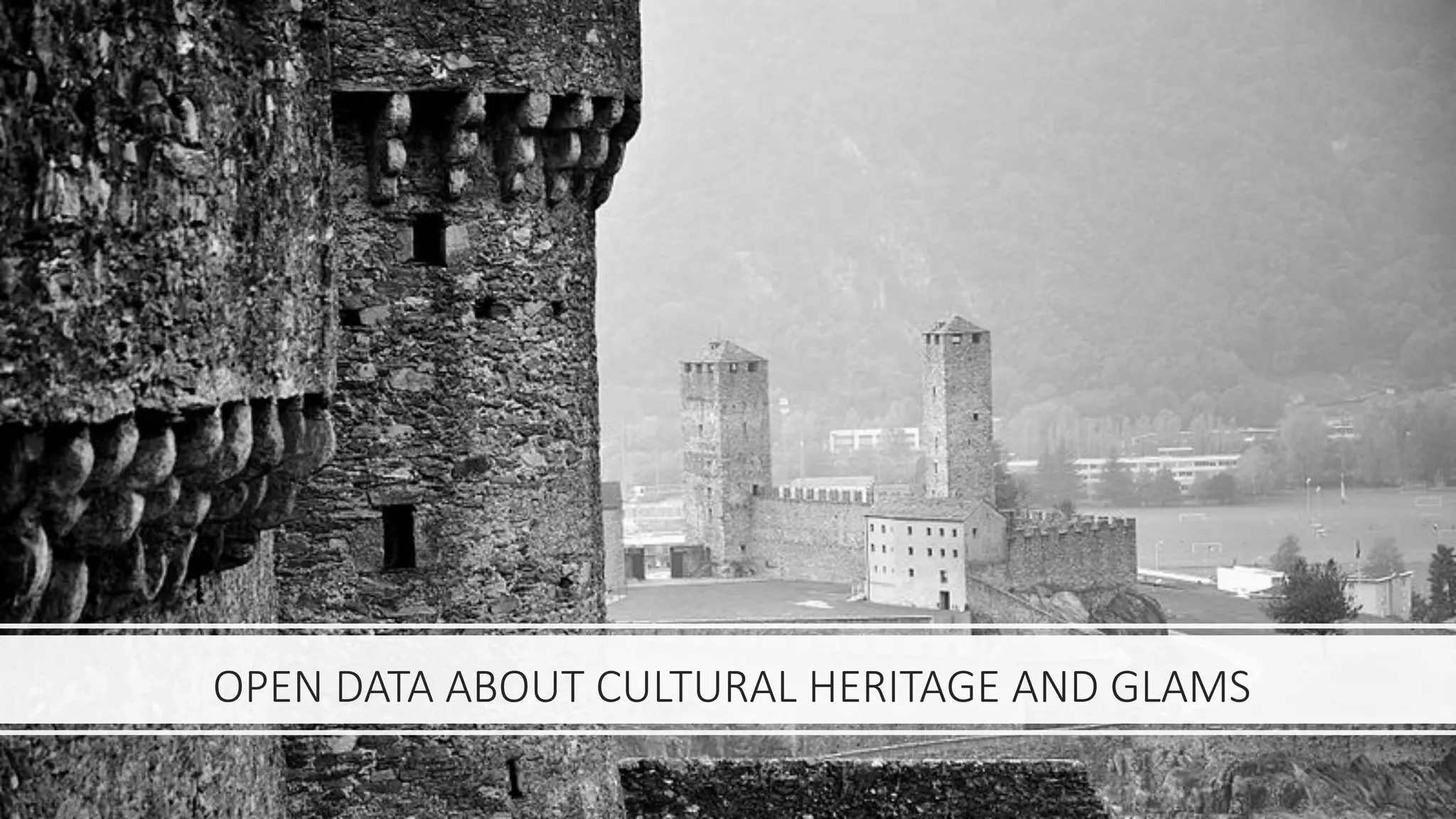
OPEN DATA ABOUT CULTURAL HERITAGE AND GLAMS
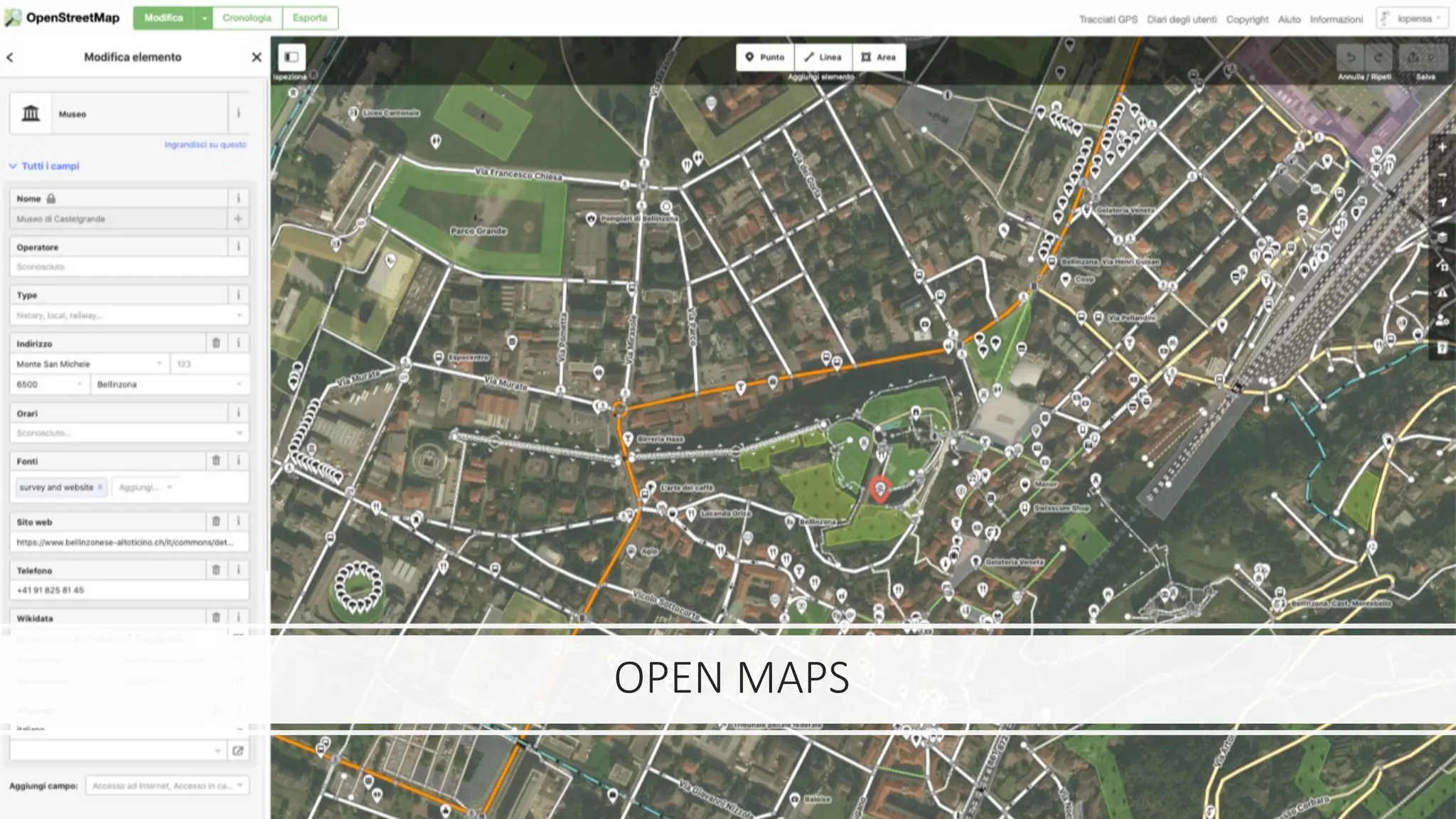
OPEN MAPS
How current data meet the standards of FAIR data?
• INSPIRE directive: https://inspire.ec.europa.eu/inspire-directive/2
• Research Data Alliance: https://research-data-network.readme.io/docs/research-data-alliance
• Swiss government directives: https://www.fedlex.admin.ch/eli/fga/2019/125/it
• National directives..
«Cultural heritage is data rich, but
information is not connected.»
Alison Heritage, Programme Officer, Strategic Planning and Research, ICCROM
Huge variety of cases and words for “describing” things at the sectoral level.
Huge difference between quantitative and qualitative data.
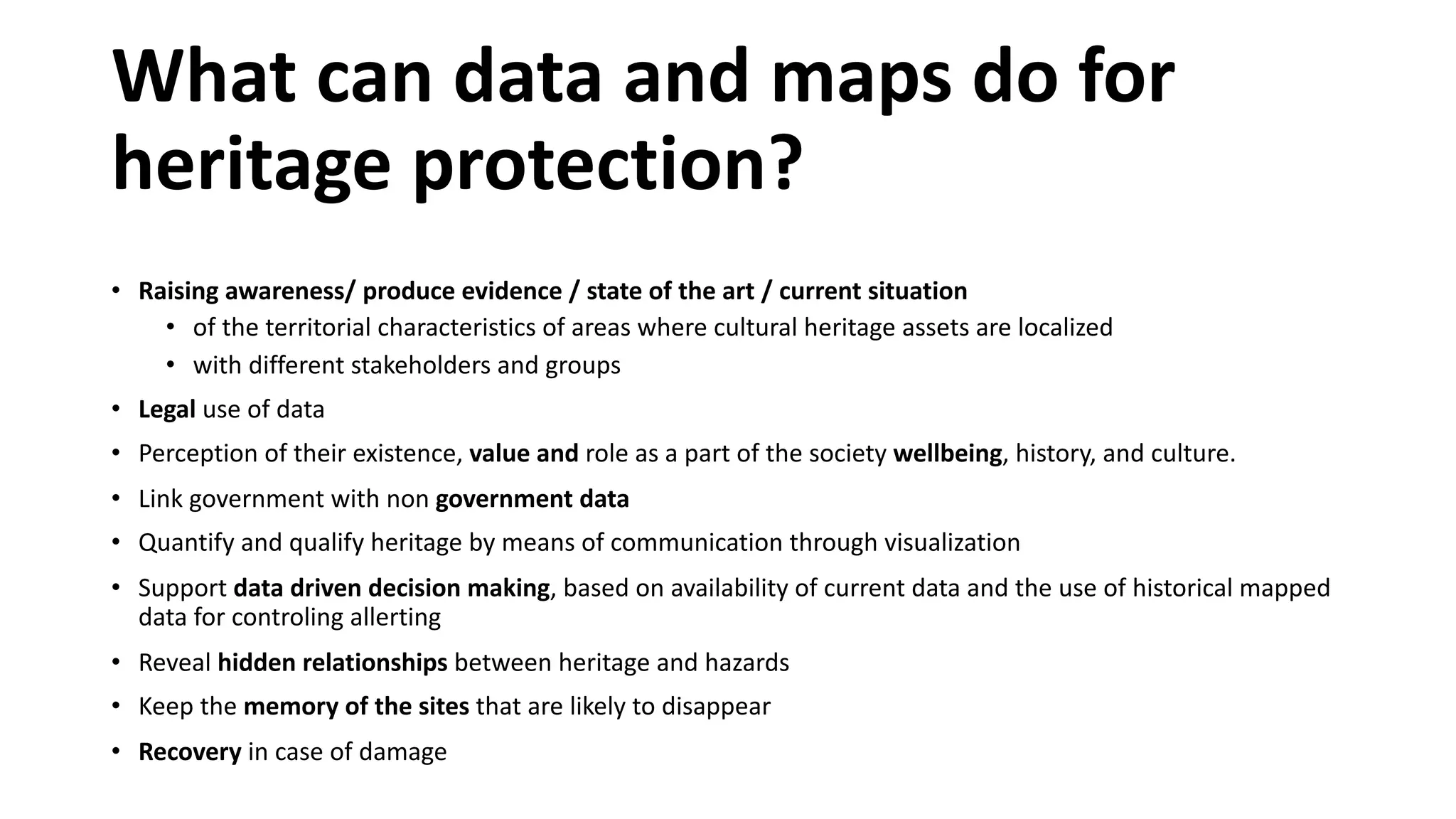
What can data and maps do for
heritage protection?
• Raising awareness/ produce evidence / state of the art / current situation
• of the territorial characteristics of areas where cultural heritage assets are localized
• with different stakeholders and groups
• Legal use of data
• Perception of their existence, value and role as a part of the society wellbeing, history, and culture.
• Link government with non government data
• Quantify and qualify heritage by means of communication through visualization
• Support data driven decision making, based on availability of current data and the use of historical mapped
data for controling allerting
• Reveal hidden relationships between heritage and hazards
• Keep the memory of the sites that are likely to disappear
• Recovery in case of damage
THANKS!
Marta Pucciarelli and Iolanda Pensa
marta.pucciarelli@supsi.ch
Institute of Design
Department for Environment Constructions and Design
University of Applied Sciences and Arts of Southern Switzerland
This work is licensed under a Creative Commons Attribution-ShareAlike 3.0 Unported License. Marta Pucciarelli and Iolanda Pensa, SUPSI.

Open data, open maps and heritage protection

  • 1.
    OPEN DATA, OPEN MAPS ANDHERITAGE PROTECTION Marta Pucciarelli and Iolanda Pensa Insitute of Design University of Applied Sciences and Arts of Southern Switzerland Intergenerational Dialogue on Climate.Culture.Peace | 25th January, 2022
  • 2.
    OPEN DATA ABOUTCULTURAL HERITAGE AND GLAMS
  • 3.
  • 4.
    How current datameet the standards of FAIR data? • INSPIRE directive: https://inspire.ec.europa.eu/inspire-directive/2 • Research Data Alliance: https://research-data-network.readme.io/docs/research-data-alliance • Swiss government directives: https://www.fedlex.admin.ch/eli/fga/2019/125/it • National directives.. «Cultural heritage is data rich, but information is not connected.» Alison Heritage, Programme Officer, Strategic Planning and Research, ICCROM Huge variety of cases and words for “describing” things at the sectoral level. Huge difference between quantitative and qualitative data.
  • 5.
    What can dataand maps do for heritage protection? • Raising awareness/ produce evidence / state of the art / current situation • of the territorial characteristics of areas where cultural heritage assets are localized • with different stakeholders and groups • Legal use of data • Perception of their existence, value and role as a part of the society wellbeing, history, and culture. • Link government with non government data • Quantify and qualify heritage by means of communication through visualization • Support data driven decision making, based on availability of current data and the use of historical mapped data for controling allerting • Reveal hidden relationships between heritage and hazards • Keep the memory of the sites that are likely to disappear • Recovery in case of damage
  • 6.
    THANKS! Marta Pucciarelli andIolanda Pensa marta.pucciarelli@supsi.ch Institute of Design Department for Environment Constructions and Design University of Applied Sciences and Arts of Southern Switzerland This work is licensed under a Creative Commons Attribution-ShareAlike 3.0 Unported License. Marta Pucciarelli and Iolanda Pensa, SUPSI.