Building the Digital Commons - 	

an introduction
Open Cultural Data
About	
  the	
  OKFN
!
A not-for-profit organisation, promoting openness in all its forms.	

!
        "From sonnets to statistics, genes to geo-data”	

!
We build tools and communities to create, use and share open
knowledge, content and data that everyone can use, share and build on.
Working	
  Groups	
  -­‐	
  join	
  today!
CKAN is an open source data portal 	

software that makes it easy to publish,	

share and find data.	

!
CKAN features dozens of governments'
data portals including United Kingdom,
Brazil, USA, Finland, Germany and ...	

www.ckan.org
We	
  build	
  tools	
  to	
  share	
  data
www.openspending.org	

!
!
!
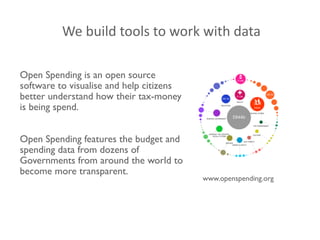
Open Spending is an open source	

software to visualise and help citizens
better understand how their tax-money
is being spend.	

!
!
Open Spending features the budget and
spending data from dozens of
Governments from around the world to
become more transparent.	

!
We	
  build	
  tools	
  to	
  work	
  with	
  data
We	
  set	
  the	
  standards	
  to	
  open
census.okfn.org
We	
  help	
  to	
  open	
  up	
  data
We	
  promote	
  open	
  data
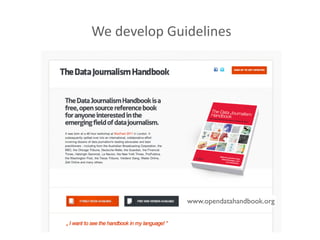
www.opendatahandbook.org
We	
  develop	
  Guidelines
www.schoolofdata.org
We	
  provide	
  training
Open Knowledge Festival	

Oken Knowledge Conference 	

Open Data Camp	

Open Data Day	

...	

www.okfn.org/events/
We	
  run	
  events
20k in prizes for apps, ideas, data	

430 entries from 	

24 EU Member States	

!
+ 400 participants from	

+ 40 countries 	

+ 6 Tracks + 40 sessions	

!
www.ogdcamp.org
We	
  run	
  hackdays	
  and	
  compeAAons
www.opendatachallenge.org
We	
  build	
  a	
  global	
  Network
Chapters: UK, Germany,Austria, Belgium, Greece and Switzerland	

!
Local groups: Finland, Brazil, Spain, Czech Republic, Italy,Australia,
Netherlands, India, South Africa, Bosnia and ...
www.okfn.org/local/
Please join :)
Open Cultural Data
What happened so far
A revolution
2nd revolution
3rd revolution
...but still
Too many silos
...but why is this?
Artificial scarcity
While information is becoming abundant, 	

access remains limited.
Apple ≠ Knowledge
!
If I share an apple with you, both of us will have half an
apple. If I share knowledge with you we will both have the
same knowledge.
What are the Commons?
“Resources accessible to all members of a society”	

- Wikipedia
Environmental Examples
AirFishForrest
Non Excludable
Non Excludable
Non Excludable
Non Rivalrous
What is the Digital
Commons?
"An information and knowledge resources that are
collectively created and owned or shared between or
among a community and that is, be (generally freely)
available to third parties.Thus, they are oriented to favor
use and reuse, rather than to exchange as a commodity.”-
Mayo Fuster Morell on Wikipedia
The premises of the
Digital Commons
Non Excludable Non Rivalrous
Re-Usable
Digital artifacts can be curated, remixed, annotated by anyone
Recent ‘open’ concepts
Open Data
Open Data is a concept of openness (similar to open
source, open content, open access, etc) applied to data.	

!
“A piece of data or content is open if anyone is free to use,
reuse, and redistribute it — subject only, at most, to the
requirement to attribute and/or share-alike.” 	

!
- www. opendefinition.org
Open Government Data
Open Government Data has become a major trend in
public administration. It’s a precondition for Open
Government principles, such as: transparency, participation
and collaboration.
Open Cultural Data
Cultural institutions making digitized artifacts and metadata
available on the internet, for everybody to reuse and build
on it.
Cultural Institutions
Public Mission
"Enable access to everyone who wants to do research"	

- British Library, Our Mission and 2020Vision	

!
"Our core values are: accessibility, sustainability, innovation and cooperation."	

-National Library of the Netherlands, Our Mission andVision	

!
"To provide diverse audiences with the best quality experience and optimum access to
our collections, physically and digitally."	

- theVictoria & Albert Museum, Mission and Objectives	

!
"The Federal Archives have the legal responsibility of permanently preserving the federal
archival documents and making them available for use."	

- German Federal Archives - Responsibilities	

!
The National Gallery of Denmark is Denmark’s premier museum of art.Through
Accessibility, education, and exhibition	

- Danish National Gallery - Mission
Why openness matters
to Cultural Institutions
• Helping GLAMs fulfill their public mission	

• Larger audience	

• Allow the audiences to participate	

• Connect and contextualize collections	

• Keep memory institutions relevant in a Digital Age
Great!
Let’s look a some examples...
Internet Archive
• 2001	

• Volunteers &
Institutions	

• 9.000.000 media files	

• Content	

• Various Licenses
Wikimedia Commons
• Volunteer driven	

• Collaboration with
GLAMs	

• 17.000.000 media files	

• Content	

• Clear licensing
Europeana
• 2008	

• ‘European Identity’	

• 28.000.000 records	

• 2600 Institutions	

• Metadata	

• Link to Institution
Digital Public Library
of America
• 2013	

• 2.500.000 records	

• 200 Institutions	

• Metadata	

• Link to Institution
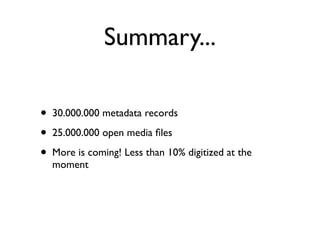
Summary...
• 30.000.000 metadata records	

• 25.000.000 open media files	

• More is coming! Less than 10% digitized at the
moment
Issues
!
• Worries about the misuse of data and content	

• Legal uncertainties: licensing, orphan works	

• Technical challenges: standards, tools	

• Concerns over lost revenue streams	

• Attraction of private schemes that lockdown heritage
Galleries, Libraries, Archives and Museums
=
=
Digital content or data that is free to use, re-
use and re-distribute without technical or
legal restriction
• A global network of
organizations, institutions
and people who work to
get content and data from
cultural heritage
institutions openly
available for anybody to
access, re-use and enjoy
openGLAM workshops
openGLAM APIs
openGLAM apps
Vistory - an example
GLAM wiki project
What data are we talking
about?
!
Digitized content and Metadata
Content!
• Digitized artifacts	

• Scanned images	

• Imagery & Photography	

• Maps	

• Transcriptions	

• Annotations	

• Descriptions	

• OCR
!
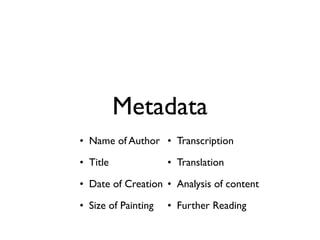
• Name of Author	

• Title	

• Date of Creation	

• Size of Painting	

• Transcription	

• Translation	

• Analysis of content	

• Further Reading
Metadata
Step by step
!
How can GLAM institutions make content available on the
internet so it can be accessed and re-used?
1. Digitalization
!
Costs, technical challenges & longtime preservation
2. Clear IP rights
!
Clear intellectual property rights & apply an open license
3. Make it accessible
!
Publish content on the internet
4. Make it discoverable
!
Enhance your content so it can be easily discovered: open
standards, metadata, improved search, search engine
optimization, specialized data catalog software, RDF
standards, publish as Linked Open Data.
Oh no, it’s complicated!
Keep it simple!
What needs to be done
And who can do it.
Policy
!
Top-down approaches to set rules and regulations.
Demand
!
Citizens, civil society organizations, science and private
sector can make a case by creating innovations build on
freely available open cultural data.
Supply
!
Pioneering GLAM institutions can engage and demonstrate
the benefits of opening up content to others through
successful initiatives and best practice.
Collaboration
!
Visitors and users can actively contribute to aspects of GLAM
collections: Curation, enrichment and improvement, or
provide content for new collections.
Curating the Commons
!
Users and Experts work hand-in-hand to create & curate the
Digital Commons.
21st Century GLAM
• It remains:	

• The key preserver of our shared cultural heritage	

• An authoritative source of information and expertise
about their collections	

• Curate, contextualize and tell stories about their
collections
21st Century GLAM
• It stands to gain:	

• An audience far beyond the wildest dreams of its first
founders	

• Connections to other collections that contextualize
stories about its objects	

• A closer connection to its audience (and the
improvements to its digital collections that come with
that)
Thanks!
Open Knowledge Foundation, www.okfn.org	

Daniel Dietrich, daniel.dietrich@okfn.org @ddie	

open Glam, www.openglam.org, @OpenGLAM
Reading
Topic Report: Open Data in Cultural Heritage
Institutions	

http://epsiplatform.eu/content/topic-report-open-data-cultural-
heritage-institutions

open GLAM - building the digital commons

  • 1.
    Building the DigitalCommons - an introduction Open Cultural Data
  • 3.
    About  the  OKFN ! A not-for-profitorganisation, promoting openness in all its forms. !         "From sonnets to statistics, genes to geo-data” ! We build tools and communities to create, use and share open knowledge, content and data that everyone can use, share and build on.
  • 4.
  • 5.
    CKAN is anopen source data portal software that makes it easy to publish, share and find data. ! CKAN features dozens of governments' data portals including United Kingdom, Brazil, USA, Finland, Germany and ... www.ckan.org We  build  tools  to  share  data
  • 6.
    www.openspending.org ! ! ! Open Spending isan open source software to visualise and help citizens better understand how their tax-money is being spend. ! ! Open Spending features the budget and spending data from dozens of Governments from around the world to become more transparent. ! We  build  tools  to  work  with  data
  • 7.
    We  set  the  standards  to  open
  • 8.
  • 9.
  • 10.
  • 11.
  • 12.
    Open Knowledge Festival OkenKnowledge Conference Open Data Camp Open Data Day ... www.okfn.org/events/ We  run  events
  • 13.
    20k in prizesfor apps, ideas, data 430 entries from 24 EU Member States ! + 400 participants from + 40 countries + 6 Tracks + 40 sessions ! www.ogdcamp.org We  run  hackdays  and  compeAAons www.opendatachallenge.org
  • 14.
    We  build  a  global  Network Chapters: UK, Germany,Austria, Belgium, Greece and Switzerland ! Local groups: Finland, Brazil, Spain, Czech Republic, Italy,Australia, Netherlands, India, South Africa, Bosnia and ... www.okfn.org/local/
  • 15.
  • 16.
  • 17.
  • 18.
  • 19.
  • 20.
  • 21.
  • 22.
  • 23.
    Artificial scarcity While informationis becoming abundant, access remains limited.
  • 24.
    Apple ≠ Knowledge ! IfI share an apple with you, both of us will have half an apple. If I share knowledge with you we will both have the same knowledge.
  • 25.
    What are theCommons? “Resources accessible to all members of a society” - Wikipedia
  • 26.
    Environmental Examples AirFishForrest Non Excludable NonExcludable Non Excludable Non Rivalrous
  • 27.
    What is theDigital Commons? "An information and knowledge resources that are collectively created and owned or shared between or among a community and that is, be (generally freely) available to third parties.Thus, they are oriented to favor use and reuse, rather than to exchange as a commodity.”- Mayo Fuster Morell on Wikipedia
  • 28.
    The premises ofthe Digital Commons Non Excludable Non Rivalrous Re-Usable Digital artifacts can be curated, remixed, annotated by anyone
  • 29.
  • 30.
    Open Data Open Datais a concept of openness (similar to open source, open content, open access, etc) applied to data. ! “A piece of data or content is open if anyone is free to use, reuse, and redistribute it — subject only, at most, to the requirement to attribute and/or share-alike.” ! - www. opendefinition.org
  • 31.
    Open Government Data OpenGovernment Data has become a major trend in public administration. It’s a precondition for Open Government principles, such as: transparency, participation and collaboration.
  • 32.
    Open Cultural Data Culturalinstitutions making digitized artifacts and metadata available on the internet, for everybody to reuse and build on it.
  • 33.
  • 34.
    Public Mission "Enable accessto everyone who wants to do research" - British Library, Our Mission and 2020Vision ! "Our core values are: accessibility, sustainability, innovation and cooperation." -National Library of the Netherlands, Our Mission andVision ! "To provide diverse audiences with the best quality experience and optimum access to our collections, physically and digitally." - theVictoria & Albert Museum, Mission and Objectives ! "The Federal Archives have the legal responsibility of permanently preserving the federal archival documents and making them available for use." - German Federal Archives - Responsibilities ! The National Gallery of Denmark is Denmark’s premier museum of art.Through Accessibility, education, and exhibition - Danish National Gallery - Mission
  • 35.
    Why openness matters toCultural Institutions • Helping GLAMs fulfill their public mission • Larger audience • Allow the audiences to participate • Connect and contextualize collections • Keep memory institutions relevant in a Digital Age
  • 36.
    Great! Let’s look asome examples...
  • 37.
    Internet Archive • 2001 •Volunteers & Institutions • 9.000.000 media files • Content • Various Licenses
  • 38.
    Wikimedia Commons • Volunteerdriven • Collaboration with GLAMs • 17.000.000 media files • Content • Clear licensing
  • 39.
    Europeana • 2008 • ‘EuropeanIdentity’ • 28.000.000 records • 2600 Institutions • Metadata • Link to Institution
  • 40.
    Digital Public Library ofAmerica • 2013 • 2.500.000 records • 200 Institutions • Metadata • Link to Institution
  • 41.
    Summary... • 30.000.000 metadatarecords • 25.000.000 open media files • More is coming! Less than 10% digitized at the moment
  • 42.
    Issues ! • Worries aboutthe misuse of data and content • Legal uncertainties: licensing, orphan works • Technical challenges: standards, tools • Concerns over lost revenue streams • Attraction of private schemes that lockdown heritage
  • 43.
    Galleries, Libraries, Archivesand Museums = = Digital content or data that is free to use, re- use and re-distribute without technical or legal restriction
  • 44.
    • A globalnetwork of organizations, institutions and people who work to get content and data from cultural heritage institutions openly available for anybody to access, re-use and enjoy
  • 45.
  • 46.
  • 47.
  • 48.
    Vistory - anexample
  • 49.
  • 50.
    What data arewe talking about? ! Digitized content and Metadata
  • 51.
    Content! • Digitized artifacts •Scanned images • Imagery & Photography • Maps • Transcriptions • Annotations • Descriptions • OCR
  • 52.
    ! • Name ofAuthor • Title • Date of Creation • Size of Painting • Transcription • Translation • Analysis of content • Further Reading Metadata
  • 53.
    Step by step ! Howcan GLAM institutions make content available on the internet so it can be accessed and re-used?
  • 54.
    1. Digitalization ! Costs, technicalchallenges & longtime preservation
  • 55.
    2. Clear IPrights ! Clear intellectual property rights & apply an open license
  • 56.
    3. Make itaccessible ! Publish content on the internet
  • 57.
    4. Make itdiscoverable ! Enhance your content so it can be easily discovered: open standards, metadata, improved search, search engine optimization, specialized data catalog software, RDF standards, publish as Linked Open Data.
  • 58.
    Oh no, it’scomplicated!
  • 59.
  • 60.
    What needs tobe done And who can do it.
  • 61.
    Policy ! Top-down approaches toset rules and regulations.
  • 62.
    Demand ! Citizens, civil societyorganizations, science and private sector can make a case by creating innovations build on freely available open cultural data.
  • 63.
    Supply ! Pioneering GLAM institutionscan engage and demonstrate the benefits of opening up content to others through successful initiatives and best practice.
  • 64.
    Collaboration ! Visitors and userscan actively contribute to aspects of GLAM collections: Curation, enrichment and improvement, or provide content for new collections.
  • 65.
    Curating the Commons ! Usersand Experts work hand-in-hand to create & curate the Digital Commons.
  • 66.
    21st Century GLAM •It remains: • The key preserver of our shared cultural heritage • An authoritative source of information and expertise about their collections • Curate, contextualize and tell stories about their collections
  • 67.
    21st Century GLAM •It stands to gain: • An audience far beyond the wildest dreams of its first founders • Connections to other collections that contextualize stories about its objects • A closer connection to its audience (and the improvements to its digital collections that come with that)
  • 68.
    Thanks! Open Knowledge Foundation,www.okfn.org Daniel Dietrich, daniel.dietrich@okfn.org @ddie open Glam, www.openglam.org, @OpenGLAM
  • 69.
    Reading Topic Report: OpenData in Cultural Heritage Institutions http://epsiplatform.eu/content/topic-report-open-data-cultural- heritage-institutions