Open Cultural Heritage Content
           & Data
             Sam Leon
   The Open Knowledge Foundation
            @noeL_maS
1. What does it mean for cultural heritage
   content and data to be “open”?
2. What are the advantages of openness?
3. What are the challenges faced by cultural
   heritage organisations trying to open up their
   data?
4. What does the Open Knowledge Foundation
   do in this field?
What do we mean by content and
              data?
1. Content – the works themselves
2. Data – information about the works, often
   referred to as “metadata”
What do we mean by “open”?
• http://opendefintition.org
• “A piece of content or data is open if anyone is
  free to use, reuse, and redistribute it —
  subject only, at most, to the requirement to
  attribute and share-alike”
Common Open Licenses
• Creative Commons Attribution
• Creative Commons Attribution Share-Alike
• Creative Commons CCZero
Advantages of openness
1.   Enriched data
2.   Objects more discoverable
3.   Artifacts more accessible
4.   Preservation
5.   Spurs on the creation of new works, tools
     and services
Challenges to openness in the cultural
           heritage sector
• Legal e.g. licensing frameworks
• Technical e.g. standards
• Cost of digitisation
What does the Open Knowledge
 Foundation do to in this field?
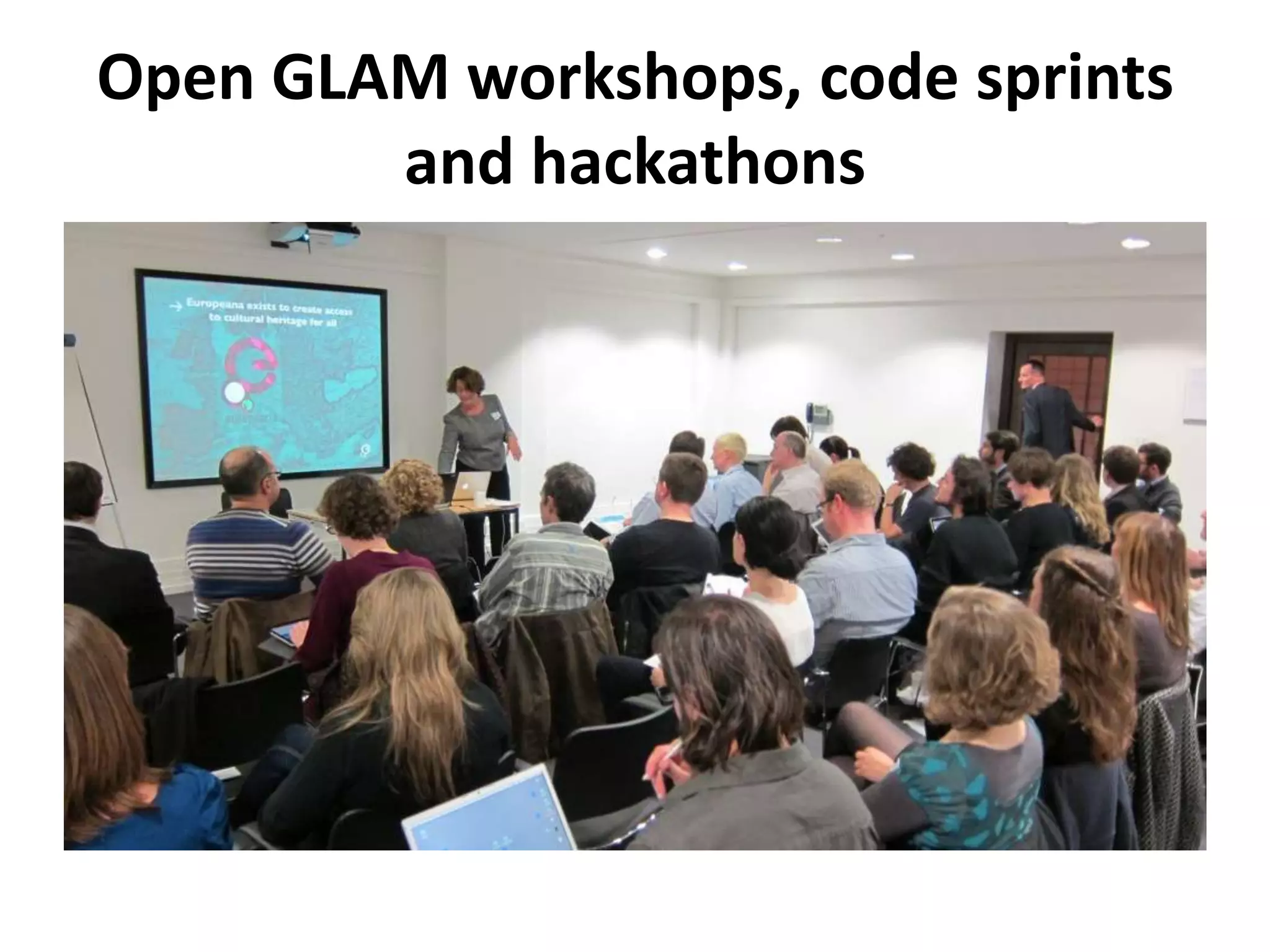
Open GLAM workshops, code sprints
        and hackathons
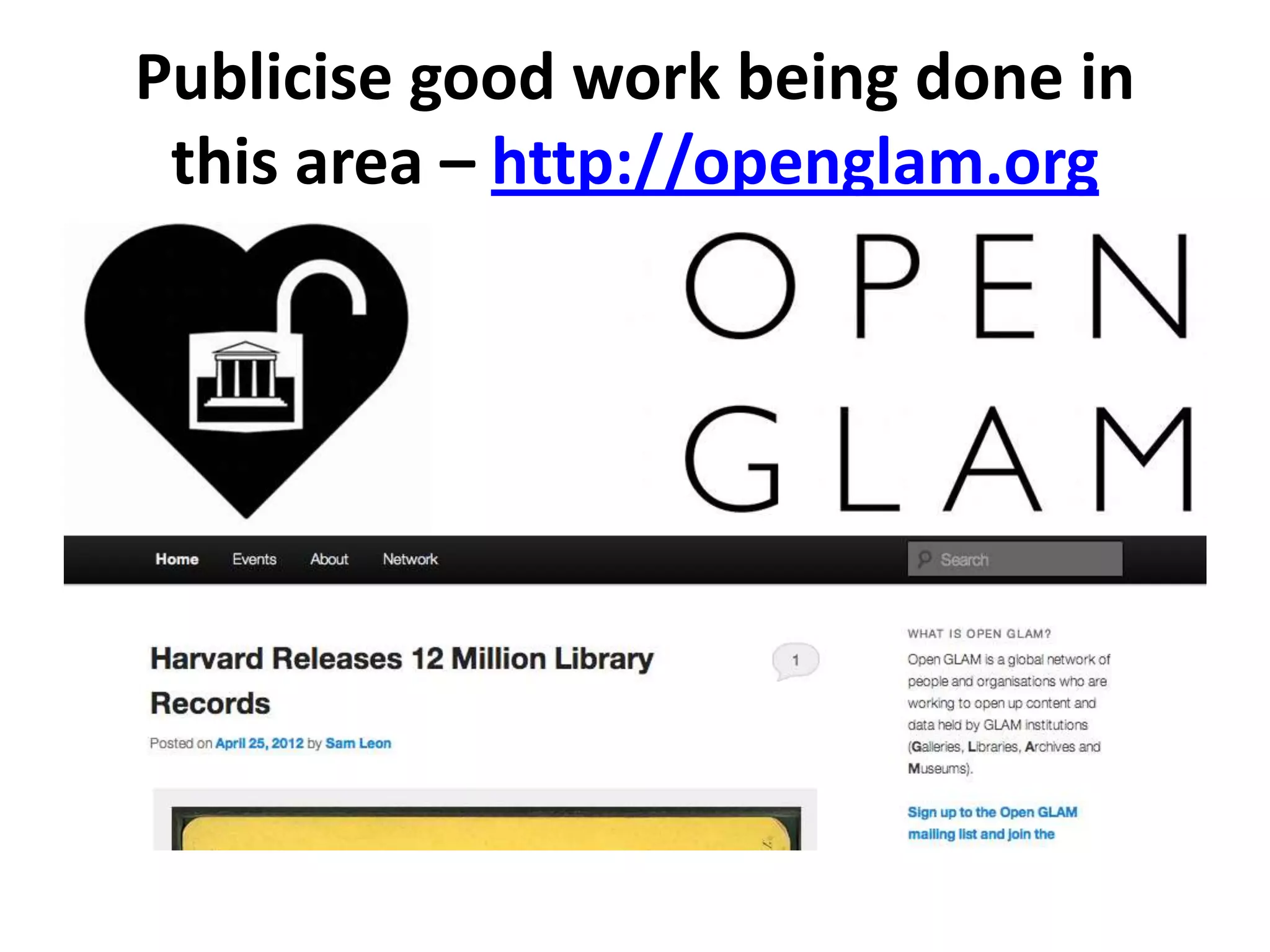
Publicise good work being done in
 this area – http://openglam.org
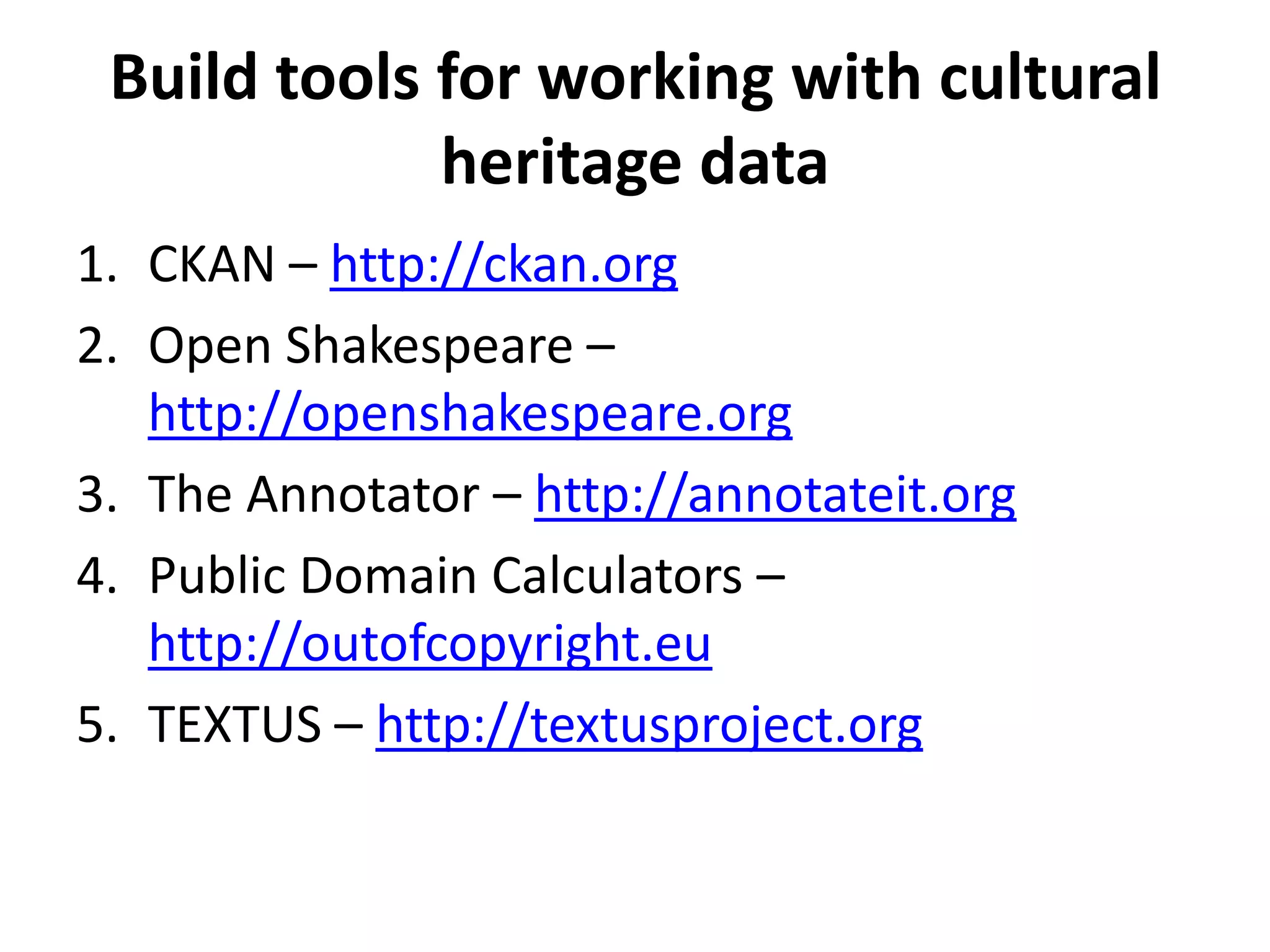
Build tools for working with cultural
             heritage data
1. CKAN – http://ckan.org
2. Open Shakespeare –
   http://openshakespeare.org
3. The Annotator – http://annotateit.org
4. Public Domain Calculators –
   http://outofcopyright.eu
5. TEXTUS – http://textusproject.org
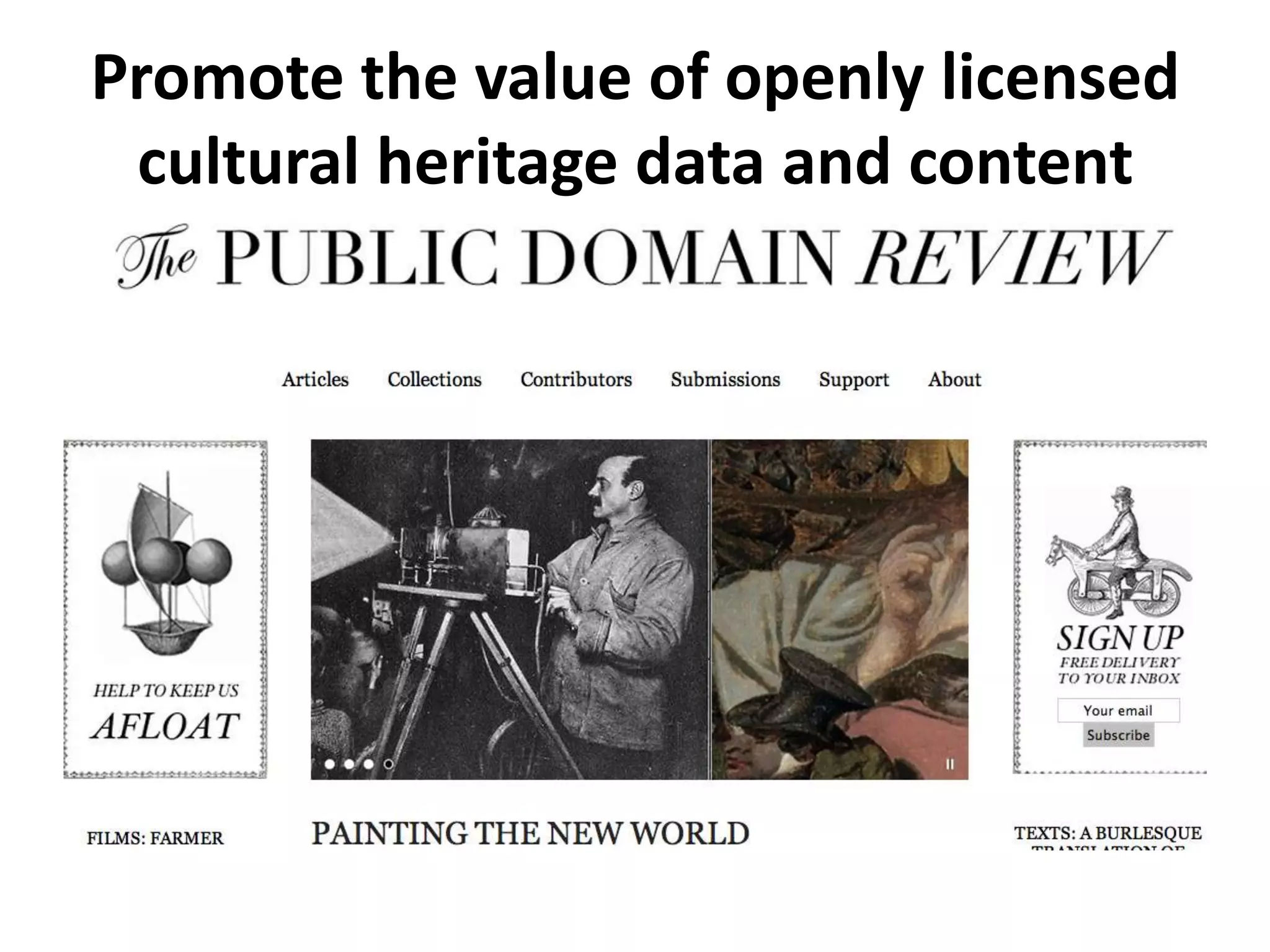
Promote the value of openly licensed
 cultural heritage data and content
Moment of opportunity
• Proposed amendment to the 2003 PSI
  Directive
• New open digitsation initiatives e.g. Internet
  Archive
• Open metadata aggregators e.g. Europeana
• A community of developers with skills for
  hacking cultural heritage data
Recommended reading
• The New Renaissance Report (2011) –
  Elisabeth Niggeman, Jacques De
  Decker, Maurice Lévy
• The Problem of the Yellow Milkmaid (2011) –
  Harry Verwayen, Martijn Arnoldus, Peter B.
  Kaufman
Thank you for listening


    sam.leon@okfn.org
    http://openglam.org
     Twitter: noeL_maS

Open Cultural Heritage Content & Data

  • 1.
    Open Cultural HeritageContent & Data Sam Leon The Open Knowledge Foundation @noeL_maS
  • 2.
    1. What doesit mean for cultural heritage content and data to be “open”? 2. What are the advantages of openness? 3. What are the challenges faced by cultural heritage organisations trying to open up their data? 4. What does the Open Knowledge Foundation do in this field?
  • 3.
    What do wemean by content and data? 1. Content – the works themselves 2. Data – information about the works, often referred to as “metadata”
  • 4.
    What do wemean by “open”? • http://opendefintition.org • “A piece of content or data is open if anyone is free to use, reuse, and redistribute it — subject only, at most, to the requirement to attribute and share-alike”
  • 5.
    Common Open Licenses •Creative Commons Attribution • Creative Commons Attribution Share-Alike • Creative Commons CCZero
  • 6.
    Advantages of openness 1. Enriched data 2. Objects more discoverable 3. Artifacts more accessible 4. Preservation 5. Spurs on the creation of new works, tools and services
  • 7.
    Challenges to opennessin the cultural heritage sector • Legal e.g. licensing frameworks • Technical e.g. standards • Cost of digitisation
  • 8.
    What does theOpen Knowledge Foundation do to in this field?
  • 9.
    Open GLAM workshops,code sprints and hackathons
  • 10.
    Publicise good workbeing done in this area – http://openglam.org
  • 11.
    Build tools forworking with cultural heritage data 1. CKAN – http://ckan.org 2. Open Shakespeare – http://openshakespeare.org 3. The Annotator – http://annotateit.org 4. Public Domain Calculators – http://outofcopyright.eu 5. TEXTUS – http://textusproject.org
  • 12.
    Promote the valueof openly licensed cultural heritage data and content
  • 13.
    Moment of opportunity •Proposed amendment to the 2003 PSI Directive • New open digitsation initiatives e.g. Internet Archive • Open metadata aggregators e.g. Europeana • A community of developers with skills for hacking cultural heritage data
  • 14.
    Recommended reading • TheNew Renaissance Report (2011) – Elisabeth Niggeman, Jacques De Decker, Maurice Lévy • The Problem of the Yellow Milkmaid (2011) – Harry Verwayen, Martijn Arnoldus, Peter B. Kaufman
  • 15.
    Thank you forlistening sam.leon@okfn.org http://openglam.org Twitter: noeL_maS

Editor's Notes

  • #4 In the past, data was kept in physical catalogues, now kept in digital databasesWorks themselves are now digitisedDigitised content and data is importantly different to its physical counterparts – it can be copied at almost no cost at all.
  • #6 Of course, this only reflects the legal side of openness – you may have openly licensed your data but it may be in non-machine readable formats like a PDF.There is a sliding scale of openness – xml or rdf, APIs with full documentation – so that programmers can build services on top of your data much
  • #7 Theatricalia – a databasae of past theatre productions – some small theatres ceased to exist and so did their records as a result – Theatricalia the only place that maintained the records
  • #8 Cost of digitisation – Google Books partnership – PUBLIC DOMAIN content – should it be monopolised?
  • #10 Bring together organizations active in this area with representatives from cultural heritage institutions
  • #14 The digital revolution and the internet promises greater access to and re-use of our shared cultural heritage because works and data can be copied at almost no cost at allThe EU may well create a legislative framework in which the data from cultural heritage institutions is treated in much the same way as other public sector information such as transport or traffic information