OPEN CONTENT
Ashley Mayor
C&I 489.05
Emerging Educational Technology
Definition
 Content (text, audio, video, arts and the like)
 Available for all
 Available in multiple formats
 Free of cost
According to the Horizon
Report…
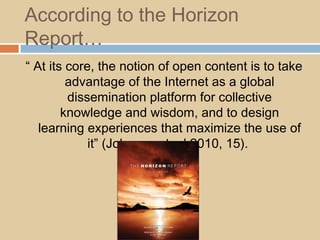
“ At its core, the notion of open content is to take
advantage of the Internet as a global
dissemination platform for collective
knowledge and wisdom, and to design
learning experiences that maximize the use of
it” (Johnson et. al 2010, 15).
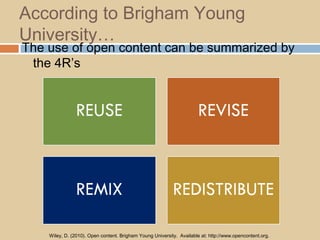
According to Brigham Young
University…
The use of open content can be summarized by
the 4R’s
Wiley, D. (2010). Open content. Brigham Young University. Available at: http://www.opencontent.org.
Reuse
The right to reuse content in the original form
“verbatim”
Examples:
- Sharepoint: A school-wide means of sharing
documents in a password protected environment
(not Sharepoint Designer)
- Illinidata: Sharing student assessment data
- Learn360: Video and Audio
- Classic Reader: Text
Revise
When content is adapted, adjusted, modified, or
altered from the original content.
Example:
- Translations: http://translate.google.com/
- Kid Friendly Illinois State Standards
Remix
When content is customized, modified, or
combined with other material.
Examples:
- Flat World Knowledge: Customized
- Wikipedia: Modified
- K12 Open Dictionary Builder: Combined
Redistribute
When content copies of the original content are
shared and your revisions or your remixes are
made available to others.
Examples:
 - Creative Commons: nonprofit organization
that increases sharing and
improves collaboration
Current Uses
 Open Educational Resources: Also known as
OERs
 Available for free
 Digital
 Available to all (Fasimpaur, K. 2008)
 For educators, students and lifelong learners
 Open Courseware Consortium (not ISU yet) open
source repository
 Open Knowledge Foundation: Non-profit open
source directory
 Open Educational Resources:
Repository/Directory
Current Uses
 Higher Education: Many universities, such as
MIT and Tufts University, believe that making
educational materials available to the public is
a SOCIAL RESONSIBILITY.
 Elementary Schools: Data sharing
 Middle Schools: Media exposure
 High Schools: Classical Literature
 All Educators: Lesson idea sharing
 AND MUCH MORE
Example Lessons Using OER
 Third grade class: Lesson on addition with
regrouping
 Reuse: SMART Tech Exchange-
http://exchange.smarttech.com
 Seventh grade class: Lesson on geometric solids
 Remix :K12 Open Dictionary Builder
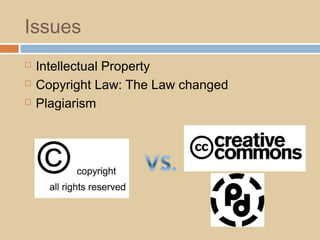
Issues
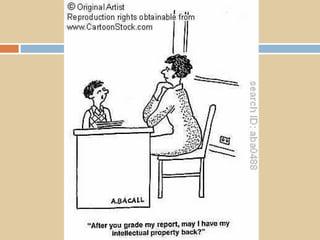
 Intellectual Property
 Copyright Law: The Law changed
 Plagiarism
Positives
 Allows for differentiated instruction
 Allows for the selection of the highest quality
sources
 Most up-to date content
 Alternative to Copyrights and monopolies
What are you going to do?
“We are on the cusp of a global revolution in
teaching and learning. Educators worldwide
are developing a vast pool of educational
resources on the Internet, open and free forall
to use” (Cape Town Open Education
Declaration 2007).
WILL YOU BE A PART OF THE REVOLUTION
CHANGING HOWWE TEACHANDLEARN?
Resources
 AIM Educational Inc. (2010). Learn360. Available at: www.learn360.com.
 Bacall, A. (2010). Intellectual property cartoon. Available at: http://www.cartoonstock.com.
 Bloomington District 87 & McLean County Unit 5 School District. (2009). Illinidata. Available at: http://www.achievementmatters.org/illinidata_u5.htm.
 Creative commons (2010). Creative commons: Share, remix, reuse legally. Available at: http://creativecommons.org/.
 Fasimpaur, K. (2010). Kids open dictionary builder. Available at: http://dictionary.k12opened.com.
 Fasimpaur, K. (2010). Free content and open tools and massive collaboration = learning for all. Available at: http://www.slideshare.net.
 Flat World Knowledge. (2010). Flat world knowledge. Available at: http://www.flatworldknowledge.com/.
 Google. (2010). Google translate. Available at: http://translate.google.com.
 Illinois Education Association. (2006). Kid friendly standards. Available at: http://www.unit5.org/pjhs/standards.htm.
 Institute for the Study of Knowledge Management in Education. (2010). OER commons: Open educational resources . Available at:
http://www.oercommons.org.
 Johnson, L., Levine, A., Smith, R., & Stone, S. (2010). The 2010 Horizon Report. Austin, Texas: The New Media Consortium.
 Open Courseware Consoritum. (2010). Open courseware consortium. Available at: http://ocwconsortium.org.
 Open Knowledge Foundation. (2010). Open knowledge foundation: Promoting open knowledge in a digital age. Available at: http://okfn.org/.
 Open Society Institute & Shuttleworth Foundation. (2007). The cape town open education declaration. Available at:
http://www.capetowndeclaration.org/.
 SMART Technologies. (2010). Smart Exchange. Available at: http://exchange.smarttech.com.
 Theroux, S. & Blackdog Media. (2004). Classic reader. Available at: http://www.classicreader.com/
 Wiley, D. (2010). Open content. Brigham Young University. Available at: http://www.opencontent.org.
 Wikimedia Foundation. (2010). Wikipedia. Available at: http://www.wikipedia.org/.

Open content emerging tech presentation

  • 1.
    OPEN CONTENT Ashley Mayor C&I489.05 Emerging Educational Technology
  • 2.
    Definition  Content (text,audio, video, arts and the like)  Available for all  Available in multiple formats  Free of cost
  • 3.
    According to theHorizon Report… “ At its core, the notion of open content is to take advantage of the Internet as a global dissemination platform for collective knowledge and wisdom, and to design learning experiences that maximize the use of it” (Johnson et. al 2010, 15).
  • 4.
    According to BrighamYoung University… The use of open content can be summarized by the 4R’s Wiley, D. (2010). Open content. Brigham Young University. Available at: http://www.opencontent.org.
  • 5.
    Reuse The right toreuse content in the original form “verbatim” Examples: - Sharepoint: A school-wide means of sharing documents in a password protected environment (not Sharepoint Designer) - Illinidata: Sharing student assessment data - Learn360: Video and Audio - Classic Reader: Text
  • 6.
    Revise When content isadapted, adjusted, modified, or altered from the original content. Example: - Translations: http://translate.google.com/ - Kid Friendly Illinois State Standards
  • 7.
    Remix When content iscustomized, modified, or combined with other material. Examples: - Flat World Knowledge: Customized - Wikipedia: Modified - K12 Open Dictionary Builder: Combined
  • 8.
    Redistribute When content copiesof the original content are shared and your revisions or your remixes are made available to others. Examples:  - Creative Commons: nonprofit organization that increases sharing and improves collaboration
  • 9.
    Current Uses  OpenEducational Resources: Also known as OERs  Available for free  Digital  Available to all (Fasimpaur, K. 2008)  For educators, students and lifelong learners  Open Courseware Consortium (not ISU yet) open source repository  Open Knowledge Foundation: Non-profit open source directory  Open Educational Resources: Repository/Directory
  • 10.
    Current Uses  HigherEducation: Many universities, such as MIT and Tufts University, believe that making educational materials available to the public is a SOCIAL RESONSIBILITY.  Elementary Schools: Data sharing  Middle Schools: Media exposure  High Schools: Classical Literature  All Educators: Lesson idea sharing  AND MUCH MORE
  • 11.
    Example Lessons UsingOER  Third grade class: Lesson on addition with regrouping  Reuse: SMART Tech Exchange- http://exchange.smarttech.com  Seventh grade class: Lesson on geometric solids  Remix :K12 Open Dictionary Builder
  • 12.
    Issues  Intellectual Property Copyright Law: The Law changed  Plagiarism
  • 13.
    Positives  Allows fordifferentiated instruction  Allows for the selection of the highest quality sources  Most up-to date content  Alternative to Copyrights and monopolies
  • 15.
    What are yougoing to do? “We are on the cusp of a global revolution in teaching and learning. Educators worldwide are developing a vast pool of educational resources on the Internet, open and free forall to use” (Cape Town Open Education Declaration 2007). WILL YOU BE A PART OF THE REVOLUTION CHANGING HOWWE TEACHANDLEARN?
  • 16.
    Resources  AIM EducationalInc. (2010). Learn360. Available at: www.learn360.com.  Bacall, A. (2010). Intellectual property cartoon. Available at: http://www.cartoonstock.com.  Bloomington District 87 & McLean County Unit 5 School District. (2009). Illinidata. Available at: http://www.achievementmatters.org/illinidata_u5.htm.  Creative commons (2010). Creative commons: Share, remix, reuse legally. Available at: http://creativecommons.org/.  Fasimpaur, K. (2010). Kids open dictionary builder. Available at: http://dictionary.k12opened.com.  Fasimpaur, K. (2010). Free content and open tools and massive collaboration = learning for all. Available at: http://www.slideshare.net.  Flat World Knowledge. (2010). Flat world knowledge. Available at: http://www.flatworldknowledge.com/.  Google. (2010). Google translate. Available at: http://translate.google.com.  Illinois Education Association. (2006). Kid friendly standards. Available at: http://www.unit5.org/pjhs/standards.htm.  Institute for the Study of Knowledge Management in Education. (2010). OER commons: Open educational resources . Available at: http://www.oercommons.org.  Johnson, L., Levine, A., Smith, R., & Stone, S. (2010). The 2010 Horizon Report. Austin, Texas: The New Media Consortium.  Open Courseware Consoritum. (2010). Open courseware consortium. Available at: http://ocwconsortium.org.  Open Knowledge Foundation. (2010). Open knowledge foundation: Promoting open knowledge in a digital age. Available at: http://okfn.org/.  Open Society Institute & Shuttleworth Foundation. (2007). The cape town open education declaration. Available at: http://www.capetowndeclaration.org/.  SMART Technologies. (2010). Smart Exchange. Available at: http://exchange.smarttech.com.  Theroux, S. & Blackdog Media. (2004). Classic reader. Available at: http://www.classicreader.com/  Wiley, D. (2010). Open content. Brigham Young University. Available at: http://www.opencontent.org.  Wikimedia Foundation. (2010). Wikipedia. Available at: http://www.wikipedia.org/.

Editor's Notes

  • #8 Flat world knowledge video clip: Chapter 3 (2:17 sec)
  • #9 Video clip: Wanna Work Together (2nd video
  • #11 Slide 6- Fasimpaur’s powerpoint
  • #12 3rd grade lesson: type in the search bar: addition regrouping 7th grade lesson: click in search bark: geometry, click on definition and add a second definition (include geometric solids)
  • #13 Creative Commons: video start at 2:00-3:00