Open Educational Resources: Contributions to the Efficacy of the Internet Jessica Eisner National University
Purposes: To define Open Educational Resources (OER) To examine the efficacy of some current OER Projects To present future visions of OER
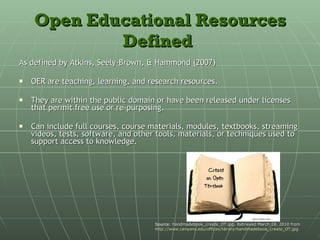
Open Educational Resources Defined   As defined by Atkins, Seely-Brown, & Hammond (2007) OER are teaching, learning, and research resources. They are within the public domain or have been released under licenses that permit free use or re-purposing. Can include full courses, course materials, modules, textbooks, streaming videos, tests, software, and other tools, materials, or techniques used to support access to knowledge. Source:  handmadebook_create_OT.jpg. Retrieved March 18, 2010 from  http://www.canyons.edu/offices/library/handmadebook_create_OT.jpg
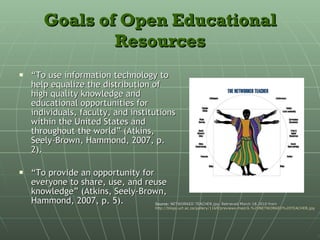
Goals of Open Educational Resources “ To use information technology to help equalize the distribution of high quality knowledge and educational opportunities for individuals, faculty, and institutions within the United States and throughout the world” (Atkins, Seely-Brown, Hammond, 2007, p. 2). “ To provide an opportunity for everyone to share, use, and reuse knowledge” (Atkins, Seely-Brown, Hammond, 2007, p. 5). Source:  NETWORKED TEACHER.jpg. Retrieved March 18,2010 from  http://blogs.uct.ac.za/gallery/1169/previews-med/6.%20NETWORKED%20TEACHER.jpg
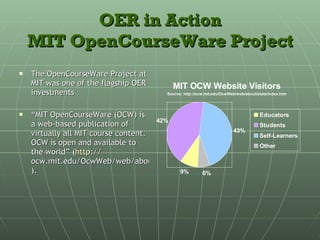
OER in Action MIT OpenCourseWare Project The OpenCourseWare Project at MIT was one of the flagship OER investments “ MIT OpenCourseWare (OCW) is a web-based publication of virtually all MIT course content. OCW is open and available to the world” ( http:// ocw.mit.edu/OcwWeb/web/about/about/index.htm ).
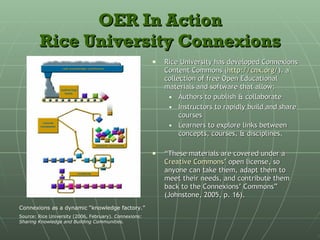
OER In Action Rice University Connexions Rice University has developed Connexions Content Commons ( http:// cnx.org / ). a collection of free Open Educational materials and software that allow: Authors to publish & collaborate Instructors to rapidly build and share courses Learners to explore links between concepts, courses, & disciplines. “ These materials are covered under a  Creative Commons’  open license, so anyone can take them, adapt them to meet their needs, and contribute them back to the Connexions’ Commons” (Johnstone, 2005, p. 16). Connexions as a dynamic “knowledge factory.”  Source: Rice University (2006, February).  Connexions: Sharing Knowledge and Building Communities.
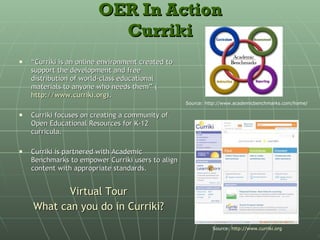
OER In Action Curriki “ Curriki is an online environment created to support the development and free distribution of world-class educational materials to anyone who needs them” ( http://www.curriki.org ).  Curriki focuses on creating a community of Open Educational Resources for K-12 curricula. Curriki is partnered with Academic Benchmarks to empower Curriki users to align content with appropriate standards. Virtual Tour What can you do in  Curriki ? Source: http://www.academicbenchmarks.com/home/ Source:  http://www.curriki.org
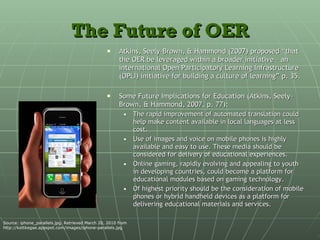
The Future of OER Atkins, Seely-Brown, & Hammond (2007) proposed “that the OER be leveraged within a broader initiative – an international Open Participatory Learning Infrastructure (OPLI) initiative for building a culture of learning” p. 35. Some Future Implications for Education (Atkins, Seely-Brown, & Hammond, 2007, p. 77): The rapid improvement of automated translation could help make content available in local languages at less cost. Use of images and voice on mobile phones is highly available and easy to use. These media should be considered for delivery of educational experiences. Online gaming, rapidly evolving and appealing to youth in developing countries, could become a platform for educational modules based on gaming technology. Of highest priority should be the consideration of mobile phones or hybrid handheld devices as a platform for delivering educational materials and services. Source: iphone_parallels.jpg. Retrieved March 20, 2010 from http://kottkegae.appspot.com/images/iphone-parallels.jpg
The Future of OER “ At the heart of the open-educational resource movement is the simple and powerful idea that the world’s knowledge is a public good and that technology in general and the World Wide Web in particular provide an extraordinary opportunity for everyone to share, use, and reuse that knowledge” (Smith & Casserly, 2006, p.10).
References: Atkins, D. E., Seely-Brown, J., and Hammond, A. L. (2007). A Review of the Open  Educational Resources (OER) Movement: Achievements, Challenges, and New  Opportunities. William and Flora Hewlett Foundation Report.  Connexions Website. Rice University.  http://cnx.org/ Curriki Website.  http://www.curriki.org/xwiki/bin/view/Main/ MIT OpenCourseWare Website. (2002-2010). MIT.  http://ocw.mit.edu/OcwWeb/web/home/home/index.htm  Rice University. (2006, February). Connexions:  Sharing Knowledge and Building  Communities.  Retrieved March 20, 2010 from  http://cnx.org/aboutus/publications/ConnexionsWhitePaper.pdf/ Smith, M.S., Casserly, C.M. (2006). The Promise of Open Educational Resources.  Change:  The Magazine of Higher Learning 38 (5), p. 8-17.  Retrieved March 20, 2010 from  EBSCOhost.

Open Educational Resources: Contributions to the Efficacy of the Internet

  • 1.
    Open Educational Resources:Contributions to the Efficacy of the Internet Jessica Eisner National University
  • 2.
    Purposes: To defineOpen Educational Resources (OER) To examine the efficacy of some current OER Projects To present future visions of OER
  • 3.
    Open Educational ResourcesDefined As defined by Atkins, Seely-Brown, & Hammond (2007) OER are teaching, learning, and research resources. They are within the public domain or have been released under licenses that permit free use or re-purposing. Can include full courses, course materials, modules, textbooks, streaming videos, tests, software, and other tools, materials, or techniques used to support access to knowledge. Source: handmadebook_create_OT.jpg. Retrieved March 18, 2010 from http://www.canyons.edu/offices/library/handmadebook_create_OT.jpg
  • 4.
    Goals of OpenEducational Resources “ To use information technology to help equalize the distribution of high quality knowledge and educational opportunities for individuals, faculty, and institutions within the United States and throughout the world” (Atkins, Seely-Brown, Hammond, 2007, p. 2). “ To provide an opportunity for everyone to share, use, and reuse knowledge” (Atkins, Seely-Brown, Hammond, 2007, p. 5). Source: NETWORKED TEACHER.jpg. Retrieved March 18,2010 from http://blogs.uct.ac.za/gallery/1169/previews-med/6.%20NETWORKED%20TEACHER.jpg
  • 5.
    OER in ActionMIT OpenCourseWare Project The OpenCourseWare Project at MIT was one of the flagship OER investments “ MIT OpenCourseWare (OCW) is a web-based publication of virtually all MIT course content. OCW is open and available to the world” ( http:// ocw.mit.edu/OcwWeb/web/about/about/index.htm ).
  • 6.
    OER In ActionRice University Connexions Rice University has developed Connexions Content Commons ( http:// cnx.org / ). a collection of free Open Educational materials and software that allow: Authors to publish & collaborate Instructors to rapidly build and share courses Learners to explore links between concepts, courses, & disciplines. “ These materials are covered under a Creative Commons’ open license, so anyone can take them, adapt them to meet their needs, and contribute them back to the Connexions’ Commons” (Johnstone, 2005, p. 16). Connexions as a dynamic “knowledge factory.” Source: Rice University (2006, February). Connexions: Sharing Knowledge and Building Communities.
  • 7.
    OER In ActionCurriki “ Curriki is an online environment created to support the development and free distribution of world-class educational materials to anyone who needs them” ( http://www.curriki.org ). Curriki focuses on creating a community of Open Educational Resources for K-12 curricula. Curriki is partnered with Academic Benchmarks to empower Curriki users to align content with appropriate standards. Virtual Tour What can you do in Curriki ? Source: http://www.academicbenchmarks.com/home/ Source: http://www.curriki.org
  • 8.
    The Future ofOER Atkins, Seely-Brown, & Hammond (2007) proposed “that the OER be leveraged within a broader initiative – an international Open Participatory Learning Infrastructure (OPLI) initiative for building a culture of learning” p. 35. Some Future Implications for Education (Atkins, Seely-Brown, & Hammond, 2007, p. 77): The rapid improvement of automated translation could help make content available in local languages at less cost. Use of images and voice on mobile phones is highly available and easy to use. These media should be considered for delivery of educational experiences. Online gaming, rapidly evolving and appealing to youth in developing countries, could become a platform for educational modules based on gaming technology. Of highest priority should be the consideration of mobile phones or hybrid handheld devices as a platform for delivering educational materials and services. Source: iphone_parallels.jpg. Retrieved March 20, 2010 from http://kottkegae.appspot.com/images/iphone-parallels.jpg
  • 9.
    The Future ofOER “ At the heart of the open-educational resource movement is the simple and powerful idea that the world’s knowledge is a public good and that technology in general and the World Wide Web in particular provide an extraordinary opportunity for everyone to share, use, and reuse that knowledge” (Smith & Casserly, 2006, p.10).
  • 10.
    References: Atkins, D.E., Seely-Brown, J., and Hammond, A. L. (2007). A Review of the Open Educational Resources (OER) Movement: Achievements, Challenges, and New Opportunities. William and Flora Hewlett Foundation Report. Connexions Website. Rice University. http://cnx.org/ Curriki Website. http://www.curriki.org/xwiki/bin/view/Main/ MIT OpenCourseWare Website. (2002-2010). MIT. http://ocw.mit.edu/OcwWeb/web/home/home/index.htm Rice University. (2006, February). Connexions: Sharing Knowledge and Building Communities. Retrieved March 20, 2010 from http://cnx.org/aboutus/publications/ConnexionsWhitePaper.pdf/ Smith, M.S., Casserly, C.M. (2006). The Promise of Open Educational Resources. Change: The Magazine of Higher Learning 38 (5), p. 8-17. Retrieved March 20, 2010 from EBSCOhost.

Editor's Notes

  • #4 Definition from: Atkins, D. E., Seely-Brown, J., and Hammond, A. L. (2007). A Review of the Open Educational Resources (OER) Movement: Achievements, Challenges, and New Opportunities. William and Flora Hewlett Foundation Report.