Open P2P Design
Markets and business models for Open and DIY projects

Massimo Menichinelli

---------------------------------------------------------------------------
June 04-05 2011
DMY Berlin - MakerLab
http://dmy-berlin.com/en/festival/2011-2/makerlab/

Presentation available on:
http://www.slideshare.net/openp2pdesign
01.
Why should a designer be
concerned about business?


 I'm a designer, after all!
(Open) Design + Business ?


a designer / researcher studying how to co-design Open
Processes with communities
--> and trying to make his design / research activity a
    sustainable business


+ a report on business models of:
* Open Hardware                     -->
* Fab Labs
* DIY Craft
                                          http://www.youcoop.org/
                                          http://www.platoniq.net/
                                           http://www.goteo.org/
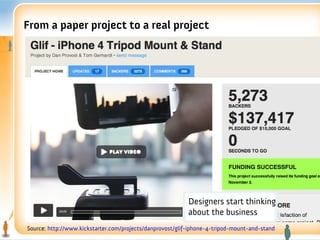
From a paper project to a real project


                                                           Designers start thinking
                                                           about the business
Source: http://www.kickstarter.com/projects/danprovost/glif-iphone-4-tripod-mount-and-stand
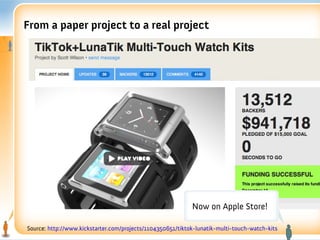
From a paper project to a real project


                                                            Now on Apple Store!

Source: http://www.kickstarter.com/projects/1104350651/tiktok-lunatik-multi-touch-watch-kits
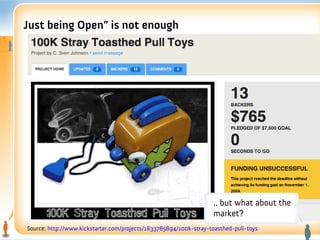
Just being Open” is not enough


                                                                   .. but what about the
                                                                   market?
Source: http://www.kickstarter.com/projects/1833785894/100k-stray-toasthed-pull-toys
02.
Open and DIY Business
(as they are now)
Business models of Open Source (software)


Non-monetary incentives:
* problem solving
* ethical questions
* education + learning
* reputation --> social interactions + jobs


--> it's not just about money! Also a gift economy
Business models of Open Source (software)


Monetary incentives:
* selling software (as open or even with dual licensing)
* offering services (customisation, support, ...)
* paid developer work
* donation
* software as service (freemium, ...)
* embedding software into hardware


--> … it's not just only volunteer work!
   Also a market economy
Business models of Open Source (software)


Red Hat
frst open source company expected to break through the
$1bn mark in 2011.
Source: http://www.channelregister.co.uk/2011/03/24/redhat_q4_f2011_numbers/


Cost of developing Linux
The Linux Foundation (LF) (2008): $10.8 billion to build the
Linux community distribution Fedora 9 in today’s dollars
with today’s software development costs.
$1.4 billion to develop the Linux kernel alone.
Source: http://www.linuxfoundation.org/sites/main/fles/publications/estimatinglinux.html
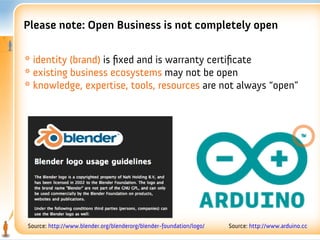
Please note: Open Business is not completely open

* identity (brand) is fxed and is warranty certifcate
* existing business ecosystems may not be open
* knowledge, expertise, tools, resources are not always “open”


Source: http://www.blender.org/blenderorg/blender-foundation/logo/   Source: http://www.arduino.cc
The levels of openness in Open Hardware
Patrick McNamara defned 4 possible levels of Openness in Open Hardware
projects:

1. Closed: any hardware for which the creator of the hardware
  will not release any information.
2. Open Interface: all the documentation on how to make a
  piece of hardware perform the function for which it is designed
  is available (minimum level of openness).
3. Open Design: in which enough detailed documentation is
  provided that a functionally compatible device could be
  created by a third party.
4. Open Implementation: the complete bill of materials
  necessary to construct the device is available.


Source: http://www.osbr.ca/ojs/index.php/osbr/article/view/379/340
The business models of Open Hardware


* Services and expertise (customization, consulting)
* Manufacturing of owned or third party Open Hardware
* Manufacturing of proprietary hardware based on Open
  Hardware
* Dual-licensing
* Proprietary hardware designs based on Open Hardware
* Proprietary software tools for developing Open Hardware
* ... and:


Source: http://www.openp2pdesign.org/2011/open-design/business-models-for-open-hardware/
The business models of Open Hardware


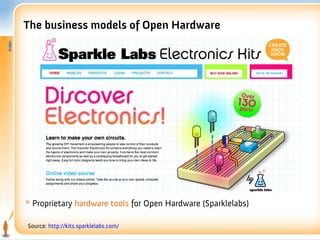
* Proprietary hardware tools for Open Hardware (Sparklelabs)

Source: http://kits.sparklelabs.com/
The business models of Open Hardware


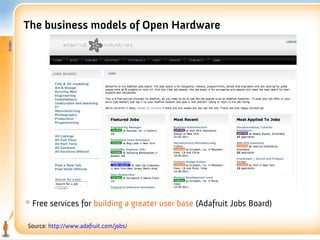
* Free services for building a greater user base (Adafruit Jobs Board)

Source: http://www.adafruit.com/jobs/
The business models of Open Hardware


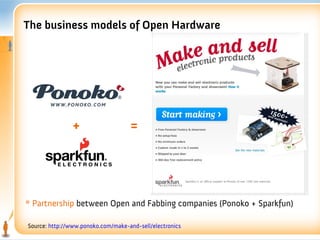
                +                   =


* Partnership between Open and Fabbing companies (Ponoko + Sparkfun)

Source: http://www.ponoko.com/make-and-sell/electronics
The business models of Open Hardware


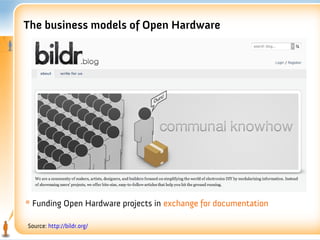
* Funding Open Hardware projects in exchange for documentation

Source: http://bildr.org/
The business models of Open Hardware


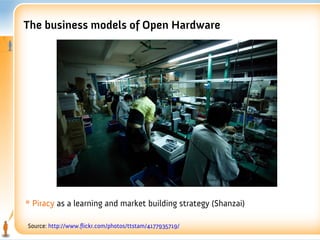
* Piracy as a learning and market building strategy (Shanzai)

Source: http://www.flickr.com/photos/ttstam/4177935719/
The business models of Open Hardware


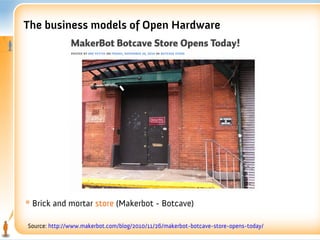
* Brick and mortar store (Makerbot - Botcave)

Source: http://www.makerbot.com/blog/2010/11/26/makerbot-botcave-store-opens-today/
The business models of Open Hardware


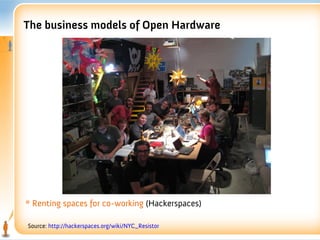
* Renting spaces for co-working (Hackerspaces)

Source: http://hackerspaces.org/wiki/NYC_Resistor
The business models of Open Hardware


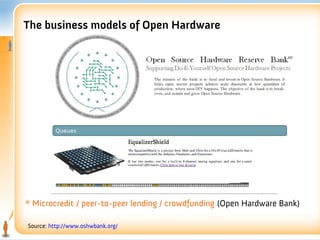
* Microcredit / peer-to-peer lending / crowdfunding (Open Hardware Bank)

Source: http://www.oshwbank.org/
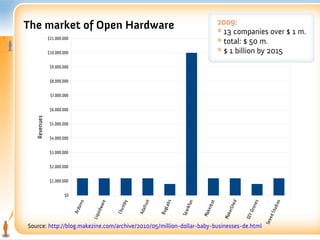
2009:
The market of Open Hardware                                                                           * 13 companies over $ 1 m.
              $11.000.000
                                                                                                      * total: $ 50 m.
              $10.000.000                                                                             * $ 1 billion by 2015
               $9.000.000


               $8.000.000


               $7.000.000


               $6.000.000
   Revenues


               $5.000.000


               $4.000.000


               $3.000.000


               $2.000.000


               $1.000.000


                      $0
                                                                         s
                                   o


                                                                                                           d
                                                              it
                                           are


                                                                                                                     s


                                                                                                                                i os
                                                       y


                                                                                        n


                                                                                                  t
                                                                                              rb o
                                                                        La b


                                                                                                                      e
                                                     mb


                                                                                                             e
                               uin


                                                                                    rkfu
                                                               fru


                                                                                                                   ron
                                                                                                         rS h


                                                                                                                             tud
                                        idw


                                                                                                e
                                                           Ada
                            Ard


                                                 Chu


                                                                     Bug


                                                                               Sp a


                                                                                            Mak


                                                                                                                     D
                                                                                                           e


                                                                                                                            dS
                                       Liqu


                                                                                                       Mak


                                                                                                                 DIY


                                                                                                                              e
                                                                                                                          See
Source: http://blog.makezine.com/archive/2010/05/million-dollar-baby-businesses-de.html
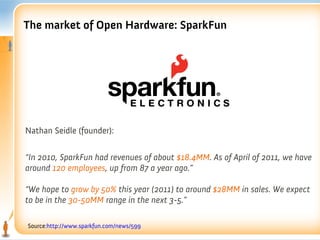
The market of Open Hardware: SparkFun


Nathan Seidle (founder):


“In 2010, SparkFun had revenues of about $18.4MM. As of April of 2011, we have
around 120 employees, up from 87 a year ago.”

“We hope to grow by 50% this year (2011) to around $28MM in sales. We expect
to be in the 30-50MM range in the next 3-5.”

Source:http://www.sparkfun.com/news/599
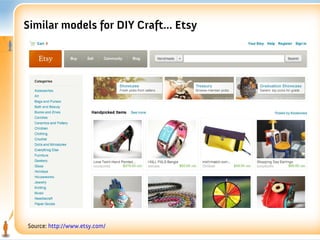
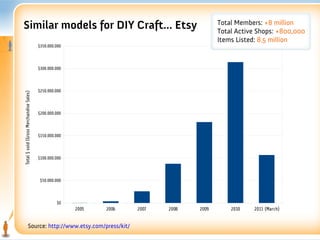
Similar models for DIY Craft... Etsy


Source: http://www.etsy.com/
Similar models for DIY Craft... Etsy                                                       Total Members: +8 million
                                                                                           Total Active Shops: +800,000
                                                                                           Items Listed: 8.5 million
                                         $350.000.000


                                         $300.000.000


                                         $250.000.000
Total $ sold (Gross Merchandise Sales)


                                         $200.000.000


                                         $150.000.000


                                         $100.000.000


                                          $50.000.000


                                                  $0
                                                        2005   2006   2007   2008   2009       2010   2011 (March)


                    Source: http://www.etsy.com/press/kit/
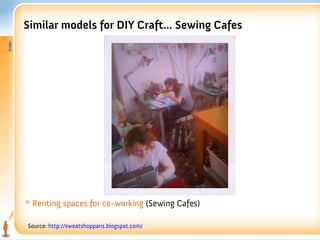
Similar models for DIY Craft... Sewing Cafes


* Renting spaces for co-working (Sewing Cafes)

Source: http://sweatshopparis.blogspot.com/
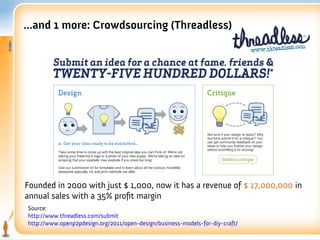
...and 1 more: Crowdsourcing (Threadless)


Founded in 2000 with just $ 1,000, now it has a revenue of $ 17,000,000 in
annual sales with a 35% proft margin
Source:
http://www.threadless.com/submit
http://www.openp2pdesign.org/2011/open-design/business-models-for-diy-craft/
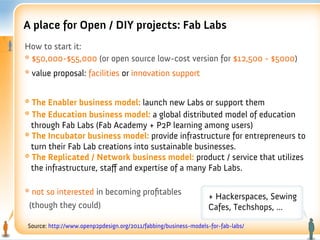
A place for Open / DIY projects: Fab Labs
How to start it:
* $50,000-$55,000 (or open source low-cost version for $12,500 - $5000)
* value proposal: facilities or innovation support


* The Enabler business model: launch new Labs or support them
* The Education business model: a global distributed model of education
  through Fab Labs (Fab Academy + P2P learning among users)
* The Incubator business model: provide infrastructure for entrepreneurs to
  turn their Fab Lab creations into sustainable businesses.
* The Replicated / Network business model: product / service that utilizes
  the infrastructure, staff and expertise of a many Fab Labs.

* not so interested in becoming proftables
                                                                 + Hackerspaces, Sewing
 (though they could)                                             Cafes, Techshops, ...

Source: http://www.openp2pdesign.org/2011/fabbing/business-models-for-fab-labs/
A place for Open / DIY projects: Fab Labs
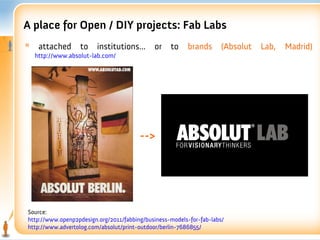
*    attached      to    institutions...     or    to    brands       (Absolut   Lab,   Madrid)
    http://www.absolut-lab.com/


                                        -->


Source:
http://www.openp2pdesign.org/2011/fabbing/business-models-for-fab-labs/
http://www.advertolog.com/absolut/print-outdoor/berlin-7686855/
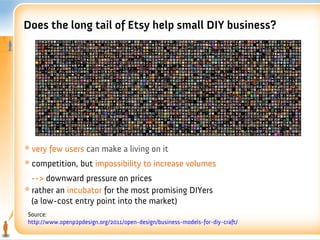
Does the long tail of Etsy help small DIY business?


* very few users can make a living on it
* competition, but impossibility to increase volumes
  --> downward pressure on prices
* rather an incubator for the most promising DIYers
  (a low-cost entry point into the market)
Source:
http://www.openp2pdesign.org/2011/open-design/business-models-for-diy-craft/
Does the long tail help small DIY business?


None of the business examined tries to help its user to make a living on their
project. At least Shapeways uses revenues to lower prices down. But
Shapeways:
* generated 244,000 € in revenue over 2009, but at the same time it lost
  1,400,000 €
* received a $ 5,000,000 fund from VC in order to open offices in the USA


Source:
http://www.openp2pdesign.org/2011/fabbing/business-models-for-fab-labs/
… and a lesson from the past


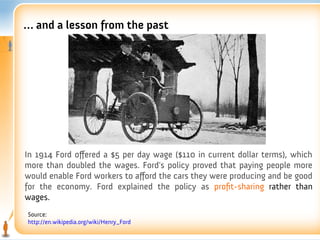
In 1914 Ford offered a $5 per day wage ($110 in current dollar terms), which
more than doubled the wages. Ford's policy proved that paying people more
would enable Ford workers to afford the cars they were producing and be good
for the economy. Ford explained the policy as proft-sharing rather than
wages.
Source:
http://en.wikipedia.org/wiki/Henry_Ford
03.
The future of Open and DIY
Business: where will be value
created?
Look for what is becoming a commodity

A commodity is a good for which there is demand, but which is
supplied without qualitative differentiation across a market. [...] the
market treats it as equivalent or nearly so no matter who produces
it.

Source: http://en.wikipedia.org/wiki/Commodity


Commoditization (also called commodifcation) occurs as a goods
or services market loses differentiation across its supply base, often
by the diffusion of the intellectual capital necessary to acquire or
produce it efficiently. […] a unique, branded product into a market
based on undifferentiated products.
Source: http://en.wikipedia.org/wiki/Commoditization
Hardware and Software, becoming commodities

* ('50s-'70s) Hardware is the product, software is for free:
   mainframes
   --> Hacker ethic of sharing information

* ('80s-'90s) Hardware is commodity, software is the product
   and it's proprietary: personal computers
   --> Microsoft emerges

* ('00s-...) Even software is a commodity, so let's sell services
   and get data from users: open source, web 2.0, services
   around software, software as service, the cloud
   --> web 2.0 emerges
Manufacturing and Design, becoming commodities

* ('90s-'00s) Manufacturing becomes a commodity and
slowly disappears in the West (thanks to China)

* ('10s-...) Now it's even more a commodity
 (thanks to Fabbing)

* ('00s-...) Professional design is slowly becoming a
 commodity
 (thanks to Fast Fashion, Ikea, design schools bubble,
 Shanzai)


--> Where is value now, in Design and Manufacturing?
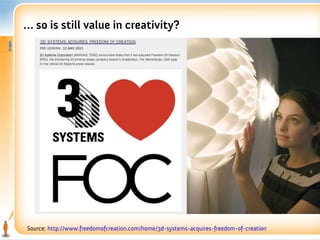
… so is still value in creativity?


Source: http://www.freedomofcreation.com/home/3d-systems-acquires-freedom-of-creation
… or in attention, collaboration, creativity from “users”?


“ We fnd this previously unmeasured type of household sector
innovation to be quite large: 6.2% of UK consumers - 2.9 million
individuals - have engaged in consumer product innovation during
the prior 3 years. In aggregate, consumers’ annual product
development expenditures are 2.3 times larger than the annual
consumer product R&D expenditures of all frms in the UK
combined. “

Eric A. Von Hippel, Jeroen De Jong, Steven Flowers
Comparing Business and Household Sector Innovation in Consumer
Products: Findings from a Representative Study in the UK
Source: http://papers.ssrn.com/sol3/papers.cfm?abstract_id=1683503
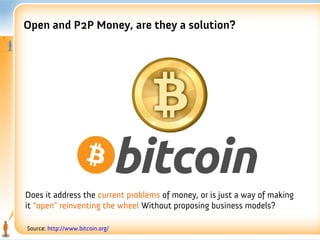
Open and P2P Money, are they a solution?


Does it address the current problems of money, or is just a way of making
it “open” reinventing the wheel Without proposing business models?

Source: http://www.bitcoin.org/
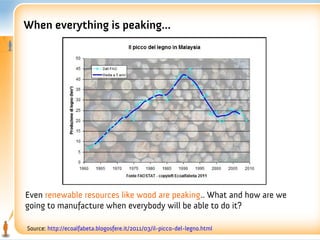
When everything is peaking...


Even renewable resources like wood are peaking.. What and how are we
going to manufacture when everybody will be able to do it?

Source: http://ecoalfabeta.blogosfere.it/2011/03/il-picco-del-legno.html
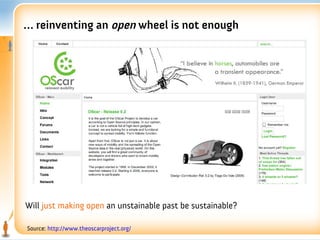
… reinventing an open wheel is not enough


Will just making open an unstainable past be sustainable?

Source: http://www.theoscarproject.org/
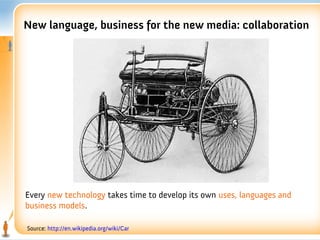
New language, business for the new media: collaboration


Every new technology takes time to develop its own uses, languages and
business models.

Source: http://en.wikipedia.org/wiki/Car
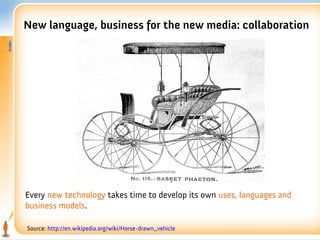
New language, business for the new media: collaboration


Every new technology takes time to develop its own uses, languages and
business models.

Source: http://en.wikipedia.org/wiki/Horse-drawn_vehicle
… blocks of an Open, DIY and P2P Economy

* open business for design, energy, materials, tools

* open business that consider information as abundant but
  materials and energy as scarce resources

* open money (but well designed and linked to energy and
  materials)

* API between open businesses

* Open processes + distributed testing of business models
Any question or comment?
Thank you!
Massimo Menichinelli

-------------------------------------------------------------------
info@openp2pdesign.org
openp2pdesign.org
twitter.com/openp2pdesign

Open Business @ DMY Berlin 2011 - MakerLab

  • 1.
    Open P2P Design Marketsand business models for Open and DIY projects Massimo Menichinelli --------------------------------------------------------------------------- June 04-05 2011 DMY Berlin - MakerLab http://dmy-berlin.com/en/festival/2011-2/makerlab/ Presentation available on: http://www.slideshare.net/openp2pdesign
  • 2.
    01. Why should adesigner be concerned about business? I'm a designer, after all!
  • 3.
    (Open) Design +Business ? a designer / researcher studying how to co-design Open Processes with communities --> and trying to make his design / research activity a sustainable business + a report on business models of: * Open Hardware --> * Fab Labs * DIY Craft http://www.youcoop.org/ http://www.platoniq.net/ http://www.goteo.org/
  • 4.
    From a paperproject to a real project Designers start thinking about the business Source: http://www.kickstarter.com/projects/danprovost/glif-iphone-4-tripod-mount-and-stand
  • 5.
    From a paperproject to a real project Now on Apple Store! Source: http://www.kickstarter.com/projects/1104350651/tiktok-lunatik-multi-touch-watch-kits
  • 6.
    Just being Open”is not enough .. but what about the market? Source: http://www.kickstarter.com/projects/1833785894/100k-stray-toasthed-pull-toys
  • 7.
    02. Open and DIYBusiness (as they are now)
  • 8.
    Business models ofOpen Source (software) Non-monetary incentives: * problem solving * ethical questions * education + learning * reputation --> social interactions + jobs --> it's not just about money! Also a gift economy
  • 9.
    Business models ofOpen Source (software) Monetary incentives: * selling software (as open or even with dual licensing) * offering services (customisation, support, ...) * paid developer work * donation * software as service (freemium, ...) * embedding software into hardware --> … it's not just only volunteer work! Also a market economy
  • 10.
    Business models ofOpen Source (software) Red Hat frst open source company expected to break through the $1bn mark in 2011. Source: http://www.channelregister.co.uk/2011/03/24/redhat_q4_f2011_numbers/ Cost of developing Linux The Linux Foundation (LF) (2008): $10.8 billion to build the Linux community distribution Fedora 9 in today’s dollars with today’s software development costs. $1.4 billion to develop the Linux kernel alone. Source: http://www.linuxfoundation.org/sites/main/fles/publications/estimatinglinux.html
  • 11.
    Please note: OpenBusiness is not completely open * identity (brand) is fxed and is warranty certifcate * existing business ecosystems may not be open * knowledge, expertise, tools, resources are not always “open” Source: http://www.blender.org/blenderorg/blender-foundation/logo/ Source: http://www.arduino.cc
  • 12.
    The levels ofopenness in Open Hardware Patrick McNamara defned 4 possible levels of Openness in Open Hardware projects: 1. Closed: any hardware for which the creator of the hardware will not release any information. 2. Open Interface: all the documentation on how to make a piece of hardware perform the function for which it is designed is available (minimum level of openness). 3. Open Design: in which enough detailed documentation is provided that a functionally compatible device could be created by a third party. 4. Open Implementation: the complete bill of materials necessary to construct the device is available. Source: http://www.osbr.ca/ojs/index.php/osbr/article/view/379/340
  • 13.
    The business modelsof Open Hardware * Services and expertise (customization, consulting) * Manufacturing of owned or third party Open Hardware * Manufacturing of proprietary hardware based on Open Hardware * Dual-licensing * Proprietary hardware designs based on Open Hardware * Proprietary software tools for developing Open Hardware * ... and: Source: http://www.openp2pdesign.org/2011/open-design/business-models-for-open-hardware/
  • 14.
    The business modelsof Open Hardware * Proprietary hardware tools for Open Hardware (Sparklelabs) Source: http://kits.sparklelabs.com/
  • 15.
    The business modelsof Open Hardware * Free services for building a greater user base (Adafruit Jobs Board) Source: http://www.adafruit.com/jobs/
  • 16.
    The business modelsof Open Hardware + = * Partnership between Open and Fabbing companies (Ponoko + Sparkfun) Source: http://www.ponoko.com/make-and-sell/electronics
  • 17.
    The business modelsof Open Hardware * Funding Open Hardware projects in exchange for documentation Source: http://bildr.org/
  • 18.
    The business modelsof Open Hardware * Piracy as a learning and market building strategy (Shanzai) Source: http://www.flickr.com/photos/ttstam/4177935719/
  • 19.
    The business modelsof Open Hardware * Brick and mortar store (Makerbot - Botcave) Source: http://www.makerbot.com/blog/2010/11/26/makerbot-botcave-store-opens-today/
  • 20.
    The business modelsof Open Hardware * Renting spaces for co-working (Hackerspaces) Source: http://hackerspaces.org/wiki/NYC_Resistor
  • 21.
    The business modelsof Open Hardware * Microcredit / peer-to-peer lending / crowdfunding (Open Hardware Bank) Source: http://www.oshwbank.org/
  • 22.
    2009: The market ofOpen Hardware * 13 companies over $ 1 m. $11.000.000 * total: $ 50 m. $10.000.000 * $ 1 billion by 2015 $9.000.000 $8.000.000 $7.000.000 $6.000.000 Revenues $5.000.000 $4.000.000 $3.000.000 $2.000.000 $1.000.000 $0 s o d it are s i os y n t rb o La b e mb e uin rkfu fru ron rS h tud idw e Ada Ard Chu Bug Sp a Mak D e dS Liqu Mak DIY e See Source: http://blog.makezine.com/archive/2010/05/million-dollar-baby-businesses-de.html
  • 23.
    The market ofOpen Hardware: SparkFun Nathan Seidle (founder): “In 2010, SparkFun had revenues of about $18.4MM. As of April of 2011, we have around 120 employees, up from 87 a year ago.” “We hope to grow by 50% this year (2011) to around $28MM in sales. We expect to be in the 30-50MM range in the next 3-5.” Source:http://www.sparkfun.com/news/599
  • 24.
    Similar models forDIY Craft... Etsy Source: http://www.etsy.com/
  • 25.
    Similar models forDIY Craft... Etsy Total Members: +8 million Total Active Shops: +800,000 Items Listed: 8.5 million $350.000.000 $300.000.000 $250.000.000 Total $ sold (Gross Merchandise Sales) $200.000.000 $150.000.000 $100.000.000 $50.000.000 $0 2005 2006 2007 2008 2009 2010 2011 (March) Source: http://www.etsy.com/press/kit/
  • 26.
    Similar models forDIY Craft... Sewing Cafes * Renting spaces for co-working (Sewing Cafes) Source: http://sweatshopparis.blogspot.com/
  • 27.
    ...and 1 more:Crowdsourcing (Threadless) Founded in 2000 with just $ 1,000, now it has a revenue of $ 17,000,000 in annual sales with a 35% proft margin Source: http://www.threadless.com/submit http://www.openp2pdesign.org/2011/open-design/business-models-for-diy-craft/
  • 28.
    A place forOpen / DIY projects: Fab Labs How to start it: * $50,000-$55,000 (or open source low-cost version for $12,500 - $5000) * value proposal: facilities or innovation support * The Enabler business model: launch new Labs or support them * The Education business model: a global distributed model of education through Fab Labs (Fab Academy + P2P learning among users) * The Incubator business model: provide infrastructure for entrepreneurs to turn their Fab Lab creations into sustainable businesses. * The Replicated / Network business model: product / service that utilizes the infrastructure, staff and expertise of a many Fab Labs. * not so interested in becoming proftables + Hackerspaces, Sewing (though they could) Cafes, Techshops, ... Source: http://www.openp2pdesign.org/2011/fabbing/business-models-for-fab-labs/
  • 29.
    A place forOpen / DIY projects: Fab Labs * attached to institutions... or to brands (Absolut Lab, Madrid) http://www.absolut-lab.com/ --> Source: http://www.openp2pdesign.org/2011/fabbing/business-models-for-fab-labs/ http://www.advertolog.com/absolut/print-outdoor/berlin-7686855/
  • 30.
    Does the longtail of Etsy help small DIY business? * very few users can make a living on it * competition, but impossibility to increase volumes --> downward pressure on prices * rather an incubator for the most promising DIYers (a low-cost entry point into the market) Source: http://www.openp2pdesign.org/2011/open-design/business-models-for-diy-craft/
  • 31.
    Does the longtail help small DIY business? None of the business examined tries to help its user to make a living on their project. At least Shapeways uses revenues to lower prices down. But Shapeways: * generated 244,000 € in revenue over 2009, but at the same time it lost 1,400,000 € * received a $ 5,000,000 fund from VC in order to open offices in the USA Source: http://www.openp2pdesign.org/2011/fabbing/business-models-for-fab-labs/
  • 32.
    … and alesson from the past In 1914 Ford offered a $5 per day wage ($110 in current dollar terms), which more than doubled the wages. Ford's policy proved that paying people more would enable Ford workers to afford the cars they were producing and be good for the economy. Ford explained the policy as proft-sharing rather than wages. Source: http://en.wikipedia.org/wiki/Henry_Ford
  • 33.
    03. The future ofOpen and DIY Business: where will be value created?
  • 34.
    Look for whatis becoming a commodity A commodity is a good for which there is demand, but which is supplied without qualitative differentiation across a market. [...] the market treats it as equivalent or nearly so no matter who produces it. Source: http://en.wikipedia.org/wiki/Commodity Commoditization (also called commodifcation) occurs as a goods or services market loses differentiation across its supply base, often by the diffusion of the intellectual capital necessary to acquire or produce it efficiently. […] a unique, branded product into a market based on undifferentiated products. Source: http://en.wikipedia.org/wiki/Commoditization
  • 35.
    Hardware and Software,becoming commodities * ('50s-'70s) Hardware is the product, software is for free: mainframes --> Hacker ethic of sharing information * ('80s-'90s) Hardware is commodity, software is the product and it's proprietary: personal computers --> Microsoft emerges * ('00s-...) Even software is a commodity, so let's sell services and get data from users: open source, web 2.0, services around software, software as service, the cloud --> web 2.0 emerges
  • 36.
    Manufacturing and Design,becoming commodities * ('90s-'00s) Manufacturing becomes a commodity and slowly disappears in the West (thanks to China) * ('10s-...) Now it's even more a commodity (thanks to Fabbing) * ('00s-...) Professional design is slowly becoming a commodity (thanks to Fast Fashion, Ikea, design schools bubble, Shanzai) --> Where is value now, in Design and Manufacturing?
  • 37.
    … so isstill value in creativity? Source: http://www.freedomofcreation.com/home/3d-systems-acquires-freedom-of-creation
  • 38.
    … or inattention, collaboration, creativity from “users”? “ We fnd this previously unmeasured type of household sector innovation to be quite large: 6.2% of UK consumers - 2.9 million individuals - have engaged in consumer product innovation during the prior 3 years. In aggregate, consumers’ annual product development expenditures are 2.3 times larger than the annual consumer product R&D expenditures of all frms in the UK combined. “ Eric A. Von Hippel, Jeroen De Jong, Steven Flowers Comparing Business and Household Sector Innovation in Consumer Products: Findings from a Representative Study in the UK Source: http://papers.ssrn.com/sol3/papers.cfm?abstract_id=1683503
  • 39.
    Open and P2PMoney, are they a solution? Does it address the current problems of money, or is just a way of making it “open” reinventing the wheel Without proposing business models? Source: http://www.bitcoin.org/
  • 40.
    When everything ispeaking... Even renewable resources like wood are peaking.. What and how are we going to manufacture when everybody will be able to do it? Source: http://ecoalfabeta.blogosfere.it/2011/03/il-picco-del-legno.html
  • 41.
    … reinventing anopen wheel is not enough Will just making open an unstainable past be sustainable? Source: http://www.theoscarproject.org/
  • 42.
    New language, businessfor the new media: collaboration Every new technology takes time to develop its own uses, languages and business models. Source: http://en.wikipedia.org/wiki/Car
  • 43.
    New language, businessfor the new media: collaboration Every new technology takes time to develop its own uses, languages and business models. Source: http://en.wikipedia.org/wiki/Horse-drawn_vehicle
  • 44.
    … blocks ofan Open, DIY and P2P Economy * open business for design, energy, materials, tools * open business that consider information as abundant but materials and energy as scarce resources * open money (but well designed and linked to energy and materials) * API between open businesses * Open processes + distributed testing of business models
  • 45.
  • 46.