Presented by Robyn Hall MLIS (UWO)

Introduction
Academic librarians’ support of open access
publishing initiatives in Canada has
enhanced library collections, research
innovation and the visibility of institutions’
scholarly output. Less attention, however,
has been paid to educating students about
open access resources.
Drawing on exemplary promotional efforts,
this poster describes ways that more
librarians might ensure students know about
open access resources and understand their
potential uses and limitations.
>> This poster is based on secondary
research conducted as part of an individual
study undertaken over the summer of 2009
at the University of Western Ontario.

What Librarians Can Do
Participate in Open Access Week
October 18-24, 2010
For more information visit:
www.openaccessweek.org
Academic libraries across Canada took part
in Open Access Week 2009, promoting OA
to their users and leading the way for this
year’s initiatives.

- SPARC (The Scholarly Publishing and
Academic Resources Coalition)

Why OA Matters to Students
• Students’ research does not end when

they graduate.
• Students deserve access to scholarly
materials regardless of what their university
can afford.
• Scholarly research is often paid for with
public funds and should therefore be
available to everyone.

• Include relevant resources
in library subject guides.
• Create web pages that
explain what OA is, where to
find OA resources, and how
to evaluate them. Concordia
and Dalhousie offer great
examples of such guides.

Integrate OA into Library Instruction
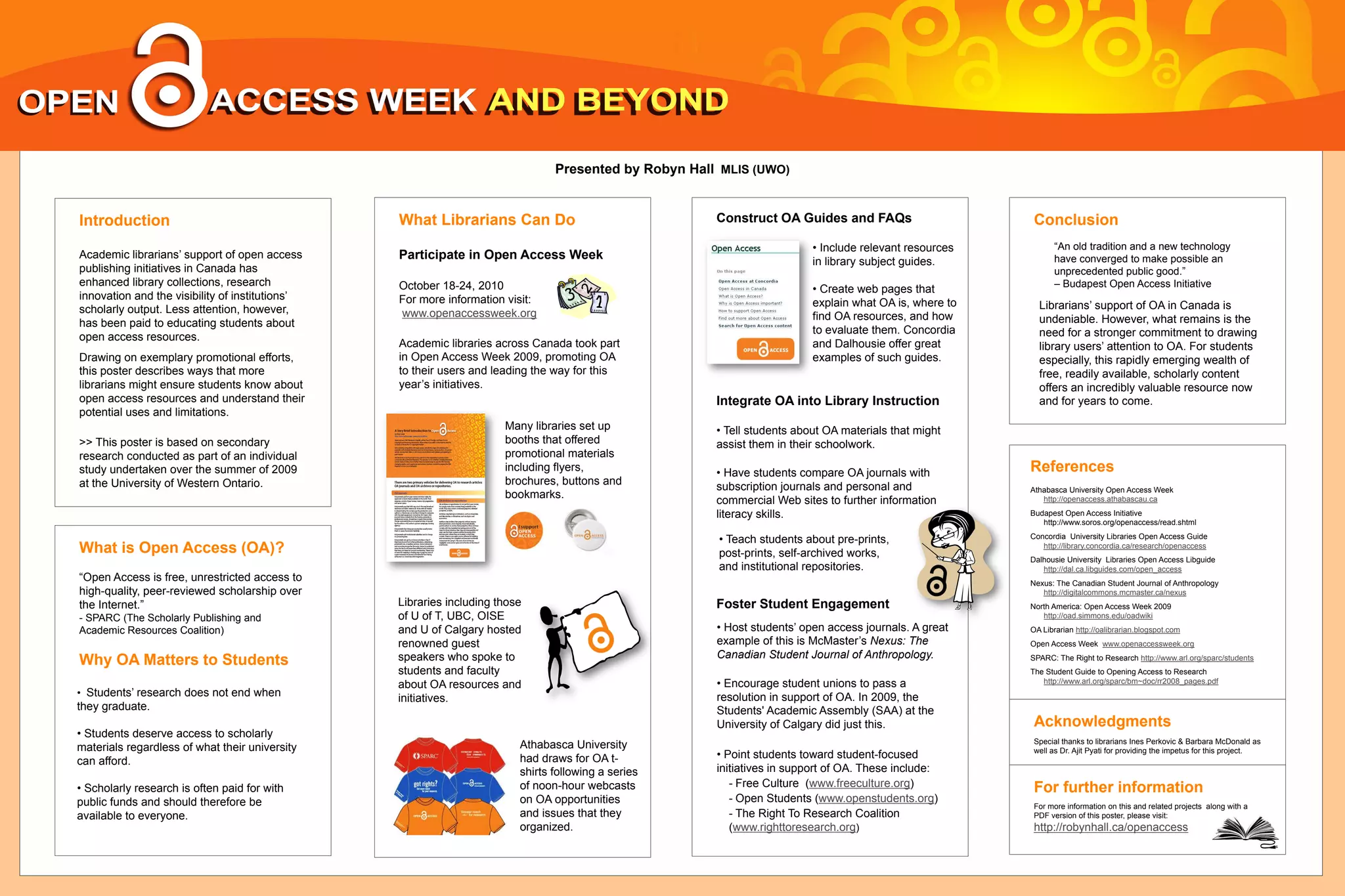
Many libraries set up
booths that offered
promotional materials
including flyers,
brochures, buttons and
bookmarks.

Conclusion
“An old tradition and a new technology
have converged to make possible an
unprecedented public good.”
– Budapest Open Access Initiative

Librarians’ support of OA in Canada is
undeniable. However, what remains is the
need for a stronger commitment to drawing
library users’ attention to OA. For students
especially, this rapidly emerging wealth of
free, readily available, scholarly content
offers an incredibly valuable resource now
and for years to come.

• Tell students about OA materials that might
assist them in their schoolwork.
• Have students compare OA journals with
subscription journals and personal and
commercial Web sites to further information
literacy skills.
• Teach students about pre-prints,
post-prints, self-archived works,
and institutional repositories.

What is Open Access (OA)?
“Open Access is free, unrestricted access to
high-quality, peer-reviewed scholarship over
the Internet.”

Construct OA Guides and FAQs

References
Athabasca University Open Access Week
http://openaccess.athabascau.ca
Budapest Open Access Initiative
http://www.soros.org/openaccess/read.shtml
Concordia University Libraries Open Access Guide
http://library.concordia.ca/research/openaccess
Dalhousie University Libraries Open Access Libguide
http://dal.ca.libguides.com/open_access
Nexus: The Canadian Student Journal of Anthropology
http://digitalcommons.mcmaster.ca/nexus

Libraries including those
of U of T, UBC, OISE
and U of Calgary hosted
renowned guest
speakers who spoke to
students and faculty
about OA resources and
initiatives.

Athabasca University
had draws for OA tshirts following a series
of noon-hour webcasts
on OA opportunities
and issues that they
organized.

Foster Student Engagement
• Host students’ open access journals. A great
example of this is McMaster’s Nexus: The
Canadian Student Journal of Anthropology.
• Encourage student unions to pass a
resolution in support of OA. In 2009, the
Students' Academic Assembly (SAA) at the
University of Calgary did just this.
• Point students toward student-focused
initiatives in support of OA. These include:
- Free Culture (www.freeculture.org)
- Open Students (www.openstudents.org)
- The Right To Research Coalition
(www.righttoresearch.org)

North America: Open Access Week 2009
http://oad.simmons.edu/oadwiki
OA Librarian http://oalibrarian.blogspot.com
Open Access Week www.openaccessweek.org
SPARC: The Right to Research http://www.arl.org/sparc/students
The Student Guide to Opening Access to Research
http://www.arl.org/sparc/bm~doc/rr2008_pages.pdf

Acknowledgments
Special thanks to librarians Ines Perkovic & Barbara McDonald as
well as Dr. Ajit Pyati for providing the impetus for this project.

For further information
For more information on this and related projects along with a
PDF version of this poster, please visit:

http://robynhall.ca/openaccess

Open Access Week and Beyond (OLA Super Conference)

  • 1.
    Presented by RobynHall MLIS (UWO) Introduction Academic librarians’ support of open access publishing initiatives in Canada has enhanced library collections, research innovation and the visibility of institutions’ scholarly output. Less attention, however, has been paid to educating students about open access resources. Drawing on exemplary promotional efforts, this poster describes ways that more librarians might ensure students know about open access resources and understand their potential uses and limitations. >> This poster is based on secondary research conducted as part of an individual study undertaken over the summer of 2009 at the University of Western Ontario. What Librarians Can Do Participate in Open Access Week October 18-24, 2010 For more information visit: www.openaccessweek.org Academic libraries across Canada took part in Open Access Week 2009, promoting OA to their users and leading the way for this year’s initiatives. - SPARC (The Scholarly Publishing and Academic Resources Coalition) Why OA Matters to Students • Students’ research does not end when they graduate. • Students deserve access to scholarly materials regardless of what their university can afford. • Scholarly research is often paid for with public funds and should therefore be available to everyone. • Include relevant resources in library subject guides. • Create web pages that explain what OA is, where to find OA resources, and how to evaluate them. Concordia and Dalhousie offer great examples of such guides. Integrate OA into Library Instruction Many libraries set up booths that offered promotional materials including flyers, brochures, buttons and bookmarks. Conclusion “An old tradition and a new technology have converged to make possible an unprecedented public good.” – Budapest Open Access Initiative Librarians’ support of OA in Canada is undeniable. However, what remains is the need for a stronger commitment to drawing library users’ attention to OA. For students especially, this rapidly emerging wealth of free, readily available, scholarly content offers an incredibly valuable resource now and for years to come. • Tell students about OA materials that might assist them in their schoolwork. • Have students compare OA journals with subscription journals and personal and commercial Web sites to further information literacy skills. • Teach students about pre-prints, post-prints, self-archived works, and institutional repositories. What is Open Access (OA)? “Open Access is free, unrestricted access to high-quality, peer-reviewed scholarship over the Internet.” Construct OA Guides and FAQs References Athabasca University Open Access Week http://openaccess.athabascau.ca Budapest Open Access Initiative http://www.soros.org/openaccess/read.shtml Concordia University Libraries Open Access Guide http://library.concordia.ca/research/openaccess Dalhousie University Libraries Open Access Libguide http://dal.ca.libguides.com/open_access Nexus: The Canadian Student Journal of Anthropology http://digitalcommons.mcmaster.ca/nexus Libraries including those of U of T, UBC, OISE and U of Calgary hosted renowned guest speakers who spoke to students and faculty about OA resources and initiatives. Athabasca University had draws for OA tshirts following a series of noon-hour webcasts on OA opportunities and issues that they organized. Foster Student Engagement • Host students’ open access journals. A great example of this is McMaster’s Nexus: The Canadian Student Journal of Anthropology. • Encourage student unions to pass a resolution in support of OA. In 2009, the Students' Academic Assembly (SAA) at the University of Calgary did just this. • Point students toward student-focused initiatives in support of OA. These include: - Free Culture (www.freeculture.org) - Open Students (www.openstudents.org) - The Right To Research Coalition (www.righttoresearch.org) North America: Open Access Week 2009 http://oad.simmons.edu/oadwiki OA Librarian http://oalibrarian.blogspot.com Open Access Week www.openaccessweek.org SPARC: The Right to Research http://www.arl.org/sparc/students The Student Guide to Opening Access to Research http://www.arl.org/sparc/bm~doc/rr2008_pages.pdf Acknowledgments Special thanks to librarians Ines Perkovic & Barbara McDonald as well as Dr. Ajit Pyati for providing the impetus for this project. For further information For more information on this and related projects along with a PDF version of this poster, please visit: http://robynhall.ca/openaccess